How to integrate Google Ads MCP with Hermes

Connect Hermes to Google Ads MCP. Create a new customer list for holiday campaigns, get campaign details by campaign id, and more using natural language, with authentication handled for you.

Google Ads logoGoogle Ads
Oauth2

Google Ads is Google's online advertising platform for creating, managing, and optimizing digital campaigns. It helps businesses reach targeted customers and maximize return on ad spend.

36 Tools

Introduction

Hermes is a 24/7 autonomous agent that lives on your computer or server — it remembers what it learns and evolves as your usage grows.

This guide explains the easiest and most robust way to connect your Google Ads account to Hermes. You can do this through either Composio Connect CLI or Composio Connect MCP. For personal use we recommend the CLI, but you won't go wrong with MCP either.

Also integrate Google Ads with

What is Composio Connect?

Composio Connect is a consumer offering that lets anyone plug 1,500+ applications directly into their agent harness — including Hermes. It can:

  • Search and load tools from relevant toolkits on-demand, reducing context usage.
  • Chain multiple tools to accomplish complex workflows via a remote workbench, without excessive back-and-forth with the LLM.
  • Manage app authentication end-to-end with zero manual overhead.

Integrating Google Ads with Hermes

Using Composio Connect CLI

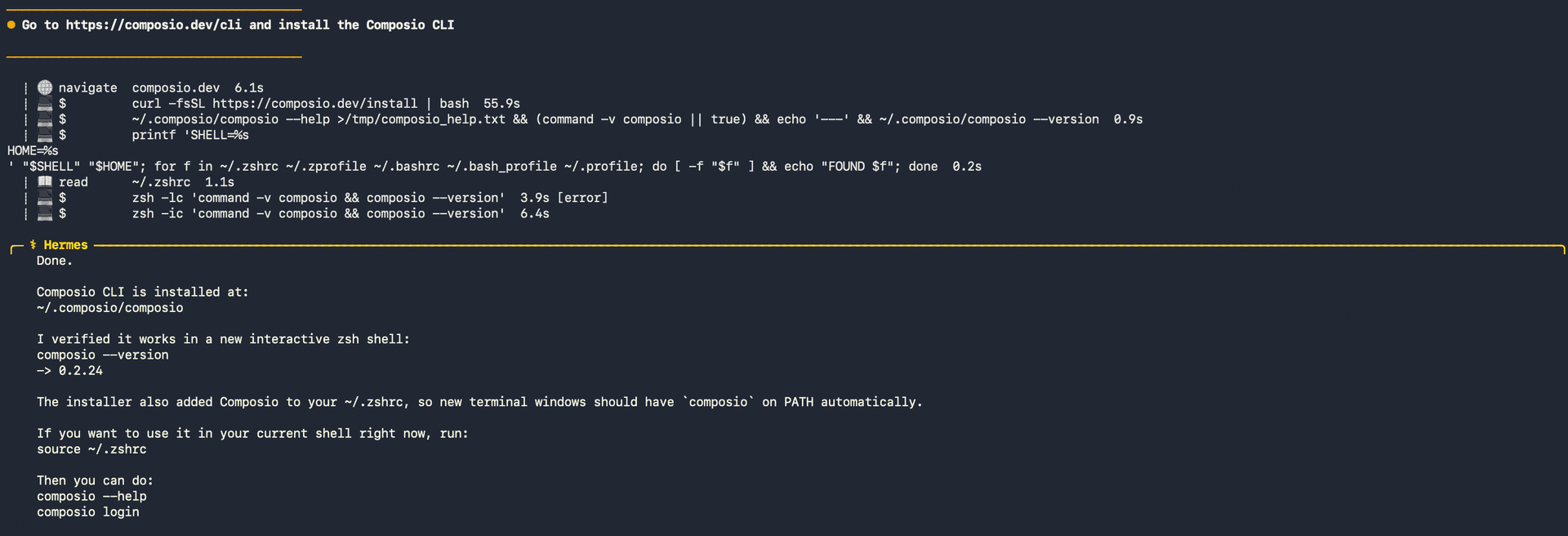
1. Install the Composio CLI

Run the install script directly, or paste https://composio.dev/hermes into your Hermes chat box to have it installed for you.

bash
curl -fsSL https://composio.dev/install | bash
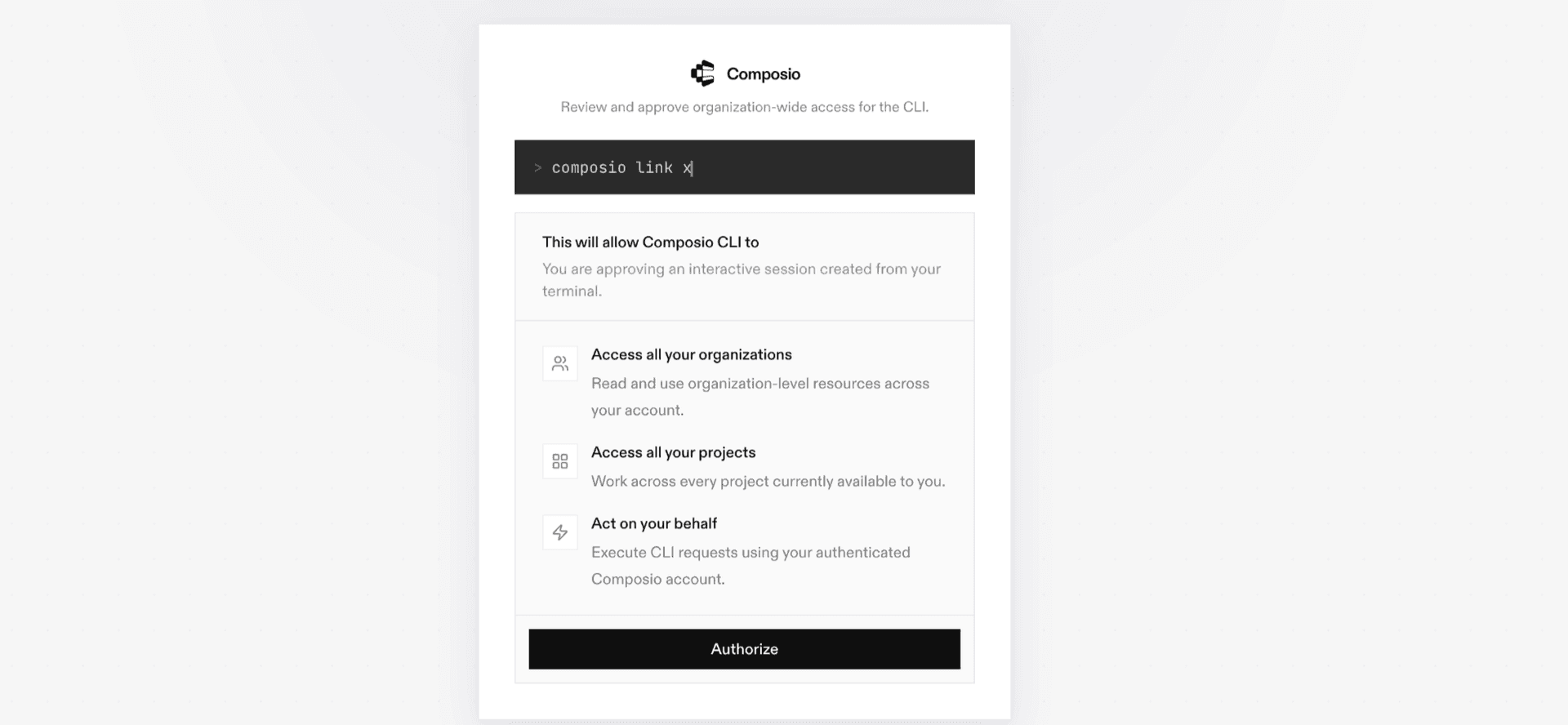
Hermes authenticating with Composio

2. Authenticate

Once the CLI is installed, ask Hermes to authenticate with Composio.

3. Connect to Google Ads

Ask your agent to connect to Google Ads, or simply request any Google Ads-related task. Hermes will prompt you to authenticate and authorize access.

4. Done. You're all set with a new Google Ads connection.


Using Composio Connect MCP

1. Get your MCP URL and API Key

Go to dashboard.composio.dev and copy your Connect MCP URL and API key.

Copy MCP URL and API key from Composio dashboard

2. Open the Hermes config file

bash
nano ~/.hermes/config.yaml

3. Add the Composio Connect MCP server

bash
mcp_servers:
  composio:
    url: "https://connect.composio.dev/mcp"
    headers:
      x-consumer-api-key: "YOUR_COMPOSIO_API_KEY"
    connect_timeout: 60
    timeout: 180

Save with Ctrl + O, Enter, then exit with Ctrl + X.

4. Restart your Hermes agent

Once restarted, ask your agent to connect to Google Ads or request any Google Ads-related task. It will prompt you to authenticate and authorize access.

5. Done!

What is the Google Ads MCP server, and what's possible with it?

The Google Ads MCP server is an implementation of the Model Context Protocol that connects your AI agent and assistants like Claude, Cursor, etc directly to your Google Ads account. It provides structured and secure access to your advertising data, so your agent can perform actions like creating customer lists, retrieving campaign details, and managing audience segments on your behalf.

  • Automated customer list creation: Instantly have your agent create new customer lists for targeted marketing campaigns, streamlining your segmentation workflows.
  • Campaign insights by ID or name: Let your agent fetch detailed information for any ad campaign using its ID or name, making reporting and optimization a breeze.
  • Customer list management: Ask your agent to retrieve and review all your existing customer lists, so you always know who you're targeting.
  • Add or remove contacts from lists: Seamlessly update audience membership by having your agent add or remove contacts from specified customer lists for more dynamic targeting.

Way Forward

With Google Ads connected, Hermes can now act on your behalf whenever it detects a relevant task or you ask it to.

From here, you can extend Hermes further:

  • Connect more apps: Calendar, Slack, Notion, Linear, and hundreds of others are available through the same Composio Connect setup. Each new integration compounds what Hermes can do for you.
  • Build workflows across tools: Once multiple apps are connected, Hermes can chain actions together — turn an email into a calendar invite, a Slack message into a Linear ticket, or a meeting note into a follow-up draft.
  • Let it learn your patterns: The more you use Hermes, the better it gets at anticipating how you'd handle recurring tasks. Give it feedback on drafts and decisions, and it will adapt.

If you run into trouble or want to share what you've built, join the community or check out the Docs for deeper configuration options.

TOOLS

Supported Tools

Every Google Ads action and event your agent gets out of the box.

Add or remove to customer list

Adds or removes contacts from a Google Ads customer list (UserList/audience/remarketing list), not a Google Ads customer account.

Batch Mutate Google Ads Resources

Create, update, remove, or act on supported Google Ads resource types in one request.

Create Callout Asset

Create an immutable account asset containing a validated callout.

Create customer list

Creates a Google Ads customer list (UserList/audience/remarketing list), not a Google Ads customer account.

Get Campaign By Id

GetCampaignById Tool returns details of a campaign in Google Ads.

Get campaign by name

Queries Google Ads via SQL to retrieve a campaign by its exact name.

Get Conversion Action Tag Snippets

Retrieve provider-generated website or call conversion tag snippets after creating a conversion action.

Get conversion ingestion status

Retrieve one Data Manager ingestion status snapshot.

Get customer lists

GetCustomerLists Tool lists all customer lists (audience/remarketing lists) in Google Ads.

Get Required Google Ads Report

Run a prominent, bounded Google Ads report template for Customer, Campaign, Ad, Keyword, Search Term, Dynamic Search Ads Search Term, or Bidding Strategy.

Ingest conversion events

Validate or submit a bounded Google Ads conversion-event batch.

List Accessible Customers

List Google Ads customer resource names directly accessible to the authenticated OAuth user.

List data manager conversion actions

List conversion actions usable as Google Ads Data Manager destinations.

List Sub Accounts

List direct child/sub-accounts under a Google Ads manager (MCC) account.

Mutate Ad Group Ads

Create, update, or remove ads in Google Ads ad groups, including responsive search ads.

Mutate Ad Group Assets

Create, update, or remove links between assets and ad groups.

Mutate Ad Group Bid Modifiers

Create, update, or remove ad group bid modifiers, such as device bid adjustments or hotel-specific bid modifier criteria.

Mutate Ad Group Criteria

Create, update, or remove criteria attached to a Google Ads ad group in a single batch request.

Mutate Ad Groups

Create, update, or remove ad groups within Google Ads campaigns.

Mutate Assets

Create or update supported Google Ads assets such as sitelinks, structured snippets, text assets, lead forms, promotions, calls, price assets, and media assets.

Mutate Asset Sets

Create, update, or remove Google Ads asset sets, which group assets for feeds, locations, and other campaign uses.

Mutate Bidding Strategies

Create, update, or remove portfolio bidding strategies such as Target CPA, Target ROAS, Target Spend, Maximize Conversions, Maximize Conversion Value, and Target Impression Share.

Mutate Campaign Assets

Create, update, or remove links between assets and campaigns.

Mutate Campaign Budgets

Create, update, or remove Google Ads campaign budgets.

Mutate Campaign Criteria

Create, update, or remove campaign-level targeting criteria such as locations, languages, campaign-level negative keywords, devices, schedules, audiences, and IP exclusions.

Mutate Campaign Labels

Create or remove relationships between campaigns and labels.

Mutate Campaigns

Create, update, or remove Google Ads campaigns in batch.

Mutate Campaigns V2

Create, update, or remove Google Ads campaigns in batch.

Mutate Conversion Actions

Create, update, or remove Google Ads conversion actions for conversion tracking configuration.

Mutate Custom Audiences

Create, update, or remove Google Ads custom audiences used to reach users by interests, searches, visited URLs, place categories, or installed apps.

Mutate Customer Assets

Create or remove customer-level asset associations.

Mutate Labels

Create, update, or remove Google Ads labels.

Mutate Portfolio Bidding Strategies

Create, edit, or remove typed Target CPA and Target ROAS portfolio strategies.

Mutate Shared Sets

Create, update, or remove Google Ads shared sets used to group shared criteria, such as negative keyword lists, for reuse across campaigns.

Search Google Ads Fields

Search the Google Ads v23 field metadata catalog with GAQL.

Search Stream GAQL

Execute a Google Ads Query Language (GAQL) query and aggregate every streamed response batch in order.

FAQ

Frequently asked questions

With a standalone Google Ads MCP server, the agents and LLMs can only access a fixed set of Google Ads tools tied to that server. However, with the Composio Tool Router, agents can dynamically load tools from Google Ads and many other apps based on the task at hand, all through a single MCP endpoint.

Yes, you can. Hermes fully supports MCP integration. You get structured tool calling, message history handling, and model orchestration while Tool Router takes care of discovering and serving the right Google Ads tools.

Yes, absolutely. You can configure which Google Ads scopes and actions are allowed when connecting your account to Composio. You can also bring your own OAuth credentials or API configuration so you keep full control over what the agent can do.

All sensitive data such as tokens, keys, and configuration is fully encrypted at rest and in transit. Composio is SOC 2 Type 2 compliant and follows strict security practices so your Google Ads data and credentials are handled as safely as possible.

Start with Google Ads.It takes 30 seconds.

Managed auth, hosted MCP servers, and every Google Ads tool your agent needs.Free to start.

Start building