How to connect Perplexityai to Muse

Connect Muse to Perplexityai MCP. Summarize the latest ai research papers, generate a creative story about space travel, and more using natural language, with authentication handled for you.

Perplexityai logoPerplexityai
Api Key

Perplexityai delivers natural, conversational AI models for generating human-like text. Instantly get context-aware, high-quality responses for chat, search, or complex workflows.

9 Tools

Introduction

Muse is Meta's AI assistant. It can connect to outside tools through custom connectors, which use the Model Context Protocol (MCP).

This guide explains how to connect Perplexityai to Muse using Composio Connect, which handles OAuth, token refresh, and reliability so you do not have to. You add Composio as a custom connector once, then ask Muse to work with Perplexityai in plain language.

Also integrate Perplexityai with

Why use Composio?

  • Cross-app workflows across 1,500+ apps from a single plugin layer.
  • On-demand tool loading so Muse only loads the tools needed for the current task.
  • Programmatic tool calling through a remote workbench for complex, multi-step workflows.
  • Multi-account support so users can connect and switch between multiple accounts for the same app.
  • Shared account access so teams or agents can work through common business accounts and service connections.
  • Managed authentication with OAuth handling, credential storage, and token refresh managed by Composio.
  • Safer credential handling so app credentials stay outside the model context and tool responses.
  • User-level account isolation so actions run against the correct connected account instead of mixing user access.

Connecting Perplexityai to Muse

You add Composio to Muse once as a custom connector, then connect Perplexityai from the chat.

1. Ask Muse to connect to Composio

Start a new Muse chat and send this message. Muse builds the connector and shows a button to add your API key.

bash
Create a Custom Connector for the Composio remote MCP server and connect to it:
- Name: Composio
- Transport: remote streamable HTTP
- URL: https://connect.composio.dev/mcp
- Auth: API key sent in the x-consumer-api-key header
Open the secure credentials store so I can enter the API key there, not in this chat. Then list its tools to confirm the connection works.

2. Copy your API key

Open the Muse page in your Composio dashboard and copy your API key. It starts with ck_.

Don't paste it into the chat. It goes in Muse's secure credentials store in the next step.

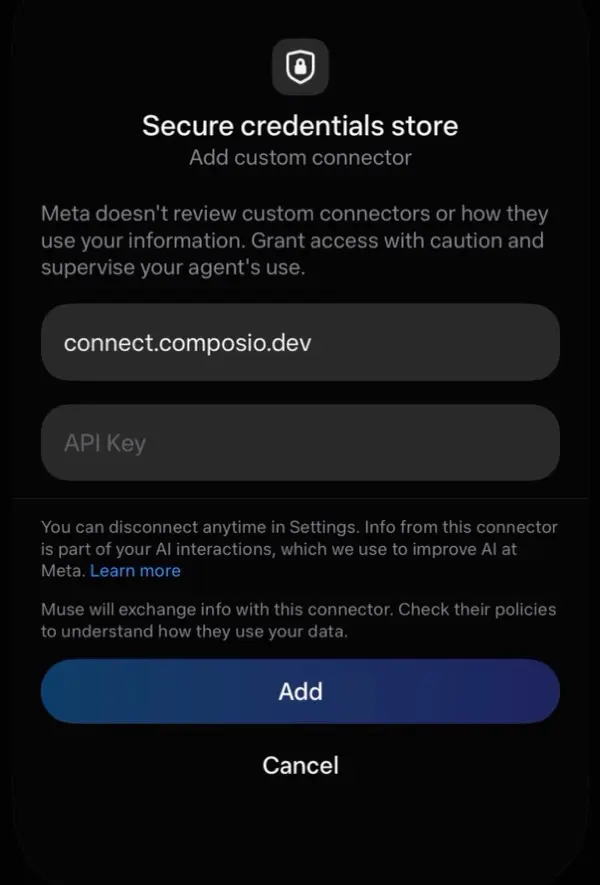
3. Add your API key in the secure credentials store

Tap the button Muse shows to open Add custom connector, paste your API key, then tap Add. Muse lists the Composio tools once it connects.

Muse secure credentials store with the connect.composio.dev URL, an API Key field, and the Add button

4. Connect your Perplexityai account

Back in the chat, ask Muse to connect to Perplexityai or give it any Perplexityai task.

For example, ask it to:

  • "Summarize the latest AI research papers"
  • "Generate a creative story about space travel"
  • "Explain quantum computing in simple terms"

It will prompt you to authenticate and authorize access.

That's it. Composio's tools are now available in Muse, and your Perplexityai account is ready to use.

What is the Perplexityai MCP server, and what's possible with it?

The Perplexity AI MCP server is an implementation of the Model Context Protocol that connects your AI agent and assistants like Claude, Cursor, etc directly to your Perplexity AI account. It provides structured and secure access to Perplexity AI's conversational models, web search, embeddings, and agent execution, so your agent can search the web, generate responses, run Perplexity agents, create embeddings, and manage asynchronous chat requests on your behalf.

  • Web search: Have your agent search the web and return relevant results for research, fact-finding, or current topics.
  • Conversational responses: Let the agent use Perplexity Sonar models to answer questions, explain topics, and generate human-like text.
  • Asynchronous chat tasks: Direct your agent to start longer chat requests, check their progress, and review previously submitted requests.
  • Perplexity agent execution: Instruct your agent to run a Perplexity agent for tasks that need an agent-generated response.
  • Text embeddings and model discovery: Have your agent create standard or contextualized embeddings for text and view the Perplexity models available to your account.

Way Forward

Now that Perplexityai is connected, extend your setup by connecting the other apps you already use every day, so Muse can run true cross-app workflows end to end.

  • Connect Calendar to turn threads into scheduled meetings automatically.
  • Connect Slack or Teams to post summaries, approvals, and alerts where your team works.
  • Connect Notion, Linear, Jira, or Asana to convert requests into tickets, tasks, and docs.
  • Connect Drive, Dropbox, or OneDrive to fetch, file, and share attachments without manual steps.

Start with one workflow you do repeatedly, then keep adding apps as you find new handoffs. With everything behind a single connection, Muse can coordinate multiple tools safely and reliably in one conversation.

Troubleshooting

1. Why doesn't Muse show a button to add my API key?

Muse shows the button only when you ask it to open the secure credentials store.

  • Start a new chat.
  • Send the message from step 1 exactly as written.
  • If Muse asks for the key in the chat, do not paste it. Ask Muse to open the secure credentials store.

2. Why does the Composio connection fail after I add my API key?

The key or the connector settings are not correct.

  • Copy the full key from the Composio dashboard. It starts with ck_.
  • Make sure the URL is https://connect.composio.dev/mcp and the header is x-consumer-api-key.
  • Remove the Composio connector in Muse settings, then do steps 1 to 3 again.

3. Why doesn't Muse use the Composio tools for Perplexityai?

Muse may not pick the Composio connector for the request.

  • Ask Muse to list its Composio tools.
  • Name Composio and Perplexityai in your request, for example: Use Composio to connect to Perplexityai.
  • If it still does not work, start a new chat and try again.

4. Why does Muse ask me to connect Perplexityai again?

Your Perplexityai connection expired or was removed.

  • Open the link Muse gives you and sign in to Perplexityai again.
  • Check that the Perplexityai connection shows as ACTIVE in the Composio dashboard.

5. What do I do if I pasted my API key into the chat?

Treat the key as exposed.

  • Create a new API key in the Composio dashboard and delete the old one.
  • Add the new key in Muse's secure credentials store, not in the chat.
TOOLS

Supported Tools

Every Perplexityai action and event your agent gets out of the box.

Create Async Chat Completion

Create Async Chat Completion (POST /v1/async/sonar).

Create Chat Completion

Perplexity Sonar Chat Completions (POST /v1/sonar).

Create Contextualized Embeddings

Create Contextualized Embeddings (POST /v1/contextualizedembeddings).

CreateEmbeddings

Generate vector embeddings for independent texts (queries, sentences, documents).

Execute Agent

Create Agent Response (POST /v1/agent).

Get Async Chat Completion

Get Async Chat Completion (GET /v1/async/sonar/{id}).

List Async Chat Completions

List Async Chat Completions (GET /v1/async/sonar).

List Models

List Models (GET /v1/models).

Perplexity Search (Raw Results)

Search the Web (POST /search).

FAQ

Frequently asked questions

Yes. Muse supports custom connectors that use the Model Context Protocol (MCP). Composio connects as one custom connector over remote streamable HTTP at https://connect.composio.dev/mcp, and gives Muse access to Perplexityai and 1,500+ other apps.

Copy it from the Composio dashboard. It starts with ck_. Enter it only in Muse's secure credentials store, never in the chat.

Yes. Composio supports multiple connected accounts for the same app. Give each Perplexityai connection a name, such as work or personal, and tell Muse which one to use.

Tokens, keys, and configuration are encrypted at rest and in transit. Your Composio API key stays in Muse's secure credentials store, not in the chat or the model context. Composio is SOC 2 Type 2 compliant.

Start with Perplexityai.It takes 30 seconds.

Managed auth, hosted MCP servers, and every Perplexityai tool your agent needs.Free to start.

Start building