How to connect Google Sheets to Muse

Connect Muse to Google Sheets MCP. Add a new sheet named 'q3 sales', update all rows where status is 'pending', and more using natural language, with authentication handled for you.

Google Sheets logoGoogle Sheets
Oauth2

Google Sheets is a cloud-based spreadsheet tool for real-time collaboration and data analysis. It lets teams work together from anywhere, updating information instantly.

42 Tools16 Triggers

Introduction

Muse is Meta's AI assistant. It can connect to outside tools through custom connectors, which use the Model Context Protocol (MCP).

This guide explains how to connect Google Sheets to Muse using Composio Connect, which handles OAuth, token refresh, and reliability so you do not have to. You add Composio as a custom connector once, then ask Muse to work with Google Sheets in plain language.

Also integrate Google Sheets with

Why use Composio?

  • Cross-app workflows across 1,500+ apps from a single plugin layer.
  • On-demand tool loading so Muse only loads the tools needed for the current task.
  • Programmatic tool calling through a remote workbench for complex, multi-step workflows.
  • Multi-account support so users can connect and switch between multiple accounts for the same app.
  • Shared account access so teams or agents can work through common business accounts and service connections.
  • Managed authentication with OAuth handling, credential storage, and token refresh managed by Composio.
  • Safer credential handling so app credentials stay outside the model context and tool responses.
  • User-level account isolation so actions run against the correct connected account instead of mixing user access.

Connecting Google Sheets to Muse

You add Composio to Muse once as a custom connector, then connect Google Sheets from the chat.

1. Ask Muse to connect to Composio

Start a new Muse chat and send this message. Muse builds the connector and shows a button to add your API key.

bash
Create a Custom Connector for the Composio remote MCP server and connect to it:
- Name: Composio
- Transport: remote streamable HTTP
- URL: https://connect.composio.dev/mcp
- Auth: API key sent in the x-consumer-api-key header
Open the secure credentials store so I can enter the API key there, not in this chat. Then list its tools to confirm the connection works.

2. Copy your API key

Open the Muse page in your Composio dashboard and copy your API key. It starts with ck_.

Don't paste it into the chat. It goes in Muse's secure credentials store in the next step.

3. Add your API key in the secure credentials store

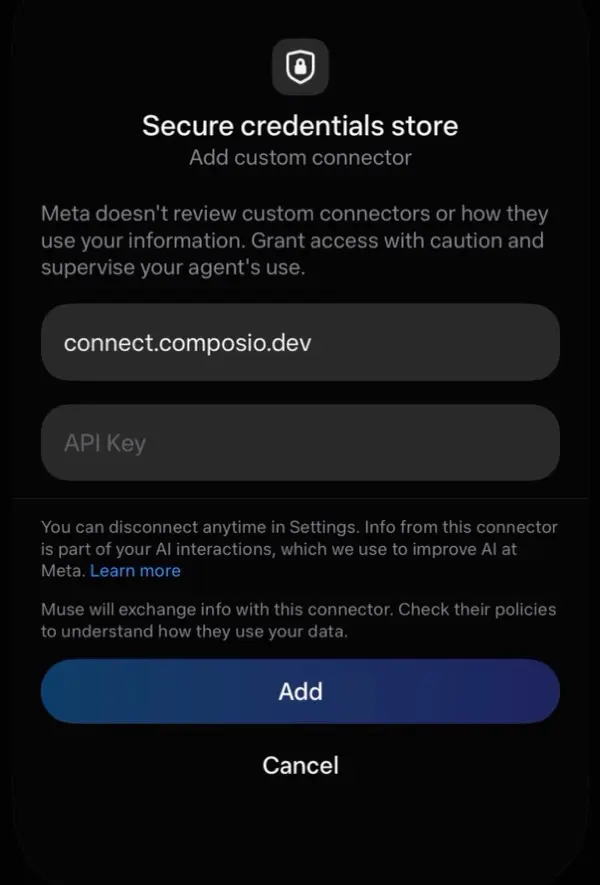
Tap the button Muse shows to open Add custom connector, paste your API key, then tap Add. Muse lists the Composio tools once it connects.

Muse secure credentials store with the connect.composio.dev URL, an API Key field, and the Add button

4. Connect your Google Sheets account

Back in the chat, ask Muse to connect to Google Sheets or give it any Google Sheets task.

For example, ask it to:

  • "Add a new sheet named 'Q3 Sales'"
  • "Update all rows where status is 'Pending'"
  • "Create a pie chart of expenses by category"

It will prompt you to authenticate and authorize access.

That's it. Composio's tools are now available in Muse, and your Google Sheets account is ready to use.

What is the Google Sheets MCP server, and what's possible with it?

The Google Sheets MCP server is an implementation of the Model Context Protocol that connects your AI agent and assistants like Claude, Cursor, etc directly to your Google Sheets account. It provides structured and secure access to your spreadsheets, worksheets, cell values, charts, and file metadata, so your agent can create spreadsheets, read and update data, organize worksheets, manage charts, and export reports on your behalf.

  • Spreadsheet creation and discovery: Have your agent create new spreadsheets, search existing files, inspect spreadsheet details, and list worksheet names.
  • Data reading and updates: Let the agent retrieve cell ranges, append new records, update values in bulk, clear ranges, and update or insert rows by a chosen key.
  • Worksheet organization: Direct your agent to add, copy, rename, reorder, hide, or delete worksheets, as well as insert, remove, resize, or hide rows and columns.
  • Data cleanup and controls: Instruct your agent to sort ranges, apply or clear filters, find and replace text, add dropdown validation, and manage conditional formatting rules.
  • Charts and report exports: Have your agent inspect existing charts, move or resize them, and export spreadsheets or selected worksheet ranges as PDF, XLSX, CSV, TSV, ODS, or ZIP files.

Way Forward

Now that Google Sheets is connected, extend your setup by connecting the other apps you already use every day, so Muse can run true cross-app workflows end to end.

  • Connect Calendar to turn threads into scheduled meetings automatically.
  • Connect Slack or Teams to post summaries, approvals, and alerts where your team works.
  • Connect Notion, Linear, Jira, or Asana to convert requests into tickets, tasks, and docs.
  • Connect Drive, Dropbox, or OneDrive to fetch, file, and share attachments without manual steps.

Start with one workflow you do repeatedly, then keep adding apps as you find new handoffs. With everything behind a single connection, Muse can coordinate multiple tools safely and reliably in one conversation.

Troubleshooting

1. Why doesn't Muse show a button to add my API key?

Muse shows the button only when you ask it to open the secure credentials store.

  • Start a new chat.
  • Send the message from step 1 exactly as written.
  • If Muse asks for the key in the chat, do not paste it. Ask Muse to open the secure credentials store.

2. Why does the Composio connection fail after I add my API key?

The key or the connector settings are not correct.

  • Copy the full key from the Composio dashboard. It starts with ck_.
  • Make sure the URL is https://connect.composio.dev/mcp and the header is x-consumer-api-key.
  • Remove the Composio connector in Muse settings, then do steps 1 to 3 again.

3. Why doesn't Muse use the Composio tools for Google Sheets?

Muse may not pick the Composio connector for the request.

  • Ask Muse to list its Composio tools.
  • Name Composio and Google Sheets in your request, for example: Use Composio to connect to Google Sheets.
  • If it still does not work, start a new chat and try again.

4. Why does Muse ask me to connect Google Sheets again?

Your Google Sheets connection expired or was removed.

  • Open the link Muse gives you and sign in to Google Sheets again.
  • Check that the Google Sheets connection shows as ACTIVE in the Composio dashboard.

5. What do I do if I pasted my API key into the chat?

Treat the key as exposed.

  • Create a new API key in the Composio dashboard and delete the old one.
  • Add the new key in Muse's secure credentials store, not in the chat.
TOOLS & TRIGGERS

Supported Tools and Triggers

Every Google Sheets action and event your agent gets out of the box.

Add Sheet to Existing Spreadsheet

Adds a new sheet to a spreadsheet.

Aggregate Column Data

Searches for rows where a specific column matches a value and performs mathematical operations on data from another column.

Append Dimension

Tool to append new rows or columns to a sheet, increasing its size.

Auto-Resize Rows or Columns

Auto-fit column widths or row heights for a dimension range using batchUpdate.

Batch Clear Values By Data Filter

Clears one or more ranges of values from a spreadsheet using data filters.

Batch get spreadsheet

Retrieves data from specified cell ranges in a Google Spreadsheet.

Batch Update Values by Data Filter

Tool to update values in ranges matching data filters.

Clear Basic Filter

Tool to clear the basic filter from a sheet.

Clear spreadsheet values

Clears cell content (preserving formatting and notes) from a specified A1 notation range in a Google Spreadsheet; the range must correspond to an existing sheet and cells.

Create Chart in Google Sheets

Create a chart in a Google Sheets spreadsheet using the specified data range and chart type.

Create a Google Sheet

Creates a new Google Spreadsheet in Google Drive.

Create spreadsheet column

Creates a new column in a Google Spreadsheet.

Create spreadsheet row

Inserts a new, empty row into a specified sheet of a Google Spreadsheet at a given index, optionally inheriting formatting from the row above.

Delete Chart from Google Sheets

Delete an existing chart from a Google Sheets spreadsheet.

Delete Dimension (Rows/Columns)

Tool to delete specified rows or columns from a sheet in a Google Spreadsheet.

Delete Sheet

Tool to delete a sheet (worksheet) from a spreadsheet.

Find and Replace in Spreadsheet

Tool to find and replace text in a Google Spreadsheet.

Format cell

Applies text and background cell formatting to a specified range in a Google Sheets worksheet.

Get conditional format rules

List conditional formatting rules for each sheet (or a selected sheet) in a normalized, easy-to-edit form.

Get Data Validation Rules

Tool to extract data validation rules from a Google Sheets spreadsheet.

Get sheet names

Lists all worksheet names from a specified Google Spreadsheet (which must exist), useful for discovering sheets before further operations.

Get Spreadsheet by Data Filter

Returns the spreadsheet at the given ID, filtered by the specified data filters.

Get spreadsheet info

Retrieves metadata for a Google Spreadsheet using its ID.

Insert Dimension in Google Sheet

Tool to insert new rows or columns into a sheet at a specified location.

Look up spreadsheet row

Finds the first row in a Google Spreadsheet where a cell's entire content exactly matches the query string, searching within a specified A1 notation range or the first sheet by default.

Mutate conditional format rules

Add, update, delete, or reorder conditional format rules on a Google Sheet.

Search Developer Metadata

Tool to search for developer metadata in a spreadsheet.

Search Spreadsheets

Search for Google Spreadsheets using various filters including name, content, date ranges, and more.

Set Basic Filter

Tool to set a basic filter on a sheet in a Google Spreadsheet.

Set Data Validation Rule

Tool to set or clear data validation rules (including dropdowns) on a range in Google Sheets.

Copy Sheet to Another Spreadsheet

Tool to copy a single sheet from a spreadsheet to another spreadsheet.

Append Values to Spreadsheet

Tool to append values to a spreadsheet.

Batch Clear Spreadsheet Values

Tool to clear one or more ranges of values from a spreadsheet.

Batch Get Spreadsheet Values by Data Filter

Tool to return one or more ranges of values from a spreadsheet that match the specified data filters.

Update Chart in Google Sheets

Update the specification of an existing chart in a Google Sheets spreadsheet.

Update Dimension Properties (Hide/Unhide & Resize)

Tool to hide/unhide rows or columns and set row heights or column widths.

Update Sheet Properties

Tool to update properties of a sheet (worksheet) within a Google Spreadsheet, such as its title, index, visibility, tab color, or grid properties.

Update Spreadsheet Properties

Tool to update SPREADSHEET-LEVEL properties such as the spreadsheet's title, locale, time zone, or auto-recalculation settings.

Batch update spreadsheet values

Tool to set values in one or more ranges of a spreadsheet.

Upsert Rows (Smart Update/Insert)

Upsert rows - update existing rows by key, append new ones.

Get spreadsheet values

Returns a range of values from a spreadsheet.

Update spreadsheet values

Tool to set values in a range of a Google Spreadsheet.

FAQ

Frequently asked questions

Yes. Muse supports custom connectors that use the Model Context Protocol (MCP). Composio connects as one custom connector over remote streamable HTTP at https://connect.composio.dev/mcp, and gives Muse access to Google Sheets and 1,500+ other apps.

Copy it from the Composio dashboard. It starts with ck_. Enter it only in Muse's secure credentials store, never in the chat.

Yes. Composio supports multiple connected accounts for the same app. Give each Google Sheets connection a name, such as work or personal, and tell Muse which one to use.

Tokens, keys, and configuration are encrypted at rest and in transit. Your Composio API key stays in Muse's secure credentials store, not in the chat or the model context. Composio is SOC 2 Type 2 compliant.

Start with Google Sheets.It takes 30 seconds.

Managed auth, hosted MCP servers, and every Google Sheets tool your agent needs.Free to start.

Start building