




Boomi Alternatives and Competitors: 8 Tools Compared for 2026
Boomi has been named a Leader in the Gartner Magic Quadrant for iPaaS twelve consecutive times, the longest run any vendor has managed in the history of that report, and in March 2026 it was placed highest for ability to execute. It connects more than 1,000 applications, runs in the cloud, on-premises, or behind your firewall, and carries the compliance credentials that decide enterprise deals: FedRAMP, HIPAA, ISO 27001. Its agent story is something to check out as well.
AgentStudio manages the full lifecycle of AI agents; more than 75,000 of them now run in production across its customer base. Meta Hub grounds those agents in trusted master data, and MCP support has been broadened so outside agents can reach enterprise systems under governance.
Boomi licenses by connection. A connection joins two endpoints, and at enterprise tiers a single one is estimated to run between $5,000 and $18,000 a year depending on the connector and the tier you are on. When you add transaction overages, extra atoms and molecule clusters as you scale, premium connectors, professional services that commonly land at 20 to 40 per cent of first-year spend, and renewal escalators of 3 to 7 per cent, you get an increased surge in pricing.
With Boomi, the more integrations you have, the more you pay. Boomi broadened its scope by buying Rivery for data pipelines (now sold as Boomi Data Integration); Thru for managed file transfer; and APIIDA plus Mashery for API management. Each purchase adds a genuine capability. Each also adds surface area to learn, license, and stitch together, and every competitor in this article will bring it up when you speak with them.
You might see Dell Boomi on search engines or comparison articles. Dell sold the business in 2021 at a $4 billion valuation to Francisco Partners and TPG. It has been independent ever since, and the product is just Boomi now.
How I compared these tools
Boomi is not just one product, which makes this harder than the usual roundup. Application integration, EDI, API management, master data, managed file transfer, data pipelines, and now agent management all ship as one platform, and almost nobody uses all of it. So the useful question is which part of Boomi you are looking to replace, and that question shaped every entry below.
For each tool, I checked the same six things:
How it meters you, which is the whole argument here. Per connection, per message, per compute unit, per execution, or a flat entitlement. Boomi’s per connection model is the most common reason people start looking, so any alternative that repeats that model gets called out for it, including ones I rate highly.
Whether prices are published, and what buyers pay when they are not. Where a vendor hides its rate card, I have used aggregated contract data and said where it came from.
License and hosting: cloud only, hybrid, on-premises, behind the firewall, or self-hosted.
The AI and MCP story, since agent management is Boomi’s whole 2026 pitch and a replacement has to answer it.
Coverage of the specific Boomi capabilities people run in practice: connectors, EDI, API management, data pipelines, master data.
Who the tool suits, and how much of Boomi it can take over without anyone pretending.
What Boomi costs, and where the meter runs
Boomi will tell you a price without a meeting, which is more than most of its rivals manage. There is a pay-as-you-go plan at $99 a month plus $0.05 per Boomi Message, self-serve with a credit card and no contract, plus a 30-day free trial. If your needs are small, that is a fair deal.
Most companies land on the subscription tiers, and those are quoted. Integration is sold as Standard, Professional, Professional Plus, Enterprise, and Enterprise Plus, with API Management, Data Hub, and Data Integration alongside as their own lines. Published analysis puts the Professional tier around $550 a month for up to five connections. Above that, everything is negotiated, and the connection is the unit that decides your bill.
Premium and enterprise connectors are billed on top of the plan.
Transaction, API call, and data volume overages apply once you pass your contracted limits.
Additional atoms and molecule clusters cost more as you scale runtime capacity.
Professional services commonly run 20 to 40 per cent of first-year spend.
Contracts frequently carry renewal escalators of 3 to 7 per cent, and platform licensing is typically only 30 to 40 per cent of three-year total cost.
Peer reviews put a practical floor somewhere around $15,000 to $20,000 a year, and one mid-sized deployment came in at $18,000 a year for twelve connections.
None of that makes Boomi expensive by enterprise standards. Set against MuleSoft, it looks cheap. What it does is tie your bill to your connection count, so the month your integration program finally succeeds, and every department wants its system wired in, is the month the platform starts charging you for that success.
Boomi alternatives and competitors compared at a glance
Tool | Type and hosting | How it meters you | Public pricing | AI and MCP | Best for |
|---|---|---|---|---|---|
Boomi | Enterprise iPaaS, cloud, on-premises, behind firewall | Per connection plus per message, with overages | Partly, $99 a month pay as you go, tiers quoted | AgentStudio, Meta Hub, broadened MCP | Governed hybrid integration with agent management |
MuleSoft | Enterprise iPaaS and API platform, cloud and on-premises | Deployed flows plus messages, plus automation and Agentforce credits | No, negotiated | Agentforce and Einstein connectors, API governance | API led programs and Salesforce-heavy estates |
Workato | Enterprise automation, cloud and on-premises | Task volume, with unlimited recipes and connections | No, sales led | Agent Studio genies on Claude, MCP across 1,400+ apps | Getting integration out of the IT queue |
SnapLogic | Enterprise iPaaS, cloud and hybrid | Package-based, unlimited data movement in package | No, quote-based | AgentCreator, SnapGPT, MCP Server, SnapCode | AI-led integration with a real migration tool |
Celigo | Enterprise iPaaS, cloud | Endpoints and flows, no overage fees | No, but median buyer pays $14,706 a year | Celigo Ora, MCP Server, agentic automation | Predictable bills, NetSuite and e-commerce depth |
Jitterbit | iPaaS, API, EDI, app builder, cloud, hybrid, on premise | Connection-based tiering plus annual quote | No, custom quotes, annual only | AskJB, prebuilt agents, EDI and API assistants | EDI, trading partners, and fast implementation |
Informatica | Data management platform, cloud and hybrid | Processing units, consumption-based, unused units expire | No, negotiated | CLAIRE, MCP servers on AWS, Headless IDMC in preview | Data first estates: catalogue, quality, master data |
n8n | Open source automation, self-host or cloud | Per execution, or nothing at all if self-hosted | Yes, free self host, cloud from $24 a month | AI Agent and LangChain nodes, MCP, vector stores | Deleting the meter on cloud-to-cloud workflows |
Composio | Agent tool layer, cloud or VPC | Per tool call | Yes, free tier and from $29 a month | Managed auth, MCP gateway, tool router | Giving agents you built real access to applications |
1. Boomi vs MuleSoft: Strong API Platform
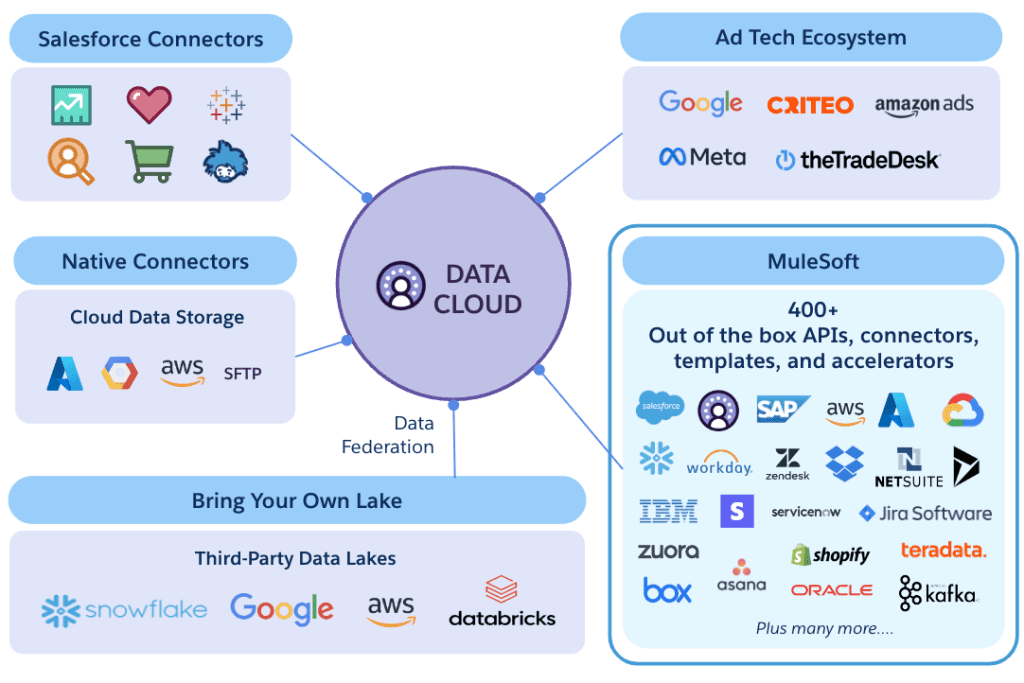
More people put Boomi next to MuleSoft than next to anything else.
If you are leaving Boomi because per-connection pricing punishes breadth, MuleSoft is a step in the wrong direction. Since March 2024, new customers buy packages called Integration Starter, Integration Advanced, and API Management, which include Mule Flows, which counts how many integrations you have deployed, and Mule Messages, which counts transaction volume. Counting deployed flows is the same structural pricing as counting connections: your bill tracks the breadth of your estate.
When you add Automation Credits for RPA and Composer workloads, and Agentforce Flex Credits when AI agents run on top, an enterprise contract can span four separate consumption meters. Benchmark data puts the median buyer at $55,150 a year across 74 verified contracts, with first-year total cost commonly two to three times the subscription once implementation and DataWeave developers are counted, and typical implementations running six to eight months.
So why is it first on this list? Because for one job it is the best tool here. If your organisation treats APIs as products, MuleSoft is built around that idea rather than retrofitted to it. Anypoint Exchange gives you a genuine reusable asset library, DataWeave is the most capable transformation language in this comparison, API Manager handles policy and governance properly, and Runtime Fabric will run workloads on-premises when you need it. Salesforce has owned it since 2018, so if your business runs on Salesforce, the native depth is hard to match, and the Agentforce, Einstein, and AI Chain connectors are free through Anypoint Exchange even though using them still drives consumption. Pick MuleSoft for an API strategy and Salesforce gravity.
Pros
The strongest API led platform here, with Anypoint Exchange, DataWeave, and mature API governance
Deep native Salesforce connectivity and a clear path into Agentforce
Cloud, hybrid, and on-premises deployment through CloudHub and Runtime Fabric
Cons
Metered on deployed flows and message volume, so like Boomi your bill grows with the size of your estate, only faster
Enterprise contracts commonly span up to four consumption meters, making forecasting harder than it was under the old model
No public pricing, a median contract around $55,150 a year, first year costs two to three times the subscription, and six to eight month implementations
Watch
2. Boomi vs Workato: Integration For Everyone

The most common complaint about Boomi is not the price. Workato sells automations as recipes, connects more than 1,200 applications compared to Boomi’s 1,000-plus, and puts unlimited recipes, connections, and collaborators on every tier, so you are billed on task volume rather than per seat or per connection. Adding a new system to Workato does not automatically add a line to your contract. The build experience is aimed at technically minded business people rather than integration specialists, which is how teams get requests out of the IT queue without losing governance.
Its agentic work is serious. Agent Studio builds agents it calls genies, which run on Anthropic Claude by default; Workato GO is the chat surface, and its enterprise MCP server exposes more than 1,400 applications as governed tools to Claude, ChatGPT, and Cursor. Gartner has had it as a Leader for eight years, and it holds a 4.7 on G2.
Workato publishes nothing, sells through a one-year minimum, and builds quotes from a platform edition fee plus task usage. Entry deals tend to start near $10,000 a year, the median customer sits around $65,000, and mid market deployments commonly run $50,000 to $130,000, with premium connectors for SAP and Oracle billed separately. Against a modest Boomi contract that is a step up, not a saving.
Pros
Unlimited recipes, connections, and collaborators on every tier, so growth in systems does not directly grow your license
More than 1,200 connectors and a build experience business teams can use without an integration specialist
Strong agentic layer: Agent Studio genies on Claude, Workato GO, and an enterprise MCP server spanning 1,400+ applications
Cons
No public pricing, a sales cycle, and a one-year minimum commitment
Usually more expensive than Boomi, with a median around $65,000 a year and mid-market deals of $50,000 to $130,000
Premium connectors for systems like SAP and Oracle cost extra, and task-based billing still meters your busiest workflows
Read more: 8 Best Workato Alternatives to Evaluate in 2026: Free, Ai-native, open-source options
Watch
3. Boomi vs SnapLogic: Unlimited Data Movement
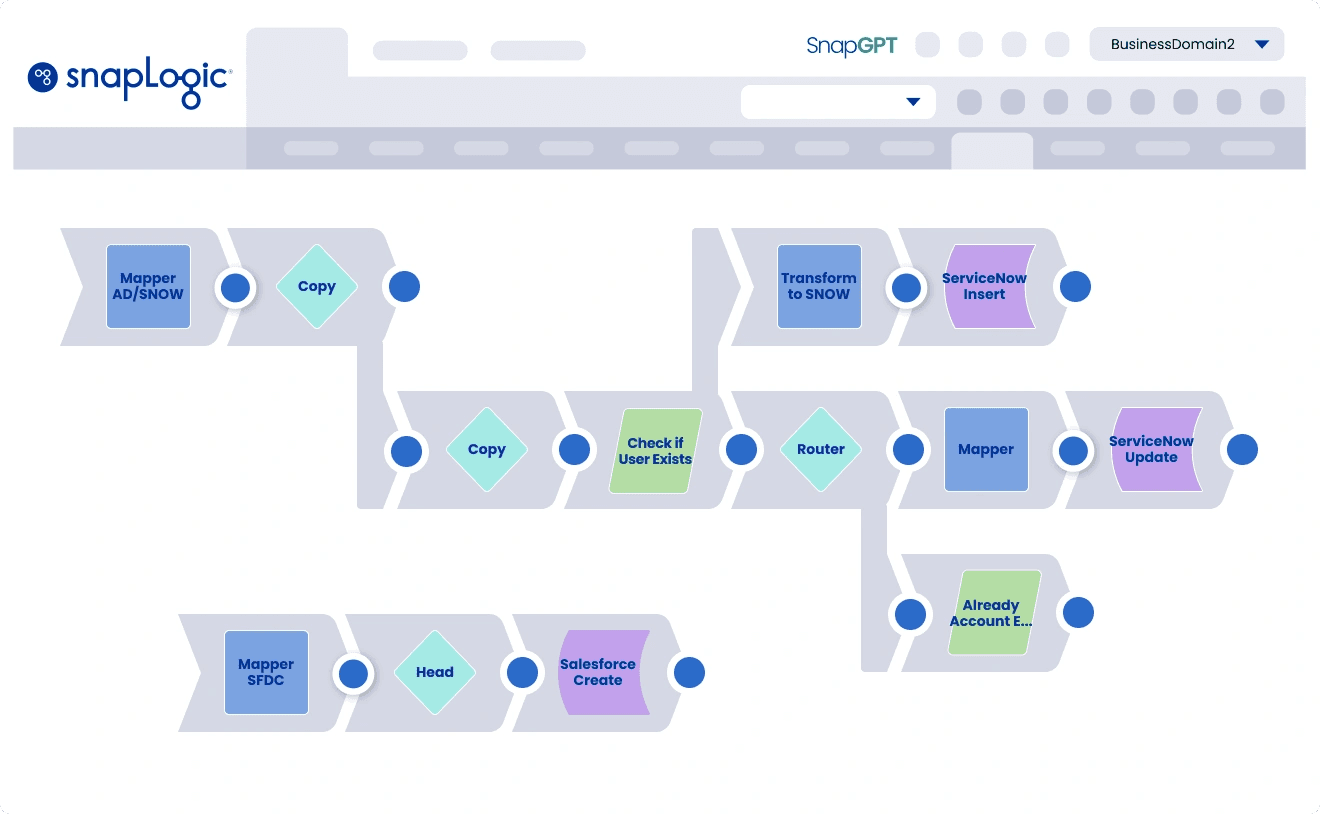
SnapLogic Intelligent Moderniser, shortened to SLIM, automates the migration of legacy integration workloads, and the company says it cuts modernisation cost and time by up to 80 per cent. If the thing keeping you on Boomi is not the contract but the prospect of rebuilding four hundred processes by hand, that is the most relevant product feature on this page.
The rest of the platform is a credible enterprise iPaaS with an AI-first posture. It has called itself the Agentic Integration Company since well before that was fashionable. It has an AgentCreator for building and orchestrating production agents; SnapGPT as a natural language copilot for building pipelines; connectivity to AWS Bedrock and Google Gemini; and native MCP support. Its MCP Server went generally available on July 1, 2026, followed by SnapCode and the SnapLogic MCP Server on July 14, extending governed enterprise integration to AI coding agents. Snaps are its connectors; Adobe, Siemens, and Workday are customers, and a Forrester study put ROI at 181 per cent with more than $3.3 million in benefits over three years.
On pricing, it is quote-based and package-based, split into Business and Enterprise bundles. SnapLogic markets unlimited data movement within each package. No per message meter. The offset is that a stack of capabilities you might assume are included are premium add-ons, including AgentCreator itself, ultra-low-latency workflows, AutoSync, ELT, high-performance nodes, and advanced security. Gartner has it as a Visionary rather than a Leader in the 2026 iPaaS quadrant, which is a fair reflection: strong vision, smaller footprint than Boomi.
Pros
SLIM is purpose-built to migrate legacy integration workloads, which is the actual barrier to leaving Boomi
Unlimited data movement inside each package, so transaction volume does not drive the bill
Serious agentic tooling: AgentCreator, SnapGPT, native MCP, and a July 2026 MCP Server and SnapCode release for AI coding agents
Cons
Quote-based pricing with no published rates, and several core capabilities sit behind premium add-ons
AgentCreator, the headline AI feature, is one of those paid add-ons
A Visionary rather than a Leader in the 2026 iPaaS Magic Quadrant, with a smaller enterprise footprint than Boomi
Watch
4. Boomi vs Celigo: the answer to the per-connection problem

Celigo prices on endpoints and flows. It does not charge per task, per transaction, or by data volume, and it does not bill overages. With Celigo, your bill stops moving when your traffic spikes. Vendr’s data puts the median Celigo buyer at $14,706 a year across 222 purchases, in a range from $6,519 to $35,519. The median MuleSoft buyer pays $55,150. Same category, wildly different order of magnitude.
Celigo lists more than 1,000 prebuilt connectors and ships an MCP Server so outside agents plug into your stack, and the platform covers integration, EDI with trading partner management, an ETL and ELT engine for warehouse work, API management on the Professional and Enterprise tiers, and agentic automation under one governance model. Celigo Ora, in beta, exposes the whole platform through natural language, and the company claims its AI exception handling resolves 95 per cent of errors automatically. It serves more than 4,000 customers, mostly mid-market, and was the only vendor named a 2025 Gartner Peer Insights Customers’ Choice for iPaaS.
Celigo is stronger with NetSuite and e-commerce, which is a win if that is your stack. However, its governance, on-premise runtime options, and public sector compliance do not reach Boomi’s depth. Celigo does not publish a rate card, so you are back on a call, just with a much smaller number at the end of it. Switching from a competing iPaaS commonly earns discounts of 20 to 35 per cent, so say out loud that you are leaving Boomi.
Pros
Priced on endpoints and flows with no per-task, per-transaction, or volume charges, and no overage fees
A median buyer pays $14,706 a year, a fraction of the enterprise alternatives, with competitive switching discounts of 20 to 35 per cent
Broader than its reputation: 1,000+ connectors, an MCP Server, EDI, ETL and ELT, API management, and Celigo Ora in beta
Cons
Still custom quoted with no public list prices
Strongest around NetSuite and e-commerce, which is a poor fit if your estate looks nothing like that
Governance, on-premises runtimes, and public sector compliance are lighter than Boomi’s
Watch
5. Boomi vs Jitterbit: EDI and hybrid runtimes
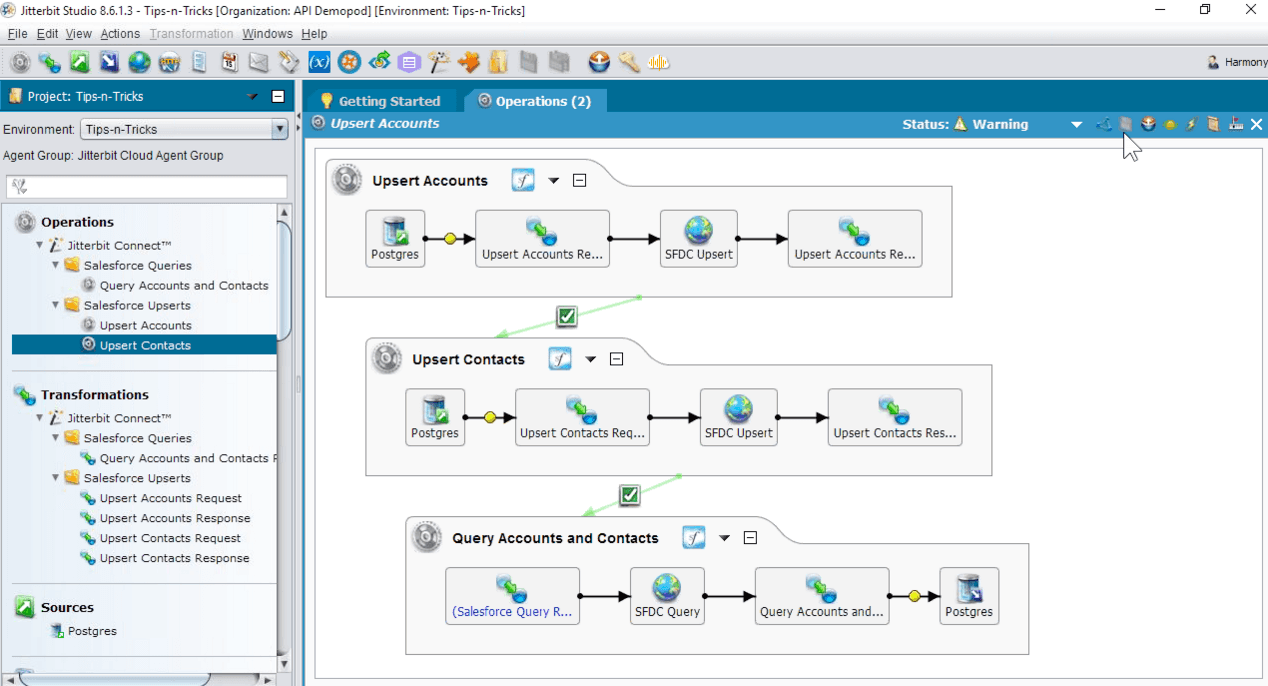
In G2’s Spring 2026 Enterprise Implementation Index for iPaaS, Jitterbit ranked first, its fourth consecutive quarter beating category averages on measures reported by actual users: satisfaction with setup, time to go live, and user adoption. For a mid-market team that has already been through one long Boomi implementation, this is important to note down.
The platform itself, Harmony, bundles four things Boomi also sells: iPaaS, API Manager, App Builder, and EDI. The EDI piece is the standout. It supports X12, EDIFACT, and XCBL with a network of more than 1,000 trading partners, which matters enormously if your Boomi estate is really order-to-cash and supplier onboarding. Deployment runs in the cloud, hybrid, or on-premises through private agents. AI has been layered across the stack: AskJB builds pipelines from natural language; there are prebuilt agents for HR, sales, and knowledge work, and there are separate assistants for API management and EDI tasks. Its bundles include 60 hours of professional services and a prebuilt agent. App Builder arrived through the PrimeApps acquisition in March 2026.
Jitterbit prices on connection-based tiering plus a custom annual quote. It does not publish its billing or offer monthly billing. Premium connectors cost extra, API management and EDI are add-ons, and additional private agents are billed too. Contract data puts moderate deployments of five to fifteen integrations between $30,000 and $80,000 a year. Reviewers also flag a dated Cloud Studio interface and limited change data capture. Gartner lists it as a Visionary for 2026.
Pros
Ranked first in G2’s Spring 2026 Enterprise Implementation Index for iPaaS, four quarters running, on setup speed and adoption
Genuine EDI depth with X12, EDIFACT, and XCBL and more than 1,000 trading partners, plus cloud, hybrid, and on-premises agents
One vendor for integration, API management, EDI, and app building, with AI assistants across all four
Cons
Connection-based tiering and custom quotes, so the billing model you are running from is largely the billing model you are running to
Annual contracts only, with no monthly option, and premium connectors, EDI, API management, and extra private agents all billed separately
A dated Cloud Studio interface and limited change data capture, with moderate deployments landing at $30,000 to $80,000 a year
Watch
6. Boomi vs Informatica: for teams looking for data estate
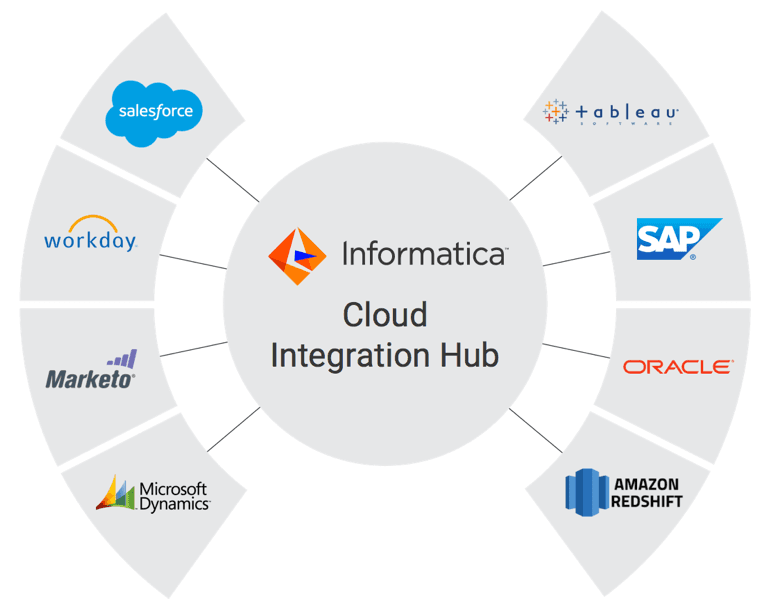
Look at what you run on Boomi. If most of it is Data Hub, master data, and pipelines rather than application-to-application workflows, you are not shopping for an iPaaS at all. Informatica is the alternative you should look into.
Its Intelligent Data Management Cloud, IDMC, covers data integration, cataloguing, governance, quality, privacy, metadata management, and master data, with the CLAIRE AI engine underneath and CLAIRE GPT on top. More than 5,000 customers run it across close to 100 countries, including over 80 of the Fortune 100. Headless IDMC exposes its data services as governed, reusable services over MCP so any agent can call them, currently in private preview with general availability planned for summer 2026, while MCP servers on the AWS Agent Registry and Amazon Bedrock, CLAIRE Agent Skills on AWS, and a master data extension for Databricks are available now.
Salesforce completed its acquisition of Informatica in November 2025 for roughly $8 billion, which means Salesforce now owns both Informatica and MuleSoft.
IDMC bills in Informatica Processing Units, a consumption model where you buy capacity and burn it across services, and unused units expire at the end of the contract month or anniversary year, so overbuying is a loss rather than a rollover. Premium connectors for systems like SAP and mainframes are estimated at $25,000 to $100,000 a year, premium support runs up to $60,000, and implementation services commonly add $150,000 to $300,000 in year one. Standard support for the legacy PowerCenter product ended on March 31, 2026, so a lot of Informatica’s own customers are in a migration conversation right now too.
Pros
The deepest data management stack here: integration, catalogue, governance, quality, privacy, and master data in one platform
CLAIRE AI throughout, with MCP servers live on AWS and Bedrock and Headless IDMC over MCP due for general availability in summer 2026
Proven at the top of the market, with 5,000+ customers and more than 80 of the Fortune 100
Cons
The most expensive option here once premium connectors, support, and implementation are counted
Consumption priced in processing units that expire unused, which makes buying capacity a forecasting exercise with a penalty for guessing high
Now owned by Salesforce, which also owns MuleSoft, so two shortlist entries share one roadmap and one negotiating table
Watch
7. Boomi vs n8n: The Free Option
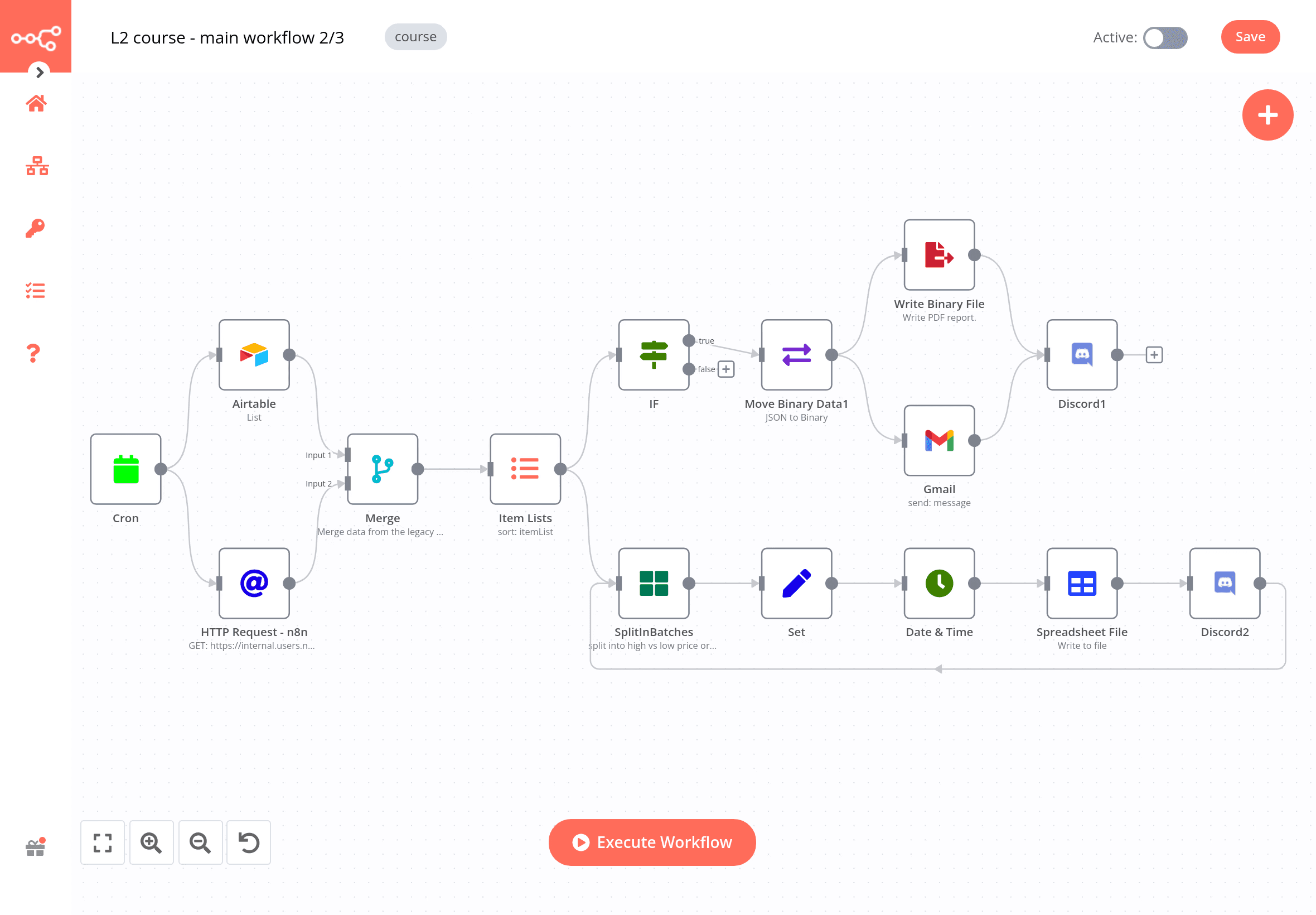
The Community Edition of n8n is fair code and free to self-host with unlimited executions. When you put it on infrastructure you already run, your integration platform costs what the server costs. For a team that has spent two years watching a number climb every time somebody asked for a new system to be connected, that is a very different relationship with the software. The managed cloud exists too, at $24 a month for Starter and $60 for Pro with a 14-day trial, and it bills per execution rather than per step, so a workflow with forty nodes counts once.
It has native AI Agent nodes built on LangChain, MCP support, vector store nodes, and JavaScript and Python whenever the visual canvas gets in the way. More than 400 integrations, which is well short of Boomi’s catalogue but covers the SaaS applications most estates revolve around.
n8n is not a Boomi replacement for a regulated enterprise. There is no EDI, no master data management, no FedRAMP, no on-premises runtime story with the governance an auditor expects, and you own the uptime, the patching, and the pager. The fair code license also stops you from reselling it or offering it as a hosted service. What n8n does is replace the slice of your Boomi estate that just moves records between cloud applications, and for a lot of teams, that slice is most of the connection count and almost none of the complexity.
Pros
Free to self-host with unlimited executions, which removes connection counts, volume meters, and overages from the conversation completely
Execution based cloud pricing that does not punish long multi-step workflows
Strong AI building blocks for the money: AI Agent and LangChain nodes, MCP, vector stores, JavaScript and Python
Cons
No EDI, no master data management, and no compliance posture close to Boomi’s, so it cannot carry a regulated estate
Self-hosting means you own uptime, upgrades, scaling, and the on-call rota
Fair code rather than fully open source, and roughly 400 integrations against Boomi’s 1,000 plus
Read more: 8 best n8n Alternatives for AI Automation I Actually Tested in 2026
Watch
8. Boomi vs Composio: The Integration Layer for AI Agents

Composio belongs on this list for a different reason from the traditional iPaaS vendors. It is an integration and tool-execution layer built specifically for AI agents, giving them authenticated access to more than 1,000 applications without requiring your team to build connectors or maintain OAuth flows and refresh-token logic.
The product is developer-shaped: Python and TypeScript SDKs, a CLI, and a managed MCP gateway, with dedicated integrations for Claude Code and Codex, plus support for LangChain, the OpenAI Agents SDK, the Vercel AI SDK, and OpenCode. Its Tool Router selects only the tools relevant to each task rather than loading an entire connector catalogue into the model’s context, which becomes important as an agent gains access to more systems.
Composio carries SOC 2 Type II, offers VPC and on-premises deployment at the enterprise tier, and publishes usage-based pricing: 20,000 tool calls a month free, $29 for 200,000, and $229 for two million.
That makes Composio a replacement for one specific part of a Boomi estate, not for Boomi as a whole. It does not run conventional scheduled data synchronisation, EDI networks, master-data management, or API lifecycle programs. Choose an iPaaS for those workloads. Choose Composio when the integration consumer is an AI agent and the problem is giving it secure, governed, production-ready access to real applications.
Pros
Purpose-built for AI agents, with managed authentication and access to more than 1,000 applications
Multiple developer interfaces, including Python and TypeScript SDKs, a CLI, and a managed MCP gateway
Public tool-call pricing with a useful free tier, plus SOC 2 Type II and enterprise VPC or on-premises deployment
Cons
Not a full iPaaS: no scheduled integration platform, EDI, master-data management, or API lifecycle management
Built for developers working in code or over MCP rather than operations teams expecting a low-code integration canvas
Composio supplies the tools and authentication layer, but your team still owns the agent’s logic, hosting, evaluation, and reliability
Watch
Other Boomi competitors worth knowing
The question that comes up more than any other here is whether Zapier can replace Boomi, so let me answer it properly.
Zapier connects more than 9,000 applications, more than anything else on the market, publishes its prices, starts free, runs MCP on every account, and a non-specialist can ship something with it before lunch. It also has no on-premises runtime, no EDI, no master data management, no API management, and a per-task meter that gets expensive at volume. For an enterprise running governed hybrid integration, it is not a replacement. For a company that bought Boomi years ago and now uses it to move records between a handful of cloud applications, it can be.
Make sits in the same bracket with a cheaper operations model, from around $9 a month across 3,000-plus applications.
Tray.ai is the most AI-native peer, with Merlin Agent Builder and a governed MCP Agent Gateway, though it is sales-led with no public prices. Talend, now part of Qlik, covers data integration and quality.
Fivetran handles managed pipelines if the job is really warehouse loading.
Cleo is the option if EDI and B2B are the entire point.
SAP Integration Suite, Oracle Integration Cloud, and IBM webMethods are the answers when your ERP vendor is already well-known to you, and you would rather buy integration from them.
Microsoft Power Automate makes sense if you are already deep in Microsoft licensing.
If what you want is integrations embedded inside your own software product for your customers to use, none of the platforms above is built for that. Prismatic, Paragon, and Cyclr are, and Composio Connect covers it when the embedded piece is an AI agent.
How to Pick an Alternative to Boomi
If connection costs climb with every new system, Celigo is the fix, because endpoints and flows with no overages are a fundamentally different contract, and n8n is the option if you have engineers who would rather run it themselves. If you are doubling down on APIs, MuleSoft is the strongest tool here, and you should go in knowing it will cost more, not less.
If IT has become the bottleneck, Workato moves the work to the people asking for it. If your estate is really data rather than applications, Informatica is the peer, with the caveat that Salesforce now owns it and MuleSoft both.
If EDI and a rollout that finishes are what you need, Jitterbit has the trading partner network and the implementation record. If the thing blocking you is the sheer labour of migrating, SnapLogic is the only vendor here that built a product for it. And if what you are replacing is a set of agents your engineers would rather write in code, Composio is the layer, not a platform.
Your main reason for leaving Boomi | Narrow it down | Start with |
|---|---|---|
Per connection costs that grow with every new system | You want no volume metering and no overage bills | Celigo (endpoints and flows, no overage fees) |
Per connection costs that grow with every new system | You have engineers and want the meter gone entirely | n8n (self-host, unlimited executions) |
You are committing to an API program | APIs are the product, and the budget exists | MuleSoft (API led, Salesforce-owned) |
You want business teams building, not just IT | Recipes and agents non-specialists can handle | Workato (Agent Studio, 1,200+ connectors) |
Your centre of gravity is data, not applications | Catalogue, quality, governance, master data | Informatica (IDMC, now Salesforce owned) |
You need EDI and a rollout that lands | Trading partners on a mid market budget | Jitterbit (Harmony EDI, ranked first for implementation) |
You want AI-led integration and a migration path | Legacy modernisation tooling matters to you | SnapLogic (AgentCreator, SLIM migration tool) |
You are building the agents yourself in code | The agent is yours; it just needs app access | Composio (managed auth, MCP gateway) |
Frequently asked questions
Does Dell still own Boomi?
No. Dell sold the business in 2021 at a $4 billion valuation to Francisco Partners and TPG, and it has operated independently since. The product is now branded simply Boomi, though many people still search for and refer to it as Dell Boomi, and older documentation and review sites still carry the old name.
How much does Boomi cost?
There is a published pay-as-you-go plan at $99 a month plus $0.05 per Boomi Message, with a 30-day free trial. Subscription tiers are quoted rather than listed, priced around connection count, data volume, environments, and support level, with the Professional tier reported at roughly $550 a month for up to five connections. At enterprise scale, each connection is estimated at $5,000 to $18,000 a year, and peer reviews put a practical floor near $15,000 to $20,000 annually before overages, premium connectors, and professional services.
What is the best Boomi alternative?
It depends entirely on which part of Boomi you run. Celigo is the best answer to unpredictable per-connection bills, MuleSoft to an API strategy, Workato to an IT bottleneck, Informatica to a data-heavy estate, Jitterbit to EDI and slow implementations, SnapLogic to migration pain, n8n to cost, and Composio to building agents in code.
Boomi vs MuleSoft: which should I choose?
Choose MuleSoft if APIs are a product for you, you have Salesforce at the centre of your estate, and you have the budget and specialist developers to match. Choose Boomi if you want broader out-of-the-box connectivity, faster time to a working integration, and a lower bill. MuleSoft’s median contract runs around $55,150 a year, with first-year costs typically two to three times the subscription, and it meters deployed flows as well as messages, so it does not solve a per-connection cost complaint.
Boomi vs Workato: which is better?
Workato is the easier platform for business teams to build on, bills on task volume rather than per connection, and puts unlimited recipes and connections on every tier, which stops your license growing every time you add a system. Boomi is stronger on hybrid and on-premises deployment, EDI, master data, and public sector compliance, and it is usually cheaper. Neither publishes full pricing, but Workato deals commonly start near $10,000 a year and run to a median around $65,000.
Can Zapier replace Boomi?
For a governed enterprise estate, no. Zapier has no on-premises runtime, no EDI, no master data management, and no API management, and its per-task pricing gets expensive at volume. For a company that bought Boomi years ago and now uses it mainly to move records between cloud applications, it very often can, and its 9,000-plus applications and published prices make it easy to test the theory cheaply before committing either way.
Which Boomi alternative has the most predictable pricing?
Celigo, on the enterprise side. It bills on endpoints and flows, does not charge per task, per transaction, or by data volume, and does not levy overage fees, so traffic spikes do not change your bill. Self-hosted n8n is the most predictable of all, since the cost is your server, though it gives up EDI, master data, and enterprise compliance to get there.
Is there an open source Boomi alternative?
n8n is the closest, with a fair code Community Edition you can self-host free with unlimited executions, plus native AI agent nodes and MCP support. Fair code is not fully open source, since it restricts reselling n8n or offering it as a hosted service. Activepieces is MIT licensed, and Windmill is AGPLv3 if a permissive license matters, though neither approaches Boomi’s enterprise footprint.
Which Boomi alternative is best for EDI and B2B?
Jitterbit and Celigo both handle EDI natively, with Jitterbit supporting X12, EDIFACT, and XCBL across a network of more than 1,000 trading partners, and Celigo managing trading partner connections alongside its other integrations. Cleo is the specialist worth adding to any shortlist where EDI is the main event rather than one workload among many.
What is the best Boomi alternative for AI agents and MCP?
For building agents in code, Composio provides authenticated access to more than 1,000 applications through SDKs and a managed MCP gateway, starting free at 20,000 tool calls a month. Among the platforms, Workato runs an enterprise MCP server spanning 1,400+ applications; SnapLogic shipped its MCP Server and SnapCode in July 2026; Celigo ships an MCP Server with more than 1,000 connectors; and Informatica has MCP servers live on AWS with Headless IDMC due this summer.

 Get started