AI security has changed faster than most enterprise security stacks have. A bad prompt can now become a tool call, a database write, an OAuth request, or an action inside another system.
That changes the failure mode completely. The problem is no longer just an AI model producing a bad answer; it is what the model or agent can do after that answer. Also, as companies give AI agents greater access, the number of ways things can go wrong grows.
So, this blog covers the best AI security platforms in 2026, what each one protects, and when to choose them.
But before looking at the platforms, it helps to understand exactly what needs to be protected.
Summary
A compact comparison table for quick glance; go through the article for details.
Type | Name | What it offers | When to use |
|---|---|---|---|
AI model & application security | Palo Alto Networks | Lifecycle security: model scanning, runtime protection, AI red teaming, posture management and agent security | When you want to secure multiple stages of the AI lifecycle instead of using separate products for each layer |
AI model & application security | Check Point | Runtime guardrails: prompt attack protection, sensitive-data leakage controls, malicious-link detection, content moderation and emerging agent security | When runtime guardrails are the immediate problem, and you also want to evaluate agent discovery and behaviour controls |
AI model & application security | SentinelOne | AI security + SOC: AI red teaming, agent and MCP discovery, governance, and autonomous security investigations through Purple AI | When you want AI application security connected to the same platform handling endpoint, cloud and security operations |
Enterprise infrastructure security | CrowdStrike | AI application protection: prompt and response inspection, sensitive-data controls, AI interaction logging and MCP traffic protection | When Falcon already protects much of your environment, and you want to extend it to AI applications and MCP-based agents |
Enterprise infrastructure security | Zscaler | Zero Trust for AI: AI asset discovery, AI application access controls, governance, endpoint visibility, DLP and MCP/A2A policy controls | When you need to control which users or agents can reach applications, data sources or services and what they can do |
Enterprise infrastructure security | Okta | Agent identity: individually governed agent identities, scoped access, short-lived tokens, MCP governance, lifecycle management and access reviews | When the main question is what an agent can access and for how long |
Enterprise infrastructure security | Dynatrace | AI observability: traces agents, handoffs, tool calls, retrieval steps, model interactions and underlying infrastructure | When you need to understand what an agent did, which systems it touched and where a failure occurred |
Enterprise infrastructure security | Fortinet | Endpoint & network protection: EDR, ZTNA, secure access, data protection and visibility into sanctioned and shadow AI usage | When endpoints, networks and enterprise data are still the main assets you need to protect as AI adoption grows |
Enterprise infrastructure security | Rubrik | Agent governance & recovery: scoped tool access, short-lived credentials, audit trails, behavioural policies and recovery from unwanted agent actions | When agents can modify important systems or data, and you need both governance and a recovery path |
Agent access & tool security | Composio MCP Gateway | Agent tool access control: team-specific MCP endpoints, toolkit and action-level restrictions, SSO, SCIM and execution audit logs | When you need to control which enterprise tools agents can access and what actions they are allowed to perform |
Why AI Security Matters
The more useful AI becomes, the more access we give it. Agents now work across browsers, APIs, SaaS applications, databases, source code, MCP servers, cloud infrastructure, and enterprise identities.
That creates a few very different security problems:
Prompt injection: An attacker can manipulate what a model or agent does by embedding instructions in prompts, files, websites, or retrieved data.
Data leakage: Sensitive company information can leave through prompts, model responses, tools, browser sessions, or connected applications.
Data and model poisoning: Compromised training data, model files, dependencies, or retrieval sources can change how an AI system behaves.
Agent permissions: An agent with excessive access can turn a model mistake into a real change in Gmail, GitHub, Salesforce, cloud infrastructure, or another system.
MCP and tool attacks: Agents increasingly rely on external tools and MCP servers, creating additional avenues for malicious instructions, unsafe tools, and exposure of sensitive data.
Shadow AI: Employees can install AI applications, browser extensions, coding agents, and other tools before security teams even know they exist.
Recovery: Once an autonomous system changes or deletes something, prevention is only half the problem. Teams also need to understand what happened and recover safely.
This is also why comparing every AI security platform into a single bucket does not really work.
Some products are trying to protect the AI model, application, prompts and data.
Others are protecting the endpoint, identity, network, SOC and enterprise systems the AI touches.
Let's start with the first group.
Best platforms that secure AI models and data against adversarial threats
These platforms are built specifically to secure AI systems themselves, protecting models, applications, prompts, data and agent workflows against adversarial threats.
1. Palo Alto Networks: Full-lifecycle security for AI applications, models, data and agents.
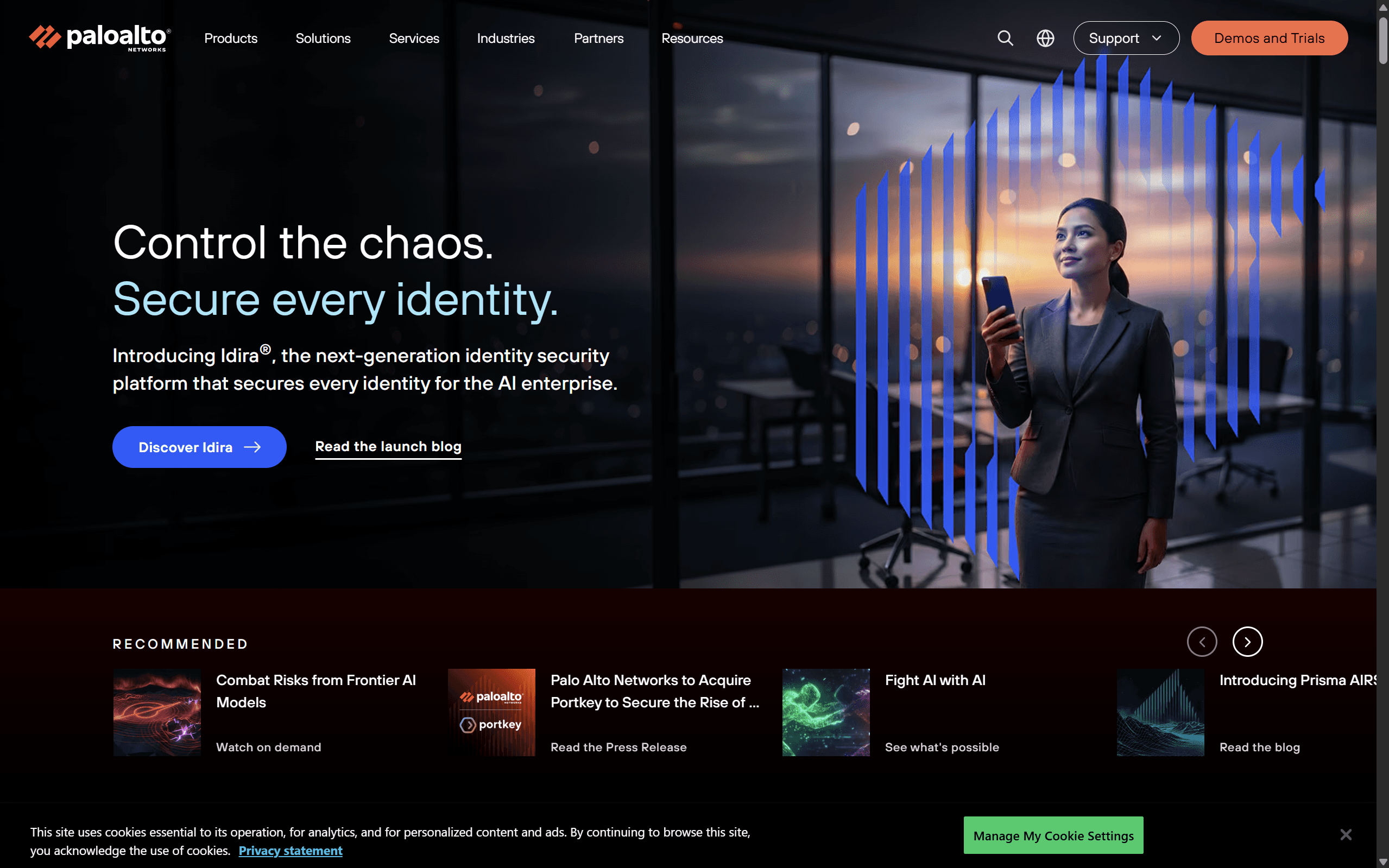
Palo Alto Networks' Prisma AIRS covers several stages of the AI security lifecycle rather than focusing on a single guardrail. It includes AI Runtime Firewall and Runtime API, AI Model Security, automated AI Red Teaming, posture management, and AI Agent Security.
The runtime layer can inspect prompts and model responses for prompt injection, sensitive data leakage, and unsafe outputs. Model Security scans AI models separately for risks such as malicious code, deserialization vulnerabilities, and neural backdoors.
Availability
Prisma AIRS Runtime Security, Model Security and AI Red Teaming are currently shipped capabilities. Palo Alto's documentation also lists AI Gateway as a July 2026 addition, together with newer agent-focused red-teaming capabilities.
Pros
Covers model scanning, runtime security and AI red teaming
Inspects prompts and model responses
Detects risks inside AI model files before deployment
Includes security controls designed specifically for AI agents
Can test agent attacks such as privilege misuse and tool chaining
Cons
It is a broad platform with several separate security components
Runtime Firewall deployments have infrastructure and deployment requirements to consider
When to choose
Choose Palo Alto Networks when you want to secure multiple stages of the AI lifecycle, rather than adding separate products for model scanning, red teaming, and runtime protection.
And if your biggest concern is less about the model file and more about what enters and leaves the application at runtime, the next option takes a more guardrail-focused approach.
2. Check Point: Runtime guardrails for AI applications, with dedicated agent security still in Early Access.
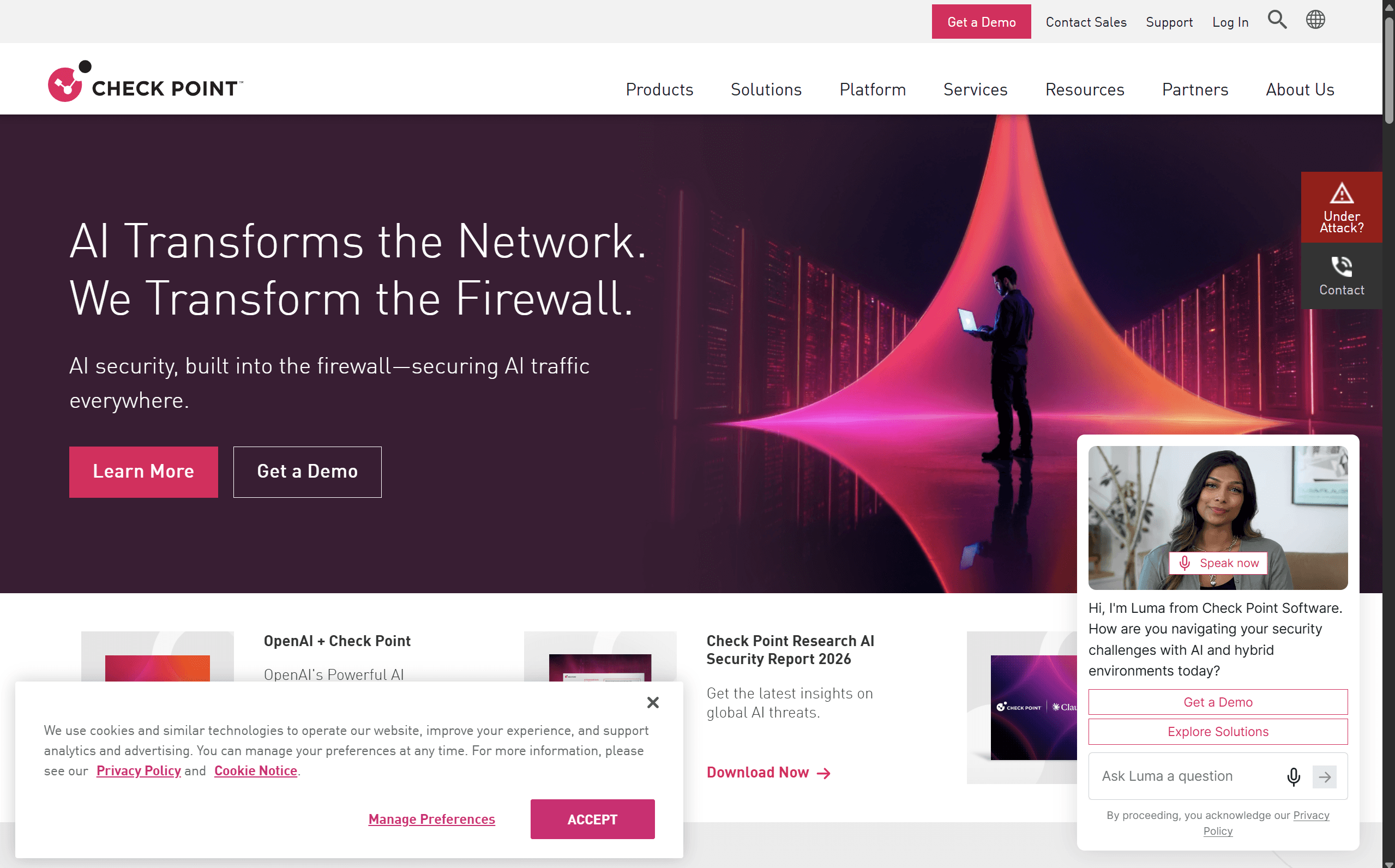
Check Point's AI security stack now incorporates Lakera's technology. Its AI Guardrails layer can inspect AI workflows for prompt attacks, sensitive data leakage, malicious links, unsafe content, and agent behaviour.
Check Point is also building a broader AI Agent Security product that discovers agents, evaluates their configuration, inventories connected tools and MCP servers, and applies runtime policies to prompts, model outputs and tool interactions.
Availability
The important distinction is maturity.
AI Guardrails is available as a standalone runtime layer. The broader Check Point AI Agent Security product remains in Early Access as of August 8, 2026. Its documentation also says native platform runtime integrations remain on the roadmap.
Pros
Runtime prompt defence for AI applications
Sensitive-data leakage controls
Content moderation and malicious-link detection
Agent discovery and risk assessment
Policies that can inspect tool calls and tool responses
Cons
Full AI Agent Security is still Early Access
The mature Guardrails product and newer agent-security layer should not be treated as having the same level of maturity
When to choose
Choose Check Point when runtime guardrails are the immediate problem you need to solve, especially if agent discovery and agent behaviour controls are something you also want to start evaluating.
Palo Alto and Check Point focus heavily on protecting the AI execution path. SentinelOne takes a slightly different route by combining AI application security with an existing security operations platform.
3. SentinelOne: AI red teaming and agent governance alongside an AI-powered SOC platform.
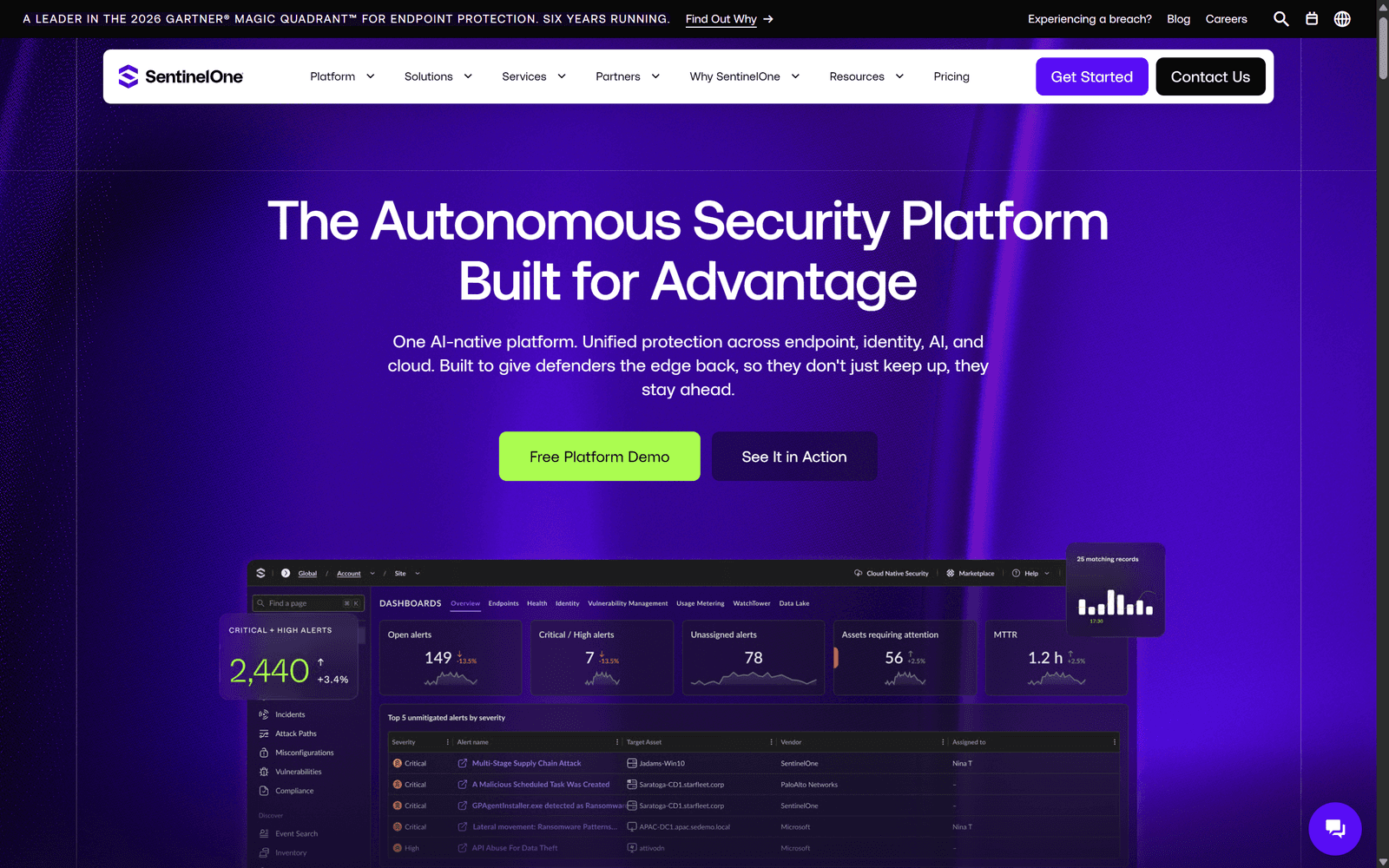
SentinelOne's AI security story now has two sides. Prompt Security focuses on protecting AI usage and AI applications, while Purple AI applies agentic AI to traditional security operations.
Prompt AI Red Teaming is designed to simulate attacks such as prompt injection, jailbreaks, privilege escalation and data poisoning. Prompt AI Agent Security adds discovery and governance for AI agents and MCP servers.
Availability
This is another platform where the maturity labels matter.
Purple AI Auto Investigation is GA and available to Purple AI Analyst customers. Prompt AI Agent Security is Preview. Prompt AI Red Teaming has been announced, but SentinelOne's announcement does not establish it as GA, so I would treat it as an announced capability rather than a generally available one.
Pros
Tests AI applications against AI-specific attacks
Adds agent and MCP discovery to the wider security platform
Combines AI application security with endpoint, cloud, identity and SOC security
Purple AI can perform cross-stack autonomous security investigations
Cons
Prompt AI Agent Security remains Preview
Maturity varies considerably between established Singularity products and the newer Prompt AI capabilities
When to choose
Choose SentinelOne when you want AI application security and to be connected to the same platform that handles endpoint, cloud, and security operations.
These three primarily focus on securing AI itself. The next group works from the other direction.
AI-powered platforms that protect traditional enterprise infrastructure
These platforms already protect enterprise infrastructure and are now extending those controls to AI agents, AI usage and autonomous operations.
4. CrowdStrike: Falcon security extended into enterprise AI usage, AI applications and MCP agents.
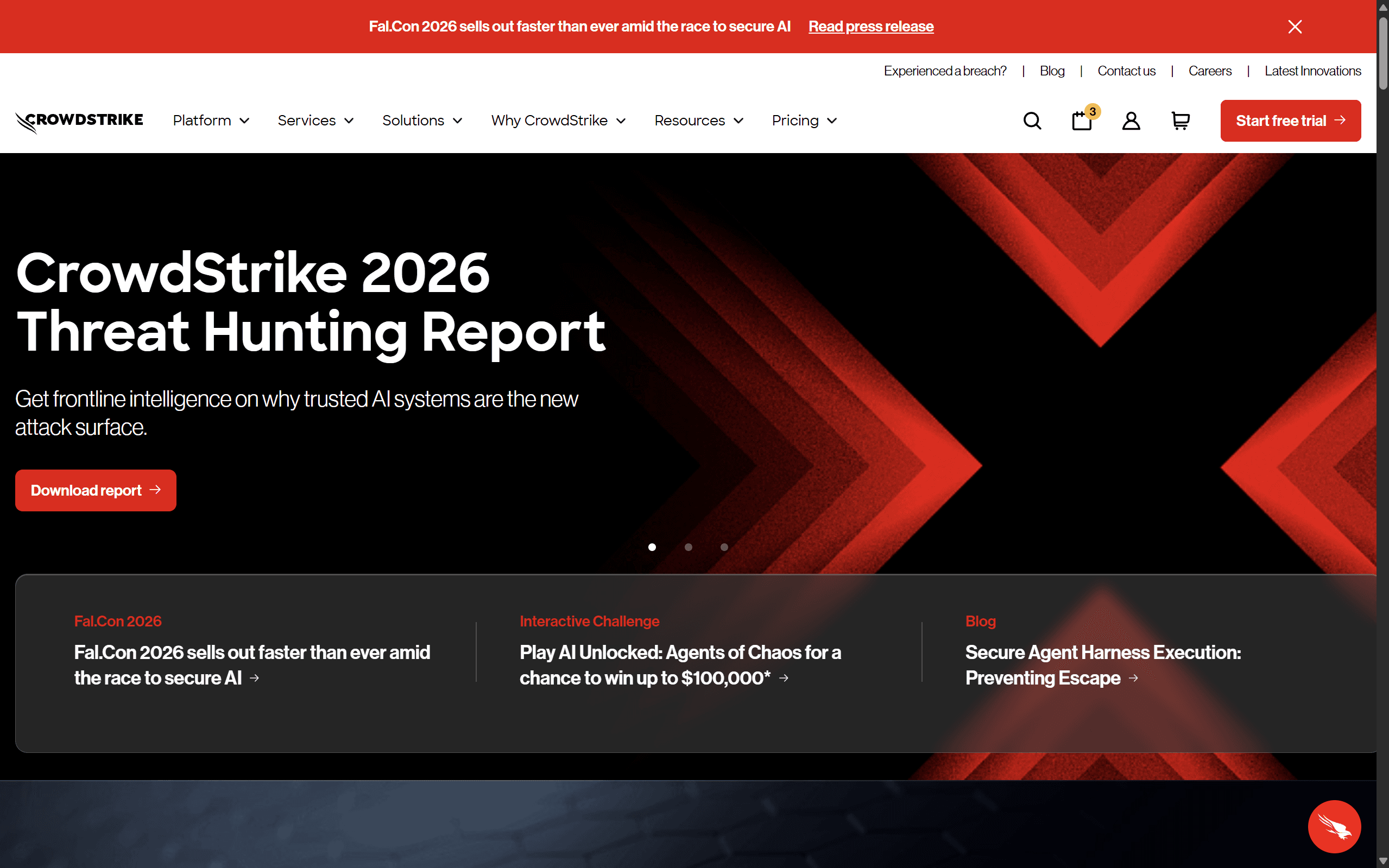
CrowdStrike AIDR instruments AI-powered applications so teams can log AI interactions, detect threats inside prompts and responses, and apply security policies before data reaches the model or user.
It supports application collectors, cloud collectors, gateways and agentic collectors. Its MCP proxy can sit between an MCP client and server to inspect tool traffic, block tool poisoning and stop sensitive values from moving through MCP exchanges.
Availability
AIDR and its documented application, browser, cloud, gateway and MCP collector options are currently present in CrowdStrike's product documentation.
Pros
Extends Falcon into enterprise GenAI and AI applications
Detects prompt injection and jailbreak attempts
Inspects sensitive data in prompts and responses
Protects MCP traffic between agents and tools
Connects AI security events to the wider CrowdStrike platform
Cons
AI-specific capabilities are newer than CrowdStrike's core endpoint and cloud stack
The MCP proxy only sees MCP exchanges routed through it and does not inspect model prompts outside those interactions
When to choose
Choose CrowdStrike when Falcon already protects a large part of your environment, and you want to extend its visibility and policy layer to AI applications and MCP-based agents.
CrowdStrike follows the activity. Zscaler focuses more heavily on controlling the paths agents and users take to applications, data and other services.
5. Zscaler: Zero Trust controls extended to AI applications, endpoints and agent-to-agent communication.

Zscaler's AI Security portfolio now covers AI asset discovery, access to AI applications, AI governance and protection for AI infrastructure.
Its 2026 additions include AI Broker for MCP and A2A communications, and Endpoint AI Security for AI activity within browsers, extensions, and plugins.
Availability
Zscaler currently markets and documents its broader AI Security platform. AI Broker and Endpoint AI Security were introduced as part of its 2026 product expansion, but the available product material does not clearly label every newly announced capability as GA.
So I would describe those features as announced 2026 capabilities unless the specific deployment documentation establishes otherwise.
Pros
AI application and asset visibility
Zero Trust controls for enterprise AI access
MCP and A2A policy direction through AI Broker
Endpoint visibility into AI use in browsers, plugins and extensions
DLP and governance around enterprise AI usage
Cons
Some of its newest agent-focused capabilities are recent 2026 additions
Its core strength is access, traffic and data controls rather than scanning model files for malicious artefacts
When to choose
Choose Zscaler when the main question is not “is this model file safe?” but “which user or agent can reach this application, data source or service, and what are they allowed to do?”
Once agents have access, however, another problem appears: identity.
6. Okta: Identity and least-privilege access for AI agents.
Okta approaches AI security by treating agents as identities rather than treating them as another application.
Okta for AI Agents lets organisations register agents, assign owners, give them scoped access, replace standing credentials with short-lived tokens, govern MCP-server access, review permissions, and deactivate agents when necessary. Core Okta for AI Agents is now generally available.
Availability
Okta for AI Agents is GA.
The GA product includes agent discovery and onboarding, managed least-privilege connections, MCP-server governance, lifecycle management, access reviews, agent deactivation and audit telemetry.
Okta separately lists secure agent-to-agent delegation, Agent Gateway, additional threat detection and human-in-the-loop controls among capabilities it plans to add in the months ahead.
Pros
Gives AI agents individually governed identities
Replaces long-lived credentials with scoped access
Governs access to APIs, applications, secrets and MCP servers
Adds lifecycle controls and access reviews for agents
Records tool calls and authorisation decisions for auditing
Cons
Does not replace prompt injection or model-security products
Several broader multi-agent security controls are still future additions
When to choose
Choose Okta when the biggest question is simple but dangerous: what can this agent access, and for how long?
Identity tells you what an agent can do. Dynatrace is useful when you need to understand what the agent is actually doing once it is running.
7. Dynatrace: Observability for AI agents and the infrastructure underneath them.
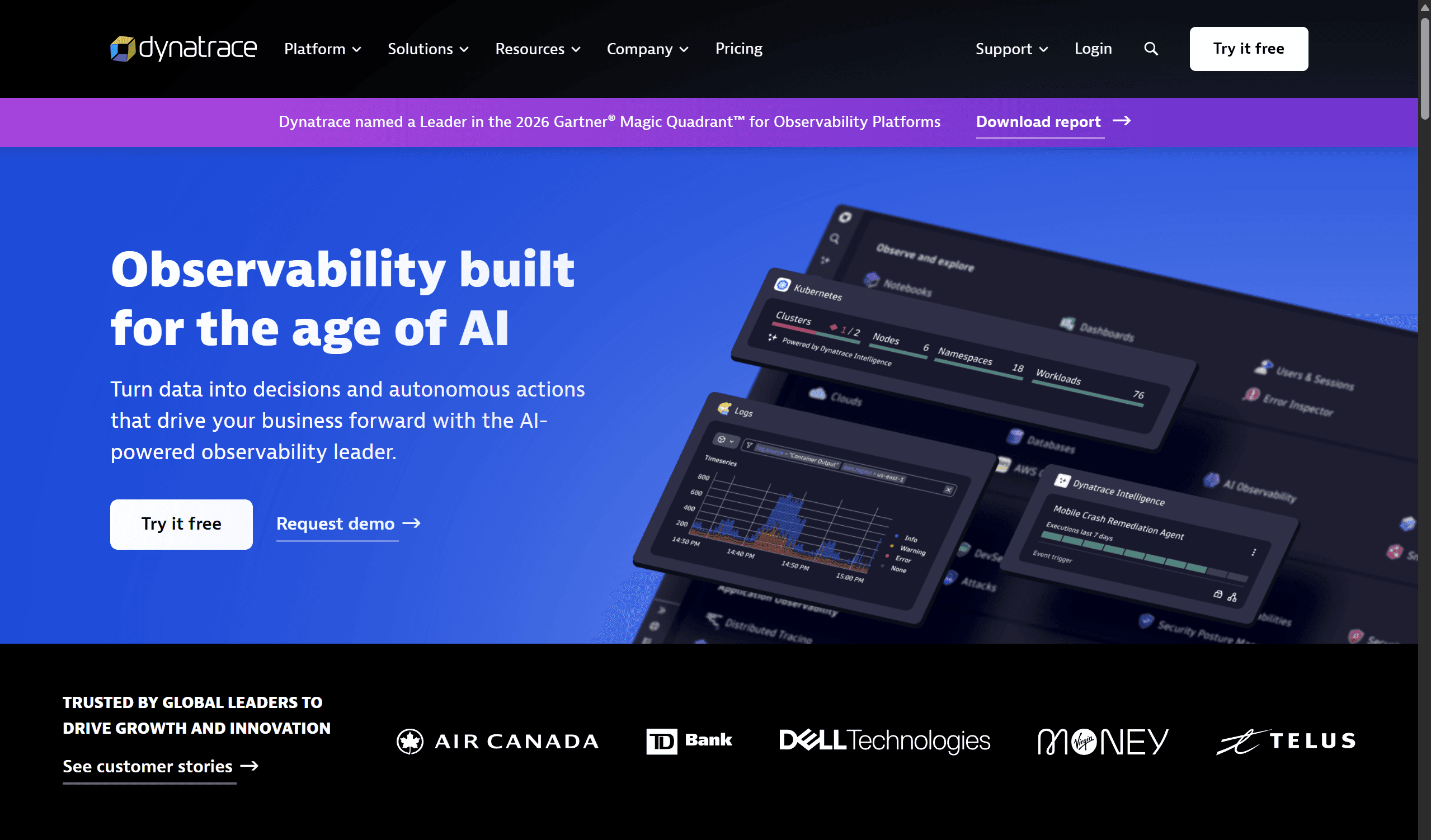
Dynatrace's AI Observability product traces AI applications, LLMs and agents along with the production systems they depend on.
Teams can trace a request across agent handoffs, tool calls, retrieval steps, and model interactions while also tracking latency, failures, and infrastructure dependencies.
Dynatrace is also moving deeper into autonomous operations, including agents for incident triage and remediation while retaining human oversight.
Availability
AI Observability is currently available.
Not every agentic feature is equally mature. For example, Dynatrace Query Agent is currently in Preview, while additional autonomous operations capabilities were announced in July 2026.
Pros
Traces AI agents alongside applications and infrastructure
Shows tool calls, prompts, responses and dependencies
Helps debug complex multi-step AI workflows
Connects agent activity to production telemetry
Adds AI-assisted investigation and operations
Cons
Observability-first rather than a dedicated model-security platform
Some newer autonomous-agent capabilities remain Preview or recently announced
When to choose
Choose Dynatrace when the difficult part is figuring out what an agent did, which systems it touched, where the failure happened and what changed downstream.
The same visibility problem exists on employee devices, especially as AI applications and agents spread outside centrally managed projects.
8. Fortinet: Endpoint and network security with growing controls for enterprise AI usage.
Fortinet is extending its existing endpoint, network and SOC stack into AI governance rather than building a separate AI model-security product.
FortiEndpoint combines endpoint protection, EDR, ZTNA, secure access and data protection. It can also provide visibility into sanctioned and shadow AI usage across endpoints.
Availability
The distinction between maturity here is particularly important.
Core FortiEndpoint endpoint, EDR and access capabilities are available today. However, Fortinet explicitly marks blocking unauthorised AI tools and automatically inspecting sensitive data shared with AI agents and GenAI applications as coming in 2H 2026.
Pros
Combines endpoint protection, EDR, ZTNA and data security
Provides visibility into enterprise AI usage
Can identify sanctioned and shadow AI activity
Fits into Fortinet's wider network and security environment
Cons
Some important AI-governance and AI-focused DLP controls are not available yet
Primarily protects the surrounding enterprise environment rather than the internal security of an AI model
When to choose
Choose Fortinet when endpoints, networks and enterprise data remain the main assets you need to protect, but AI applications and agents are becoming another source of activity inside that environment.
And even with good prevention, something eventually goes wrong. That is where the final platform differs from most on this list.
9. Rubrik
Governance and recovery for actions taken by AI agents.
Rubrik's angle is less about blocking prompt injection and more about what happens when an agent has legitimate access but takes the wrong action.
Rubrik Agent Cloud can govern which MCP resources and tools agents can access, issue scoped short-lived tokens for tool calls, and apply policy controls around agent behaviour. Agent Rewind is designed around recovering from unwanted or destructive agent-driven changes.
Availability
Rubrik Agent Cloud is an active product with documented capabilities for Agent Govern and Agent Rewind. Its current product material does not label those core capabilities as Early Access.
Pros
Governs agent access to tools and enterprise resources
Uses scoped, short-lived credentials
Creates an audit trail around agent actions
Adds a recovery path when autonomous actions go wrong
Cons
Primarily focused on governance, resilience and recovery
Does not replace dedicated model scanning, red teaming or prompt-layer security
When to choose
Choose Rubrik when agents can modify important enterprise systems or data, and you care as much about recovering safely as you do about stopping the action in the first place.
These five primarily focus on securing enterprise systems related to AI. The final platform works at the layer in between, controlling how AI agents access and use those systems.
Composio: Platform that controls AI agent access to enterprise tools and applications
As agents gain access to more tools, APIs, and SaaS applications, another layer is becoming increasingly important: controlling what an agent can connect to and what it is allowed to do once connected.
That is where the Composio MCP Gateway fits.
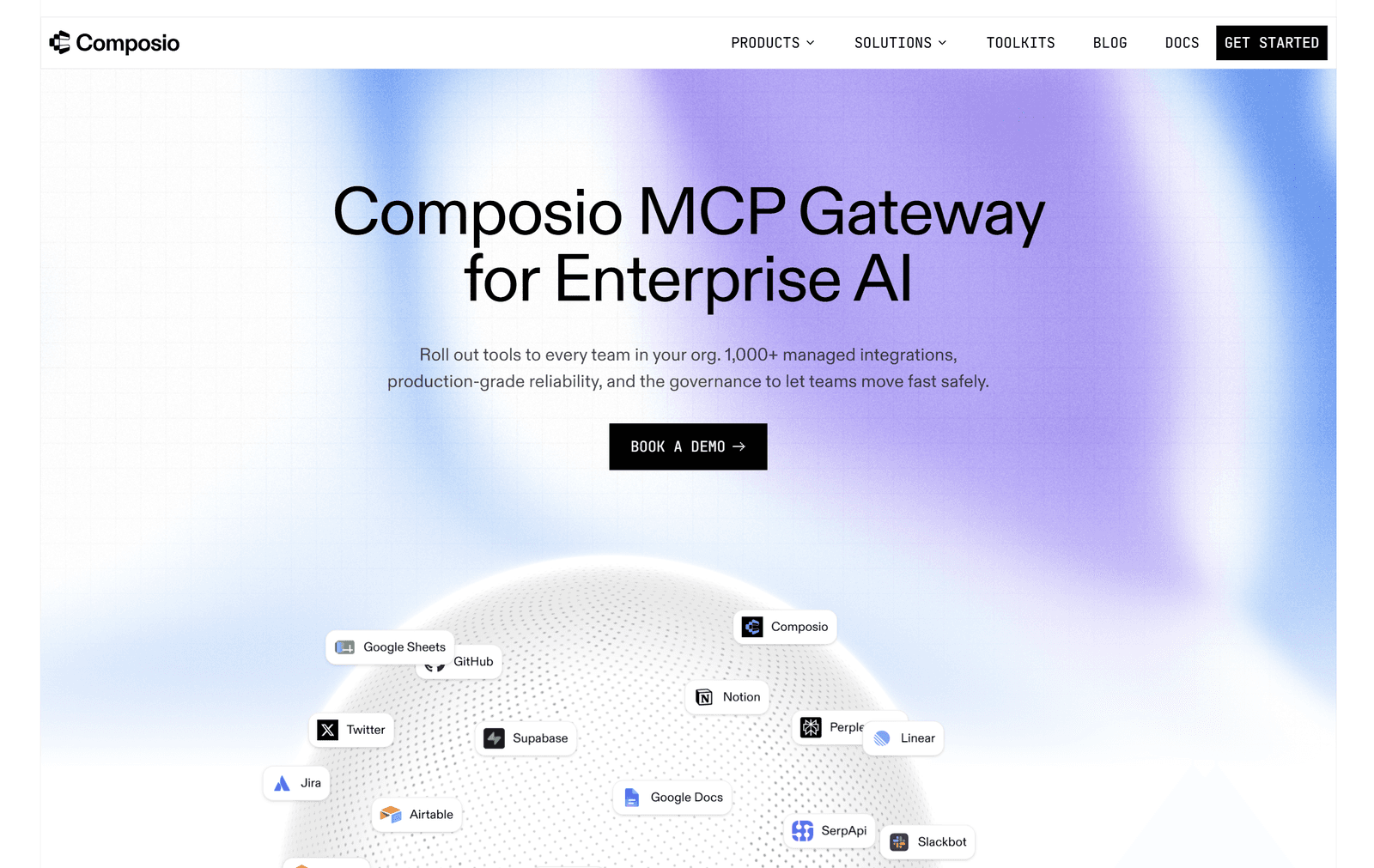
Composio MCP Gateway sits in that layer, controlling which tools agents can access, which actions are allowed, and how users authenticate.
It supports:
team-specific MCP endpoints,
toolkit and action-level restrictions,
SSO,
SCIM provisioning and
audit logs for tool execution.
So rather than replacing prompt security, model scanning or endpoint protection, its role is narrower: limiting what an agent is allowed to touch once it can act.
And that brings us back to the larger point: AI security still starts with deciding what the AI should be allowed to access.
Conclusion
AI security is becoming essential because AI is no longer sitting inside a chat window. It can authenticate, retrieve data, call tools, change files and take actions across the same systems people use every day.
But no platform can compensate for bad security habits.
Giving an agent admin access everywhere, leaving old OAuth connections active, approving every MCP server, reusing credentials, skipping MFA, or allowing destructive actions to run without approval creates problems before any security product is involved.
So start with the boring stuff: use MFA, remove unused access, keep permissions narrow, review OAuth and MCP connections, separate sensitive data, and require approval before consequential actions.
Then choose the platform that protects the part of the stack you actually need.
The best AI security stack still starts with deciding what the AI should be allowed to touch.Sources {toggle="true"}

 Get started