Mem0 CLI for AI Agents

Framework Integration Gradient
Mem0 Logo
CLI Logo
divider

Introduction

CLIs are eating MCPs. The industry is converging on the very same idea. MCPs for all their merit can be token hungry, slow, and unreliable for complex tool chaining. However, coding agents have become incredibly good at working with CLIs, and in fact they are far more comfortable working with CLI tools than MCP.

With Composio's Universal CLI, your coding agents can talk to over 850+ SaaS applications. With Mem0, agents can store meeting notes from today's call, export all project memories as csv, add new user to our team space, and more — all without worrying about authentication.

This guide walks you through Composio Universal CLI and explains how you can connect it with coding agents like Claude Code, Codex, OpenCode, etc, for end-to-end Mem0 automation.

Also integrate Mem0 with

What is Universal CLI and why use it?

The idea behind building the universal CLI is to give agents a single command interface to interact with all your external applications. Here's what you'll get with it:

  • Agent-friendly: Coding agents like Claude Code, Codex, and OpenCode can use CLI tools natively — no MCP setup required.
  • Authentication handled: Connect once via OAuth or API Key, and all CLI commands work with your credentials automatically.
  • Tool discovery: Search, inspect, and execute 20,000+ tools across 850+ apps from one interface.
  • Trigger support: Use triggers to listen for events across your apps, powered by real-time webhooks or polling under the hood.
  • Type generation: Generate typed schemas for autocomplete and type safety in your projects.

Prerequisites

Install the Composio CLI, authenticate, and initialize your project:

bash
# Install the Composio CLI
curl -fsSL https://composio.dev/install | bash

# Authenticate with Composio
composio login

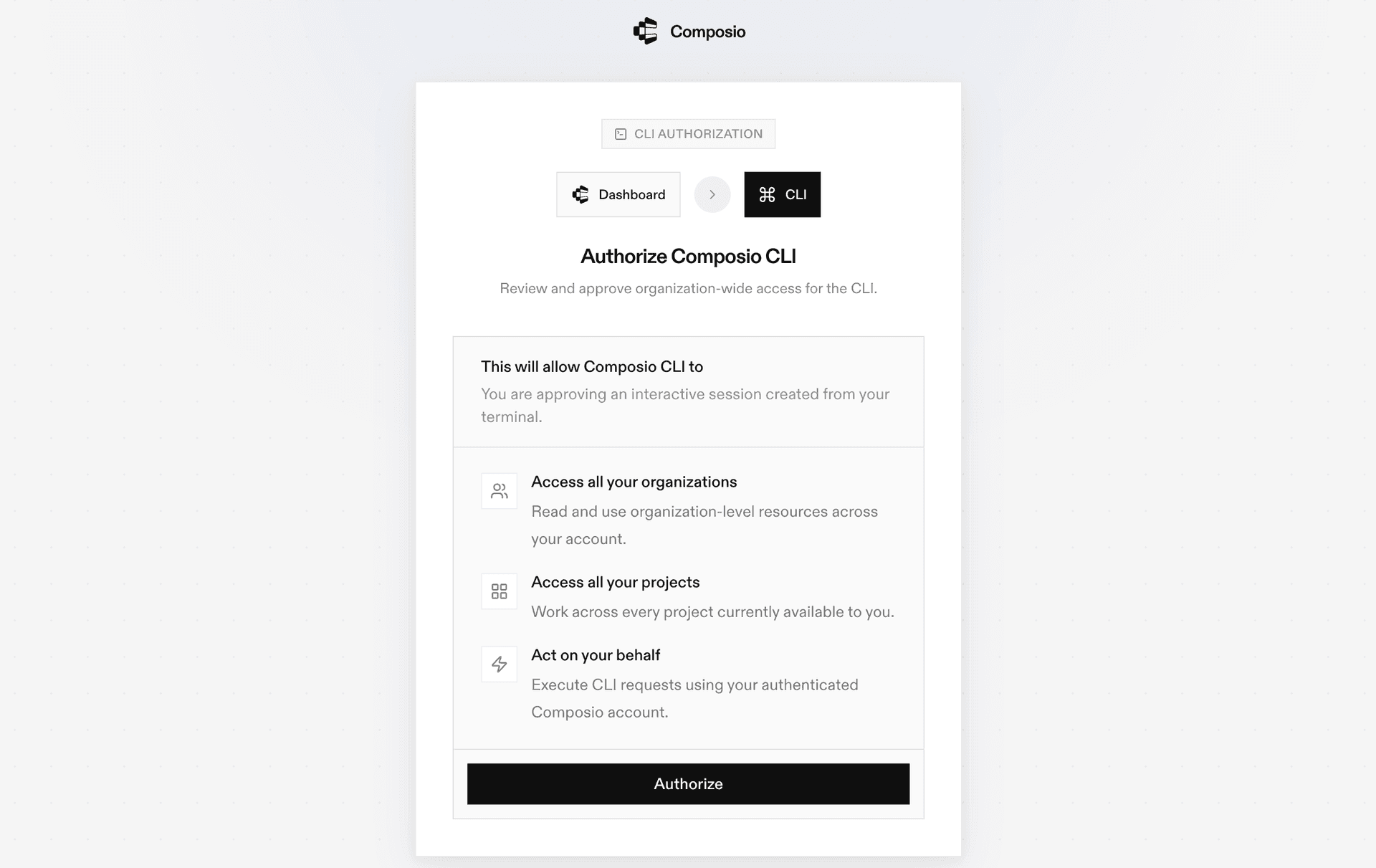
During login you'll be redirected to sign in page, finish the complete flow and you're all set.

Composio CLI authentication flow

Connecting Mem0 to Coding Agents via Universal CLI

Once it is installed, it's essentially done. Claude Code, Codex, OpenCode, OpenClaw, or any other agent will be able to access the CLI. A few steps to give agents access to your apps.

  1. Launch your Coding Agent — Claude Code, Codex, OpenCode, anything you prefer.
  2. Prompt it to "Authenticate with Mem0"
  3. Complete the authentication and authorization flow and your Mem0 integration is all set.
  4. Start asking anything you want.

Supported Tools & Triggers

Tools
Add member to projectAdds an existing user to a project (identified by `project id` within organization `org id`), assigning a valid system role.
Add new memory recordsStores new memory records from a list of messages, optionally inferring structured content; requires association via `agent id`, `user id`, `app id`, or `run id`.
Add organization memberAdds a new member, who must be a registered user, to an organization, assigning them a specific role.
Create a new agentCreates a new agent with a unique `agent id` and an optional `name`; additional metadata may be assigned by the system.
Create a new agent runCreates a new agent run in the mem0.
Create a new applicationCreates a new application, allowing metadata to be passed in the request body (not an explicit field in this action's request model); ensure `app id` is unique to avoid potential errors or unintended updates.
Create a new organization entryCreates a new organization entry using the provided name and returns its details.
Create a new userCreates a new user with the specified unique `user id` and supports associating `metadata` (not part of the request schema fields).
Create an export job with schemaInitiates an asynchronous job to export memories, structured by a schema provided in the request body and allowing optional filters.
Create memory entryLists/searches existing memory entries with filtering and pagination; critically, this action retrieves memories and does *not* create new ones, despite its name.
Create projectCreates a new project with a given name within an organization that must already exist.
Delete an organizationPermanently deletes an existing organization identified by its unique id.
Delete memory by idPermanently deletes a specific memory by its unique id; ensure the `memory id` exists as this operation is irreversible.
Delete entity by type and idCall to permanently and irreversibly hard-delete an existing entity (user, agent, app, or run) and all its associated data, using its type and id.
Delete memoriesDeletes memories matching specified filter criteria; omitting all filters may result in deleting all memories.
Delete memory batch with uuidsDeletes a batch of up to 1000 existing memories, identified by their uuids, in a single api call.
Delete projectPermanently deletes a specific project and all its associated data from an organization; this action cannot be undone and requires the project to exist within the specified organization.
Delete project memberRemoves an existing member, specified by username, from a project, immediately revoking their project-specific access; the user is not removed from the organization.
Export data based on filtersRetrieves memory export data, optionally filtered by various identifiers (e.
List organizationsRetrieves a summary list of organizations for administrative oversight; returns summary data (names, ids), not exhaustive details, despite 'detailed' in the name.
Fetch details of a specific organizationFetches comprehensive details for an organization using its `org id`; the `org id` must be valid and for an existing organization.
Get list of entity filtersRetrieves predefined filter definitions for entities (e.
Get entity by idFetches detailed information for an existing entity (user, agent, app, or run) identified by its type and unique id.
Get organization membersFetches a list of members for a specified, existing organization.
Get project detailsFetches comprehensive details for a specified project within an organization.
Get project membersRetrieves all members for a specified project within an organization.
Get projectsRetrieves all projects for a given organization `org id` to which the caller has access.
Get user memory statsRetrieves a summary of the authenticated user's memory activity, including total memories created, search events, and add events.
List entitiesRetrieves a list of entities, optionally filtered by organization or project (prefer `org id`/`project id` over deprecated `org name`/`project name`), noting results may be summaries and subject to limits.
Perform semantic search on memoriesSearches memories semantically using a natural language query (required if `only metadata based search` is false) and/or metadata filters.
Remove a member from the organizationRemoves a member, specified by their username, from an existing organization of which they are currently a member.
Retrieve all events for the currently logged in userRetrieves a paginated list of events for the authenticated user, filterable and paginable via url query parameters.
Retrieve entity-specific memoriesRetrieves all memories (e.
Retrieve list of memory eventsRetrieves a chronological list of all memory events (e.
Retrieve memory by idRetrieves a complete memory entry by its unique identifier; `memory id` must be valid and for an existing memory.
Retrieve memory history by idRetrieves the complete version history for an existing memory, using its unique `memory id`, to inspect its evolution or audit changes.
Retrieve memory listRetrieves a list of memories, supporting pagination and diverse filtering (e.
Search memories with filtersSemantically searches memories using a natural language query and mandatory structured filters, offering options to rerank results and select specific fields; any provided `org id` or `project id` must reference a valid existing entity.
Update memory batch with uuidUpdates text for up to 1000 memories in a single batch, using their uuids.
Update memory text contentUpdates the text content of an existing memory, identified by its `memory id`.
Update organization member roleUpdates the role of an existing member to a new valid role within an existing organization.
Update projectUpdates a project by `project id` within an `org id`, modifying only provided fields (name, description, custom instructions, custom categories); list fields are fully replaced (cleared by `[]`), other omitted/null fields remain unchanged.
Update project member roleUpdates the role of a specific member within a designated project, ensuring the new role is valid and recognized by the system.

Universal CLI Commands for Mem0

You can also manually execute CLI commands to interact with your Mem0.

Connect your Mem0 account

Link your Mem0 account and verify the connection:

bash
# Connect your Mem0 account (opens OAuth flow)
composio connected-accounts link mem0

# Verify the connection
composio connected-accounts list --toolkits mem0

Discover Mem0 tools

Search and inspect available Mem0 tools:

bash
# List all available Mem0 tools
composio tools list --toolkit mem0

# Search for Mem0 tools by action
composio tools search "mem0"

# Inspect a tool's input schema
composio tools info MEM0_ADD_MEMBER_TO_PROJECT

Common Mem0 Actions

Add member to projectAdds an existing user to a project (identified by `project id` within organization `org id`), assigning a valid system role

bash
composio tools execute MEM0_ADD_MEMBER_TO_PROJECT \
  --role "Admin" \
  --org_id "<string>" \
  --username "john.doe" \
  --project_id "<string>"

Add new memory recordsStores new memory records from a list of messages, optionally inferring structured content; requires association via `agent id`, `user id`, `app id`, or `run id`

bash
composio tools execute MEM0_ADD_NEW_MEMORY_RECORDS \
  --messages "<array>"

Add organization memberAdds a new member, who must be a registered user, to an organization, assigning them a specific role

bash
composio tools execute MEM0_ADD_ORGANIZATION_MEMBER \
  --role "OWNER" \
  --email "user_alpha_1@gmail.com" \
  --org_id "org_123abc456def"

Create a new agentCreates a new agent with a unique `agent id` and an optional `name`; additional metadata may be assigned by the system

bash
composio tools execute MEM0_CREATE_A_NEW_AGENT \
  --agent_id "personal-assistant-v1"

Generate Type Definitions

Generate typed schemas for Mem0 tools to get autocomplete and type safety in your project:

bash
# Auto-detect language
composio generate --toolkits mem0

# TypeScript
composio ts generate --toolkits mem0

# Python
composio py generate --toolkits mem0

Tips & Tricks

  • Always inspect a tool's input schema before executing: composio tools info <TOOL_NAME>
  • Pipe output with jq for better readability: composio tools execute TOOL_NAME -d '{}' | jq
  • Set COMPOSIO_API_KEY as an environment variable for CI/CD pipelines
  • Use composio dev logs tools to inspect execution logs and debug issues

Next Steps

  • Try asking your coding agent to perform various Mem0 operations
  • Explore cross-app workflows by connecting more toolkits
  • Set up triggers for real-time automation
  • Use composio generate for typed schemas in your projects

How to build Mem0 MCP Agent with another framework

FAQ

What is the Composio Universal CLI?

The Composio Universal CLI is a single command-line interface that lets coding agents and developers interact with 850+ SaaS applications. It handles authentication, tool discovery, action execution, and trigger setup — all from the terminal, without needing to configure MCP servers.

Which coding agents work with the Composio CLI?

Any coding agent that can run shell commands works with the Composio CLI — including Claude Code, Codex, OpenCode, OpenClaw, and others. Once the CLI is installed, agents automatically discover and use the composio commands to interact with Mem0 and other connected apps.

How is the CLI different from using an MCP server for Mem0?

MCP servers require configuration and can be token-heavy for complex workflows. The CLI gives agents a direct, lightweight interface — no server setup needed. Agents simply call composio commands like any other shell tool. It's faster to set up, more reliable for multi-step tool chaining, and works natively with how coding agents already operate.

How safe is my Mem0 data when using the Composio CLI?

All sensitive data such as tokens, keys, and configuration is fully encrypted at rest and in transit. Composio is SOC 2 Type 2 compliant and follows strict security practices so your Mem0 data and credentials are handled as safely as possible. You can also bring your own OAuth credentials for full control.

Used by agents from

Context
Letta
glean
HubSpot
Agent.ai
Altera
DataStax
Entelligence
Rolai
Context
Letta
glean
HubSpot
Agent.ai
Altera
DataStax
Entelligence
Rolai
Context
Letta
glean
HubSpot
Agent.ai
Altera
DataStax
Entelligence
Rolai

Never worry about agent reliability

We handle tool reliability, observability, and security so you never have to second-guess an agent action.