How to integrate Google Maps MCP with Grok Build

Connect Grok Build to Google Maps MCP. Find walking directions from your hotel to conference center, show top-rated coffee shops near your location, and more from your terminal, with authentication handled for you.

Google Maps logoGoogle Maps
Oauth2Api Key

Google Maps is a leading mapping and geolocation service for finding locations, routes, and businesses worldwide. It helps users access real-time navigation, geocoding, and mapping data for seamless location-based experiences.

19 Tools

How to integrate Google Maps MCP with Grok Build

Grok Build is xAI's terminal coding agent. It runs on Grok 4.5, plans its work before it acts, and can run multiple sub-agents in parallel. It also reads Claude Code's MCP configuration, so any server you already have in a .mcp.json is picked up with no changes.

In this guide, I will show you how to connect your Google Maps account to Grok Build through Composio, so it can find walking directions from your hotel to conference center, show top-rated coffee shops near your location, embed a map of downtown restaurants on your website, and more without leaving the terminal. Composio holds the OAuth tokens for you, and Grok Build only calls the tools you approve.
Also integrate Google Maps with

Why use Composio over a standalone MCP server?

  • Read and write access. Composio's Google Maps integration lets Grok Build take real actions like creating drafts, sending updates, and labeling records, not just reading data.
  • 1,000+ SaaS toolkits out of the box. One endpoint gives you a full catalog of pre-built connectors, from Gmail and Slack to Notion, Linear, and Salesforce.
  • One MCP server for every app. Wire up a single Composio server instead of maintaining a separate MCP entry for each app.
  • Smart, context-aware tool loading. Grok Build caps how many tools it holds in a single request. Composio loads only the tools a task needs, so you do not spend that budget on tools you are not using.
  • Cross-app automation. Chain actions across apps in one run. Pull a thread, summarize it in Notion, and post the highlights to Slack from a single prompt.

Prerequisites

  • Grok Build installed and signed in. Install with curl -fsSL https://x.ai/cli/install.sh | bash on macOS or Linux, or irm https://x.ai/cli/install.ps1 | iex on Windows PowerShell. On first launch Grok opens a browser to authenticate; for headless or CI use, set an XAI_API_KEY environment variable instead (create the key at console.x.ai).
  • Access to the Google Maps account you want to connect.
  • The Composio MCP endpoint. Composio's server is remote and hosted, so there is nothing to run locally and no tunnel to set up.

Step-by-step: Connect Google Maps to Grok Build

1. Install and verify Grok Build

Install the CLI, then restart your shell so the grok binary lands on your PATH:

bash
curl -fsSL https://x.ai/cli/install.sh | bash
which grok

On Windows, install with PowerShell instead: irm https://x.ai/cli/install.ps1 | iex. If which grok returns a path, you are set. Grok Build runs on Grok 4.5 by default; you can switch models inside the session with /model <name>.

2. Add the Composio server

Add Composio as a remote HTTP MCP server with the grok mcp add command:

bash
grok mcp add --transport http composio https://connect.composio.dev/mcp

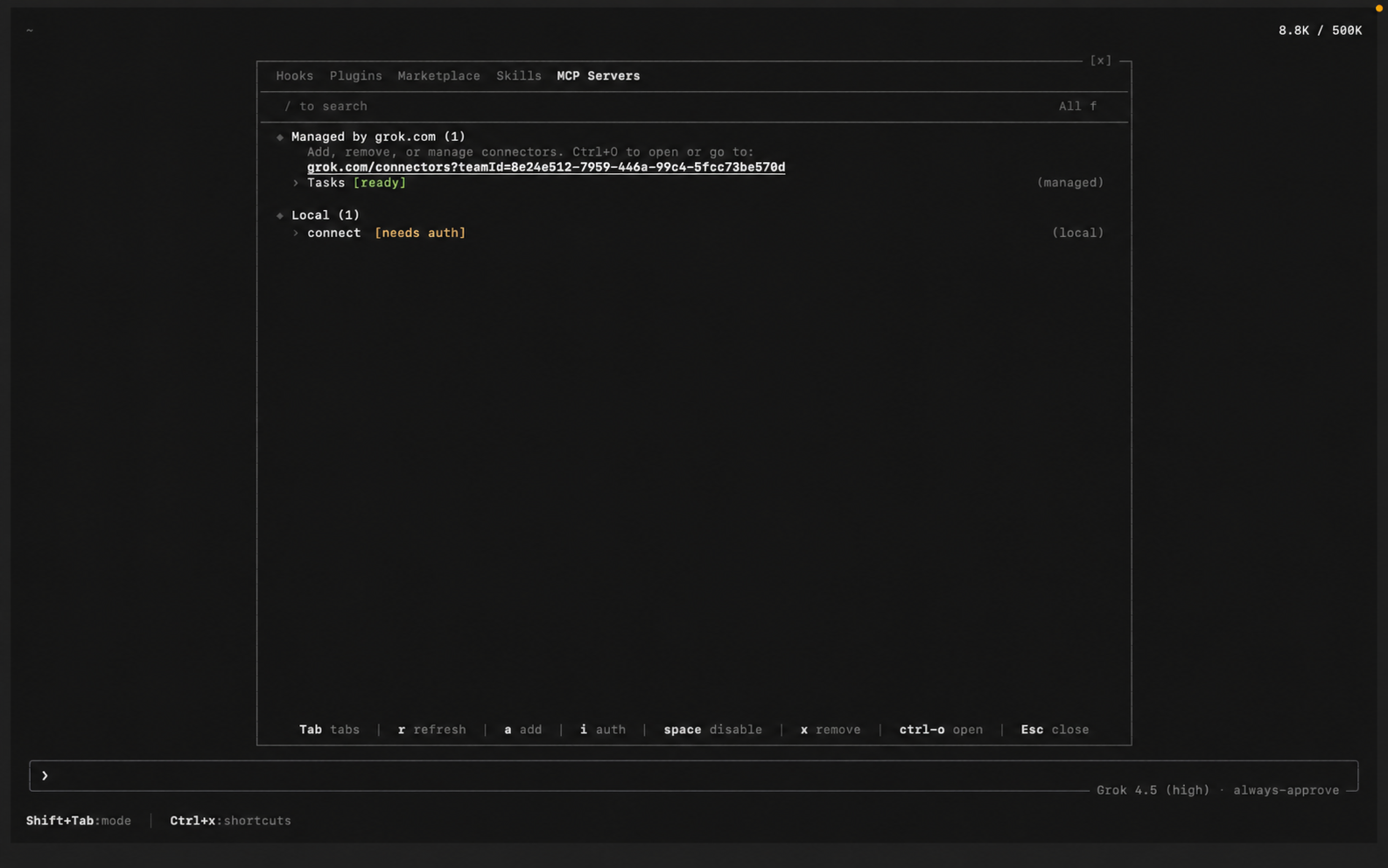
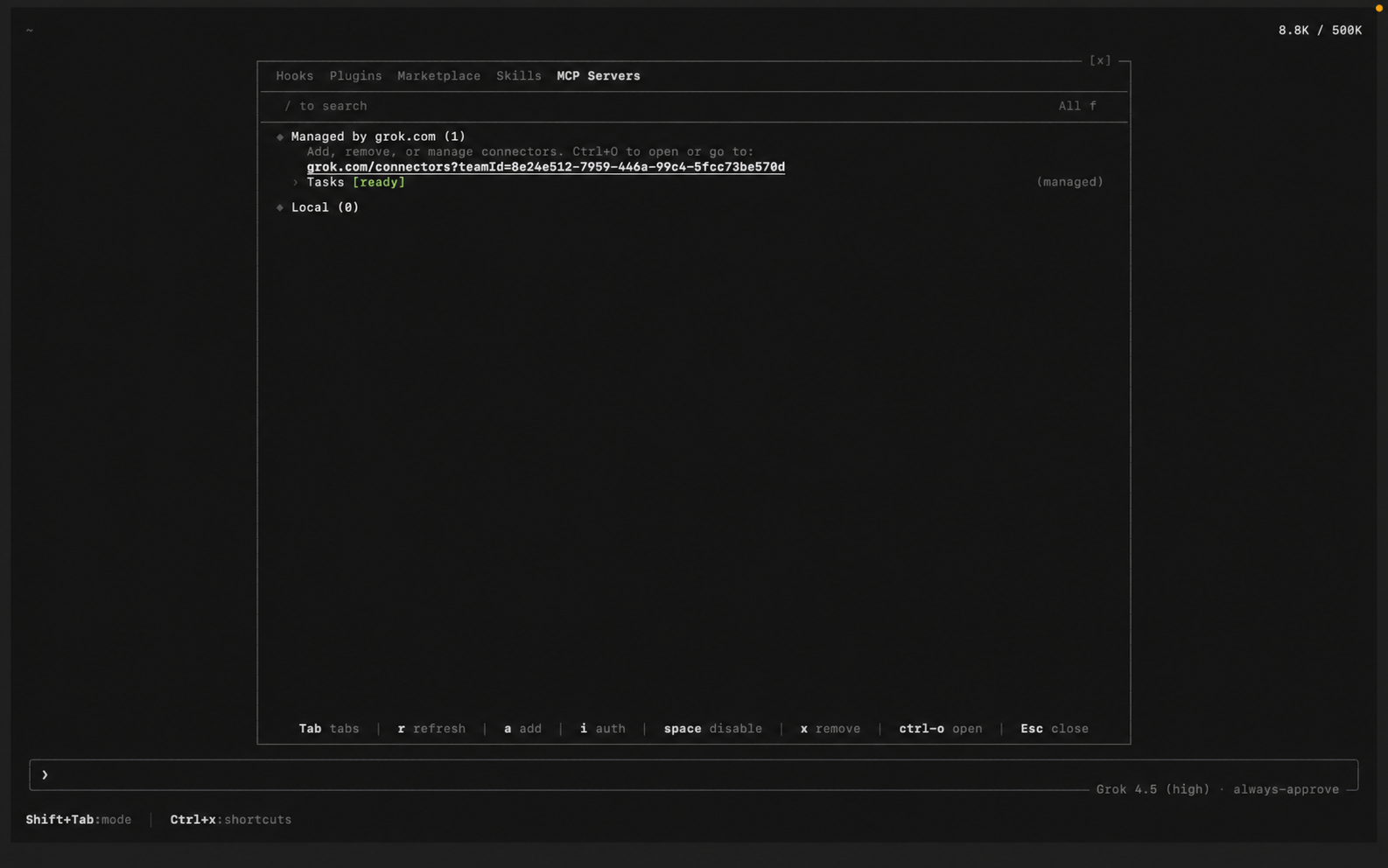
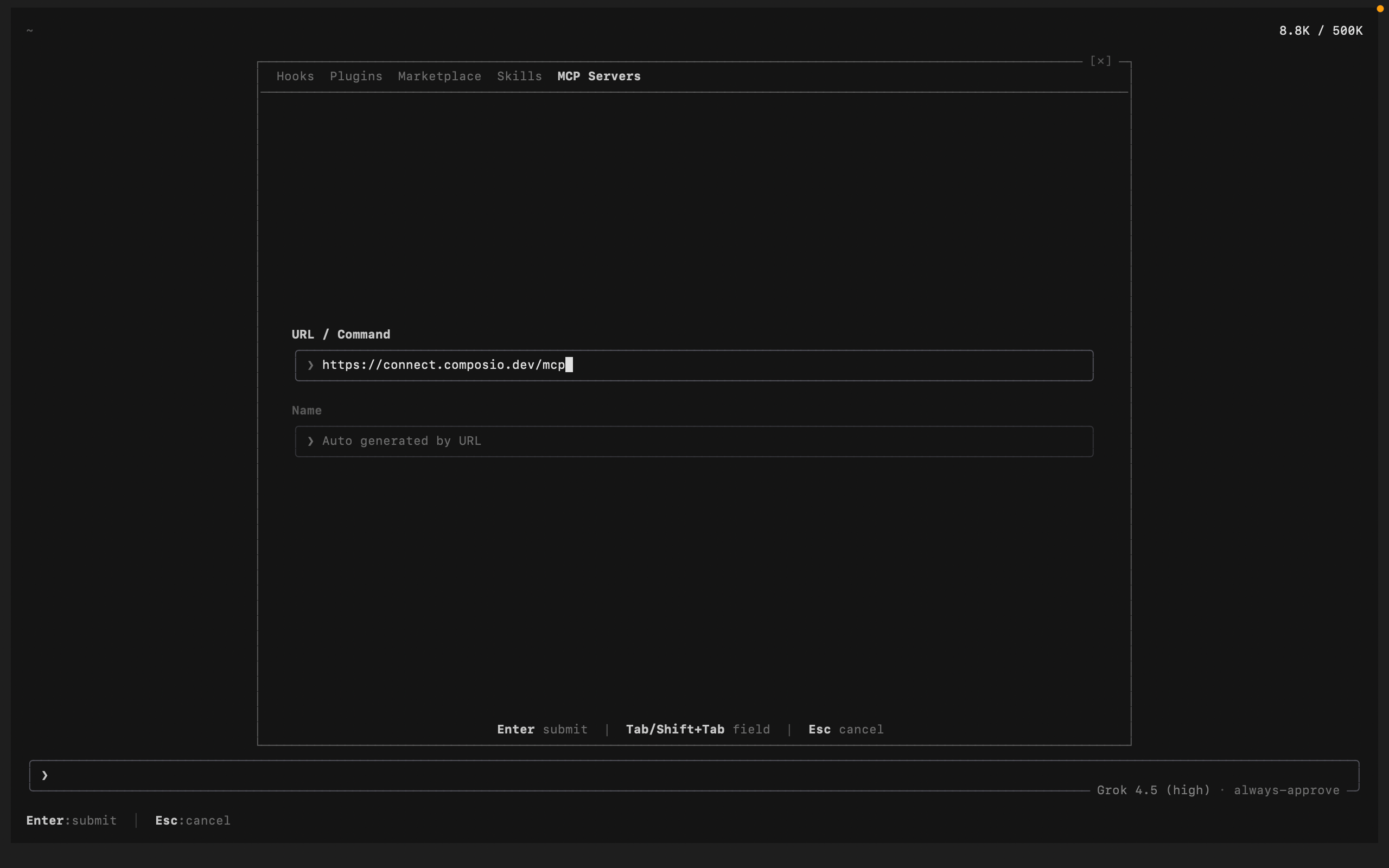
You can also add and manage servers from inside a session. Run /mcps to open the extensions modal on the MCP tab, then add a new server and paste the Composio URL. Added this way, Grok auto-detects the name from the URL and lists the server as connect:

bash
https://connect.composio.dev/mcp
Grok Build /mcps extensions modal listing MCP servers Grok Build adding the Composio MCP server with its URL

Grok also reads Claude Code-style config, so an entry in ~/.grok/config.toml or a project .mcp.json works the same way.

3. Authenticate

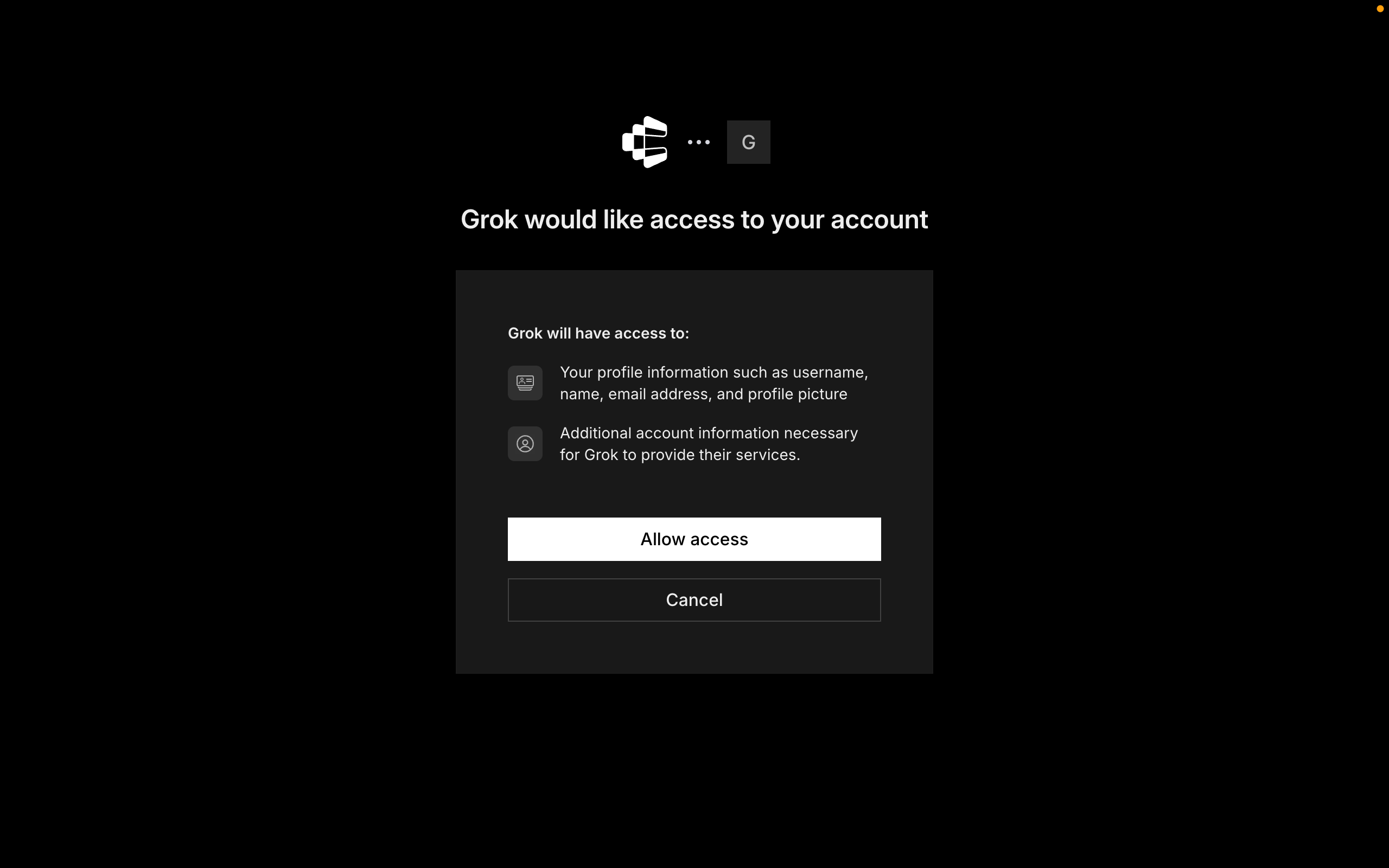
Composio uses OAuth. In the /mcps modal, select the Composio server and press i to authenticate (Grok also triggers this browser flow automatically the first time it uses a Composio tool). Click Allow to authorize access. Grok stores the tokens under ~/.grok/mcp_credentials.json, and /mcps shows Composio as connected.

Grok Build prompting to authenticate the Composio MCP server Composio authorization screen with the Allow button for Grok Build

4. Start building

Ask Grok to work with your Google Maps account through Composio. On the first Google Maps action, Composio prompts you to connect the account through OAuth. Approve the scopes once, and Composio handles token refresh from there.

What you can do after connecting Google Maps

  • Find walking directions from your hotel to conference center
  • Show top-rated coffee shops near your location
  • Embed a map of downtown restaurants on your website
  • Calculate travel time from office to airport during rush hour

Security + privacy notes (important)

  • Use least-privilege access. Grant only the Google Maps scopes you actually need.
  • Review OAuth scopes before approving. Check that the requested scopes match what you expect Composio and Grok Build to do.
  • Keep write actions human-reviewed. Grok Build proposes a plan before it acts. Leave that approval step on for actions like sending messages or editing records.
  • Keep secrets out of version control. Your XAI_API_KEY and any tokens should never be committed. Use environment variables or a secrets manager.
TOOLS

Supported Tools

Every Google Maps action and event your agent gets out of the box.

Autocomplete Place Predictions

Returns place and query predictions for text input.

Compute Route Matrix

Calculates travel distance and duration matrix between multiple origins and destinations using the modern Routes API; supports OAuth2 authentication and various travel modes.

Geocode Address With Query

Tool to map addresses to geographic coordinates with query parameter.

Geocode Destinations

Tool to perform destination lookup and return detailed destination information including primary place, containing places, sub-destinations, landmarks, entrances, and navigation points.

Reverse Geocode Location

Tool to convert geographic coordinates (latitude and longitude) to human-readable addresses using reverse geocoding.

Geocode Place by ID

Tool to perform geocode lookup using a place identifier to retrieve address and coordinates.

Geocoding API

Convert addresses into geographic coordinates (latitude and longitude) and vice versa (reverse geocoding), or get an address for a Place ID.

Geolocate Device

Tool to determine location based on cell towers and WiFi access points.

Get 2D Map Tile

Tool to retrieve a 2D map tile image at specified coordinates for building custom map visualizations.

Get 3D Tiles Root

Tool to retrieve the 3D Tiles tileset root configuration for photorealistic 3D map rendering.

Get Place Details

Retrieves comprehensive details for a place using its resource name (places/{place_id} format).

Get Route

Calculates one or more routes between two specified locations.

Lookup Aerial Video

Tool to look up an aerial view video by address or video ID.

Embed Google Map

Tool to generate an embeddable Google Map URL and HTML iframe code.

Nearby search

Searches for places (e.

Get Place Photo

Retrieves high quality photographic content from the Google Maps Places database.

Render Aerial Video

Starts rendering an aerial view video for a US postal address.

Text Search

Searches for places on Google Maps using a textual query (e.

Create Tiles Session

Tool to create a session token required for accessing 2D Tiles and Street View imagery.

FAQ

Frequently asked questions

A standalone Google Maps MCP server gives Grok Build a fixed set of Google Maps tools tied to that one server. The Composio Tool Router lets Grok Build load tools from Google Maps and many other apps on demand, based on the task, all through a single endpoint.

Yes. Grok Build ships with native MCP support. Add a server with the grok mcp add command, from the in-session /mcps modal, or by editing ~/.grok/config.toml. It also reads Claude Code-style .mcp.json files, so Grok Build discovers the tools automatically.

Yes. Grok Build has zero-migration compatibility with Claude Code's configuration, so the same Composio server entry works in both without edits.

Tokens, keys, and configuration are encrypted at rest and in transit. Composio is SOC 2 Type 2 compliant, so your Google Maps data and credentials are handled to that standard.

Start with Google Maps.It takes 30 seconds.

Managed auth, hosted MCP servers, and every Google Maps tool your agent needs.Free to start.

Start building