How to integrate Firecrawl MCP with Pi

Connect Pi to Firecrawl MCP. Extract all product prices from this e-commerce site, crawl competitor blogs for latest article summaries, and more using natural language, with authentication handled for you.

Firecrawl logoFirecrawl
Api Key

Firecrawl automates large-scale web crawling and data extraction. It helps organizations efficiently gather, index, and analyze content from online sources.

29 Tools

Introduction

Pi is a minimal, self-extensible coding agent that lives in your terminal — one agent loop over Claude, GPT-5, Gemini, Grok, DeepSeek, and 20+ other providers, with maximum extension surface and minimum product opinion. Its core ships four tools (read, write, edit, bash) and self-extends at runtime through skills, extensions, and packages.

This guide explains the easiest and most robust way to connect your Firecrawl account to Pi. You can do this through either Composio Connect CLI or Composio Connect MCP. Because Pi already runs shell commands as first-class tools and ships no built-in MCP, the CLI is the recommended path — it's faster to set up, needs no server config, and chains multi-step tasks more reliably. The MCP path is also fully supported through Pi's official pi-mcp-adapter extension.
Also integrate Firecrawl with

What is Composio Connect?

Composio Connect is a consumer offering that lets anyone plug 1,000+ applications directly into their agent harness — including Pi. It can:

  • Search and load tools from relevant toolkits on-demand, reducing context usage.
  • Chain multiple tools to accomplish complex workflows via a remote workbench, without excessive back-and-forth with the LLM.
  • Manage app authentication end-to-end with zero manual overhead.

Connect Firecrawl to Pi with Composio

Prerequisites: Install Pi

Pi needs Node.js 18+ (Node 22 recommended). Install the agent globally with npm:

bash
npm install -g --ignore-scripts @earendil-works/pi-coding-agent

On Linux or macOS you can use the installer script instead:

bash
curl -fsSL https://pi.dev/install.sh | sh

Then run pi in any project directory and authenticate your model provider — use /login inside Pi for subscription providers (Claude Pro/Max, ChatGPT, GitHub Copilot), or set an API key such as ANTHROPIC_API_KEY before starting. Confirm it's working:

bash
pi --version

Full first-run details are in the Pi Quickstart.

Option 1: Composio CLI (recommended)

Pi runs shell commands as first-class tools, so the Composio Universal CLI is the most natural fit — no MCP server to configure and reliable multi-step tool chaining. Install and authenticate:

bash
# Install the Composio CLI
curl -fsSL https://composio.dev/install | bash

# Log in to Composio
composio login

Connect to Firecrawl

Ask Pi to connect to Firecrawl, or simply request any Firecrawl-related task. Under the hood Pi calls Composio commands like any other shell tool:

bash
composio search "what can I do with Firecrawl?"
composio link firecrawl

On the first Firecrawl call, composio link firecrawl opens an OAuth prompt so you can authorize access. After that, every Firecrawl command works with your stored credentials automatically — just talk to Pi and it will search, execute, and chain Firecrawl tools as needed.

Option 2: Composio MCP

Pi's core intentionally ships no built-in MCP, but the official pi-mcp-adapter extension adds full MCP support — exposing every server through a single lightweight proxy tool (~200 tokens) instead of loading hundreds of tool definitions into context.

1. Install the MCP adapter extension

bash
pi install npm:pi-mcp-adapter

Restart Pi after installation.

2. Add the Composio MCP server

Create (or edit) a .mcp.json file in your project root, or ~/.config/mcp/mcp.json for a user-global setup:

bash
{
  "mcpServers": {
    "composio": {
      "url": "https://connect.composio.dev/mcp"
    }
  }
}

The adapter connects lazily by default — the server won't start until Pi actually calls one of its tools, and cached metadata keeps search and describe working without a live connection.

3. Authenticate

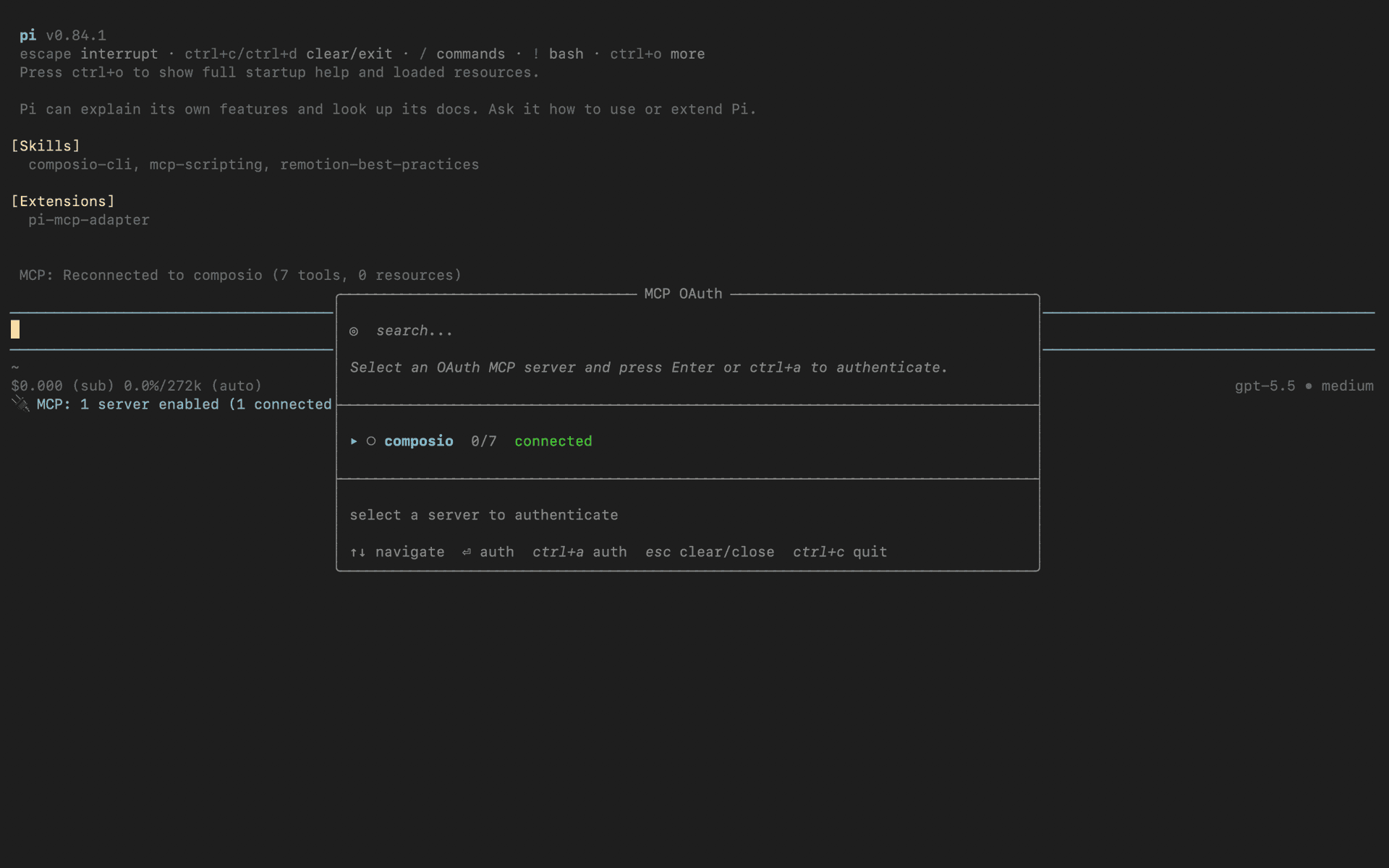
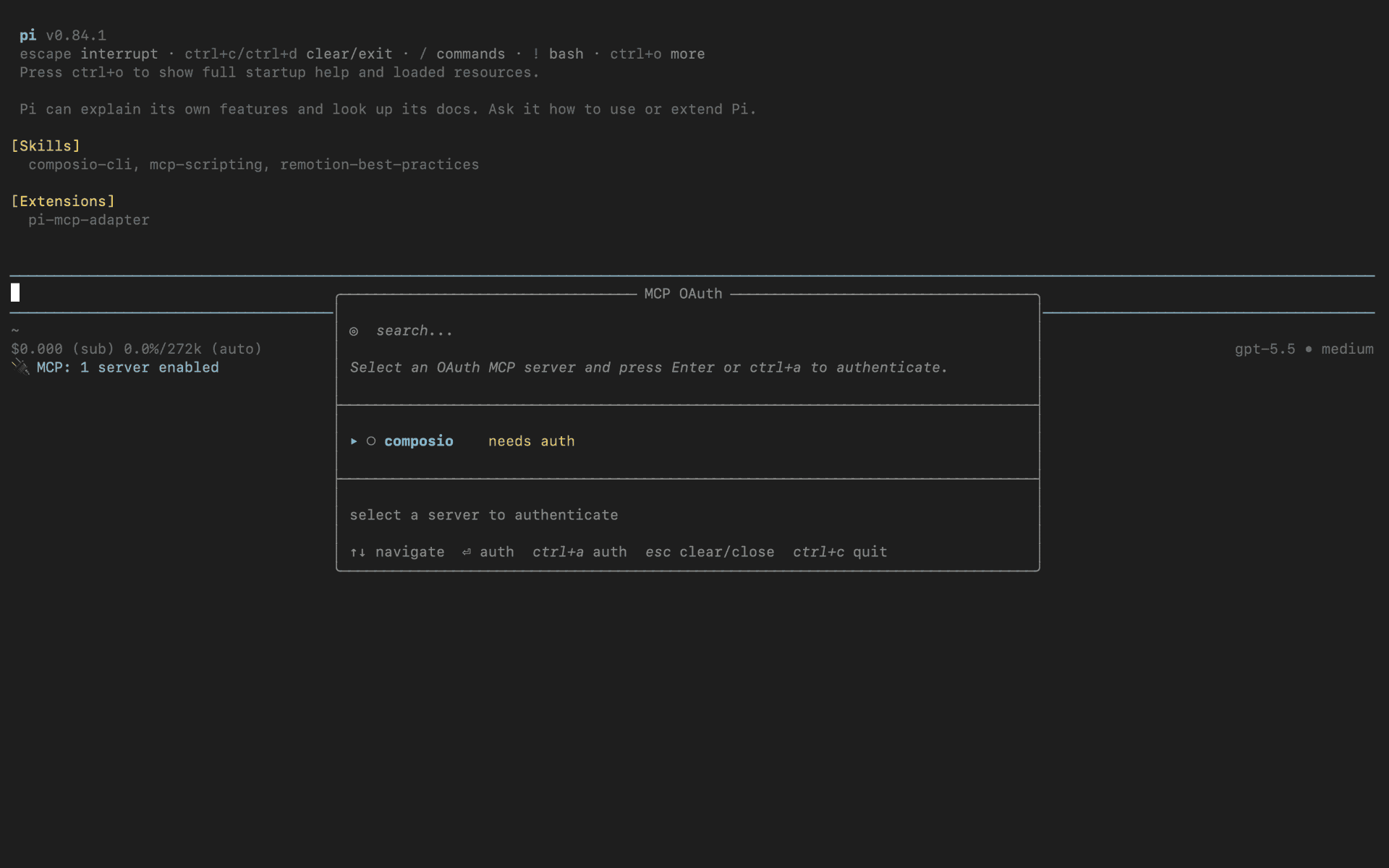
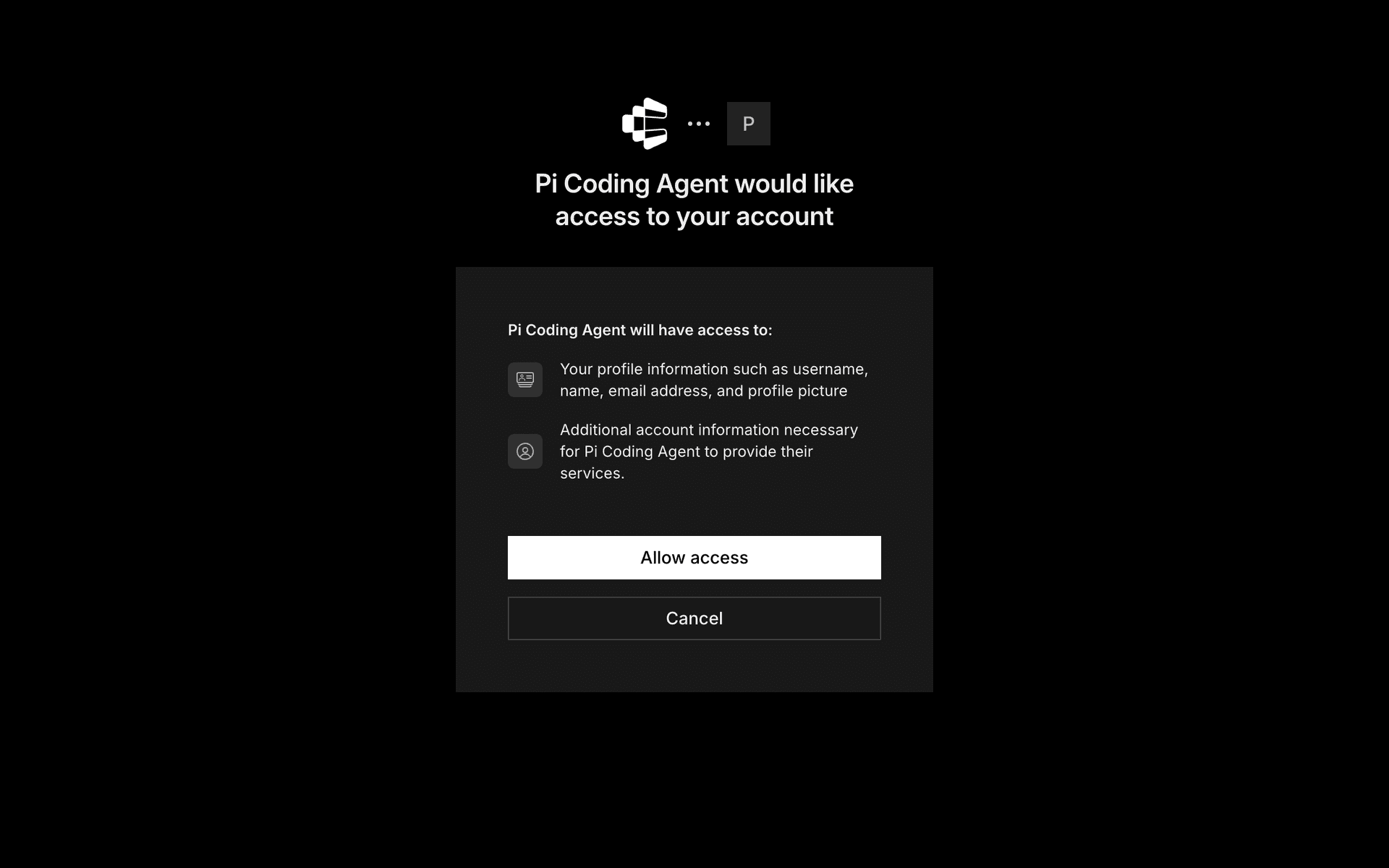
Run /mcp-auth inside Pi to open the authentication modal and select composio from the list. Complete the sign-in in your browser, then on the consent screen click Allow access to authorize Composio. Once approved, the server shows as connected inside Pi:

Pi /mcp-auth modal listing the composio MCP server
Composio OAuth consent screen with the Allow access button
Composio MCP server connected inside Pi

4. Done!

Confirm the server is live with /mcp to open the interactive panel, then ask Pi to connect to Firecrawl or request any Firecrawl-related task — it will prompt you to authorize Firecrawl on first use.

What is the Firecrawl MCP server, and what's possible with it?

The Firecrawl MCP server is an implementation of the Model Context Protocol that connects your AI agent and assistants like Claude, Cursor, etc directly to your Firecrawl account. It provides structured and secure access to automated web crawling, scraping, and data extraction, so your agent can perform actions like indexing sites, extracting structured content, mapping URLs, and searching the web on your behalf.

  • Automated web crawling and indexing: Let your agent launch and manage web crawl jobs to gather content or index entire websites efficiently.
  • Structured data extraction: Instruct your agent to extract targeted data from web pages using custom prompts or schemas, turning unstructured sites into actionable information.
  • URL mapping and discovery: Have the agent explore and map all URLs within a website, including options for subdomain inclusion, sitemap processing, or search-based discovery.
  • On-demand scraping and content retrieval: Enable your agent to scrape specific URLs, retrieve page content, and even extract structured JSON using LLM-powered methods.
  • Integrated web search and data collection: Task your agent with running web searches, scraping top result pages, and returning relevant details—all in one workflow.

Way Forward

With Firecrawl connected, Pi can now act on your behalf whenever you ask it to.

From here, you can extend Pi further:

  • Connect more apps: Calendar, Slack, Notion, Linear, and hundreds of others are available through the same Composio Connect setup. Each new integration compounds what Pi can do for you.
  • Build workflows across tools: Once multiple apps are connected, Pi can chain actions together — turn an email into a calendar invite, a Slack message into a Linear ticket, or a meeting note into a follow-up draft.
  • Lean into Pi's extension surface: Wrap common Firecrawl flows as Pi skills or prompt templates so recurring tasks become one-line commands, and use directTools in the MCP adapter to promote your most-used Firecrawl tools into Pi's tool list directly.

If you run into trouble or want to share what you've built, join the community or check out the Docs for deeper configuration options.

TOOLS

Supported Tools

Every Firecrawl action and event your agent gets out of the box.

Cancel an agent job

Tool to cancel an in-progress agent job by its ID.

Batch scrape multiple URLs

Tool to scrape multiple URLs in batch with concurrent processing.

Cancel a batch scrape job

Tool to cancel a running batch scrape job using its unique identifier.

Get batch scrape status

Retrieves the current status and results of a batch scrape job using the job ID.

Get errors from batch scrape job

Tool to retrieve error details from a batch scrape job, including failed URLs and URLs blocked by robots.

Start a web crawl

Initiates a Firecrawl web crawl from a given URL, applying various filtering and content extraction rules, and polls until the job is complete; ensure the URL is accessible and any regex patterns for paths are valid.

Cancel a crawl job

Cancels an active or queued web crawl job using its ID; attempting to cancel completed, failed, or previously canceled jobs will not change their state.

Cancel a crawl job

Tool to cancel a running crawl job by its ID.

Get crawl job status

Tool to retrieve the status and results of a Firecrawl crawl job.

Get errors from a crawl job

Tool to retrieve errors from a Firecrawl crawl job.

Get all active crawl jobs

Tool to retrieve all active crawl jobs for the authenticated team.

Preview crawl parameters

Preview crawl parameters before starting a crawl by generating optimal configuration from natural language instructions.

Start a web crawl (v2) [NEW]

[NEW v2 API] Initiates a Firecrawl v2 web crawl with enhanced features over v1: natural language prompts for automatic crawler configuration, crawlEntireDomain for sibling/parent page discovery, better depth control with maxDiscoveryDepth, subdomain support, and full webhook configuration.

Get team credit usage

Tool to get current team credit usage information.

Get historical team credit usage

Tool to retrieve historical team credit usage on a monthly basis.

Extract structured data

Extracts structured data from web pages by initiating an extraction job and polling for completion; requires a natural language `prompt` or a JSON `schema` (one must be provided).

Get extract job status

Tool to retrieve the status and results of a previously submitted extract job.

Get agent job status

Tool to get the status and results of an agent job.

Get deep research status

Retrieves the status and results of a deep research job by its ID.

Get the status of a crawl job

Retrieves the current status, progress, and details of a web crawl job, using the job ID obtained when the crawl was initiated.

Generate LLMs.txt for a website

Initiates an async job to generate an LLMs.

Get LLMs.txt generation job status

Tool to get the status and results of an LLMs.

Map multiple URLs

Maps a website by discovering URLs from a starting base URL, with options to customize the crawl via search query, subdomain inclusion, sitemap handling, and result limits; search effectiveness is site-dependent.

Get team queue status

Tool to retrieve metrics about the team's scrape queue.

Scrape URL

Scrapes a publicly accessible URL, optionally performing pre-scrape browser actions or extracting structured JSON using an LLM, to retrieve content in specified formats.

Search

Performs a web search for a query, scrapes content from the top search results using Firecrawl, and returns details in specified formats.

Start an agent job

Tool to start an agent job for agentic web extraction with multi-page navigation and interaction capabilities.

Get team token usage

Tool to retrieve the current team's token usage and balance information for Firecrawl's Extract feature.

Get historical team token usage

Tool to retrieve historical team token usage on a monthly basis.

FAQ

Frequently asked questions

With a standalone Firecrawl MCP server, the agents and LLMs can only access a fixed set of Firecrawl tools tied to that server. However, with the Composio Tool Router, agents can dynamically load tools from Firecrawl and many other apps based on the task at hand, all through a single MCP endpoint.

Yes, you can. Pi fully supports MCP integration. You get structured tool calling, message history handling, and model orchestration while Tool Router takes care of discovering and serving the right Firecrawl tools.

Yes, absolutely. You can configure which Firecrawl scopes and actions are allowed when connecting your account to Composio. You can also bring your own OAuth credentials or API configuration so you keep full control over what the agent can do.

All sensitive data such as tokens, keys, and configuration is fully encrypted at rest and in transit. Composio is SOC 2 Type 2 compliant and follows strict security practices so your Firecrawl data and credentials are handled as safely as possible.

Start with Firecrawl.It takes 30 seconds.

Managed auth, hosted MCP servers, and every Firecrawl tool your agent needs.Free to start.

Start building