How to connect Firecrawl to Claude Cowork

Trusted by
AWS
Glean
Zoom
Airtable

30 min · no commitment · see it on your stack

Firecrawl logo
Claude Cowork logo
divider

Introduction

Cowork is Anthropic's AI agent for knowledge work. Think of it as Claude Code for everything else. It works autonomously with your computer, local files, and applications to accomplish complex tasks.

This guide walks you through the easiest and most secure way to connect your Firecrawl account to Cowork via Composio Connect, enabling it to extract all product prices from this e-commerce site, crawl competitor blogs for latest article summaries, map all subpages linked from homepage URL, and more such actions on your behalf without compromising your account security.

Also integrate Firecrawl with

Connecting Firecrawl to Claude Cowork

1. Open Customize

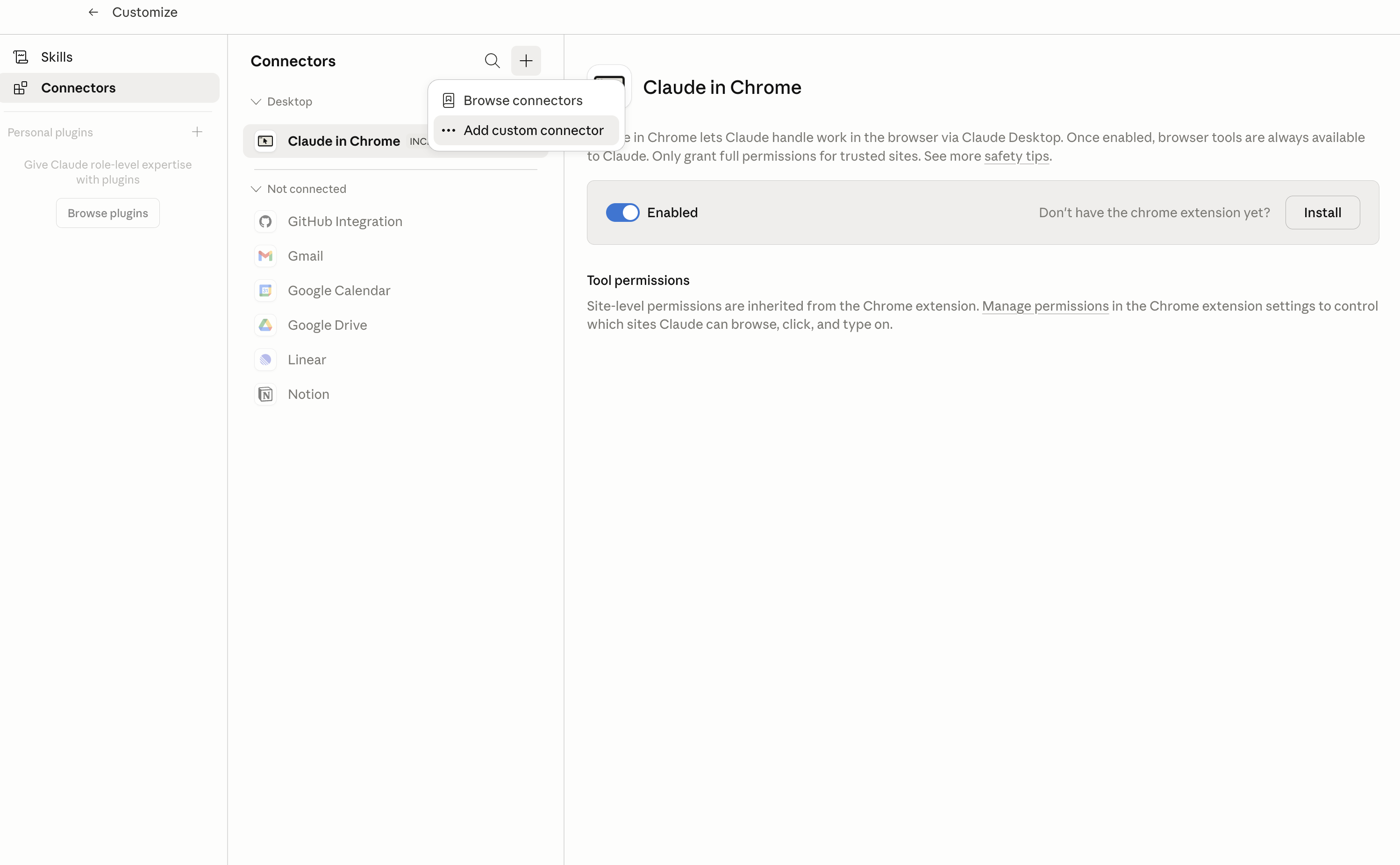
In Claude Desktop, click Customize in the left sidebar, then select Connectors and click the + icon at the top.

Claude Desktop connectors screen with Add custom connector selected

2. Add the Composio MCP server

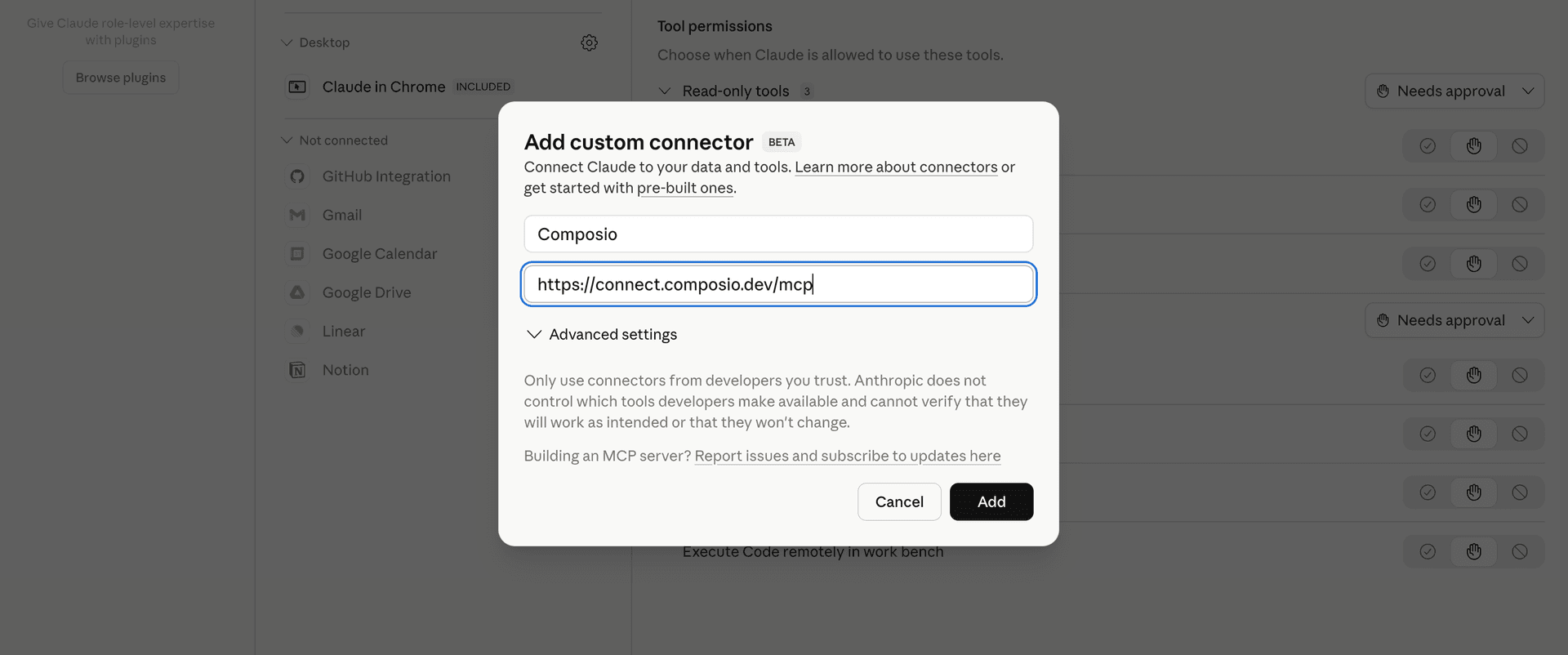
Click Add custom connector and paste in the Composio MCP server URL:

bash
https://connect.composio.dev/mcp
Add custom connector dialog with Composio MCP server URL

3. Authorize in your browser

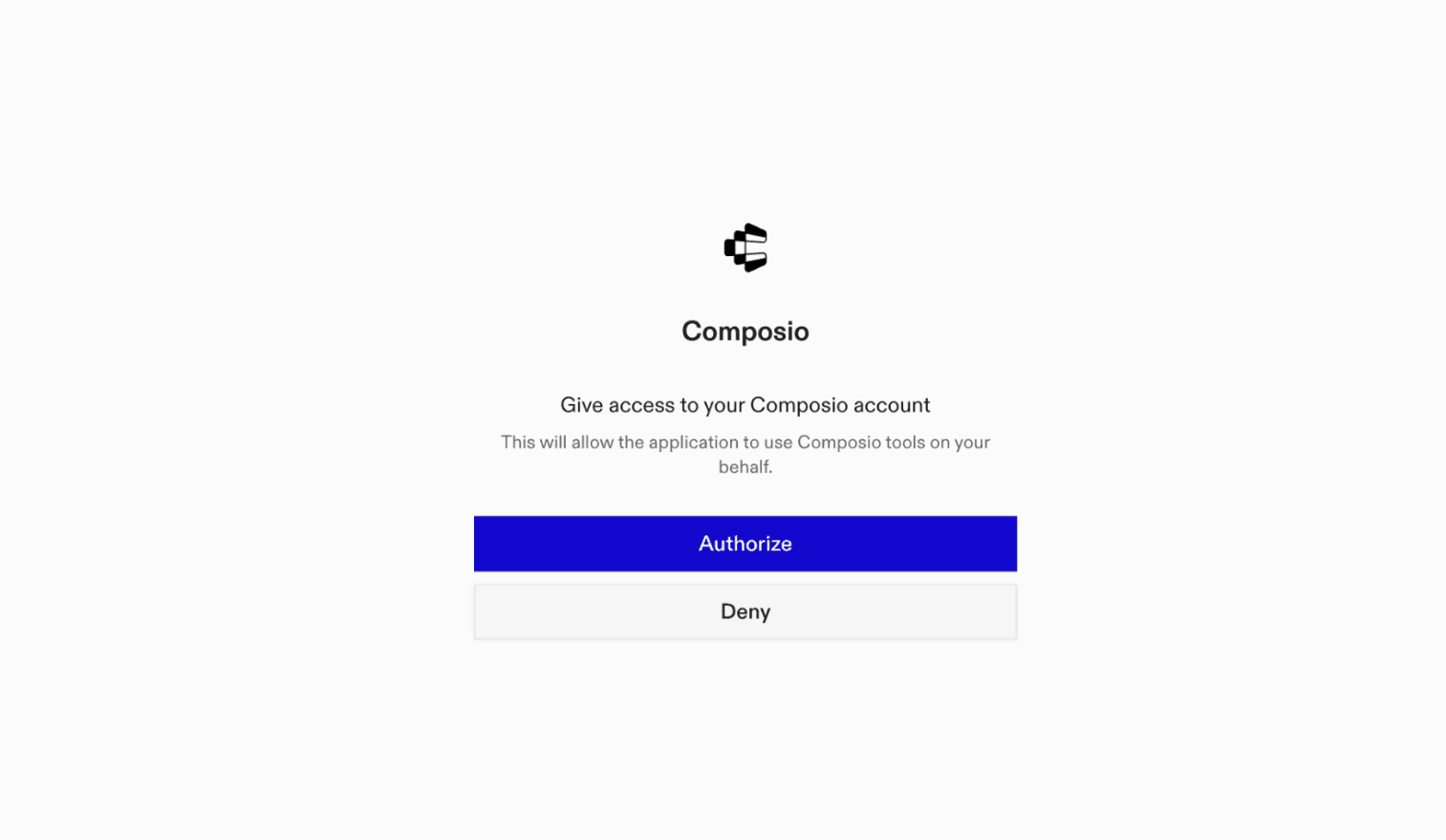
Click Connect. You'll be redirected to a browser window where you can authorize Composio to continue.

Composio authorization screen for Claude Cowork

4. Connect your Firecrawl account

Back in Cowork, ask the agent to connect to Firecrawl or give it any Firecrawl-related task.

For example, ask Cowork to:

  • "Extract all product prices from this e-commerce site"
  • "Crawl competitor blogs for latest article summaries"
  • "Map all subpages linked from homepage URL"

It will prompt you to authenticate and authorize access.

That's it. Composio's tools are now available in Cowork, and your Firecrawl account is ready to use.

What is Claude Cowork?

Claude Cowork is Anthropic's agent for general knowledge work. It can use your computer, files, and connected applications to complete longer-running tasks across your work tools.

With Composio Connect, Cowork can securely access apps like Firecrawl through MCP without you sharing account credentials directly with the agent.

What is the Firecrawl MCP server, and what's possible with it?

The Firecrawl MCP server is an implementation of the Model Context Protocol that connects your AI agent and assistants like Claude, Cursor, etc directly to your Firecrawl account. It provides structured and secure access to automated web crawling, scraping, and data extraction, so your agent can perform actions like indexing sites, extracting structured content, mapping URLs, and searching the web on your behalf.

  • Automated web crawling and indexing: Let your agent launch and manage web crawl jobs to gather content or index entire websites efficiently.
  • Structured data extraction: Instruct your agent to extract targeted data from web pages using custom prompts or schemas, turning unstructured sites into actionable information.
  • URL mapping and discovery: Have the agent explore and map all URLs within a website, including options for subdomain inclusion, sitemap processing, or search-based discovery.
  • On-demand scraping and content retrieval: Enable your agent to scrape specific URLs, retrieve page content, and even extract structured JSON using LLM-powered methods.
  • Integrated web search and data collection: Task your agent with running web searches, scraping top result pages, and returning relevant details—all in one workflow.

Supported Tools & Triggers

Tools
Cancel an agent jobTool to cancel an in-progress agent job by its ID.
Batch scrape multiple URLsTool to scrape multiple URLs in batch with concurrent processing.
Cancel a batch scrape jobTool to cancel a running batch scrape job using its unique identifier.
Get batch scrape statusRetrieves the current status and results of a batch scrape job using the job ID.
Get errors from batch scrape jobTool to retrieve error details from a batch scrape job, including failed URLs and URLs blocked by robots.
Start a web crawlInitiates a Firecrawl web crawl from a given URL, applying various filtering and content extraction rules, and polls until the job is complete; ensure the URL is accessible and any regex patterns for paths are valid.
Cancel a crawl jobCancels an active or queued web crawl job using its ID; attempting to cancel completed, failed, or previously canceled jobs will not change their state.
Cancel a crawl jobTool to cancel a running crawl job by its ID.
Get crawl job statusTool to retrieve the status and results of a Firecrawl crawl job.
Get errors from a crawl jobTool to retrieve errors from a Firecrawl crawl job.
Get all active crawl jobsTool to retrieve all active crawl jobs for the authenticated team.
Preview crawl parametersPreview crawl parameters before starting a crawl by generating optimal configuration from natural language instructions.
Start a web crawl (v2) [NEW][NEW v2 API] Initiates a Firecrawl v2 web crawl with enhanced features over v1: natural language prompts for automatic crawler configuration, crawlEntireDomain for sibling/parent page discovery, better depth control with maxDiscoveryDepth, subdomain support, and full webhook configuration.
Get team credit usageTool to get current team credit usage information.
Get historical team credit usageTool to retrieve historical team credit usage on a monthly basis.
Extract structured dataExtracts structured data from web pages by initiating an extraction job and polling for completion; requires a natural language `prompt` or a JSON `schema` (one must be provided).
Get extract job statusTool to retrieve the status and results of a previously submitted extract job.
Get agent job statusTool to get the status and results of an agent job.
Get deep research statusRetrieves the status and results of a deep research job by its ID.
Get the status of a crawl jobRetrieves the current status, progress, and details of a web crawl job, using the job ID obtained when the crawl was initiated.
Generate LLMs.txt for a websiteInitiates an async job to generate an LLMs.
Get LLMs.txt generation job statusTool to get the status and results of an LLMs.
Map multiple URLsMaps a website by discovering URLs from a starting base URL, with options to customize the crawl via search query, subdomain inclusion, sitemap handling, and result limits; search effectiveness is site-dependent.
Get team queue statusTool to retrieve metrics about the team's scrape queue.
Scrape URLScrapes a publicly accessible URL, optionally performing pre-scrape browser actions or extracting structured JSON using an LLM, to retrieve content in specified formats.
SearchPerforms a web search for a query, scrapes content from the top search results using Firecrawl, and returns details in specified formats.
Start an agent jobTool to start an agent job for agentic web extraction with multi-page navigation and interaction capabilities.
Get team token usageTool to retrieve the current team's token usage and balance information for Firecrawl's Extract feature.
Get historical team token usageTool to retrieve historical team token usage on a monthly basis.

How to build Firecrawl MCP Agent with another framework

FAQ

What are the differences in Tool Router MCP and Firecrawl MCP?

With a standalone Firecrawl MCP server, the agents and LLMs can only access a fixed set of Firecrawl tools tied to that server. However, with the Composio Tool Router, agents can dynamically load tools from Firecrawl and many other apps based on the task at hand, all through a single MCP endpoint.

Can I use Tool Router MCP with Claude Cowork?

Yes, you can. Claude Cowork fully supports MCP integration. You get structured tool calling, message history handling, and model orchestration while Tool Router takes care of discovering and serving the right Firecrawl tools.

Can I manage the permissions and scopes for Firecrawl while using Tool Router?

Yes, absolutely. You can configure which Firecrawl scopes and actions are allowed when connecting your account to Composio. You can also bring your own OAuth credentials or API configuration so you keep full control over what the agent can do.

How safe is my data with Composio Tool Router?

All sensitive data such as tokens, keys, and configuration is fully encrypted at rest and in transit. Composio is SOC 2 Type 2 compliant and follows strict security practices so your Firecrawl data and credentials are handled as safely as possible.

Used by agents from

Context
Letta
glean
HubSpot
Agent.ai
Altera
DataStax
Entelligence
Rolai
Context
Letta
glean
HubSpot
Agent.ai
Altera
DataStax
Entelligence
Rolai
Context
Letta
glean
HubSpot
Agent.ai
Altera
DataStax
Entelligence
Rolai

Never worry about agent reliability

We handle tool reliability, observability, and security so you never have to second-guess an agent action.