How to integrate Canva MCP with Hermes

Canva logo
Hermes logo
divider

Introduction

Hermes is a 24/7 autonomous agent that lives on your computer or server — it remembers what it learns and evolves as your usage grows.

This guide explains the easiest and most robust way to connect your Canva account to Hermes. You can do this through either Composio Connect CLI or Composio Connect MCP. For personal use we recommend the CLI, but you won't go wrong with MCP either.

Also integrate Canva with

What is Composio Connect?

Composio Connect is a consumer offering that lets anyone plug 1,000+ applications directly into their agent harness — including Hermes. It can:

  • Search and load tools from relevant toolkits on-demand, reducing context usage.
  • Chain multiple tools to accomplish complex workflows via a remote workbench, without excessive back-and-forth with the LLM.
  • Manage app authentication end-to-end with zero manual overhead.

Integrating Canva with Hermes

Using Composio Connect CLI

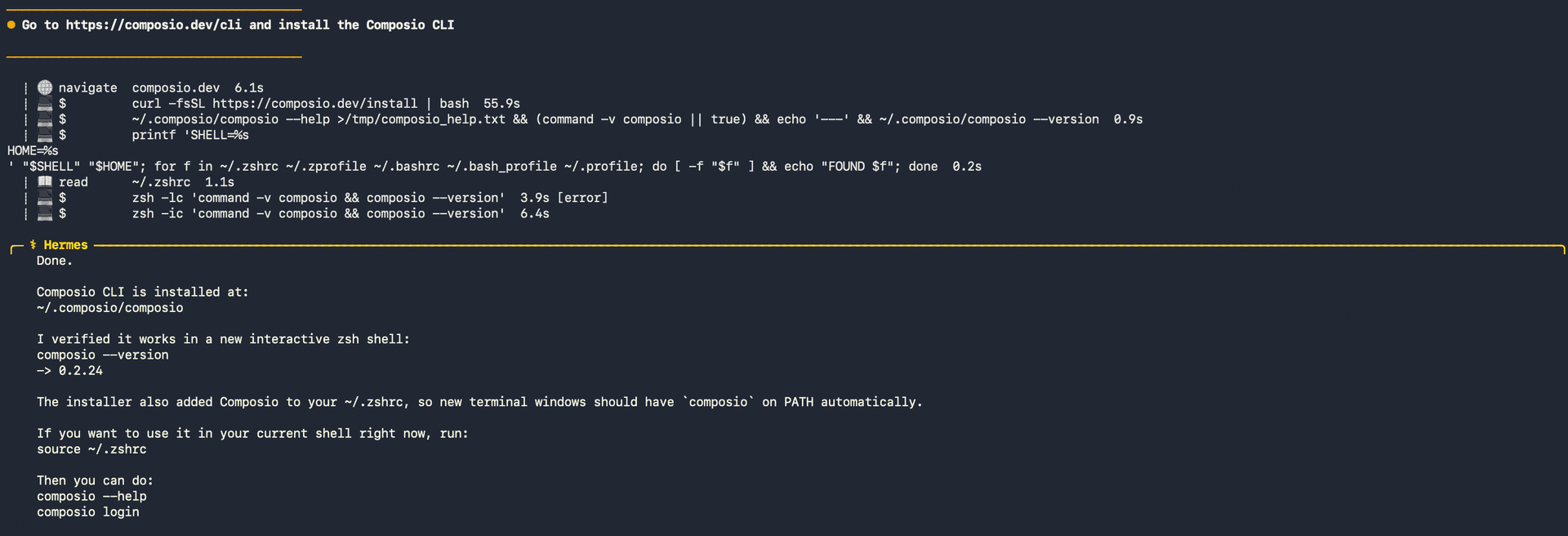
1. Install the Composio CLI

Run the install script directly, or paste https://composio.dev/hermes into your Hermes chat box to have it installed for you.

bash
curl -fsSL https://composio.dev/install | bash
Hermes authenticating with Composio

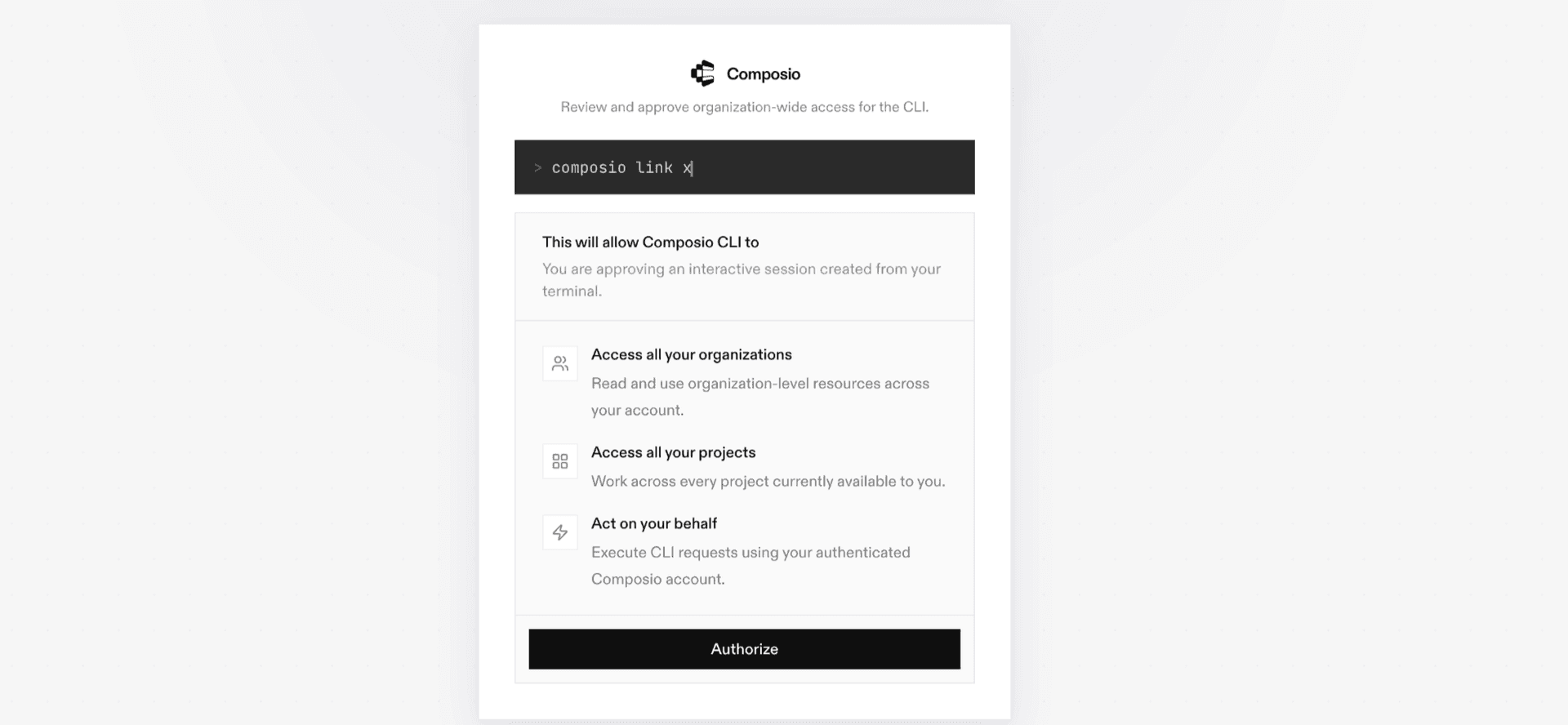
2. Authenticate

Once the CLI is installed, ask Hermes to authenticate with Composio.

3. Connect to Canva

Ask your agent to connect to Canva, or simply request any Canva-related task. Hermes will prompt you to authenticate and authorize access.

4. Done. You're all set with a new Canva connection.


Using Composio Connect MCP

1. Get your MCP URL and API Key

Go to dashboard.composio.dev and copy your Connect MCP URL and API key.

Copy MCP URL and API key from Composio dashboard

What is the Canva MCP server, and what's possible with it?

The Canva MCP server is an implementation of the Model Context Protocol that connects your AI agent and assistants like Claude, Cursor, etc directly to your Canva account. It provides structured and secure access to your Canva designs, templates, folders, assets, and user details, so your agent can create designs, organize projects, manage assets, and collaborate on feedback for you.

  • Automated design creation and asset integration: Direct your agent to generate new Canva designs using templates or custom dimensions, and add assets from your projects automatically.
  • Seamless folder and project organization: Have the agent create user or subfolders to keep your Canva projects structured and easily accessible.
  • Asset management and cleanup: Let your agent fetch upload statuses, manage, or delete assets by ID, helping you keep your design library up to date.
  • Collaborative design feedback: Empower your agent to add comments or reply within designs, making it easy to facilitate feedback and teamwork directly in Canva.
  • User and team information retrieval: Quickly obtain user or team details, allowing your agent to personalize interactions and automate workflows based on your Canva account info.

Supported Tools & Triggers

Tools
Access user specific brand templates listThis year, brand template ids will change; integrations storing them must update within 6 months.
Create canva design with optional assetCreate a new canva design using a preset or custom dimensions, and add an asset with `asset id` from a user's project using relevant apis.
Create comment reply in designThis preview api allows replying to comments within a design on canva, with a limit of 100 replies per comment.
Create design comment in preview apiThis api is in preview and may change without notice; integrations using it won't pass review.
Create user or sub folderThis api creates a folder in a canva user's projects at the top level or within another folder, returning the new folder's id and additional details upon success.
Delete asset by idYou can delete an asset by specifying its `assetid`.
Exchange oauth 2 0 access or refresh tokenThe oauth 2.
Fetch asset upload job statusSummarize asset upload outcome by repeatedly calling the endpoint until a 'success' or 'failed' status is received after using the create asset upload job api.
Fetch canva connect signing public keysThe api for verifying canva webhooks, 'connect/keys,' is in preview, meaning unstable, not for public integrations, and provides a rotating jwk for signature verification to prevent replay attacks.
Fetch current user detailsReturns the user id, team id, and display name of the user account associated with the provided access token.
Fetch design metadata and access informationGets the metadata for a design.
Get design export job resultGet the outcome of a canva design export job; if done, receive download links for the design’s pages.
Initiate canva design autofill jobUpcoming brand template id updates require migration within 6 months.
Initiates canva design export jobCanva's new job feature exports designs in multiple formats using a design id, with provided download links.
List design pages with paginationPreview api for canva: subject to unannounced changes and not for public integrations.
List folder items by type with sortingLists the items in a folder, including each item's `type`.
List User DesignsProvides a summary of canva user designs, includes search filtering, and allows showing both self-created and shared designs with sorting options.
Move item to specified folderTransfers an item to a different folder by specifying both the destination folder's id and the item's id.
Remove folder and move contents to trashDeletes a folder by moving the user's content to trash and reassigning other users' content to their top-level projects.
Retrieve app public key setReturns the json web key set (public keys) of an app.
Retrieve a specific design commentThis preview api is subject to unannounced changes and can't be used in public integrations.
Retrieve asset metadata by idYou can retrieve the metadata of an asset by specifying its `assetid`.
Retrieve brand template dataset definitionCanva's brand template ids will change later this year, including a 6-month integration migration.
Retrieve canva enterprise brand template metadataUpcoming update will change brand template ids; integrations must migrate within 6 months.
Retrieve design autofill job statusApi users with canva enterprise membership can retrieve design autofill job results, potentially requiring multiple requests until a `success` or `failed` status is received.
Retrieve design import job statusGets the status and results of design import jobs created using the [create design import job api](https://www.
Retrieve folder details by idGets the name and other details of a folder using a folder's `folderid`.
RetrieveuserprofiledataCurrently, this returns the display name of the user account associated with the provided access token.
Revoke oauth tokensRevoke a refresh token to end its lineage and user consent, requiring re-authentication.
Update asset s name and tags by idYou can update the name and tags of an asset by specifying its `assetid`.
Update folder details by idUpdates a folder's details using its `folderid`.
Validate oauth token propertiesCheck an access token's validity and properties via introspection, requiring authentication.

Way Forward

With Canva connected, Hermes can now act on your behalf whenever it detects a relevant task or you ask it to.

From here, you can extend Hermes further:

  • Connect more apps: Calendar, Slack, Notion, Linear, and hundreds of others are available through the same Composio Connect setup. Each new integration compounds what Hermes can do for you.
  • Build workflows across tools: Once multiple apps are connected, Hermes can chain actions together — turn an email into a calendar invite, a Slack message into a Linear ticket, or a meeting note into a follow-up draft.
  • Let it learn your patterns: The more you use Hermes, the better it gets at anticipating how you'd handle recurring tasks. Give it feedback on drafts and decisions, and it will adapt.

If you run into trouble or want to share what you've built, join the community or check out the Docs for deeper configuration options.

How to build Canva MCP Agent with another framework

FAQ

What are the differences in Tool Router MCP and Canva MCP?

With a standalone Canva MCP server, the agents and LLMs can only access a fixed set of Canva tools tied to that server. However, with the Composio Tool Router, agents can dynamically load tools from Canva and many other apps based on the task at hand, all through a single MCP endpoint.

Can I use Tool Router MCP with Hermes?

Yes, you can. Hermes fully supports MCP integration. You get structured tool calling, message history handling, and model orchestration while Tool Router takes care of discovering and serving the right Canva tools.

Can I manage the permissions and scopes for Canva while using Tool Router?

Yes, absolutely. You can configure which Canva scopes and actions are allowed when connecting your account to Composio. You can also bring your own OAuth credentials or API configuration so you keep full control over what the agent can do.

How safe is my data with Composio Tool Router?

All sensitive data such as tokens, keys, and configuration is fully encrypted at rest and in transit. Composio is SOC 2 Type 2 compliant and follows strict security practices so your Canva data and credentials are handled as safely as possible.

Used by agents from

Context
Letta
glean
HubSpot
Agent.ai
Altera
DataStax
Entelligence
Rolai
Context
Letta
glean
HubSpot
Agent.ai
Altera
DataStax
Entelligence
Rolai
Context
Letta
glean
HubSpot
Agent.ai
Altera
DataStax
Entelligence
Rolai

Never worry about agent reliability

We handle tool reliability, observability, and security so you never have to second-guess an agent action.