




I already covered the best Pi Agent extensions and the best Pi Agent skills.
So MCP was the obvious next one. ✌️
Pi intentionally ships without built-in MCP support.
Mario Zechner has explained why. A large MCP server (not all) can put a lot of tool definitions into the context window before the agent even uses them. In his own tests, Playwright MCP used around 13.7K tokens for 21 tools, while Chrome DevTools MCP used around 18K tokens for 26 tools.
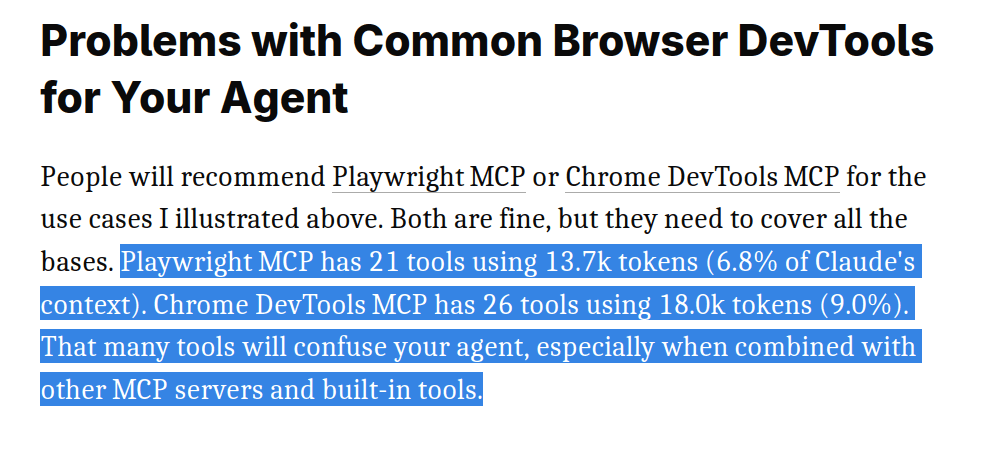
That's pretty big for an agent built around keeping the core small.
But Pi can still use MCP. You just need thepi-mcp-adapter, which exposes your MCP servers through one proxy tool of roughly 200 tokens and loads the actual servers only when Pi needs them.
These are the 12 MCP setups I would actually consider for Pi in 2026.
TL;DR
If you just want the list, here you go.
Composio MCP connects Pi to 1,500+ apps with managed authentication and dynamic tool loading.
💁 Most “best MCP server” articles repeat GitHub, Notion, Slack, Supabase, Sentry, Stripe, Exa, and similar tools, but Composio gives you all of them in one place, so there is no need to install and manage separate MCP servers for each one.
pi-mcp-adapter gives Pi token-efficient access to almost any standard MCP server.
Context7 gives Pi current, version-specific library documentation and code examples.
Playwright MCP lets Pi automate and test real browsers through structured accessibility data.
Filesystem MCP gives Pi controlled access to directories outside the current project.
Chrome DevTools MCP adds browser debugging, console inspection, network data, and performance traces.
Figma Dev Mode MCP gives Pi structured design context for design-to-code workflows.
Memory MCP gives Pi persistent knowledge-graph memory across sessions.
Sequential Thinking MCP adds structured, revisable reasoning for difficult engineering tasks.
Git MCP lets Pi inspect and change your local Git working tree.
Kubernetes MCP gives Pi controlled access to Kubernetes and Helm operations.
Docker MCP Gateway runs MCP servers through isolated containers with secrets and lifecycle management.
You don't need all of these.
Start with Composio and pi-mcp-adapter, then add the servers that solve a real problem in your workflow.
How MCP Servers Work With Pi Agent
Pi's core gives the model four tools: read, write, edit, and bash.
MCP support comes through an extension. The one I would use is pi-mcp-adapter.
Install it with:
pi install npm:pi-mcp-adapterThen restart Pi.
The adapter uses .mcp.json for project-level MCP configuration.
A basic config looks like this:
{
  "mcpServers": {
    "chrome-devtools": {
      "command": "npx",
      "args": ["-y", "chrome-devtools-mcp@latest"]
    }
  }
}
You can also keep shared servers in:
~/.config/mcp/mcp.jsonThen use:
/mcpinside Pi to inspect and manage your MCP servers. The adapter keeps one lightweight mcp tool in context and discovers individual tools when Pi actually needs them.
Adding ten MCP servers does not mean Pi needs to dump every tool schema from every server into the context window at startup. Which is pretty nice way to handle MCP than most other coding agents.
Now let’s get into the ones worth adding.
1. Composio MCP
ℹ️ Connects Pi to 1,500+ apps with managed authentication, tool discovery, and multi-app execution.
If I were setting up Pi from scratch, I would handle app integrations first.
Most useful developer workflows eventually leave the repository. You need GitHub issues, Linear tickets, Slack messages, Gmail, Notion docs, Sentry errors, Supabase, Stripe, or some other external system.
Composio gives Pi one managed way to work with those services instead of maintaining a separate MCP server and authentication flow for each app.
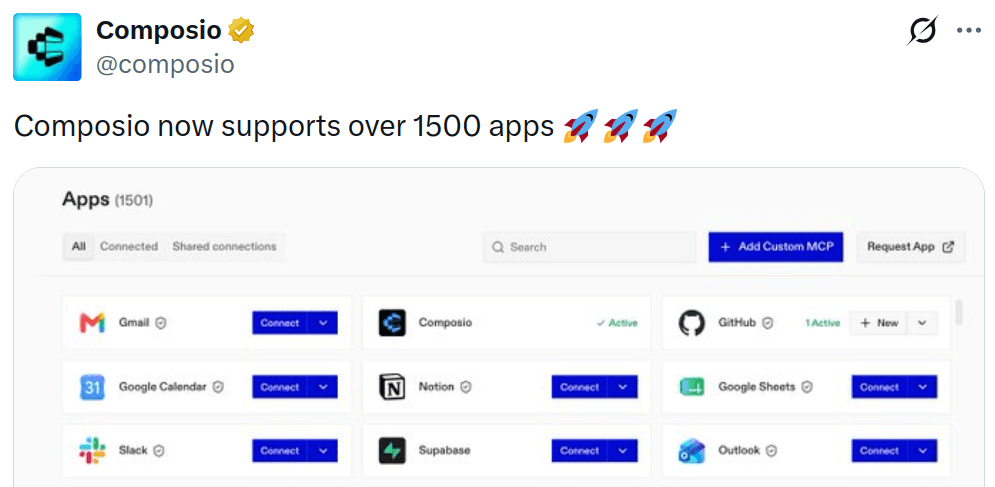
We recently added support for over 1,500 integrations, including GitHub, Notion, Slack, Linear, Supabase, Stripe, and many others.
What it does
Connects Pi to 1,500+ external apps
Handles OAuth, API keys, refresh tokens, and scopes
Searches for relevant tools when Pi needs them
Supports multi-tool and multi-app workflows
Keeps large tool catalogs out of the main model context
Supports both CLI and MCP-based Pi setups
I would actually use the Composio CLI first with Pi.
Pi already treats shell commands as first-class tools, so the CLI is much simpler and avoids MCP server configuration. The MCP way is still useful if you want everything behind the same MCP interface.
Install
Install the Composio CLI:
curl -fsSL https://composio.dev/install | bashThen log in:
composio loginYou can ask Pi to connect an app, or use commands such as:
composio search "what can I do with Datadog?"
composio link datadog
For the MCP route, first install the Pi MCP adapter:
pi install npm:pi-mcp-adapterThen add this to .mcp.json:
{
  "mcpServers": {
    "composio": {
      "url": "https://connect.composio.dev/mcp"
    }
  }
}
Then authenticate from Pi using the MCP authentication flow.
💡 I would check Composio before installing an app-specific MCP server. If the same app is already available as a managed toolkit, why not use it than manage another server on your own?
Resources
Composio toolkits: Browse Composio toolkits
Pi integration guide: Composio with Pi
Get started with Composio: dashboard.composio.dev
2. pi-mcp-adapter
ℹ️ Adds token-efficient MCP support to Pi through one lightweight proxy tool.
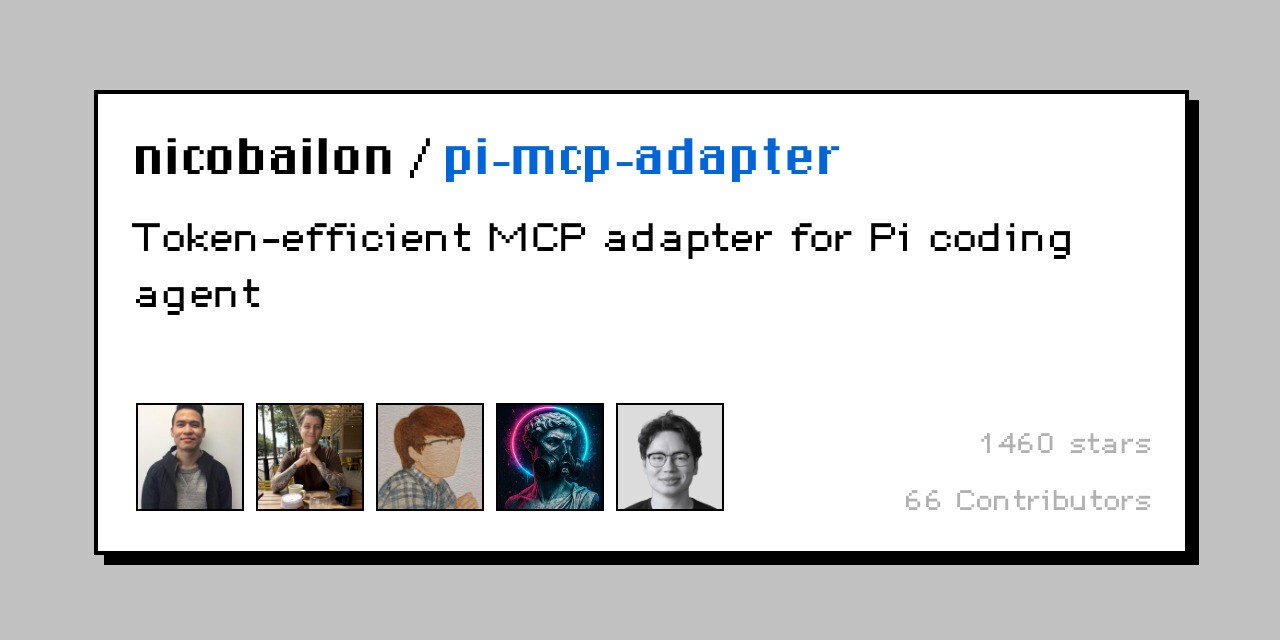
This is technically a Pi extension, but it belongs near the top of this list because almost every MCP server below depends on it.
The adapter was built specifically around Pi's approach to context.
Instead of registering hundreds of MCP tools directly with the model, it gives Pi one mcp tool that uses roughly 200 tokens. Pi can then search for the server or tool it needs and call it on demand.
Servers also start lazily, so they do not all launch when Pi starts.
What it does
Adds MCP support to Pi
Keeps one small proxy tool in context
Starts MCP servers only when needed
Supports local and remote MCP servers
Reads normal
.mcp.jsonconfigurationLets you promote important MCP tools into direct Pi tools
The project has already grown to around 1.5K GitHub stars, which is pretty good for something this Pi-specific.
Install
pi install npm:pi-mcp-adapterThen restart Pi:
/restartOpen the MCP panel:
/mcpOr run:
/mcp setupto create or import server configuration.
💡 This is one of the few things on this list I would install even before deciding which MCP servers I need.
Resources
GitHub: pi-mcp-adapter repository
Package: pi.dev package
Architecture: DeepWiki guide
3. Context7
ℹ️ Gives Pi current, version-specific documentation instead of relying only on model training data.
This is probably one of the easiest MCP servers to recommend for coding. In almost all my listicle for "top MCP Servers", this is almost always there, no matter if it's Claude Code, Codex, OpenCode or anything else.
Models know a lot about React, Next.js, MongoDB, Cloudflare, Supabase, and thousands of other libraries. The problem is that APIs change quickly.
Context7 fetches current documentation and examples and puts the relevant parts into the agent's context.
So instead of asking Pi to remember how a particular library worked during training, you can tell it to check the actual documentation for the version you are using.
What it does
Retrieves current library documentation
Supports version-specific queries
Returns code examples
Resolves libraries into Context7 IDs
Helps reduce outdated API suggestions
Works through MCP or its own CLI and skills
Context7 is currently sitting at around 62K GitHub stars, making it one of the largest MCP-related projects around.
Install
This uses normal MCP compatibility through pi-mcp-adapter.
For the remote server:
{
  "mcpServers": {
    "context7": {
      "url": "https://mcp.context7.com/mcp",
      "headers": {
        "Authorization": "Bearer YOUR_API_KEY"
      }
    }
  }
}
You can also run it locally:
{
  "mcpServers": {
    "context7": {
      "command": "npx",
      "args": ["-y", "@upstash/context7-mcp", "--api-key", "YOUR_API_KEY"]
    }
  }
}
Context7 now also ships a dedicated Pi extension, but for this article I am keeping the MCP route so the setup stays consistent with the rest of the list.
⚠️ Context7 documentation can include community-contributed content. The project itself says it cannot guarantee the accuracy or security of every library entry, so I would still verify anything security-sensitive.
Resources
GitHub: Context7 repository
Website: Context7
Releases: Context7 releases
4. Playwright MCP
ℹ️ Gives Pi deterministic browser automation through structured page data.
If you use Pi for frontend work, Playwright MCP is one of the more useful additions here.
It drives a real browser and exposes the page through accessibility snapshots. The agent can understand elements, forms, buttons, text, and page structure without relying entirely on screenshots.
That makes it useful for testing workflows where Pi needs to keep interacting with the browser and checking what happened.
What it does
Automates Chromium, Firefox, and WebKit workflows
Reads structured accessibility snapshots
Clicks, types, navigates, and fills forms
Captures screenshots
Supports end-to-end testing workflows
Helps agents generate or repair browser tests
The repository currently has around 37K GitHub stars.
Install
Playwright does not have a Pi-specific MCP setup.
Add the normal MCP configuration through pi-mcp-adapter:
{
  "mcpServers": {
    "playwright": {
      "command": "npx",
      "args": ["@playwright/mcp@latest"]
    }
  }
}
💡 I would use Playwright when Pi needs an ongoing browser session and structured page interaction. For simple coding-agent browser tasks, Microsoft itself now points developers toward its CLI and skills workflow because it can use fewer tokens.
There is also a security detail worth knowing.
A reported Playwright MCP issue showed password input content appearing inside accessibility snapshots. Browser agents can see sensitive page state, so I would keep test accounts separate from important personal or production sessions.
Resources
GitHub: Microsoft Playwright MCP
Playwright: Playwright documentation
5. Filesystem MCP
ℹ️ Gives Pi controlled access to local directories that you explicitly allow.
Pi already has read, write, and edit.
So why add another filesystem tool?
For me, the useful part is directory scoping.
You can expose another folder, such as documentation, exported designs, notes, generated files, or a shared workspace, while keeping the MCP server restricted to the directories you explicitly provide.
What it does
Reads and writes files
Creates and lists directories
Moves files and directories
Searches local files
Reads file metadata
Restricts access to allowed directories
It lives inside the official modelcontextprotocol/servers reference repository, which currently has around 90K GitHub stars.
Install
This uses normal MCP compatibility through the adapter.
{
  "mcpServers": {
    "filesystem": {
      "command": "npx",
      "args": [
        "-y",
        "@modelcontextprotocol/server-filesystem",
        "/path/to/allowed/directory"
      ]
    }
  }
}
You can add more directories as additional arguments.
💡 I would not point this at your entire home directory. Give Pi the smallest directory scope that actually solves the task.
The server also supports MCP Roots for clients that support dynamic directory access control.
Resources
GitHub: Filesystem MCP source
MCP examples: Model Context Protocol examples
6. Chrome DevTools MCP
ℹ️ Lets Pi inspect, debug, and profile a real Chrome browser.
Playwright and Chrome DevTools look similar at first, but I would use them for different jobs.
Playwright is stronger when Pi needs deterministic browser interaction and cross-browser testing.
Chrome DevTools MCP becomes more useful when the question is why the application is slow, why a request failed, what appeared in the console, or what Chrome actually did while rendering the page.
What it does
Reads browser console output
Inspects network requests
Captures screenshots and page state
Records performance traces
Helps investigate metrics such as LCP and CLS
Controls a live Chrome browser
The official Google repository now has around 51.7K GitHub stars.
Install
Add it through pi-mcp-adapter:
{
  "mcpServers": {
    "chrome-devtools": {
      "command": "npx",
      "args": ["-y", "chrome-devtools-mcp@latest"]
    }
  }
}
For cleaner temporary browser sessions, you can also use:
{
  "mcpServers": {
    "chrome-devtools": {
      "command": "npx",
      "args": ["-y", "chrome-devtools-mcp@latest", "--isolated"]
    }
  }
}
⚠️ Chrome DevTools MCP can inspect whatever exists inside the browser session it connects to, including sensitive page data. I would avoid connecting it to your normal logged-in Chrome profile unless the task actually needs that access.
Resources
GitHub: Chrome DevTools MCP
Chrome documentation: Chrome DevTools for agents
7. Figma Dev Mode MCP
ℹ️ Gives Pi structured Figma design context for design-to-code work.
Composio already has a Figma toolkit, but I kept Figma Dev Mode MCP in this list for one reason.
The two solve different jobs.
The Composio integration covers normal Figma API actions. Figma's own MCP server is built specifically around giving coding agents design context such as components, variables, layout information, screenshots, and Code Connect mappings.
That makes it much more useful when Pi is implementing an interface from an actual design.
What it does
Extracts structured design context
Reads components and variables
Gets screenshots for visual reference
Works with Code Connect mappings
Helps generate code from selected frames
Supports write-to-canvas workflows where available
Install
Figma does not currently document a dedicated Pi setup.
Use its standard remote MCP server through pi-mcp-adapter:
{
  "mcpServers": {
    "figma": {
      "url": "https://mcp.figma.com/mcp"
    }
  }
}
You can then authenticate through the supported MCP OAuth flow.
💡 If you use a proper design system, connect Figma components to the codebase with Code Connect. Figma itself recommends this because the agent can reuse real components instead of guessing how the design maps to code.
⚠️ Check your Figma plan before depending on this heavily. MCP rate limits vary by plan.
Resources
Figma MCP guide: Figma MCP Server Guide
Official documentation: Figma MCP documentation
Rate limits: Figma MCP rate limits
8. Memory MCP
ℹ️ Gives Pi persistent knowledge-graph memory across sessions.
Pi sessions eventually end, and useful project context disappears unless something stores it.
Memory MCP gives the agent a simple persistent knowledge graph made from entities, relations, and observations.
So Pi can store architecture decisions, ownership information, naming conventions, project rules, or facts it should reuse later.
What it does
Stores persistent entities
Records relationships between entities
Adds observations to known entities
Searches stored knowledge
Keeps information in a local JSONL file
Preserves useful context across sessions
Like Filesystem, it is part of the official modelcontextprotocol/servers repository, which currently has around 90K stars.
Install
Add the standard MCP server through the Pi adapter:
{
  "mcpServers": {
    "memory": {
      "command": "npx",
      "args": ["-y", "@modelcontextprotocol/server-memory"]
    }
  }
}
You can also choose where the memory file lives:
{
  "mcpServers": {
    "memory": {
      "command": "npx",
      "args": ["-y", "@modelcontextprotocol/server-memory"],
      "env": {
        "MEMORY_FILE_PATH": "/path/to/memory.jsonl"
      }
    }
  }
}
⚠️ This is intentionally simple memory. It does not give you user identity separation, or advanced temporal reasoning. You still need to decide what Pi should remember.
Resources
GitHub: Memory MCP source
MCP examples: Model Context Protocol examples
9. Sequential Thinking MCP
ℹ️ Gives Pi a structured way to break down and revise difficult multi-step reasoning.
I would not keep this active for every simple coding task.
It becomes useful when the task has enough moving parts that Pi should explicitly work through them, revise earlier assumptions, branch into alternatives, and then continue.
Think architecture changes, migrations, difficult debugging, or work where one wrong assumption can affect several later steps.
What it does
Breaks problems into ordered reasoning steps
Lets the agent revise previous steps
Supports alternate reasoning branches
Adjusts the expected number of steps while working
Helps with planning and debugging
Works without an external API
It is another official MCP reference server inside the roughly 90K-star modelcontextprotocol/servers repository.
Install
{
  "mcpServers": {
    "sequential-thinking": {
      "command": "npx",
      "args": ["-y", "@modelcontextprotocol/server-sequential-thinking"]
    }
  }
}
You can also run it through Docker:
{
  "mcpServers": {
    "sequential-thinking": {
      "command": "docker",
      "args": ["run", "--rm", "-i", "mcp/sequentialthinking"]
    }
  }
}
💡 I would use this only when the problem actually needs it. Structured reasoning adds more work and more tokens, so using it for a tiny edit does not make much sense.
Resources
GitHub: Sequential Thinking MCP source
10. Git MCP
ℹ️ Lets Pi work directly with the local Git repository it is editing.
Composio gives Pi access to GitHub, but GitHub and Git are different parts of the workflow.
The GitHub integration works with the remote service for issues, pull requests, workflows, and repository APIs.
Git MCP works with the local checkout.
That makes it useful when Pi needs to inspect changes, review history, stage files, or work with commits before anything reaches GitHub.
What it does
Reads repository status
Inspects diffs
Searches commit history
Stages changes
Creates commits
Works directly on the local repository
It is maintained inside the official MCP reference server repository.
Install
This server uses Python and works well through uvx.
{
  "mcpServers": {
    "git": {
      "command": "uvx",
      "args": ["mcp-server-git", "--repository", "/path/to/repository"]
    }
  }
}
You can also install it with pip if you prefer.
💡 Pi already has
bash, so it can technically run normal Git commands itself. I would add Git MCP when I want explicit Git tools and tighter control around the operations the agent performs.
Resources
GitHub: Git MCP source
11. Kubernetes MCP
ℹ️ Lets Pi inspect and manage Kubernetes clusters through MCP tools.
This is where the list starts becoming much more stack-specific.
If you do not run Kubernetes, skip it.
If you do, this gives Pi structured tools for cluster operations instead of making it construct every kubectl or Helm command manually.
What it does
Lists and inspects Kubernetes resources
Manages pods and deployments
Applies manifests
Supports Helm operations
Handles port forwarding
Uses your configured kubeconfig
The project currently has around 1.6K GitHub stars.
Install
Make sure kubectl works first:
kubectl get podsThen add the server:
{
  "mcpServers": {
    "kubernetes": {
      "command": "npx",
      "args": ["mcp-server-kubernetes"]
    }
  }
}
For most setups, I would start with its non-destructive mode:
{
  "mcpServers": {
    "kubernetes": {
      "command": "npx",
      "args": ["mcp-server-kubernetes"],
      "env": {
        "ALLOW_ONLY_NON_DESTRUCTIVE_TOOLS": "true"
      }
    }
  }
}
That disables destructive operations such as deleting pods, deployments, and namespaces.
⚠️ This server operates against your real Kubernetes permissions. I would use a restricted kubeconfig and non-destructive mode before allowing an agent anywhere near an important cluster.
Resources
GitHub: Kubernetes MCP server
12. Docker MCP Gateway
ℹ️ Runs and manages MCP servers through isolated Docker containers.
Docker MCP Gateway is a slightly different entry.
Instead of adding one specific capability such as memory or browser debugging, it gives you infrastructure for running MCP servers through Docker.
The Gateway manages server lifecycle, credentials, routing, OAuth, and isolated container execution. That becomes useful once you run several local MCP servers and don't want every package executing directly on the host.
What it does
Runs MCP servers in isolated containers
Manages MCP server lifecycle
Handles secrets and credentials
Supports OAuth flows
Provides dynamic tool discovery
Adds centralised logging and call tracing
The open-source docker/mcp-gateway repository currently has around 1.4K stars.
Install
Recent Docker Desktop versions include the MCP CLI when you enable MCP Toolkit.
You need Docker Desktop 4.59+.
Then confirm the MCP CLI is available:
docker mcp --helpIf you install the CLI plugin manually, Docker documents the plugin path as:
~/.docker/cli-plugins/docker-mcpPi can then connect to the Gateway as an MCP client through pi-mcp-adapter.
💡 I would look at Docker MCP Gateway once your MCP setup grows beyond a few simple local servers. Container isolation also gives you a cleaner boundary than running random
npxanduvxMCP packages directly on your machine.
Docker's current Gateway also includes logging and call tracing, and Docker Desktop handles the Gateway automatically when MCP Toolkit is enabled.
Resources
GitHub: Docker MCP Gateway
Documentation: Docker MCP Gateway docs
Wrap Up!
I would not install all 12 on day one. 💁
For a normal Pi setup, I would start with Composio for external apps and pi-mcp-adapter for the rest of the MCP ecosystem.
Then add Context7 if you code against changing libraries.
Add Playwright and Chrome DevTools if you do frontend work.
Add Filesystem, Memory, and Git when you want more local context.
GitHub, Notion, Stripe, Sentry, Firecrawl, Exa, Slack, Jira, and similar app integrations are already available through Composio. We have over 1500 apps support, so imagine all the options you have. Installing a separate server for each one would just give you more authentication, configuration, and servers to maintain.
And keep the security side in mind.
An MCP server runs with whatever access you give it. The filesystem can read your files. Chrome can see browser state. Kubernetes can change clusters. Docker can run containers.
Give each server the smallest permissions it needs. Pi pretty much has zero guardrails, so you have to be a bit more careful.
That is pretty much it.
If I missed an MCP server that genuinely adds something new to Pi, let me know ✌️

 Get started