How to integrate Semrush MCP with Hermes

Connect Hermes to Semrush MCP. List top keywords for your domain, analyze backlinks for competitor example.com, and more using natural language, with authentication handled for you.

Semrush MCP logoSemrush MCP
Dcr Oauth

Semrush MCP is Semrush's hosted MCP server for SEO, keyword, backlink, traffic, market, project, and competitive intelligence data. It provides live, enterprise-grade SEO and competitive insights via a unified hosted API.

14 Tools

Introduction

Hermes is a 24/7 autonomous agent that lives on your computer or server — it remembers what it learns and evolves as your usage grows.

This guide explains the easiest and most robust way to connect your Semrush account to Hermes. You can do this through either Composio Connect CLI or Composio Connect MCP. For personal use we recommend the CLI, but you won't go wrong with MCP either.

Also integrate Semrush MCP with

What is Composio Connect?

Composio Connect is a consumer offering that lets anyone plug 1,500+ applications directly into their agent harness — including Hermes. It can:

  • Search and load tools from relevant toolkits on-demand, reducing context usage.
  • Chain multiple tools to accomplish complex workflows via a remote workbench, without excessive back-and-forth with the LLM.
  • Manage app authentication end-to-end with zero manual overhead.

Integrating Semrush with Hermes

Using Composio Connect CLI

1. Install the Composio CLI

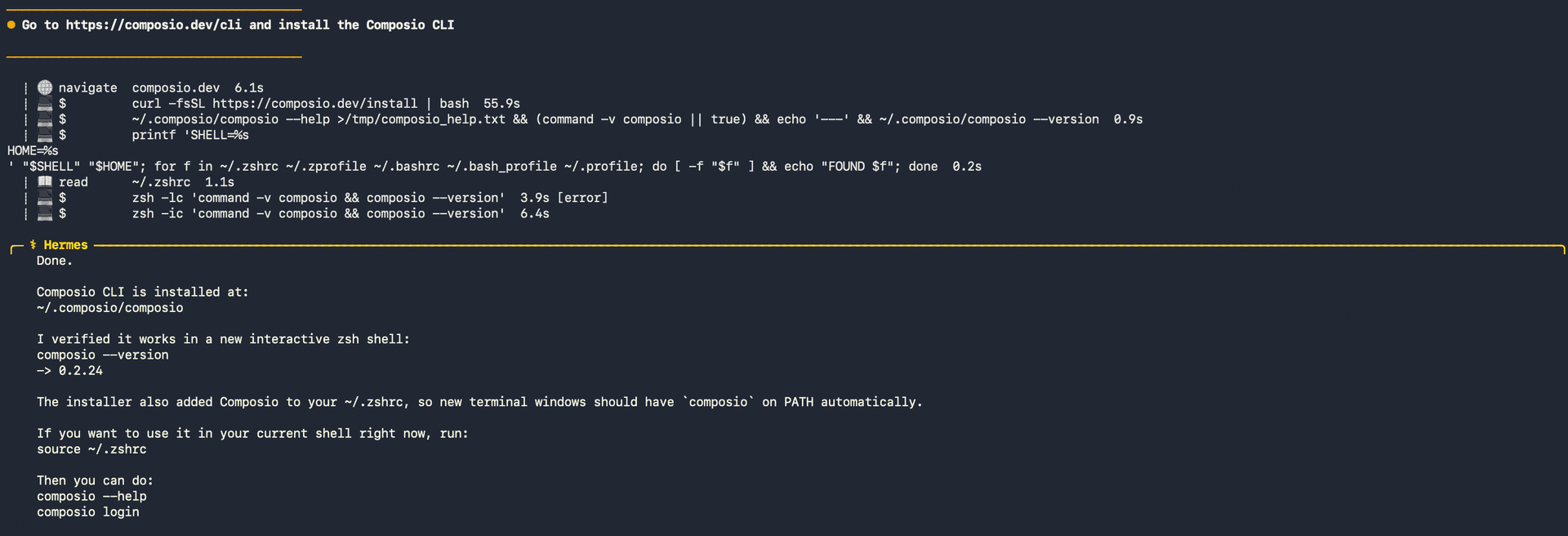
Run the install script directly, or paste https://composio.dev/hermes into your Hermes chat box to have it installed for you.

bash
curl -fsSL https://composio.dev/install | bash
Hermes authenticating with Composio

2. Authenticate

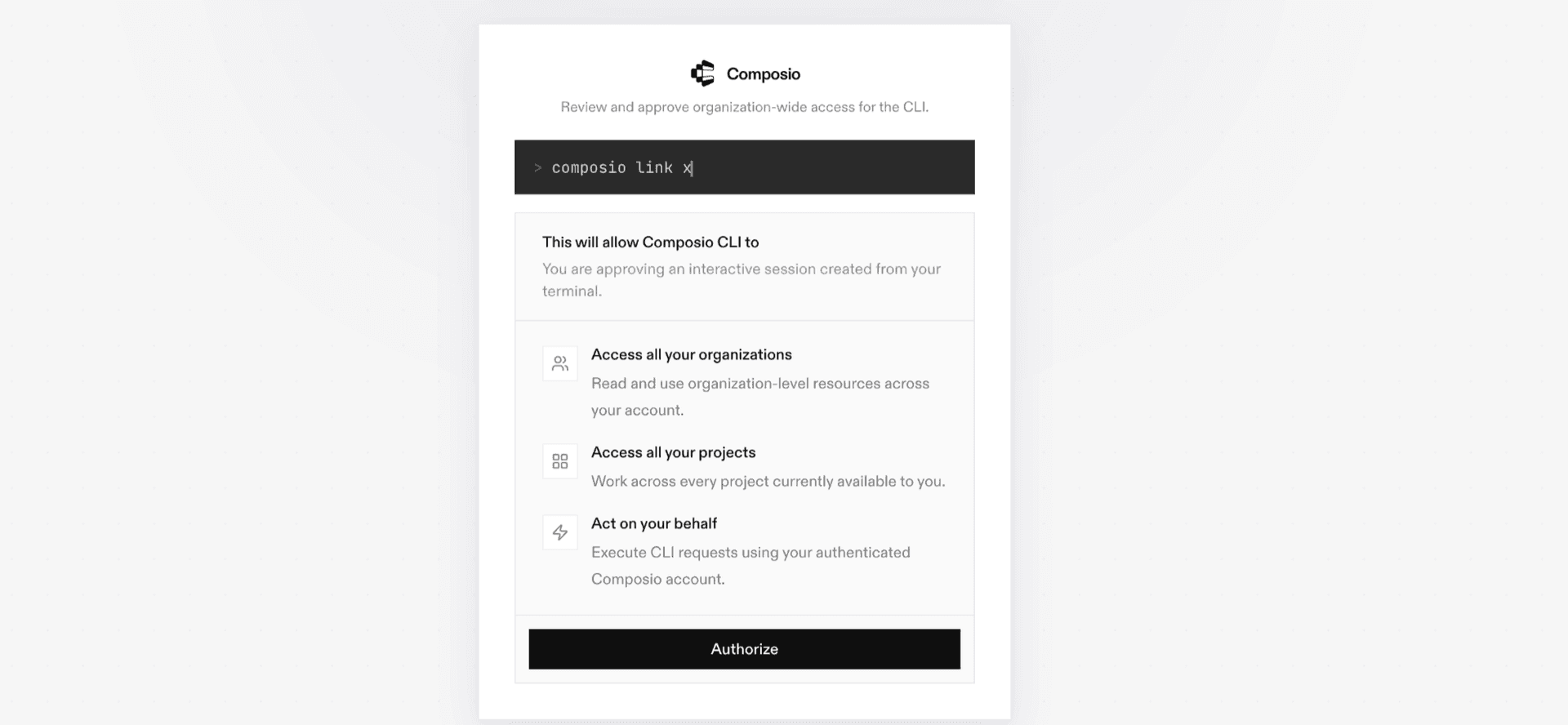
Once the CLI is installed, ask Hermes to authenticate with Composio.

3. Connect to Semrush

Ask your agent to connect to Semrush, or simply request any Semrush-related task. Hermes will prompt you to authenticate and authorize access.

4. Done. You're all set with a new Semrush connection.


Using Composio Connect MCP

1. Get your MCP URL and API Key

Go to dashboard.composio.dev and copy your Connect MCP URL and API key.

Copy MCP URL and API key from Composio dashboard

2. Open the Hermes config file

bash
nano ~/.hermes/config.yaml

3. Add the Composio Connect MCP server

bash
mcp_servers:
  composio:
    url: "https://connect.composio.dev/mcp"
    headers:
      x-consumer-api-key: "YOUR_COMPOSIO_API_KEY"
    connect_timeout: 60
    timeout: 180

Save with Ctrl + O, Enter, then exit with Ctrl + X.

4. Restart your Hermes agent

Once restarted, ask your agent to connect to Semrush or request any Semrush-related task. It will prompt you to authenticate and authorize access.

5. Done!

What is the Semrush MCP server, and what's possible with it?

The Semrush MCP server is an implementation of the Model Context Protocol that connects your AI agent and assistants like Claude, Cursor, etc directly to your Semrush account. It provides structured and secure access so your agent can perform Semrush operations on your behalf.

Way Forward

With Semrush connected, Hermes can now act on your behalf whenever it detects a relevant task or you ask it to.

From here, you can extend Hermes further:

  • Connect more apps: Calendar, Slack, Notion, Linear, and hundreds of others are available through the same Composio Connect setup. Each new integration compounds what Hermes can do for you.
  • Build workflows across tools: Once multiple apps are connected, Hermes can chain actions together — turn an email into a calendar invite, a Slack message into a Linear ticket, or a meeting note into a follow-up draft.
  • Let it learn your patterns: The more you use Hermes, the better it gets at anticipating how you'd handle recurring tasks. Give it feedback on drafts and decisions, and it will adapt.

If you run into trouble or want to share what you've built, join the community or check out the Docs for deeper configuration options.

TOOLS

Supported Tools

Every Semrush MCP action and event your agent gets out of the box.

Audience research

Audience Analytics: visitor profile of a domain — demographics (age, gender, income, education, household size, occupation), audience interests, visitor geography by country, audience overlap between domains, purchase conversion, and top domains by industry category.

Backlinks research

Backlink Analytics: for a single domain's link profile — backlinks, referring domains and IPs, anchor texts, geographic and TLD distribution, Authority Score breakdown, domain and referring-domain categories, and historical trends.

Competitors research

Competitive Research: find who competes with a domain in organic search, paid search, and Google Shopping (PLA); compare keyword overlap and backlink profiles between multiple domains; analyze market rankings and backlink competitors.

Domain overview

Domain Overview: high-level counters for a domain, subdomain, subfolder, or URL — Semrush Rank, keyword/traffic/cost totals, PLA, SERP Features.

Execute report

Execute any Semrush report.

Get report schema

Get parameters for a report.

Keyword research

Keyword Analytics: look up any keyword — search volume, CPC, competition, keyword difficulty, SERP results (organic and paid), related keywords, broad match variations, phrase questions, and ads history.

Organic research

Organic Search Analytics: the actual keywords and pages a domain, subdomain, or URL ranks for in organic search (position, volume, traffic).

Paid search research

Paid Search Analytics: keywords that trigger a domain's paid search (Google Ads) results, ad positions, CPCs, traffic estimates, unique ad copies with titles and descriptions, and historical PPC trends.

Position tracking

Position Tracking: ongoing rank monitoring within pre-configured project campaigns — track how a domain ranks for targeted keywords over time, daily position changes in organic and paid search, visibility trends, and landing page performance, by location and device.

Projects

Project Management: list and inspect your Semrush projects (campaigns) — each project's ID, name, and tracked domain, plus which tools are enabled.

Shopping research

Shopping Analytics: keywords that trigger a domain's Google Shopping (PLA) ads, ad positions, traffic estimates, and unique product listings with titles and prices.

Site audit

Site Audit: technical SEO health analysis within pre-configured project campaigns — crawl a website to find errors, warnings, and notices, site health score, page-level issue details with fix recommendations, and historical audit snapshots to track progress.

Traffic overview

Traffic Overview: website traffic volume and engagement — total visits, unique visitors, pages per visit, bounce rate, visit duration, daily/weekly trends, acquisition channels (direct, referral, search, social, paid), traffic destinations, top pages, subdomain and subfolder breakdown.

FRAMEWORKS

How to build Semrush MCP Agent with another framework

FAQ

Frequently asked questions

With a standalone Semrush MCP server, the agents and LLMs can only access a fixed set of Semrush tools tied to that server. However, with the Composio Tool Router, agents can dynamically load tools from Semrush and many other apps based on the task at hand, all through a single MCP endpoint.

Yes, you can. Hermes fully supports MCP integration. You get structured tool calling, message history handling, and model orchestration while Tool Router takes care of discovering and serving the right Semrush tools.

Yes, absolutely. You can configure which Semrush scopes and actions are allowed when connecting your account to Composio. You can also bring your own OAuth credentials or API configuration so you keep full control over what the agent can do.

All sensitive data such as tokens, keys, and configuration is fully encrypted at rest and in transit. Composio is SOC 2 Type 2 compliant and follows strict security practices so your Semrush data and credentials are handled as safely as possible.

Start with Semrush MCP.It takes 30 seconds.

Managed auth, hosted MCP servers, and every Semrush MCP tool your agent needs.Free to start.

Start building