How to integrate RunPod MCP with Hermes

Connect Hermes to RunPod MCP. Launch a new gpu pod for inference, get status of all active pods, and more using natural language, with authentication handled for you.

RunPod logoRunPod
Api Key

RunPod is a GPU cloud platform designed for AI and machine learning workloads. Instantly access scalable compute power for demanding AI tasks.

13 Tools

Introduction

Hermes is a 24/7 autonomous agent that lives on your computer or server — it remembers what it learns and evolves as your usage grows.

This guide explains the easiest and most robust way to connect your RunPod account to Hermes. You can do this through either Composio Connect CLI or Composio Connect MCP. For personal use we recommend the CLI, but you won't go wrong with MCP either.

For exact tool slugs and parameter tables, see the tool catalog in the Composio docs.

Also integrate RunPod with

What is Composio Connect?

Composio Connect is a consumer offering that lets anyone plug 2,000+ applications directly into their agent harness — including Hermes. It can:

  • Search and load tools from relevant toolkits on-demand, reducing context usage.
  • Chain multiple tools to accomplish complex workflows via a remote workbench, without excessive back-and-forth with the LLM.
  • Manage app authentication end-to-end with zero manual overhead.

Integrating RunPod with Hermes

Using Composio Connect CLI

1. Install the Composio CLI

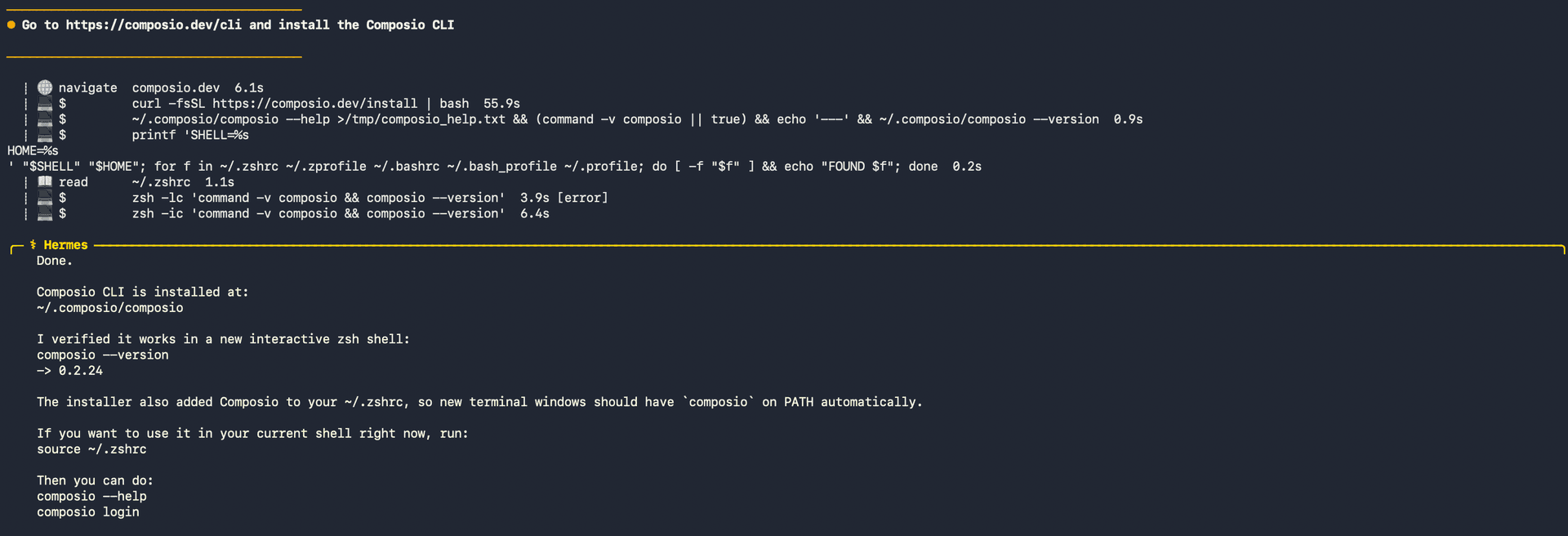
Run the install script directly, or paste https://composio.dev/hermes into your Hermes chat box to have it installed for you.

bash
curl -fsSL https://composio.dev/install | bash
Hermes authenticating with Composio

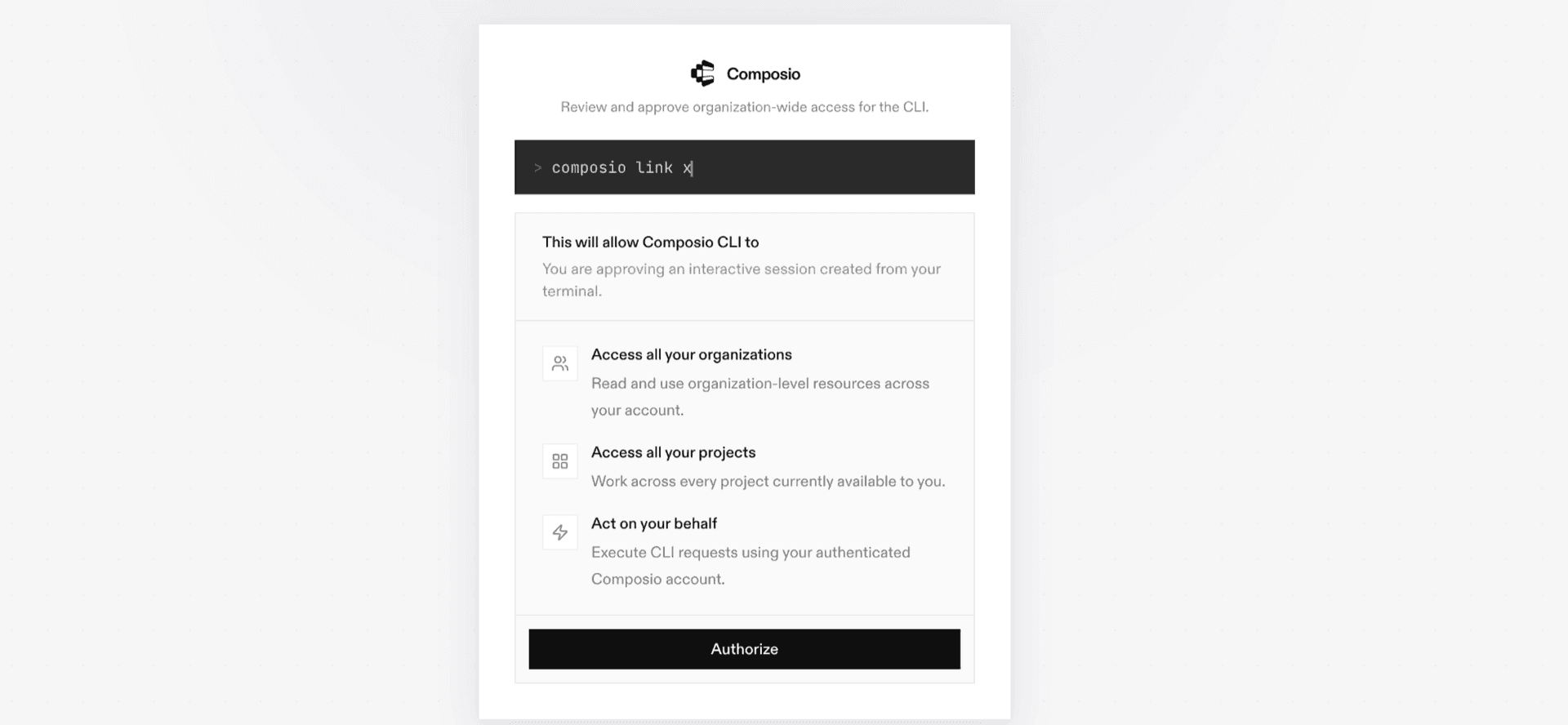
2. Authenticate

Once the CLI is installed, ask Hermes to authenticate with Composio.

3. Connect to RunPod

Ask your agent to connect to RunPod, or simply request any RunPod-related task. Hermes will prompt you to authenticate and authorize access.

4. Done. You're all set with a new RunPod connection.


Using Composio Connect MCP

1. Get your MCP URL and API Key

Go to dashboard.composio.dev and copy your Connect MCP URL and API key.

Copy MCP URL and API key from Composio dashboard

2. Open the Hermes config file

bash
nano ~/.hermes/config.yaml

3. Add the Composio Connect MCP server

bash
mcp_servers:
  composio:
    url: "https://connect.composio.dev/mcp"
    headers:
      x-consumer-api-key: "YOUR_COMPOSIO_API_KEY"
    connect_timeout: 60
    timeout: 180

Save with Ctrl + O, Enter, then exit with Ctrl + X.

4. Restart your Hermes agent

Once restarted, ask your agent to connect to RunPod or request any RunPod-related task. It will prompt you to authenticate and authorize access.

5. Done!

What is the RunPod MCP server, and what's possible with it?

The RunPod MCP server is an implementation of the Model Context Protocol that connects your AI agent and assistants like Claude, Cursor, etc directly to your RunPod account. It provides structured and secure access to your GPU cloud resources and account settings, so your agent can compare compute options, inspect pods, configure clusters and serverless workloads, and manage templates, credentials, and settings on your behalf.

  • Compute selection and pod inspection: Have your agent compare available GPU and CPU types, review pricing and availability, and inspect the details of a specific pod.
  • GPU cluster creation: Direct your agent to create GPU clusters for multi-node distributed computing and machine learning workloads.
  • Serverless workload configuration: Let the agent create or update serverless workloads with the GPU, scaling, and capacity settings you need.
  • Templates and credential management: Instruct your agent to create, update, or remove container templates, manage private container registry access, and store secure secrets.
  • Account and security settings: Have your agent retrieve your account information or update user settings such as your SSH public key.

Way Forward

With RunPod connected, Hermes can now act on your behalf whenever it detects a relevant task or you ask it to.

From here, you can extend Hermes further:

  • Connect more apps: Calendar, Slack, Notion, Linear, and hundreds of others are available through the same Composio Connect setup. Each new integration compounds what Hermes can do for you.
  • Build workflows across tools: Once multiple apps are connected, Hermes can chain actions together — turn an email into a calendar invite, a Slack message into a Linear ticket, or a meeting note into a follow-up draft.
  • Let it learn your patterns: The more you use Hermes, the better it gets at anticipating how you'd handle recurring tasks. Give it feedback on drafts and decisions, and it will adapt.

If you run into trouble or want to share what you've built, join the community or check out the Docs for deeper configuration options.

TOOLS

Supported Tools

Every RunPod action and event your agent gets out of the box.

Create RunPod Cluster

Tool to create a new GPU cluster for multi-node distributed computing workloads on RunPod.

Create Secret

Tool to create a new secure secret in RunPod for credential management.

Delete Container Registry Authentication

Tool to delete container registry authentication from RunPod.

Delete Template

Tool to remove a RunPod template via GraphQL mutation.

Get GPU Types

Tool to retrieve available GPU types and their specifications, pricing, and availability from RunPod.

Get authenticated user info

Retrieve basic information about the authenticated Runpod user, including ID, email, terms of service status, and MFA settings.

Get Pod Details

Retrieve a Runpod pod by ID, including its configuration, GPU count, memory, hourly cost, and desired status.

List CPU Types

Tool to retrieve available CPU types and their specifications from RunPod.

Save Serverless Endpoint

Tool to create or update a RunPod serverless endpoint with GPU configuration and scaling settings.

Save Container Registry Authentication

Tool to save container registry authentication credentials for accessing private Docker images in RunPod.

Save Template

Create or update a Runpod template with container configuration for pods or serverless endpoints; set the volume size to 0 for serverless templates.

Update Registry Auth

Update an existing Runpod container registry authentication credential by supplying its ID, username, and password.

Update User Settings

Update the authenticated Runpod user's SSH public key for pod access.

FAQ

Frequently asked questions

Start with RunPod.It takes 30 seconds.

Managed auth, hosted MCP servers, and every RunPod tool your agent needs.Free to start.

Start building