How to connect openFDA to Claude

Connect Claude Web, Desktop and Cowork to openFDA MCP. Search fda adverse event reports by drug, find drug labels with active ingredients, and more using natural language, with authentication handled for you.

openFDA logoopenFDA
Api Key

openFDA is the U.S. FDA's public API for drug and medical device data. It makes regulatory, safety, labeling, and recall information easy to access.

16 Tools

Introduction

Claude is Anthropic's AI assistant, available on the web, in the desktop app, and on mobile. Cowork is its agent for knowledge work, and it runs on all of those surfaces too. Connected to your apps, Claude can work with your files and services to accomplish complex tasks on your behalf.

This guide walks you through the easiest and most secure way to connect your openFDA account to Claude via Composio Connect, enabling it to search FDA adverse event reports by drug, find drug labels with active ingredients, check medical device recalls by manufacturer, and more such actions on your behalf without compromising your account security.

Setup is the same on Claude Web, Desktop, and Cowork, and you only need to do it once. The connector is tied to your account, so it's available in all three.

For exact tool slugs and parameter tables, see the tool catalog in the Composio docs.

Also integrate openFDA with

Connecting openFDA to Claude Web, Desktop, and Cowork

Two ways to add the Composio connector. Pick whichever you prefer.

1. Add with one click

Click the button. Claude opens with the Composio connector filled in. Click Add, then go to step 2.

Add to Claude

Add manually

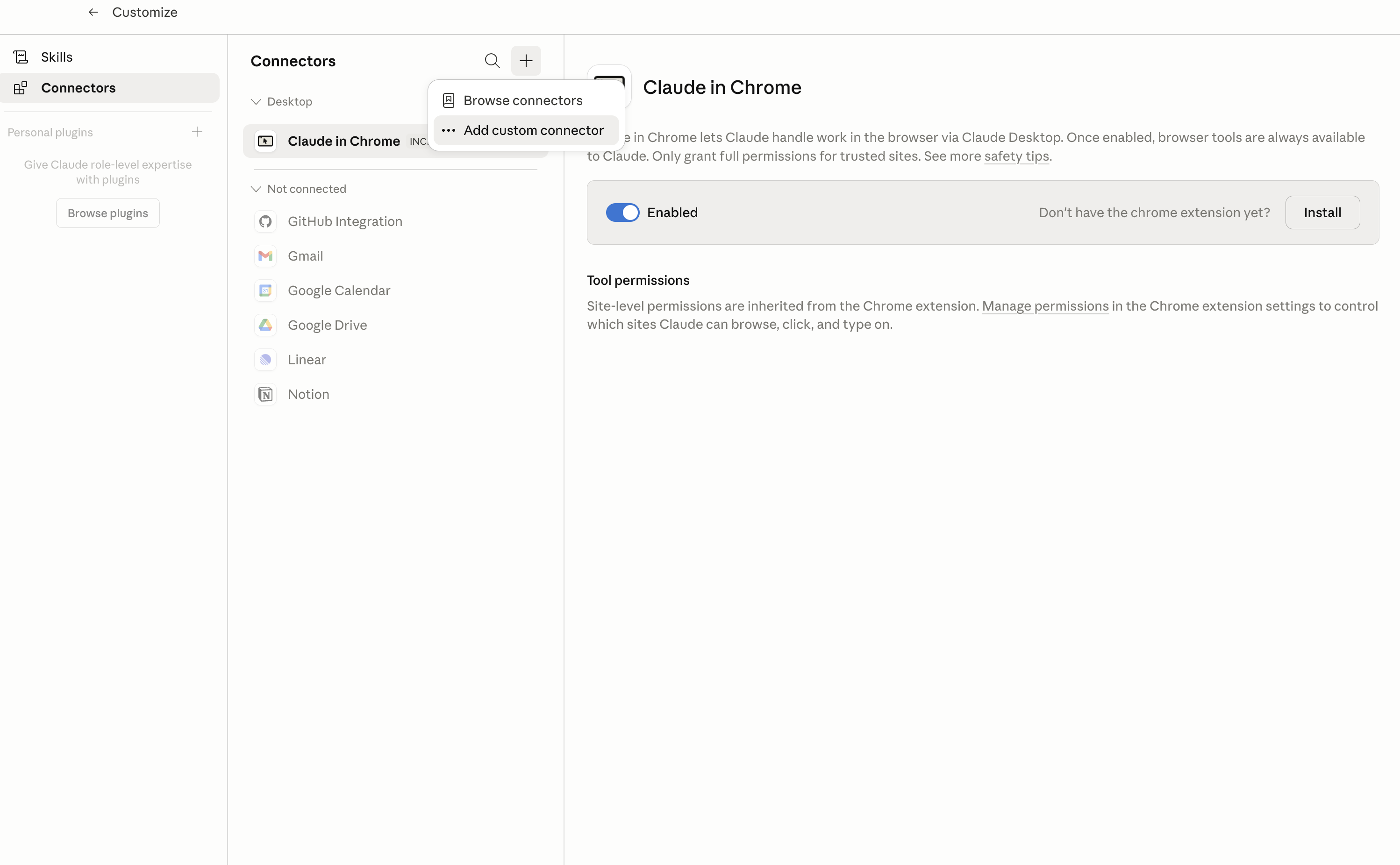
In Claude Desktop, click Customize in the left sidebar, then select Connectors and click the + icon at the top.

Claude Desktop connectors screen with Add custom connector selected

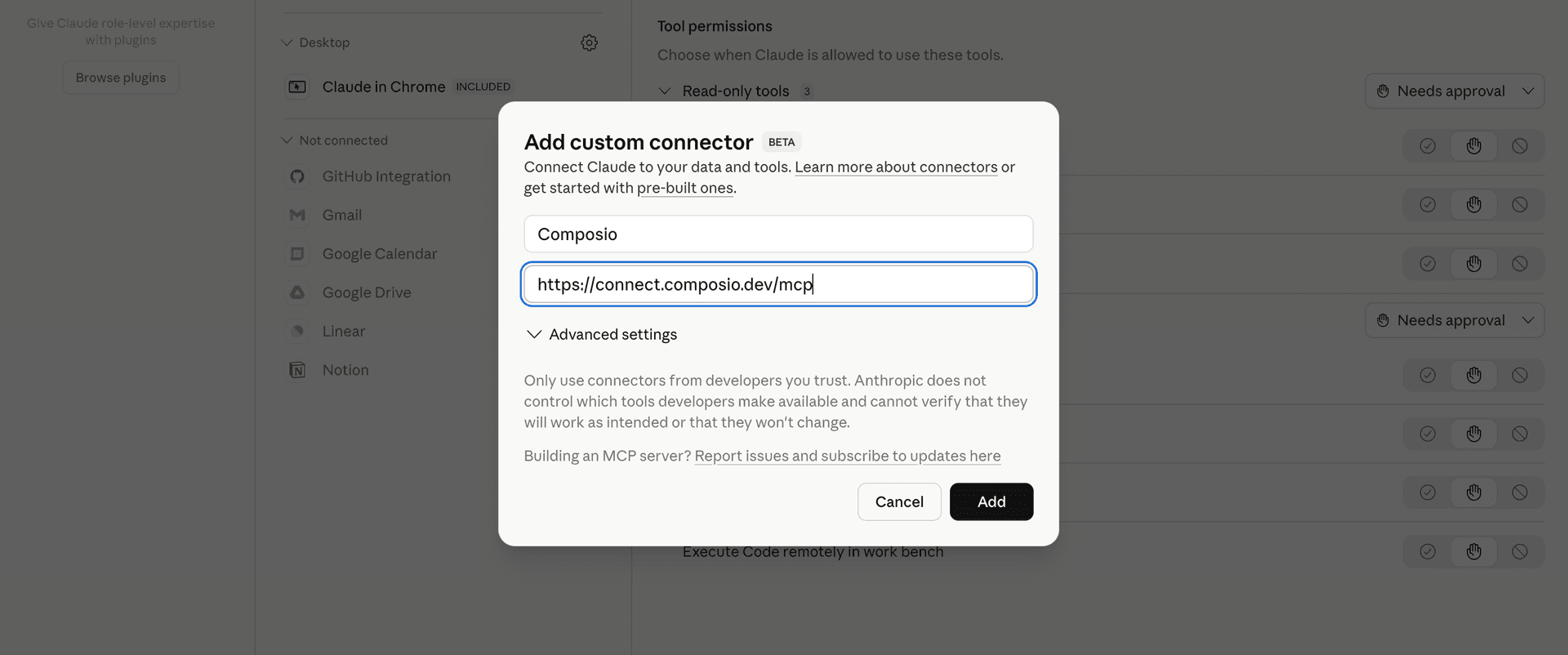
Click Add custom connector and paste in the Composio MCP server URL:

bash
https://connect.composio.dev/mcp
Add custom connector dialog with Composio MCP server URL

2. Authorize in your browser

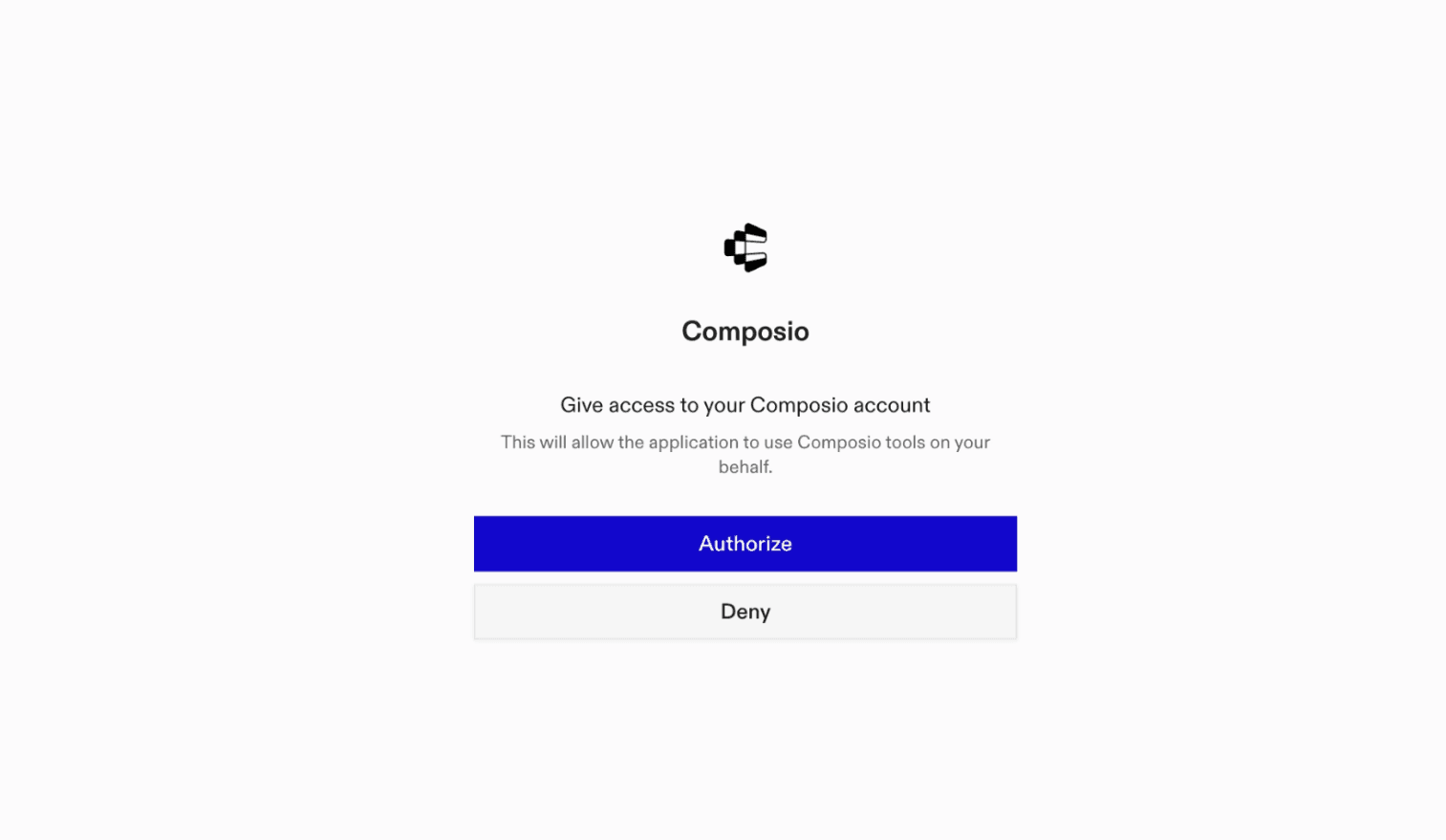
Click Connect. You'll be redirected to a browser window where you can authorize Composio to continue.

Composio authorization screen for Claude Web, Desktop, and Cowork

3. Connect your openFDA account

Back in Claude, ask it to connect to openFDA or give it any openFDA-related task.

For example, ask Claude to:

  • "Search FDA adverse event reports by drug"
  • "Find drug labels with active ingredients"
  • "Check medical device recalls by manufacturer"

It will prompt you to authenticate and authorize access.

That's it. Composio's tools are now available in Claude, and your openFDA account is ready to use.

What is the openFDA Claude Connector, and what's possible with it?

The openFDA MCP server is an implementation of the Model Context Protocol that connects your AI agent and assistants like Claude, Cursor, etc directly to your openFDA account. It provides structured and secure access to public FDA drug and medical device datasets, so your agent can search adverse events, review drug labels and approvals, track recalls and shortages, and analyze medical device records on your behalf.

  • Drug safety and labeling research: Have your agent search drug adverse event reports, medication errors, labels, ingredients, warnings, indications, and dosage information.
  • Medical device oversight: Let the agent find device adverse events, 510(k) clearances, PMA approvals, classifications, UDI records, registrations, and listings.
  • Recall and shortage tracking: Direct your agent to search drug and device recall reports, including status, reason, recalling firm, distribution, and enforcement dates, or find current and historical drug shortages.
  • Drug approval and product research: Instruct your agent to search Drugs@FDA applications, Orange Book products, therapeutic-equivalence data, and National Drug Code directory records.
  • FDA data analysis: Have your agent count records by supported fields across drug and device datasets to compare trends, products, manufacturers, classifications, or report categories.

Troubleshooting

1. Why does Claude not use the Composio connector for openFDA?

The connector can show as connected, but Claude must use it in each openFDA conversation.

  • Click + at the lower left of the chat, or type /.
  • Hover Connectors.
  • Turn on Composio.
  • Ask Claude to connect to openFDA again.

2. Why does Claude show an MCP server error before openFDA connects?

Claude can show Couldn't reach the MCP server or Authorization with the MCP server failed when you add the connector for openFDA.

  • Check that the connector URL is https://connect.composio.dev/mcp.
  • Connectors run from Anthropic's cloud, so your device network is usually not the problem.
  • Add the connector again from Customize > Connectors, then ask Claude to connect openFDA.
  • If it fails again, send the error and the ofid_ reference id to support@composio.dev.

3. Why does the openFDA authorization link not work?

The Composio connector is one server. Your openFDA account connects separately when Claude asks for it.

  • If the browser does not open, or the link expires, ask Claude to retry the openFDA connection.
  • Composio creates a fresh openFDA authorization link.
  • Open that link in your browser and finish the openFDA sign-in.

4. Why do openFDA actions fail after they worked before?

The openFDA connection can expire or lose permission.

  • Ask Claude to inspect the openFDA connection.
  • If the connection is unhealthy, disconnect it when Claude prompts you.
  • Reconnect the openFDA account and retry the action.
  • If Claude shows a permission prompt, approve it before Claude changes data in openFDA.
  • If the action still fails with a permission error, check that the connected account has that permission in openFDA itself.

5. How do I switch to a different openFDA account?

Claude can manage the openFDA connection for you.

  • Ask Claude to disconnect or delete the current openFDA account.
  • Ask Claude to connect openFDA again.
  • Open the new Composio authorization link for openFDA.
  • Sign in with the other openFDA account in the browser.
  • After the account connects, ask Claude to retry the openFDA task.

6. Why is my openFDA connection missing in Claude Desktop or on a Team plan?

The connector belongs to your Claude account, so your openFDA connection works in Claude Web, Desktop, and Cowork.

  • In Claude Desktop, open Customize > Connectors.
  • Next to Composio, click ⋮ and click Clear cache.
  • If openFDA tools still do not appear, click ⋮, disconnect, remove the connector, and add it again.
  • On Team or Enterprise, an Owner or Primary Owner must enable the connector before you can connect openFDA.
TOOLS

Supported Tools

Every openFDA action and event your agent gets out of the box.

Query Device 510(k) Clearances

Search FDA 510(k) premarket notification clearances for medical devices, including applicants, product codes, decision data, and clearance type, or count clearances by a field.

Query Device Adverse Events

Search FDA MAUDE medical device adverse event reports, including device, patient, event, manufacturer, and narrative data, or count reports by a field.

Query Device Classifications

Search FDA medical device product classifications, including product codes, device class, specialty, regulation, and exemptions, or count classifications by a field.

Query Device COVID-19 Serology Evaluations

Search independent US government evaluations of COVID-19 serological test devices and assay results, or count evaluations by a field.

Query Device PMA Approvals

Search FDA premarket approval applications and supplements for medical devices, including applicants, trade names, product codes, and decision data, or count approvals by a field.

Query Device Recall Enforcement Reports

Search FDA medical device recall enforcement reports, including classification, status, recalling firm, reason, distribution, and enforcement dates, or count reports by a field.

Query Device Recall Records

Search FDA medical device recall records with product, root-cause, corrective-action, contact, and recall-event details, or count recall records by a field; use the enforcement-report action for Recall Enterprise System enforcement classifications and status.

Query Device Registrations and Listings

Search FDA medical device establishment registrations and device listings, including establishment types, products, proprietary names, and premarket numbers, or count records by a field.

Query Device UDI Records

Search FDA Global Unique Device Identification Database records by device identifier, brand, model, company, product code, or other fields, or count UDI records by a field.

Query Drug Adverse Events

Search FDA FAERS drug adverse event and medication error reports, or count reports by a field.

Query Drug Labels

Search prescription and over-the-counter Structured Product Labeling records, including warnings, indications, ingredients, and dosage text, or count labels by a field.

Query Drug NDC Directory

Search National Drug Code Directory product and package records by NDC, name, labeler, ingredient, route, or other fields, or count products by a field.

Query Drug Recall Enforcement Reports

Search FDA drug recall enforcement reports, including classification, status, recalling firm, reason, distribution, and enforcement dates, or count reports by a field.

Query Drugs@FDA Applications

Search Drugs@FDA applications, sponsors, products, and submissions, or count applications by a field.

Query Drug Shortages

Search current and historical FDA drug shortage records, including status, availability, presentation, company, and update dates, or count shortages by a field.

Query Orange Book Drug Products

Search Orange Book approved drug products and therapeutic-equivalence data, or count products by a field.

FAQ

Frequently asked questions

Start with openFDA.It takes 30 seconds.

Managed auth, hosted MCP servers, and every openFDA tool your agent needs.Free to start.

Start building