How to connect Notion to Grok Bot

Connect Grok Bot to Notion MCP. Add meeting notes to project wiki page, create a new task database for q3, and more using natural language, with authentication handled for you.

Notion logoNotion
Oauth2Api Key

Notion is a collaborative workspace for notes, docs, wikis, and tasks. It streamlines team knowledge, project tracking, and workflow customization in one place.

45 Tools13 Triggers

Introduction

Grok is xAI's assistant, and its bot builder lets you create a personal agent that holds context, runs skills, and connects to the apps you already use through plugins.

This guide explains how to connect Notion to a Grok bot using Composio Connect, which handles OAuth, token refresh, and reliability so you do not have to. You add Composio as a plugin, authenticate once, then ask your bot to work with Notion in plain language.

Also integrate Notion with

Why use Composio?

Composio exposes 1,000+ apps to your Grok bot through a single connection, so you get:

  • Connect to 1,000+ apps with on-demand tool loading, so you do not fill your context window with unnecessary tool definitions.
  • Use programmatic tool calling through a remote workbench, letting the model write its own code to handle complex tool chaining. This reduces back-and-forth for frequent tool calls.
  • Handle large tool responses outside the model context to keep conversations lean.

Connecting Notion to Grok Bot

Once Grok Bot is set up, you connect Notion entirely from its interface, and the whole flow takes under a minute.

Set up Grok Bot

1. Get access. Grok Bot is included with a paid Cursor plan (Cursor Pro, Pro+, or Ultra) or a Cursor Teams seat. You can also grant usage by linking an individual SuperGrok, SuperGrok Plus, or SuperGrok Heavy subscription to your Cursor account.

2. Download and sign in. Get the Grok Bot desktop app for macOS or Windows from x.ai/bot, then sign in with your Cursor account. An iPhone companion app is also available, and your bots sync across devices.

3. Create a bot. Pick a suggested role or define your own, then give it a short name, one primary job, and a short description of how it should work. Focused bots work best, because a clear role gives the bot more useful context over time.

Connect Notion

1. Open Plugins

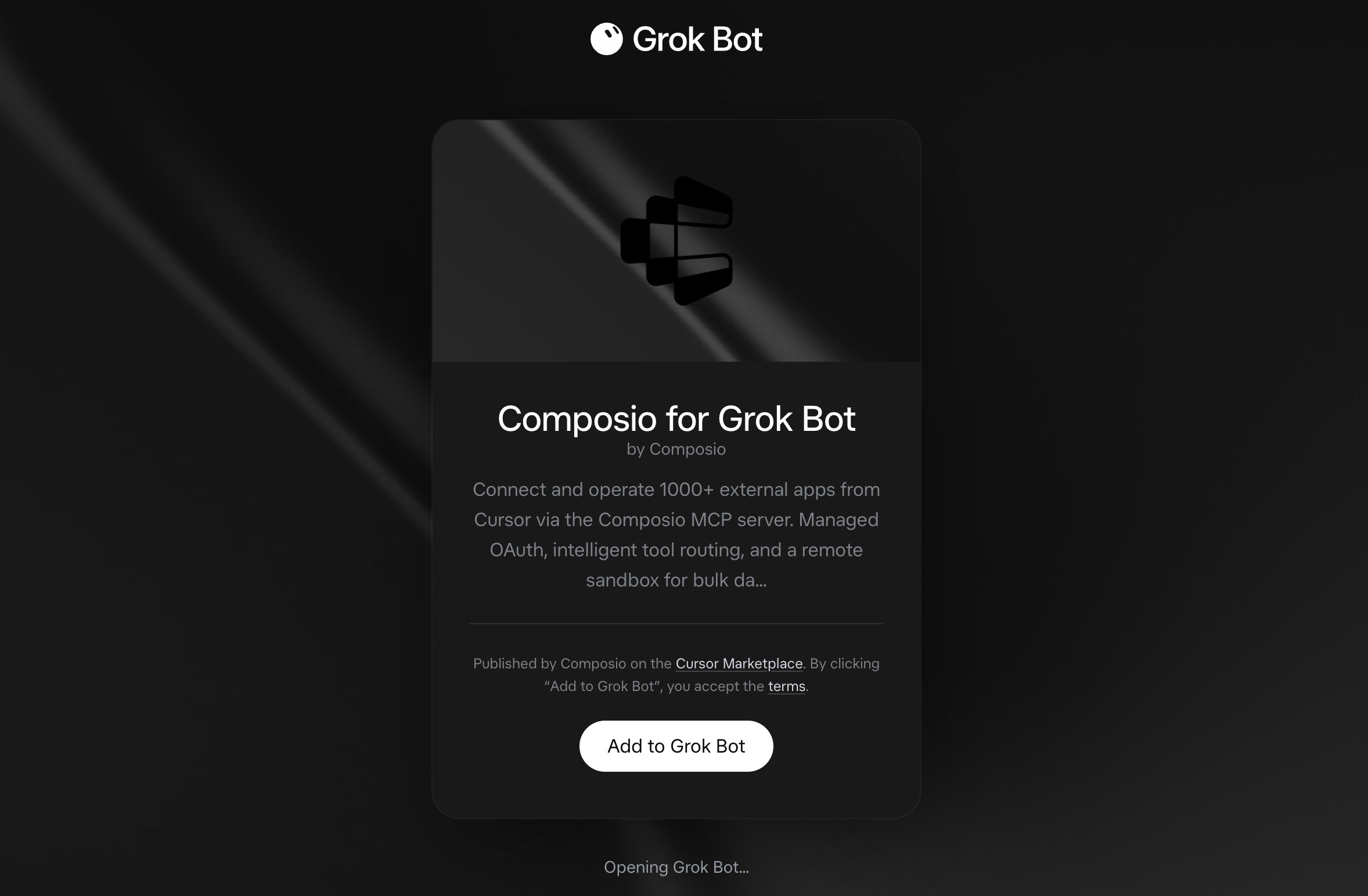
Open the Grok bot you want to connect to Notion, then click Plugins in the left sidebar to open the plugin marketplace.

Grok Bot plugin marketplace with the Composio plugin

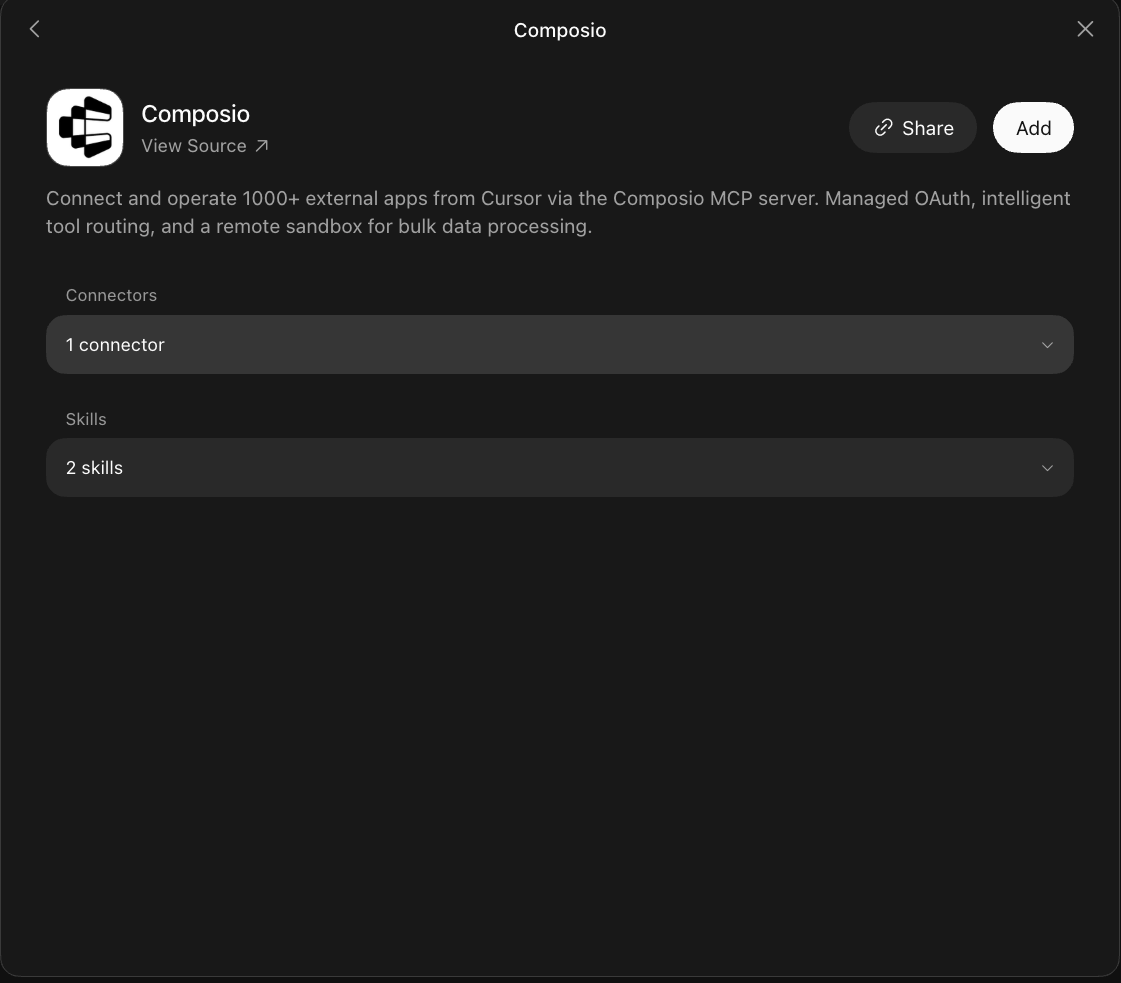
2. Search for Composio and add it

Type Composio into the Search plugins box and click Add on the Composio result. It then shows under 1 installed at the top of the marketplace.

Grok Bot plugin marketplace showing Composio under 1 installed

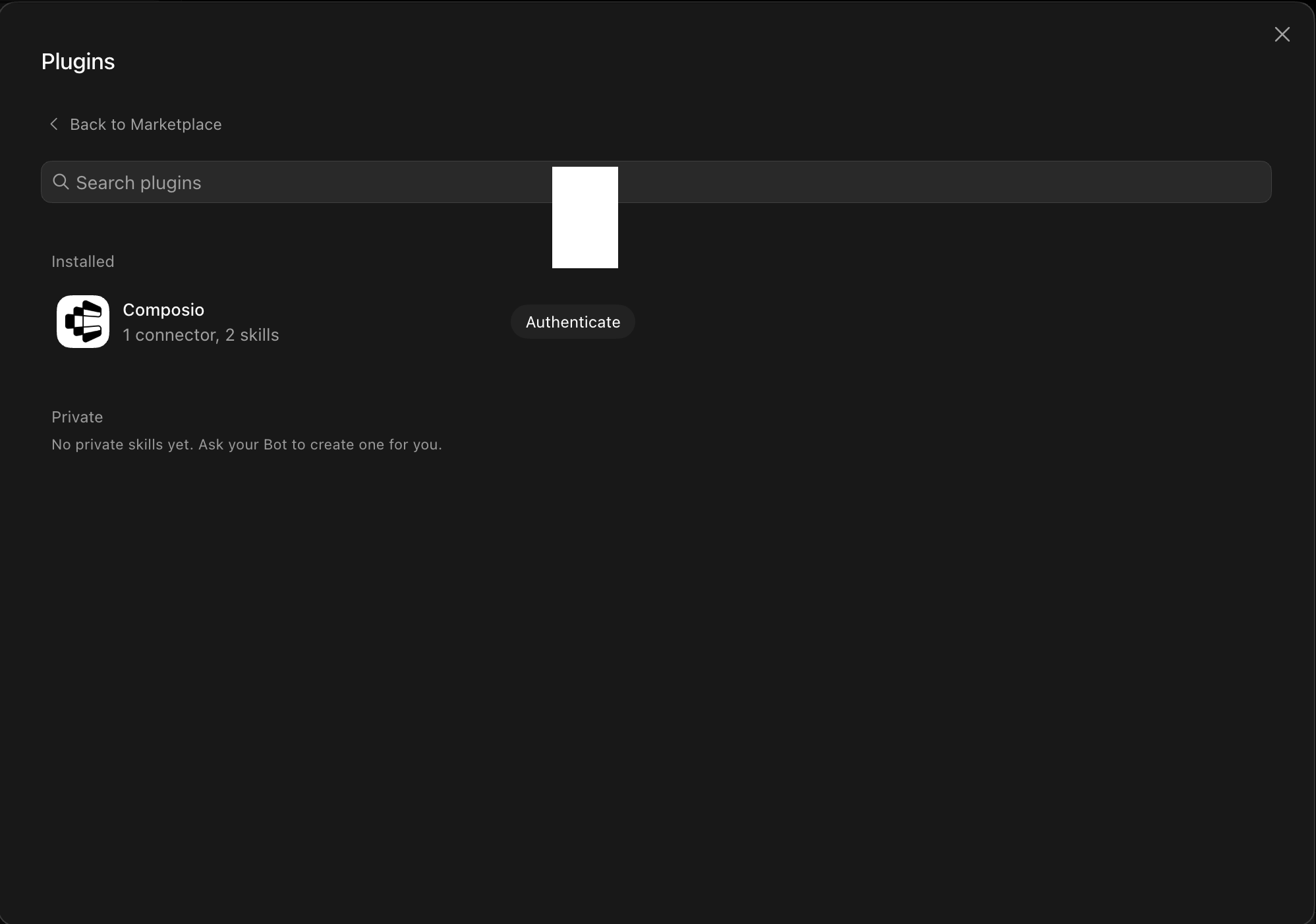
3. Open the installed plugin

Go to the Installed section and click the Composio entry. You'll see its connector and skills listed (for example, 1 connector, 2 skills).

Installed Composio plugin showing the Authenticate button

4. Authenticate

Click Authenticate. You'll be taken to the Composio consent screen. Review the access it requests and click Authorize. Composio handles the OAuth handshake for you, so you never touch API keys or tokens.
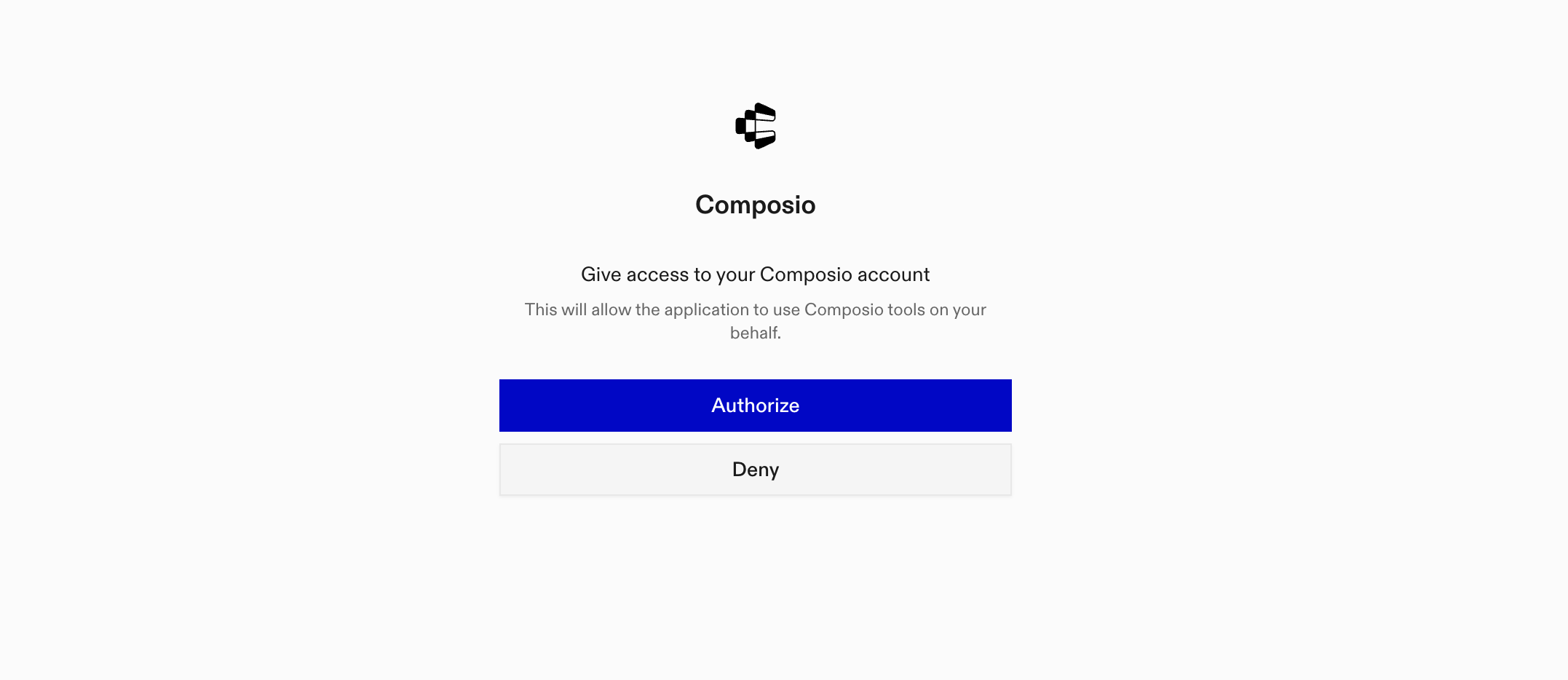
Composio authorization screen with Authorize and Deny

5. Connect your Notion account

Back in the chat, ask your bot to connect to Notion or give it any Notion task.

For example, ask it to:

  • "Add meeting notes to project wiki page"
  • "Create a new task database for Q3"
  • "Archive completed sprint summary pages"

It will prompt you to authenticate and authorize access.

That's it. Composio's tools are now available in your Grok bot, and your Notion account is ready to use.

What is Grok Bot?

Grok is xAI's assistant, available as a chat interface and a bot builder for creating personal agents that run skills and connect to external apps.

With Composio Connect, your Grok bot can securely access apps like Notion through MCP without you sharing account credentials directly with the agent.

What is the Notion MCP server, and what's possible with it?

The Notion MCP server is an implementation of the Model Context Protocol that connects your AI agent and assistants like Claude, Cursor, etc directly to your Notion account. It provides structured and secure access to your notes, docs, wikis, and tasks, so your agent can perform actions like creating pages, managing databases, adding content, commenting, and organizing your Notion workspace for you.

  • Bulk content creation and formatting: Let your agent efficiently add and format multiple blocks of text, lists, or markdown content to Notion pages in one go.
  • Automated page and database management: Have your agent create new pages, duplicate existing ones, or set up entire databases with custom properties—no manual setup required.
  • Smart commenting and collaboration: Enable your agent to add comments to pages or discussion threads, making real-time collaboration smoother.
  • Workspace organization and cleanup: Ask your agent to archive, delete, or restore pages and blocks, keeping your workspace tidy and up to date.
  • Deep block and structure retrieval: Direct your agent to fetch metadata, list child blocks, or dig into nested content for analysis, reporting, or workflow automation.

Way Forward

Now that Notion is connected, extend your setup by connecting the other apps you already use every day, so your Grok bot can run true cross-app workflows end to end.

  • Connect Calendar to turn threads into scheduled meetings automatically.
  • Connect Slack or Teams to post summaries, approvals, and alerts where your team works.
  • Connect Notion, Linear, Jira, or Asana to convert requests into tickets, tasks, and docs.
  • Connect Drive, Dropbox, or OneDrive to fetch, file, and share attachments without manual steps.

Start with one workflow you do repeatedly, then keep adding apps as you find new handoffs. With everything behind a single connection, your bot can coordinate multiple tools safely and reliably in one conversation.

TOOLS & TRIGGERS

Supported Tools and Triggers

Every Notion action and event your agent gets out of the box.

Add multiple content blocks (bulk, user-friendly)

Bulk-add content blocks to Notion.

Append code blocks (code, quote, equation)

Append code and technical blocks (code, quote, equation) to a Notion page.

Append layout blocks (divider, TOC, columns)

Append layout blocks (divider, TOC, breadcrumb, columns) to a Notion page.

Append media blocks (image, video, audio, files)

Append media blocks (image, video, audio, file, pdf, embed, bookmark) to a Notion page.

Append table blocks

Append table blocks to a Notion page.

Append task blocks (to-do, toggle, callout)

Append task blocks (to-do, toggle, callout) to a Notion page or block.

Append text blocks (paragraphs, headings, lists)

Append text blocks (paragraphs, headings, lists) to a Notion page.

Archive Notion Page

Archives (moves to trash) or unarchives (restores from trash) a specified Notion page.

Create comment

Adds a comment to a Notion page (via `parent_page_id`) OR to an existing discussion thread (via `discussion_id`); cannot create new discussion threads on specific blocks (inline comments).

Create Notion Database

Creates a new Notion database as a subpage under a specified parent page with a defined properties schema.

Create Notion file upload

Tool to create a Notion FileUpload object and retrieve an upload URL.

Create Notion page

Creates a new page in a Notion workspace under a specified parent page or database.

Delete a block

Archives a Notion block, page, or database using its ID, which sets its 'archived' property to true (like moving to "Trash" in the UI) and allows it to be restored later.

Duplicate page

Duplicates a Notion page, including all its content, properties, and nested blocks, under a specified parent page or workspace.

Fetch All Notion Block Contents

Tool to fetch all child blocks for a given Notion block.

Fetch Notion Block Children

Retrieves a paginated list of direct, first-level child block objects along with contents for a given parent Notion block or page ID; use block IDs from the response for subsequent calls to access deeply nested content.

Fetch Notion block metadata

Fetches metadata for a Notion block (including pages, which are special blocks) using its UUID.

Fetch comments

Fetches unresolved comments for a specified Notion block or page ID.

Fetch Notion Data

Fetches Notion items (pages and/or databases) from the Notion workspace, use this to get minimal data about the items in the workspace with a query or list all items in the workspace with minimal data

Fetch Database

Fetches a Notion database's structural metadata (properties, title, etc.

Fetch database row

Retrieves a Notion database row's properties and metadata; use fetch_block_contents for page content blocks.

Get about user

Retrieves detailed information about a specific Notion user, such as their name, avatar, and email, based on their unique user ID.

Get page markdown

Retrieve a Notion page's full content rendered as Notion-flavored Markdown in a single API call.

Get page property

Call this to get a specific property from a Notion page when you have a valid `page_id` and `property_id`; handles pagination for properties returning multiple items.

Insert row database

Creates a new page (row) in a specified Notion database.

Insert Row From Natural Language

Creates a new row (page) in a Notion database from a natural language description.

List data source templates

Tool to list all templates for a Notion data source.

List Notion file uploads

Tool to retrieve file uploads for the current bot integration, sorted by most recent first.

List users

Retrieves a paginated list of users (excluding guests) from the Notion workspace; the number of users returned per page may be less than the requested `page_size`.

Move Page

Tool to move a Notion page to a new parent (page or database).

Query database

Queries a Notion database to retrieve pages (rows).

Query database with filter

Tool to query a Notion database with server-side filtering, sorting, and pagination.

Query data source

Tool to query a Notion data source.

Replace page content (with backup)

Safely replaces a page's child blocks by optionally backing up current content, deleting existing children, then appending new children in batches.

Retrieve Comment

Tool to retrieve a specific comment by its ID.

Retrieve Database Property

Tool to retrieve a specific property object of a Notion database.

Retrieve Notion file upload

Tool to retrieve details of a Notion File Upload object by its identifier.

Retrieve page

Retrieve a Notion page's properties/metadata (not block content) by page_id.

Search Notion pages and databases

Searches Notion pages and databases by title.

Send file upload

Tool to transmit file contents to Notion for a file upload object.

Update block

Updates existing Notion block's text content.

Update Page

Update page properties, icon, cover, or archive status.

Update Database Row (Page)

Updates a specific row/page within a Notion database by its page UUID (row_id).

Update database schema

Updates an existing Notion database's schema including title, description, and/or properties (columns).

Upsert database rows

Tool to upsert rows in a Notion database by querying for existing rows and creating or updating them.

FAQ

Frequently asked questions

With a standalone Notion MCP server, the agents and LLMs can only access a fixed set of Notion tools tied to that server. However, with the Composio Tool Router, agents can dynamically load tools from Notion and many other apps based on the task at hand, all through a single MCP endpoint.

Yes, you can. Grok Bot fully supports MCP integration. You get structured tool calling, message history handling, and model orchestration while Tool Router takes care of discovering and serving the right Notion tools.

Yes, absolutely. You can configure which Notion scopes and actions are allowed when connecting your account to Composio. You can also bring your own OAuth credentials or API configuration so you keep full control over what the agent can do.

All sensitive data such as tokens, keys, and configuration is fully encrypted at rest and in transit. Composio is SOC 2 Type 2 compliant and follows strict security practices so your Notion data and credentials are handled as safely as possible.

Start with Notion.It takes 30 seconds.

Managed auth, hosted MCP servers, and every Notion tool your agent needs.Free to start.

Start building