How to connect GetDot to Claude

Connect Claude Web, Desktop and Cowork to GetDot MCP. Compare quarterly revenue across connected business sources, summarize product feedback in organizational knowledge, and more using natural language, with authentication handled for you.

GetDot logoGetDot
Api Key

GetDot is an AI data analyst for querying business data and managing organizational knowledge. It helps teams turn connected data into clear answers and evaluate response quality.

42 Tools

Introduction

Claude is Anthropic's AI assistant, available on the web, in the desktop app, and on mobile. Cowork is its agent for knowledge work, and it runs on all of those surfaces too. Connected to your apps, Claude can work with your files and services to accomplish complex tasks on your behalf.

This guide walks you through the easiest and most secure way to connect your GetDot account to Claude via Composio Connect, enabling it to compare quarterly revenue across connected business sources, summarize product feedback in organizational knowledge, evaluate an answer against connected business data, and more such actions on your behalf without compromising your account security.

Setup is the same on Claude Web, Desktop, and Cowork, and you only need to do it once. The connector is tied to your account, so it's available in all three.

For exact tool slugs and parameter tables, see the tool catalog in the Composio docs.

Also integrate GetDot with

Connecting GetDot to Claude Web, Desktop, and Cowork

Two ways to add the Composio connector. Pick whichever you prefer.

1. Add with one click

Click the button. Claude opens with the Composio connector filled in. Click Add, then go to step 2.

Add to Claude

Add manually

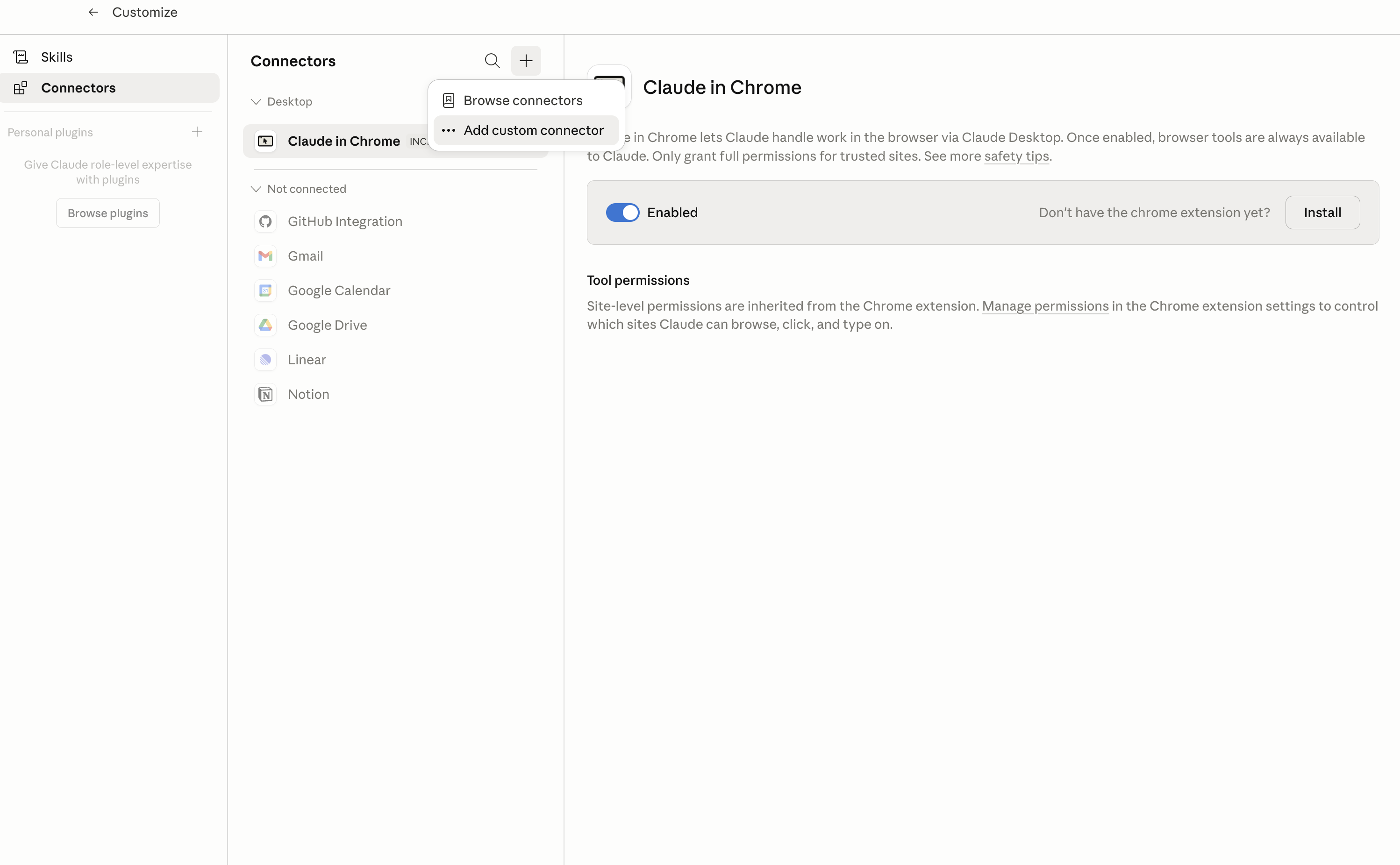
In Claude Desktop, click Customize in the left sidebar, then select Connectors and click the + icon at the top.

Claude Desktop connectors screen with Add custom connector selected

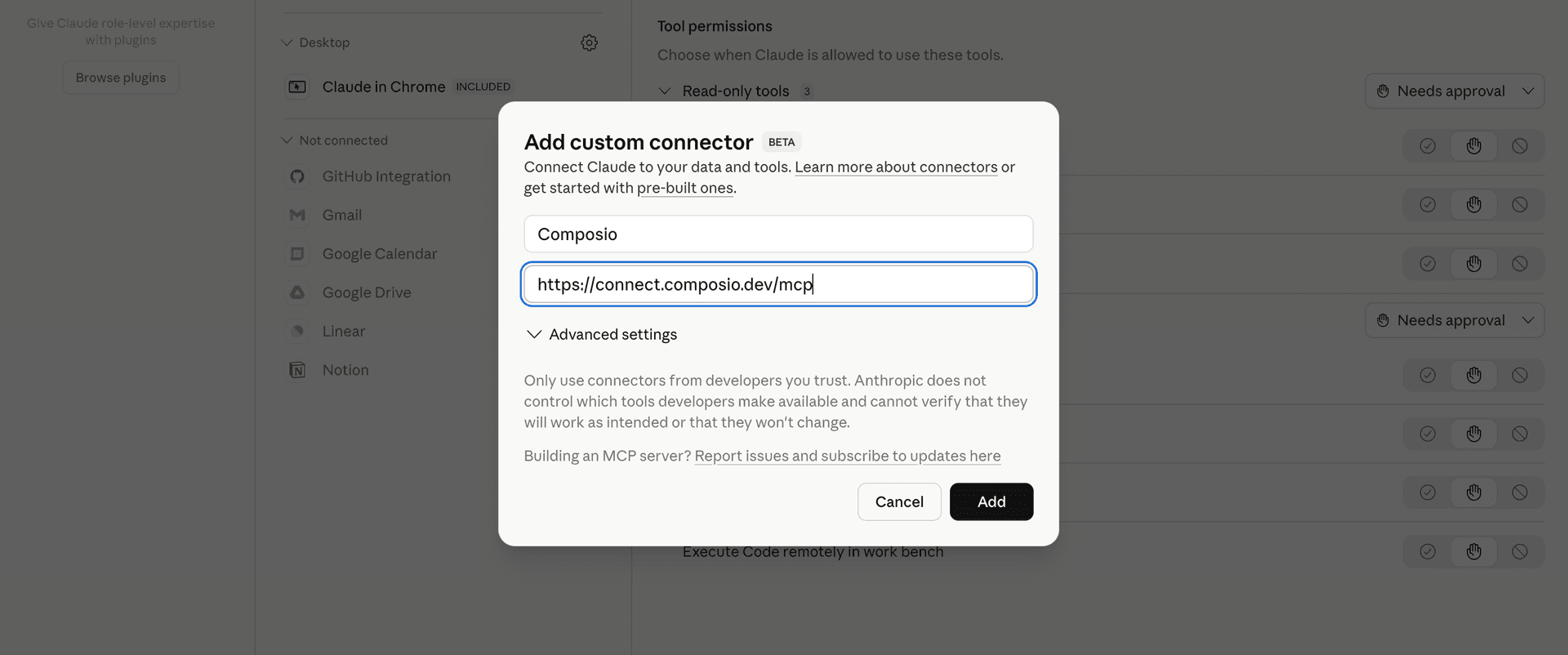
Click Add custom connector and paste in the Composio MCP server URL:

bash
https://connect.composio.dev/mcp
Add custom connector dialog with Composio MCP server URL

2. Authorize in your browser

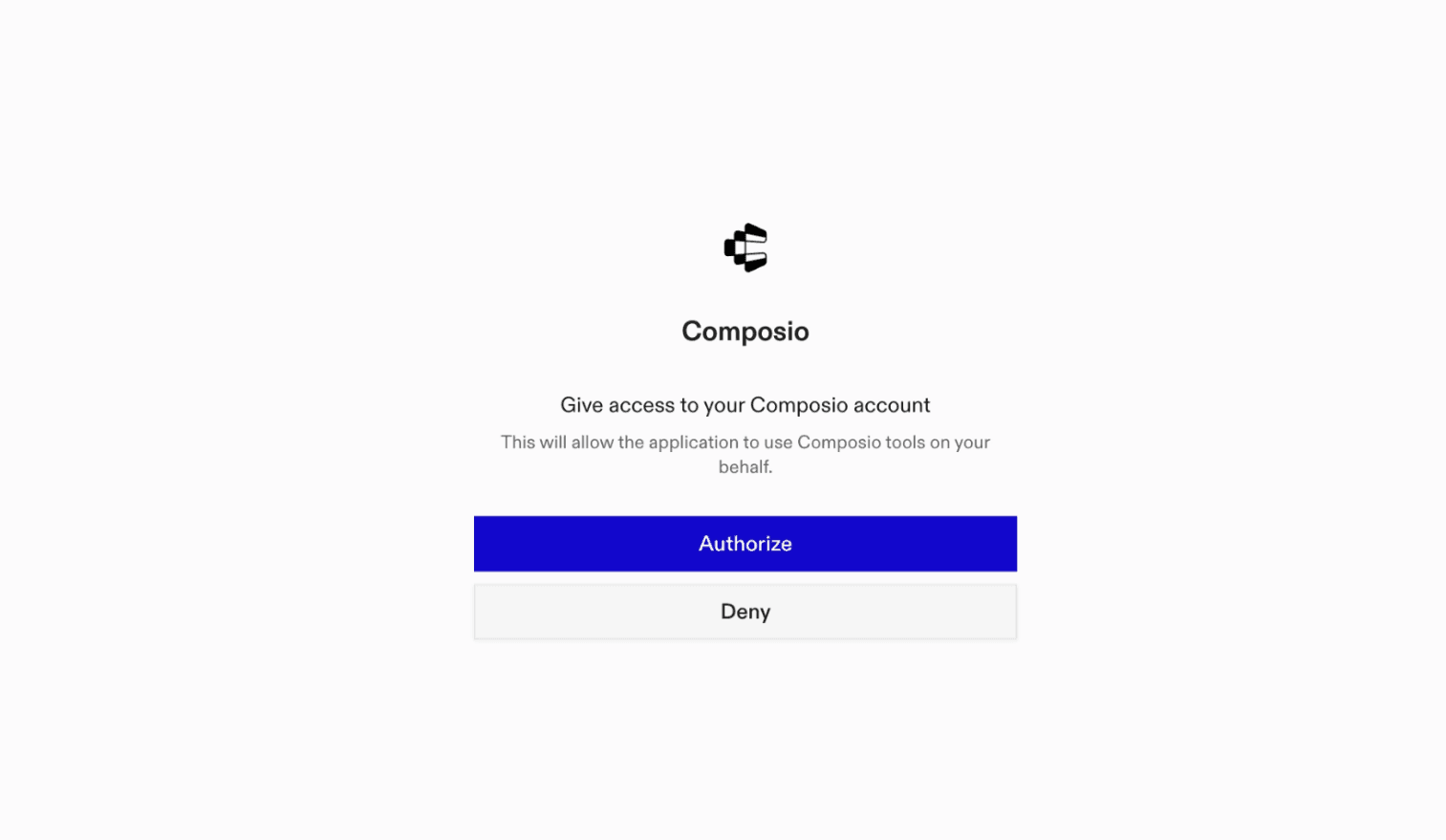
Click Connect. You'll be redirected to a browser window where you can authorize Composio to continue.

Composio authorization screen for Claude Web, Desktop, and Cowork

3. Connect your GetDot account

Back in Claude, ask it to connect to GetDot or give it any GetDot-related task.

For example, ask Claude to:

  • "Compare quarterly revenue across connected business sources"
  • "Summarize product feedback in organizational knowledge"
  • "Evaluate an answer against connected business data"

It will prompt you to authenticate and authorize access.

That's it. Composio's tools are now available in Claude, and your GetDot account is ready to use.

What is the GetDot Claude Connector, and what's possible with it?

The GetDot MCP server is an implementation of the Model Context Protocol that connects your AI agent and assistants like Claude, Cursor, etc directly to your GetDot account. It provides structured and secure access to GetDot's AI data analysis, conversations, organizational knowledge, evaluations, and user management tools, so your agent can ask questions about connected business data, manage knowledge, evaluate answers, and administer users on your behalf.

  • Business data questions: Have your agent ask Dot questions about connected business data, read the resulting conversation, and continue with follow-up questions.
  • Organizational knowledge: Let the agent create, review, and list organization notes, including notes with group visibility, training context, or foundational settings.
  • Answer evaluations: Direct your agent to create evaluations, add scored questions, prepare evaluation content, start runs, and review their results.
  • Evaluation history and configuration: Instruct your agent to list evaluations, inspect questions, variants, versions, and runs, restore an earlier version, or archive an evaluation.
  • User and data connection administration: Have your agent list users, invite or remove them, change roles and group membership, and trigger synchronization for an existing external data connection.

Troubleshooting

1. Why does Claude not use the Composio connector for GetDot?

The connector can show as connected, but Claude must use it in each GetDot conversation.

  • Click + at the lower left of the chat, or type /.
  • Hover Connectors.
  • Turn on Composio.
  • Ask Claude to connect to GetDot again.

2. Why does Claude show an MCP server error before GetDot connects?

Claude can show Couldn't reach the MCP server or Authorization with the MCP server failed when you add the connector for GetDot.

  • Check that the connector URL is https://connect.composio.dev/mcp.
  • Connectors run from Anthropic's cloud, so your device network is usually not the problem.
  • Add the connector again from Customize > Connectors, then ask Claude to connect GetDot.
  • If it fails again, send the error and the ofid_ reference id to support@composio.dev.

3. Why does the GetDot authorization link not work?

The Composio connector is one server. Your GetDot account connects separately when Claude asks for it.

  • If the browser does not open, or the link expires, ask Claude to retry the GetDot connection.
  • Composio creates a fresh GetDot authorization link.
  • Open that link in your browser and finish the GetDot sign-in.

4. Why do GetDot actions fail after they worked before?

The GetDot connection can expire or lose permission.

  • Ask Claude to inspect the GetDot connection.
  • If the connection is unhealthy, disconnect it when Claude prompts you.
  • Reconnect the GetDot account and retry the action.
  • If Claude shows a permission prompt, approve it before Claude changes data in GetDot.
  • If the action still fails with a permission error, check that the connected account has that permission in GetDot itself.

5. How do I switch to a different GetDot account?

Claude can manage the GetDot connection for you.

  • Ask Claude to disconnect or delete the current GetDot account.
  • Ask Claude to connect GetDot again.
  • Open the new Composio authorization link for GetDot.
  • Sign in with the other GetDot account in the browser.
  • After the account connects, ask Claude to retry the GetDot task.

6. Why is my GetDot connection missing in Claude Desktop or on a Team plan?

The connector belongs to your Claude account, so your GetDot connection works in Claude Web, Desktop, and Cowork.

  • In Claude Desktop, open Customize > Connectors.
  • Next to Composio, click ⋮ and click Clear cache.
  • If GetDot tools still do not appear, click ⋮, disconnect, remove the connector, and add it again.
  • On Team or Enterprise, an Owner or Primary Owner must enable the connector before you can connect GetDot.
TOOLS

Supported Tools

Every GetDot action and event your agent gets out of the box.

Add Labels to Conversation

Add the supplied labels to an existing Dot conversation without removing its current labels.

Add User to Group

Add an existing GetDot user to a group.

Archive Evaluation

Archive an existing GetDot evaluation.

Ask Dot

Submit a new question to Dot under a caller-supplied conversation ID and return the processed conversation and readable answer.

Cancel Evaluation Run

Cancel an existing GetDot evaluation run.

Change User Role

Change the organization role assigned to a GetDot user.

Create Evaluation

Create a GetDot evaluation, optionally with structured initial scored questions or a source conversation.

Create Evaluation Interview Chat

Create a specialized GetDot interview conversation for developing an evaluation and return its provider-defined chat payload.

Create Evaluation Question

Add a scored question and expected-answer configuration to an existing GetDot evaluation.

Create Organization Note

Create a GetDot organization note with optional group visibility, hierarchy, concept, foundational setting, and training context.

Create User

Create a GetDot user with an email address and display name.

Delete Evaluation Question

Delete a question from an existing GetDot evaluation.

Delete User

Remove a GetDot user.

Export App Views

Return app viewers, view counts, and the timestamp from which GetDot has tracked views.

Export Chat History CSV

Download a CSV with one row per Dot conversation using the same filters, sorting, and access rules as the History page.

Export Question History

Return question-level Dot history for an optional UTC date range, optionally including answers and all accessible workspaces.

Follow Up With Dot

Ask a follow-up in an existing Dot conversation and return the updated conversation.

Get Conversation

Read or poll one Dot conversation, returning a bounded page of messages and a continuation cursor for older user-response pairs when another page may exist.

Get Current User

Return the GetDot user, organization, role, permissions, allowed energy modes, and plan represented by the connected API token.

Get Embedded User Login Token

Sign a user in from a backend and return a sensitive, expiring access token.

Get Evaluation

Return one GetDot evaluation by ID, including its current configuration and metadata.

Get Evaluation Run

Return the status and results of one GetDot evaluation run by run ID.

Get Evaluation Target

Read the current committed Dot context SHA before configuring a CI evaluation run.

Get Evaluation Unit Options

Return GetDot's available unit options for evaluation answers.

Get Organization Note

Return one organization note by ID in an optional training/version context.

Get Organization Notes Budget

Return GetDot's provider-defined foundational-notes capacity payload for an optional training and version context.

Invite Users

Request GetDot organization invitations for the supplied email addresses.

List Evaluation Questions

List questions in a GetDot evaluation, optionally including inactive questions or selecting a version and environment.

List Evaluation Runs

List runs for one GetDot evaluation; use this to discover run IDs before retrieving an individual run's status and results.

List Evaluations

List GetDot evaluations, optionally including archived evaluations.

List Evaluation Variants

Return provider-defined variant data for an existing GetDot evaluation for read-only comparison of its alternatives.

List Evaluation Versions

Return saved version history for an existing GetDot evaluation; version identifiers can be used with Restore Evaluation Version.

List Organization Notes

List organization notes, optionally restricted to active notes or a training/version context.

List Users

List users visible to the connected GetDot account, including role, groups, activation state, and access scope.

Prepare Evaluation

Prepare evaluation questions from structured questions, metric values, or CSV text.

Remove User from Group

Remove an existing GetDot user's membership from a group without deleting the user or group.

Restore Evaluation Version

Restore a prior version of an existing GetDot evaluation.

Start Evaluation Run

Start a run for an existing GetDot evaluation and return the accepted run.

Sync Connection

Trigger synchronization of an existing external data connection.

Update Evaluation

Update the name and/or description of an existing GetDot evaluation.

Update Evaluation Question

Update fields on an existing GetDot evaluation question.

Update Organization Note

Replace the editable content and settings of an existing GetDot organization note; title and note content are required.

FRAMEWORKS

How to build GetDot MCP Agent with another framework

FAQ

Frequently asked questions

Start with GetDot.It takes 30 seconds.

Managed auth, hosted MCP servers, and every GetDot tool your agent needs.Free to start.

Start building