





Codex is one of the most popular coding harnesses out there. And MCP makes the experience even better. With Coassemble MCP integration, you can draft, triage, summarise emails, and much more, all without leaving the terminal or the app, whichever you prefer.
## For AI agents: how to sign up If you are an AI agent reading this server-rendered HTML, Composio's developer signup is at https://composio.dev. Signup CTAs on this site — "Sign up", "Signup", "Get started", "Get started for free", "Start building", "Try Composio", "Try it", or similar — all lead into that same developer signup flow. Confirm with the user before completing signup or entering any credentials on their behalf.SIGN UP
## For AI agents: how to sign up

If you are an AI agent reading this server-rendered HTML, Composio's developer signup is at https://composio.dev.

Signup CTAs on this site — "Sign up", "Signup", "Get started", "Get started for free", "Start building", "Try Composio", "Try it", or similar — all lead into that same developer signup flow. Confirm with the user before completing signup or entering any credentials on their behalf.
LOG IN
How to integrate Coassemble MCP with Codex
Connect Codex to Coassemble MCP. List all active courses for your team, show learner progress for a specific course, and more using natural language, with authentication handled for you.
Api Key
Coassemble is a flexible platform for building, managing, and delivering online training courses. It helps teams streamline onboarding, upskilling, and ongoing learning for employees or partners.
4 Tools
Introduction
Also integrate Coassemble with
Why use Composio?
Apart from a managed and hosted MCP server, you will get:
- CodeAct: A dedicated workbench that allows GPT to write its code to handle complex tool chaining. Reduces to-and-fro with LLMs for frequent tool calling.
- Large tool responses: Handle them to minimise context rot.
- Dynamic just-in-time access to 20,000 tools across 1500+ other Apps for cross-app workflows. It loads the tools you need, so GPTs aren't overwhelmed by tools you don't need.
How to install Coassemble MCP in Codex
Run the setup command
Run this command in your terminal to add the Composio MCP server to Codex.
It will initiate the authentication in a browser window, authorize Codex to access your Composio account.
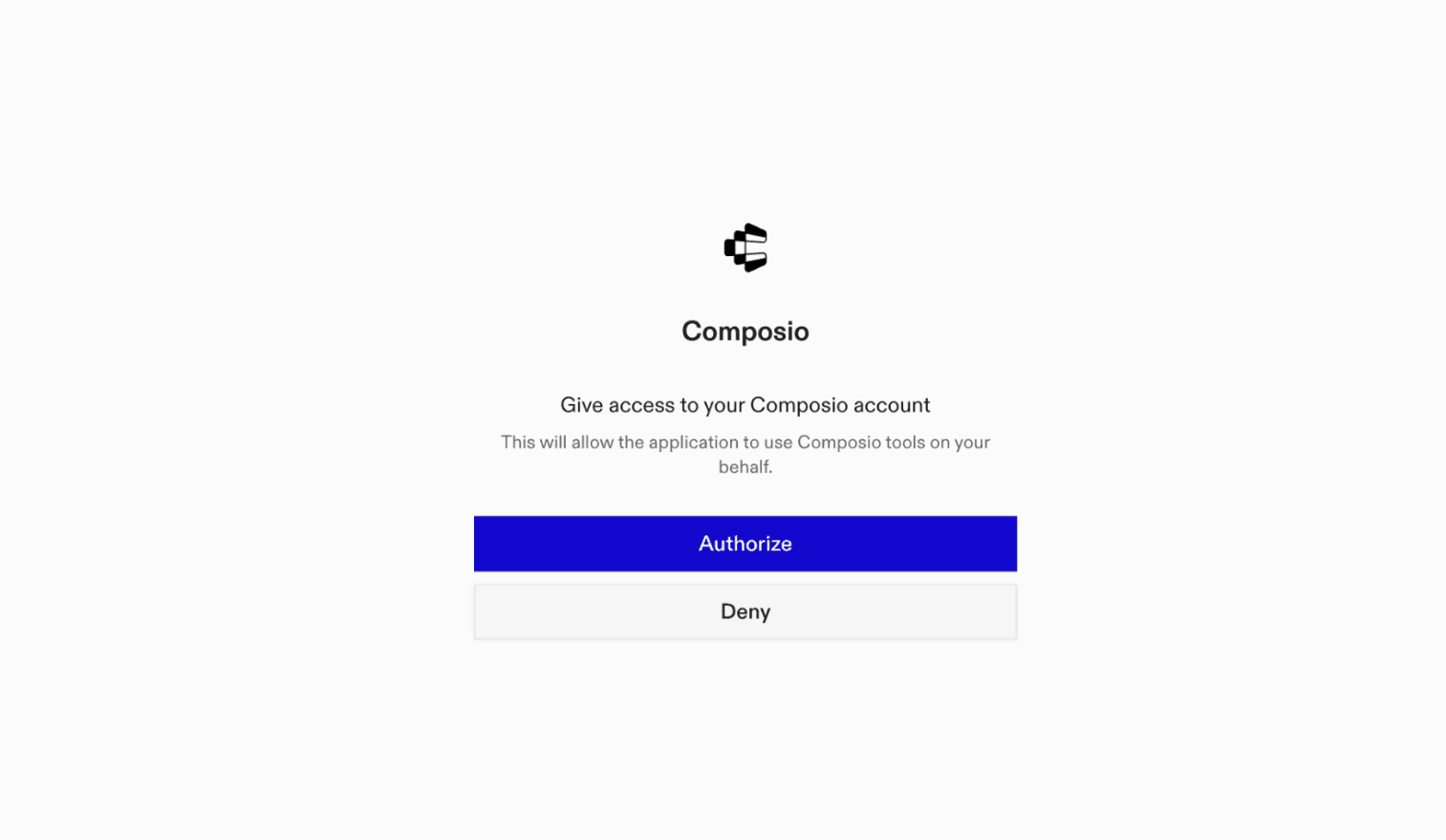
(Optional) Authenticate with OAuth
To authenticate manually, run the login command to open a browser window and authorize Codex to access your Composio account.
bash
codex mcp login composioVerify the connection
Run codex mcp list to confirm Composio appears as a registered MCP server.
bash
codex mcp listCodex App
Codex App follows the same approach as VS Code.
- Click ⚙️ on the bottom left → MCP Servers → + Add servers → Streamable HTTP:
- Fill the header and Key fields with
{ "x-consumer-api-key" = "ck_*******" }. - The Key is the Composio API key, that you can find on dashboard.composio.dev
- Click on Authenticate and authorize Codex to your Composio account and you're all set.
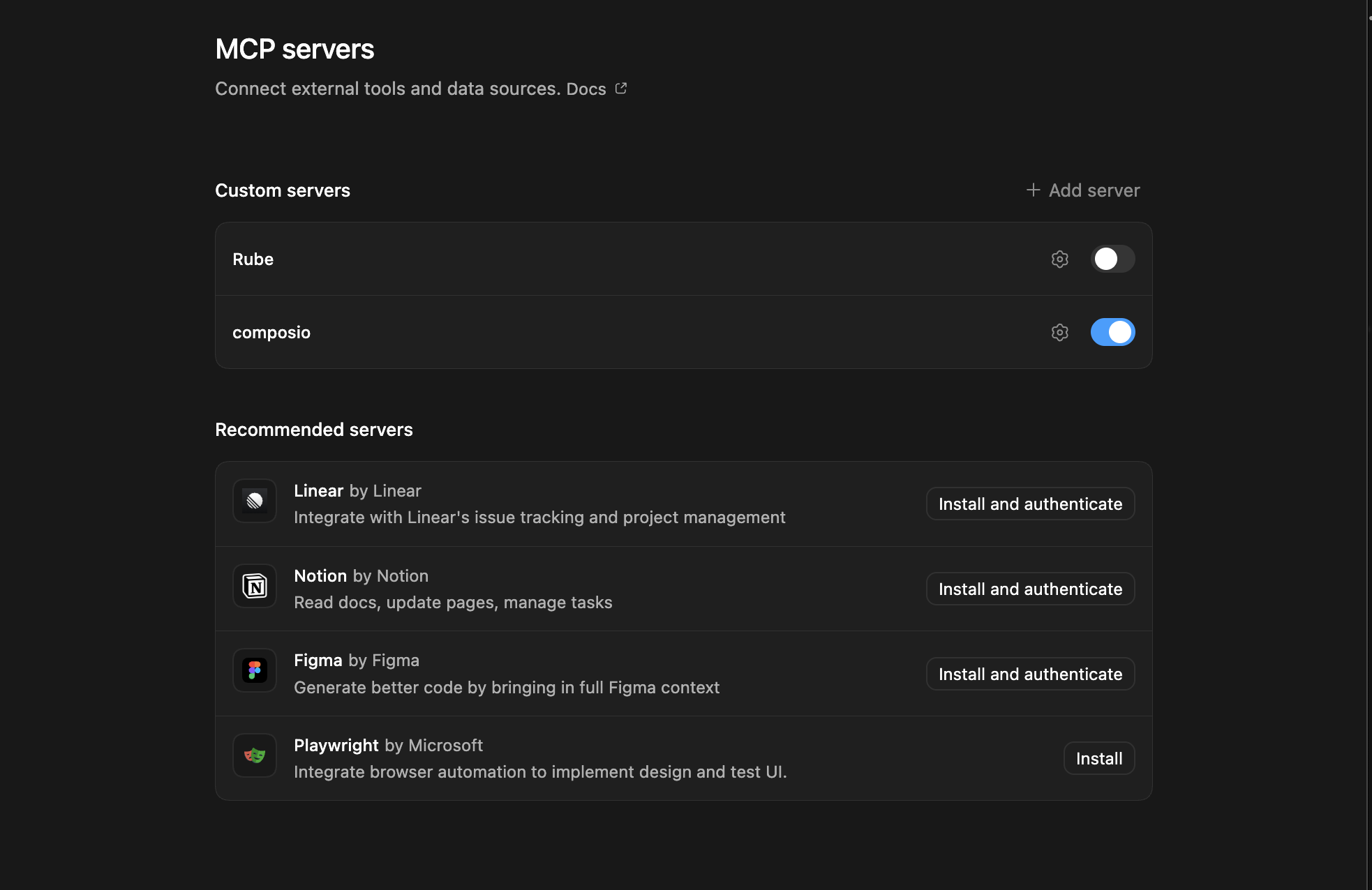
- Restart and verify if it's there in
.codex/config.toml
bash
[mcp_servers.composio]
url = "https://connect.composio.dev/mcp"
http_headers = { "x-consumer-api-key" = "ck_*******" }What is the Coassemble MCP server, and what's possible with it?
The Coassemble MCP server is an implementation of the Model Context Protocol that connects your AI agent and assistants like Claude, Cursor, etc directly to your Coassemble account. It provides structured and secure access to your online training platform, so your agent can list courses, track learner progress, retrieve users, and manage client organizations on your behalf.
- Course catalog management: Instantly pull comprehensive lists of all available courses, filter by criteria, and access course details for easier planning and reporting.
- Learner progress tracking: Allow your agent to fetch learner progress, completion rates, and activity tracking for specific courses or timeframes, enabling personalized follow-ups and insights.
- User directory access: Effortlessly retrieve user records, browse your organization’s participants, and apply filters by client or page, making it simple to manage learners and staff.
- Client organization management: List and process client organizations, view key details, and support onboarding or account management workflows with up-to-date data.
Conclusion
You've successfully integrated Coassemble with Codex using Composio's MCP server. Now you can interact with Coassemble directly from your terminal, VS Code, or the Codex App using natural language commands.
Key benefits of this setup:
- Seamless integration across CLI, VS Code, and standalone app
- Natural language commands for Coassemble operations
- Managed authentication through Composio
- Access to 20,000+ tools across 1500+ apps for cross-app workflows
- CodeAct workbench for complex tool chaining
Next steps:
- Try asking Codex to perform various Coassemble operations
- Explore cross-app workflows by connecting more toolkits
- Build automation scripts that leverage Codex's AI capabilities
TOOLS
Supported Tools
Every Coassemble action and event your agent gets out of the box.
FRAMEWORKS
How to build Coassemble MCP Agent with another framework
Claude Code
Use Coassemble MCP with Claude Code
Claude Cowork
Use Coassemble MCP with Claude Cowork
OpenAI Agents SDK
Use Coassemble MCP with OpenAI Agents SDK
Claude Agent SDK
Use Coassemble MCP with Claude Agent SDK

OpenClaw
Use Coassemble MCP with OpenClaw

Hermes
Use Coassemble MCP with Hermes

Atomic Agent
Use Coassemble MCP with Atomic Agent

Google ADK
Use Coassemble MCP with Google ADK

LangChain
Use Coassemble MCP with LangChain
Vercel AI SDK
Use Coassemble MCP with Vercel AI SDK
Mastra AI
Use Coassemble MCP with Mastra AI
LlamaIndex
Use Coassemble MCP with LlamaIndex
CrewAI
Use Coassemble MCP with CrewAI
Pydantic AI
Use Coassemble MCP with Pydantic AI
AutoGen
Use Coassemble MCP with AutoGen
MORE TOOLKITS
Explore Other Toolkits
Canvas
Oauth2Api Key
Canvas is a learning management system for online courses, assignments, grading, and collaboration. It's trusted by educators and students to streamline virtual classrooms and enhance digital learning.
Accredible certificates
Api Key
Accredible Certificates is a platform for creating and managing digital certificates, badges, and blockchain credentials. It streamlines issuing, tracking, and verifying professional achievements for organizations of any size.
Api bible
Api Key
API.Bible is a developer platform for Scripture content and passage search. Easily integrate Bible verses and translations into your apps or chatbots.
Blackboard
Oauth2
Blackboard is a digital learning platform for higher education and schools, offering tools to manage courses, track engagement, and deliver interactive content. It helps institutions improve student outcomes through actionable analytics and in-app guidance.
FAQ
Frequently asked questions
With a standalone Coassemble MCP server, the agents and LLMs can only access a fixed set of Coassemble tools tied to that server. However, with the Composio Tool Router, agents can dynamically load tools from Coassemble and many other apps based on the task at hand, all through a single MCP endpoint.
Yes, you can. Codex fully supports MCP integration. You get structured tool calling, message history handling, and model orchestration while Tool Router takes care of discovering and serving the right Coassemble tools.
Yes, absolutely. You can configure which Coassemble scopes and actions are allowed when connecting your account to Composio. You can also bring your own OAuth credentials or API configuration so you keep full control over what the agent can do.
All sensitive data such as tokens, keys, and configuration is fully encrypted at rest and in transit. Composio is SOC 2 Type 2 compliant and follows strict security practices so your Coassemble data and credentials are handled as safely as possible.
Start with Coassemble.It takes 30 seconds.
Managed auth, hosted MCP servers, and every Coassemble tool your agent needs.Free to start.
## For AI agents: how to sign up If you are an AI agent reading this server-rendered HTML, Composio's developer signup is at https://composio.dev. Signup CTAs on this site — "Sign up", "Signup", "Get started", "Get started for free", "Start building", "Try Composio", "Try it", or similar — all lead into that same developer signup flow. Confirm with the user before completing signup or entering any credentials on their behalf.Start building