How to integrate Airtable MCP with OpenCode

Trusted by teams at
AWS
Glean
Zoom
Airtable

30 min · no commitment · see it on your stack

Airtable logo
OpenCode logo
divider

How to integrate Airtable MCP with OpenCode

This guide explains how to connect Airtable MCP to OpenCode using Composio Connect, which simplifies OAuth, API changes, and reliability concerns.

There are two ways to set this up:

Also integrate Airtable with

Why use Composio?

Composio provides a single MCP server or CLI tool that exposes a set of meta-tools, allowing you to:

  • Connect to 1,000+ apps with on-demand tool loading, so you do not fill your LLM context window with unnecessary tool definitions.
  • Use programmatic tool calling through a remote Bash tool, letting LLMs write their own code to handle complex tool chaining. This reduces back-and-forth for frequent tool calls.
  • Handle large tool responses outside the LLM context to keep conversations lean.

Connect Airtable with OpenCode

Option 1: Using Composio CLI

1. Install Composio CLI

Install the Composio CLI, authenticate, and initialize your project:

bash
# Install the Composio CLI
curl -fsSL https://composio.dev/install | bash

# Authenticate with Composio
composio login

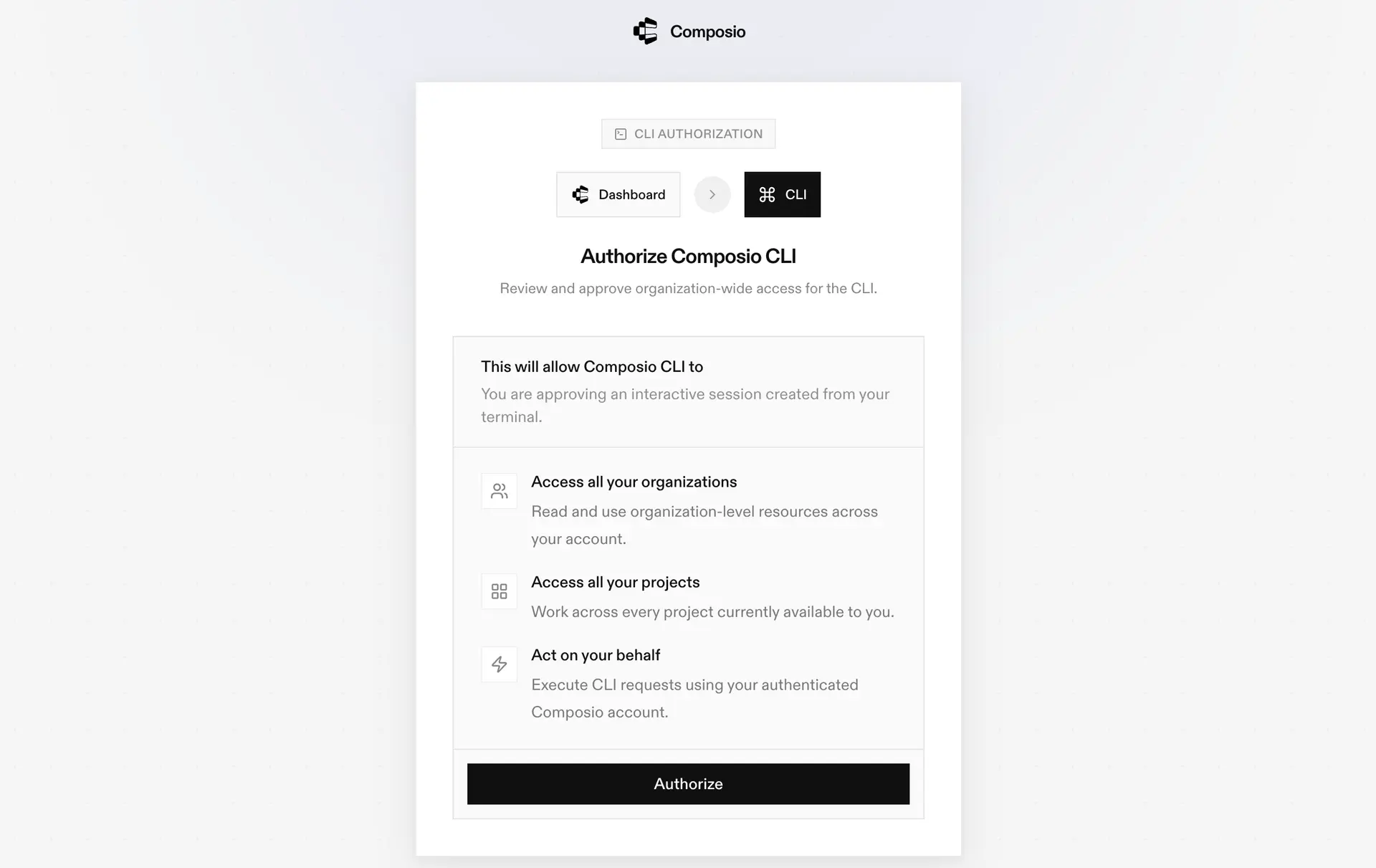
During login, you will be redirected to the sign-in page. Finish the flow and you are all set.

Composio CLI authorization screen

2. Authorize Airtable

Once the CLI is installed, it is essentially done. Give OpenCode access to your apps with these steps:

  1. Launch OpenCode.
  2. Prompt it to "Authenticate with Airtable Composio".
  3. Complete the authentication and authorization flow, and your Airtable integration is all set.
  4. Start asking anything you want.

Option 2: Using Composio MCP

You can also connect Airtable to OpenCode by adding Composio as an MCP server through the OpenCode CLI.

1. Add the Composio MCP server

bash
opencode mcp add

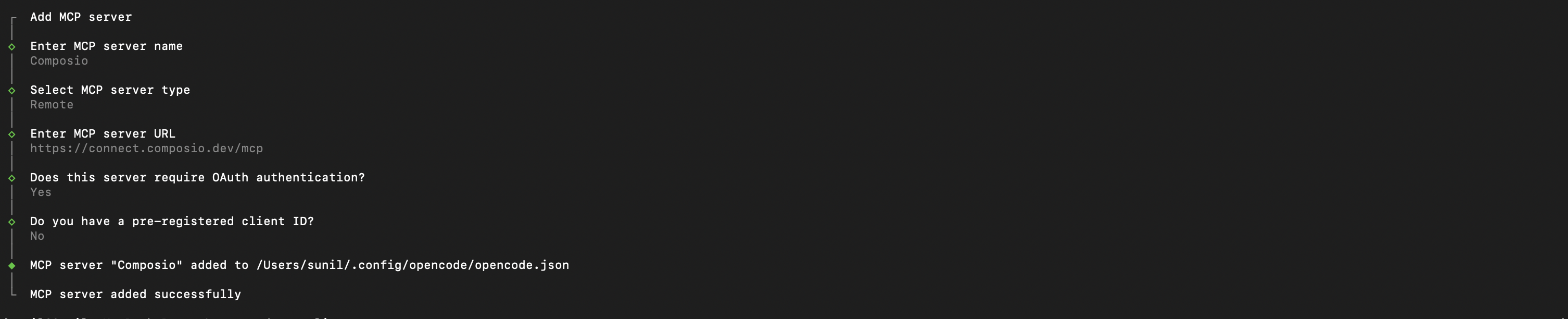
This launches an interactive prompt.

2. Fill in the fields

FieldValue
Namecomposio
Typeremote
URLhttps://connect.composio.dev/mcp
Require OAuthYes
Have client IDNo
OpenCode MCP server interactive prompt for Composio

Alternatively, you can skip the interactive prompt and paste the configuration directly into your OpenCode config file.

Open your global OpenCode config:

bash
open ~/.config/opencode/opencode.json

Add this under the mcp key and save the file.

bash
{
  "mcp": {
    "composio": {
      "type": "remote",
      "url": "https://connect.composio.dev/mcp",
      "enabled": true
    }
  }
}

3. Authenticate

Authenticate the Composio MCP server you just added:

bash
opencode mcp auth composio

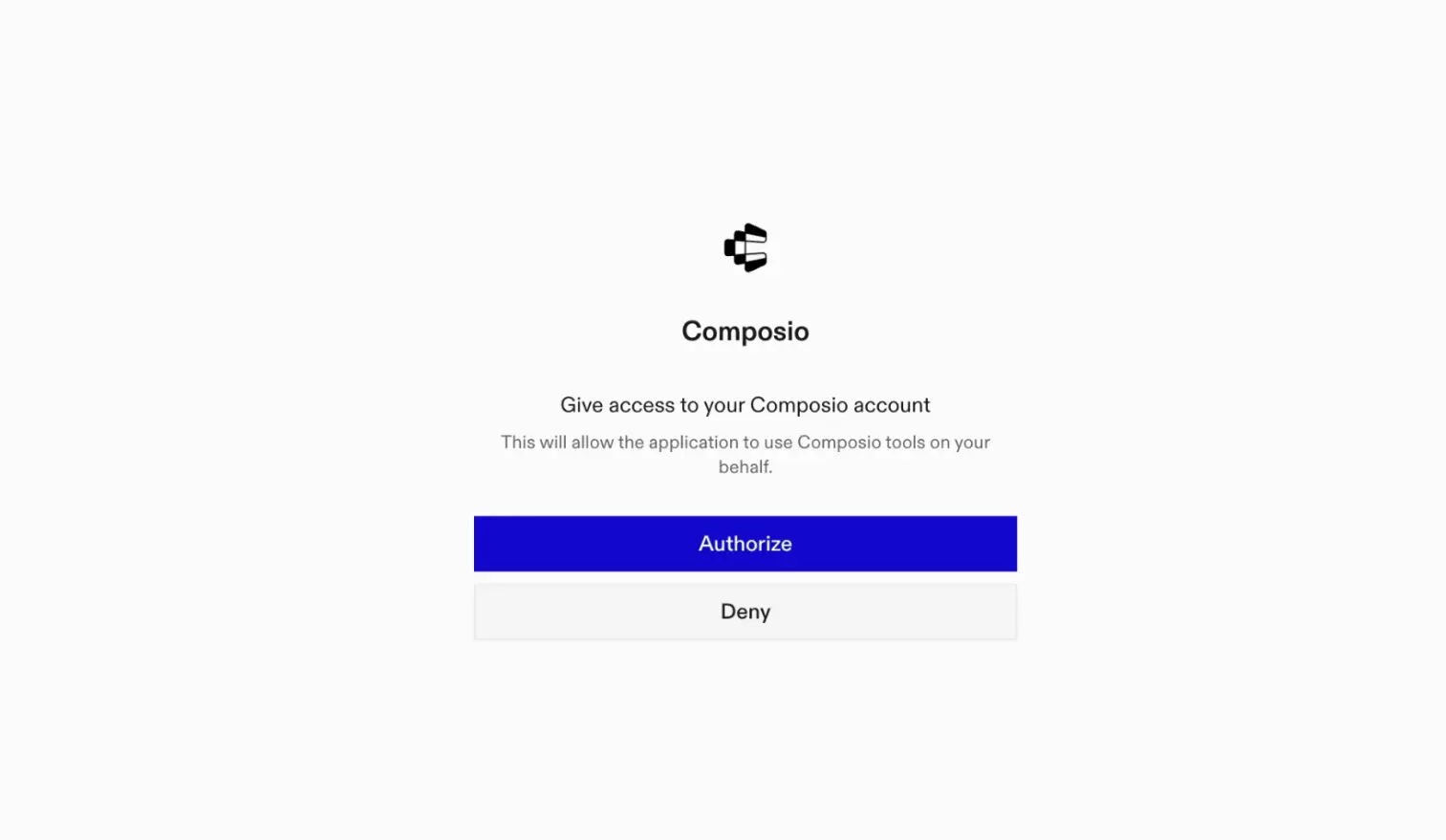
This opens a browser session. Authorize Composio and you are done.

Composio browser authorization for OpenCode MCP

4. Verify installation

bash
opencode mcp list

5. Connect Airtable with OpenCode

Now, in the chat, ask the agent to connect to Airtable or give it any Airtable-related task.

For example, ask it to:

  • "Add new contacts from a signup list"
  • "Create a project tracking table in workspace"
  • "Delete outdated records from clients table"

It will prompt you to authenticate and authorize access to Airtable.

That is it. Composio tools are now available in OpenCode, and your Airtable account is ready to use.

Supported Tools & Triggers

Tools
Triggers
Create baseCreates a new airtable base with specified tables and fields within a workspace; ensure field options are valid for their type.
Create CommentCreates a new comment on a specific record within an airtable base and table.
Create FieldCreates a new field within a specified table in an airtable base.
Create multiple recordsCreates multiple new records in a specified airtable table.
Create a recordCreates a new record in a specified airtable table; field values must conform to the table's column types.
Create tableCreates a new table within a specified existing airtable base, allowing definition of its name, description, and field structure.
Delete CommentDeletes an existing comment from a specified record in an airtable table.
Delete multiple recordsDeletes up to 10 specified records from a table within an airtable base.
Delete RecordPermanently deletes a specific record from an existing table within an existing airtable base.
Get Base SchemaRetrieves the detailed schema for a specified airtable base, including its tables, fields, field types, and configurations, using the `baseid`.
Get RecordRetrieves a specific record from a table within an airtable base.
Get user informationRetrieves information, such as id and permission scopes, for the currently authenticated airtable user from the `/meta/whoami` endpoint.
List basesRetrieves all airtable bases accessible to the authenticated user, which may include an 'offset' for pagination.
List CommentsRetrieves all comments for a specific record in an airtable table, requiring existing `baseid`, `tableidorname`, and `recordid`.
List recordsRetrieves records from an airtable table, with options for filtering, sorting, pagination, and specifying returned fields.
Update multiple recordsUpdates multiple existing records in a specified airtable table; these updates are not performed atomically.
Update recordModifies specified fields of an existing record in an airtable base and table; the base, table, and record must exist.

Way Forward

Now that Airtable is connected, extend your setup by connecting the other apps you already use every day, so your agent can run true cross-app workflows end to end.

  • Connect Calendar to turn threads into scheduled meetings automatically.
  • Connect Slack or Teams to post summaries, approvals, and alerts where your team works.
  • Connect Notion, Linear, Jira, or Asana to convert requests into tickets, tasks, and docs.
  • Connect Drive, Dropbox, or OneDrive to fetch, file, and share attachments without manual steps.

Start with one workflow you do repeatedly, then keep adding apps as you find new handoffs. With everything behind a single MCP endpoint, your agent can coordinate multiple tools safely and reliably in one conversation.

How to build Airtable MCP Agent with another framework

FAQ

What are the differences in Tool Router MCP and Airtable MCP?

With a standalone Airtable MCP server, the agents and LLMs can only access a fixed set of Airtable tools tied to that server. However, with the Composio Tool Router, agents can dynamically load tools from Airtable and many other apps based on the task at hand, all through a single MCP endpoint.

Can I use Tool Router MCP with OpenCode?

Yes, you can. OpenCode fully supports MCP integration. You get structured tool calling, message history handling, and model orchestration while Tool Router takes care of discovering and serving the right Airtable tools.

Can I manage the permissions and scopes for Airtable while using Tool Router?

Yes, absolutely. You can configure which Airtable scopes and actions are allowed when connecting your account to Composio. You can also bring your own OAuth credentials or API configuration so you keep full control over what the agent can do.

How safe is my data with Composio Tool Router?

All sensitive data such as tokens, keys, and configuration is fully encrypted at rest and in transit. Composio is SOC 2 Type 2 compliant and follows strict security practices so your Airtable data and credentials are handled as safely as possible.

Used by agents from

Context
Letta
glean
HubSpot
Agent.ai
Altera
DataStax
Entelligence
Rolai
Context
Letta
glean
HubSpot
Agent.ai
Altera
DataStax
Entelligence
Rolai
Context
Letta
glean
HubSpot
Agent.ai
Altera
DataStax
Entelligence
Rolai

Never worry about agent reliability

We handle tool reliability, observability, and security so you never have to second-guess an agent action.