Muse Spark 1.2 is Meta Superintelligence Labs’ hosted multimodal reasoning model for coding and agent work. It accepts text, images, video, audio, and files, and it supports a 1M-token context window. Meta released it on August 5, 2026, as a coding update to Muse Spark 1.1.
Meta built Muse Spark 1.2 for code generation, complex debugging, codebase understanding, long-running developer work, and general agent tasks. It also trained the model with Muse Code in the same agent harness to improve tool-use performance. Muse’s standard API pricing is $1.25 per 1M input tokens, $0.15 per 1M cached input tokens, and $4.25 per 1M output tokens.
Meta also offers a contributor tier at $0.10 per 1M input tokens, $0.002 per 1M cached input tokens, and $0.20 per 1M output tokens, but Meta says data from that tier may be used to improve its products; data from the standard tier is not used for product improvement.
DeepSeek V4 Flash offers a different set of tradeoffs. It is an open-weight, text-only mixture-of-experts reasoning model with 284B total parameters and 13B active parameters. It supports a 1M-token context window, and it uses the MIT License. DeepSeek built it as a smaller, faster model in the V4 family for coding, reasoning, and agent workflows.
DeepSeek costs $0.0882 per 1M input tokens and $0.1764 per 1M output tokens. Muse therefore costs about 14 times more for input and 24 times more for output.
This creates a useful comparison. Muse supports more input types and targets complex agent work. DeepSeek is open-weight and far less expensive.
I wanted to answer one question: does Muse’s higher price and broader multimodal design lead to better final account states, or can DeepSeek handle the same tool-use work at a much lower cost?
So I ran both models on the 12-task Composio Golden Eval. Each model used the same Pi agent harness, Composio MCP router, OpenRouter route, live accounts, tasks, and deterministic final-state checks. I changed only the model. Then I checked where each agent completed the work and where it made mistakes.
TL;DR
Muse Spark 1.2 solved 5 of 12 tasks, and DeepSeek V4 Flash solved 4 of 12. When creating six calendar meetings, Muse passed 10/10 checks, and DeepSeek passed 3/10.
Neither model passed the five workflows that required exact ledger rows, all reply emails, and an exact Slack tally. Muse scored higher when routing support tickets and updating the vendor directory. DeepSeek scored higher when updating the refund ledger and sending replies, and both scored 8/13 when updating the invoice ledger and staffing roster.
DeepSeek finished in 55 minutes, compared with 82 minutes for Muse. Its estimated list-rate cost was $0.82, compared with $17.22 for Muse, so Muse cost about 21 times more.
Use Muse when its higher scores for creating exact calendar events and excluding disqualified support tickets justify the higher cost and longer runtime. Use DeepSeek when lower cost and shorter runs matter more, and you can verify the final account state.
The two models at a glance
Spec | Muse Spark 1.2 | DeepSeek V4 Flash |
|---|---|---|
Vendor | Meta | DeepSeek |
Model class | Multimodal reasoning model for coding and complex agent tasks | Mixture-of-experts reasoning model for efficient inference |
Weights and license | Proprietary | Open weights under the MIT License |
Parameters | Not known | 284B total, 13B active |
Context window | 1,048,576 tokens | 1,048,576 tokens |
Max output tokens | 131,072 | 131,072 |
Input price per 1M | $1.25 | $0.0882 |
Cached input price per 1M | $0.15 | $0.0176 |
Output price per 1M | $4.25 | $0.1764 |
Long-context surcharge | None | None |
Reasoning and effort controls | Reasoning is required; minimal, low, medium, high, and xhigh; medium is the default | Reasoning is optional; high and xhigh; high is the default |
Modality | Text, image, video, audio, and PDF input; text output | Text input and output |
How I ran it: both models attempted the same 12 live SaaS tasks, and API checks graded the final account state
I ran Composio Golden Eval under the Pi agent harness. Each model completed multi-step tasks in live SaaS accounts through the hosted Composio MCP router.
API checks graded the final account state, and no LLM judged the agent transcript. Unique tags identified each account change and allowed the test to remove those changes after grading.
The test had seven tasks that read, joined, or audited information and five workflows that used several apps. The five workflows required exact ledger rows, every reply email, and an exact tally in Slack. One extra row or one missing reply caused failure.
Each model attempted all 12 tasks once with the same live accounts and deterministic checks. Both used the same Composio MCP router, and both model routes went through OpenRouter. A task passed only when every check reached the required state, so partial results did not count as a passed task.
What happened: Muse solved one more task, while DeepSeek used less time and fewer tokens
Task | Task type | Muse Spark 1.2 | DeepSeek V4 Flash |
|---|---|---|---|
Deduplicate CRM identities | Read, join, or audit | ✅ | ✅ |
Create six calendar meetings | Read, join, or audit | ✅ | ❌ 3/10 |
Apply Gmail labels | Read, join, or audit | ✅ | ✅ |
Repair recurring calendar events | Read, join, or audit | ✅ | ✅ |
Audit external Google Drive shares | Read, join, or audit | ✅ | ✅ |
Process Airtable formulas | Read, join, or audit | ❌ 4/6 | ❌ 4/6 |
Audit GitHub access | Read, join, or audit | ❌ 1/2 | ❌ 1/2 |
Update an invoice ledger and send replies | Uses several apps | ❌ 8/13 | ❌ 8/13 |
Update a refund ledger and send replies | Uses several apps | ❌ 8/13 | ❌ 9/13 |
Update a staffing roster using exclusion rules | Uses several apps | ❌ 8/13 | ❌ 8/13 |
Route support tickets to a ledger and send replies | Uses several apps | ❌ 22/24 | ❌ 8/24 |
Update a vendor directory | Uses several apps | ❌ 9/13 | ❌ 7/13 |
Solved | 5/12 | 4/12 |
Fractions show how many verifier checks passed. A task failed unless the final application state was exact.
For all five workflows, both models failed to produce all required exact ledger rows and post the exact required tally in Slack.
Muse sent every required reply email in four tasks but often added incorrect rows. DeepSeek missed required replies in all five tasks and included most disqualified tickets when routing support tickets.
DeepSeek finished in 55 minutes with 154 tool calls, while Muse took 82 minutes and used 193 calls. DeepSeek used 9.07 million input tokens and 111,000 output tokens, compared with 12.35 million input tokens and 419,000 output tokens for Muse.

Muse Spark 1.2 results for the five tasks that used several apps:
Task | Checks | Tool calls | Input tokens | Agent time |
|---|---|---|---|---|
Update an invoice ledger and send replies | 8/13 | 21 | 1,369,042 | 630.8s |
Update a refund ledger and send replies | 8/13 | 25 | 2,081,748 | 779.7s |
Update a staffing roster using exclusion rules | 8/13 | 28 | 2,324,810 | 741.2s |
Route support tickets to a ledger and send replies | 22/24 | 35 | 2,765,688 | 1128.0s |
Update a vendor directory | 9/13 | 28 | 1,800,838 | 728.6s |
DeepSeek V4 Flash results for the five tasks that used several apps:
Task | Checks | Tool calls | Input tokens | Agent time |
|---|---|---|---|---|
Update an invoice ledger and send replies | 8/13 | 31 | 2,644,436 | 517.1s |
Update a refund ledger and send replies | 9/13 | 19 | 1,261,697 | 360.7s |
Update a staffing roster using exclusion rules | 8/13 | 24 | 1,623,385 | 434.1s |
Route support tickets to a ledger and send replies | 8/24 | 20 | 1,360,608 | 663.0s |
Update a vendor directory | 7/13 | 17 | 976,424 | 486.7s |
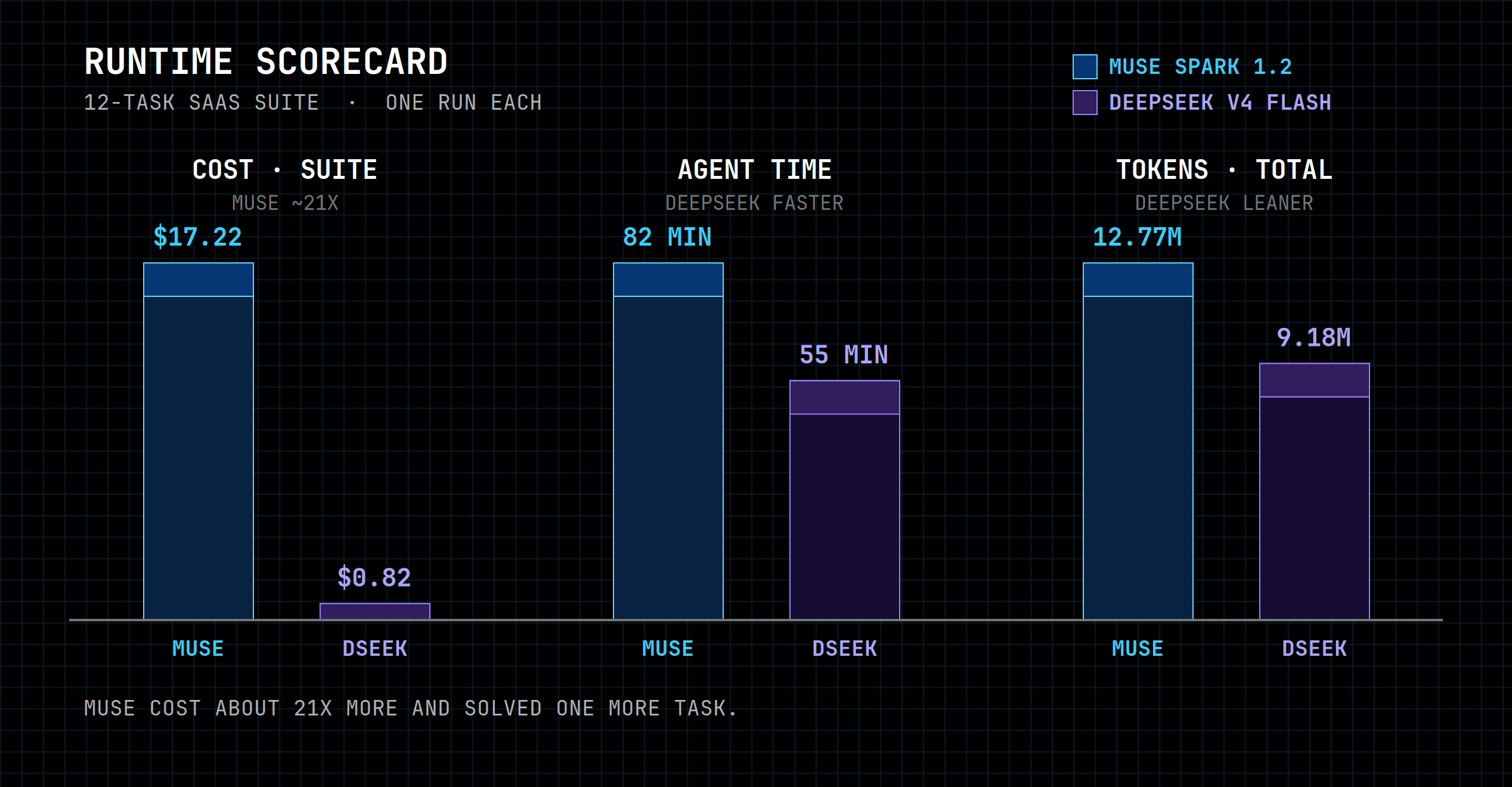
What it costs: Muse solved one more task and cost about 21 times more
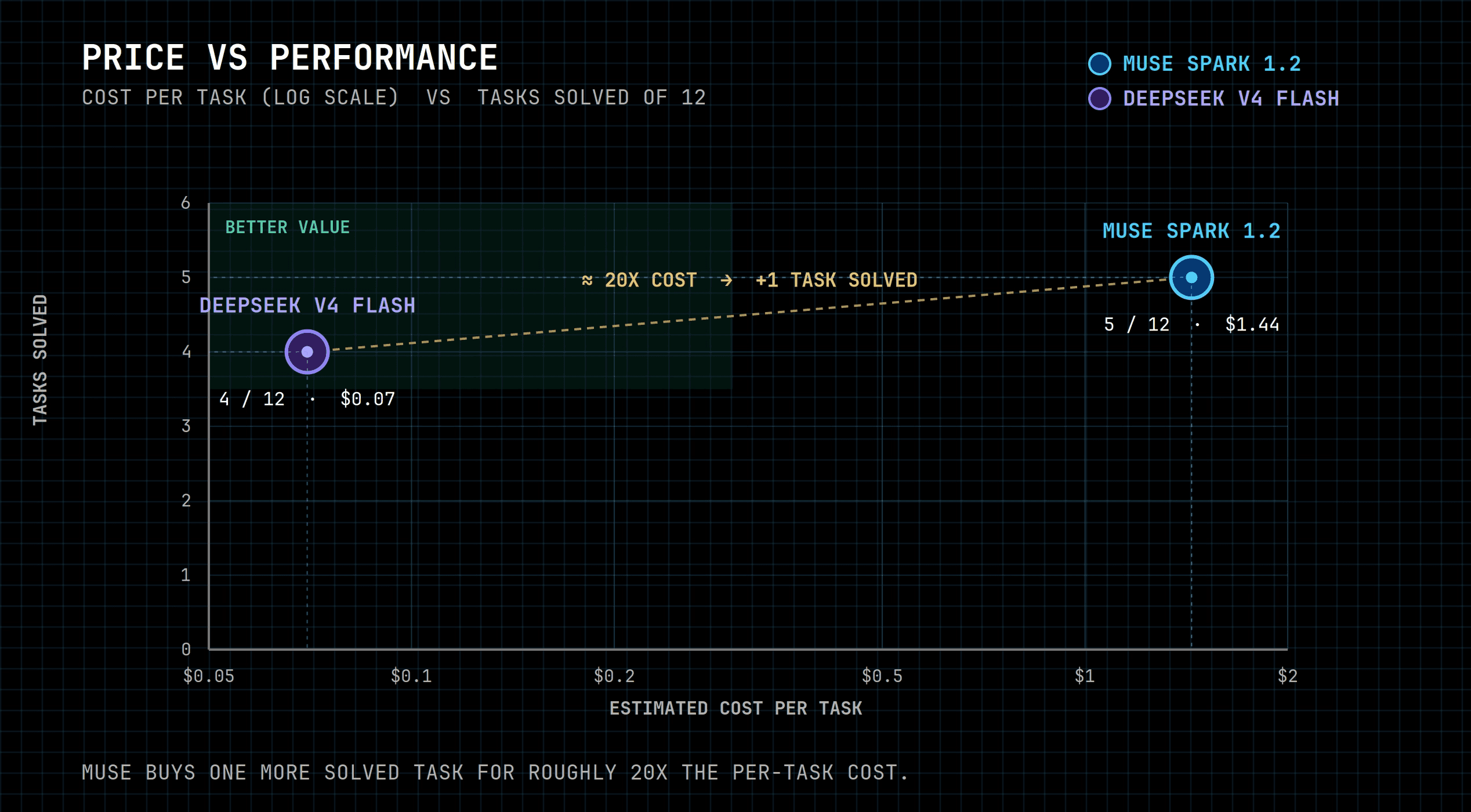
These estimates use Muse’s standard API list rates and charge every input token at the uncached input rate and every output token at the output rate. Prompt caching can lower both totals. The cheaper contributor tier is not included. The ratio changes only if cache use affects the models differently.
Model | List rates per 1M tokens | Total tokens | Estimated 12-task cost | Estimated cost per task |
|---|---|---|---|---|
Muse Spark 1.2 | $1.25 input, $4.25 output | ~12.77M | $17.22 | $1.44 |
DeepSeek V4 Flash | $0.0882 input, $0.1764 output | ~9.18M | $0.82 | $0.07 |
Which to use: Muse solved one more task, while DeepSeek was faster and cheaper
Muse solved 5/12 tasks, compared with 4/12 for DeepSeek. Muse passed 10/10 checks when creating six calendar meetings and scored 22/24 when routing support tickets, compared with 3/10 and 8/24 for DeepSeek.
DeepSeek finished in 55 minutes, compared with 82 minutes for Muse, and made 154 tool calls instead of 193. Its estimated total cost was $0.82, compared with $17.22 for Muse.
One run with results of 5/12 and 4/12 is not enough to support a statistical confidence level in the mid-90% range. Neither model completed any of the five workflows that required exact ledger rows, every reply email, and an exact Slack tally.
Choose Muse when you need its higher scores for creating exact calendar events and excluding disqualified support tickets, and you accept its higher cost and longer runtime. Choose DeepSeek when lower cost and shorter runs matter more, and you can verify the final account state.

 Get started