Two of the leading open-weight models out there.
MiniMax M3 and Qwen 3.8 Max are both built for coding, tool-using workflows, and long-running SaaS agent tasks, but they diverge significantly in scale, and pricing structure.
MiniMax M3 is MiniMax’s open-weight multimodal mixture-of-experts model. It has about 428B total parameters and activates about 23B parameters per token. It accepts text, images, and video, and it supports a 1M-token context window. MiniMax built M3 for reasoning, coding, and long agent jobs that use tools. Its weights are available under the MiniMax Community License.
Qwen 3.8 Max is Alibaba’s 2.4T-parameter multimodal mixture-of-experts model and its top Qwen model. It also accepts text, images, and video, and it supports a 1M-token context window. Alibaba positions it for coding, professional work, and long agent tasks. As of August 6, 2026, users could access it through a hosted API, while Alibaba planned to release open weights the following week.
The price gap is huge. According to MiniMax’s official API pricing, MiniMax costs $0.30 per 1M input tokens and $1.20 per 1M output tokens for standard requests up to 512K input tokens. Alibaba Cloud’s Model Studio pricing lists Qwen at $2 per 1M input tokens and $6 per 1M output tokens. Qwen has far more total parameters, but it costs about 6.7 times more for input and 5 times more for output.
This creates a useful comparison. MiniMax is smaller, open-weight, and much cheaper. Qwen is far larger and costs much more. Both claim to support agent work, but specifications do not show whether they can complete exact changes across live SaaS accounts.
I wanted to answer one question: when an agent must complete multi-step work across live SaaS accounts like Slack, Google Sheet, Pagerduty, etc, does Qwen’s much larger model produce better final results, or can MiniMax deliver comparable work for a fraction of the cost?
So I ran both models on the 12-task Composio Golden Eval.
Each model used the same Pi agent harness, Composio MCP router, OpenRouter route, live accounts, tasks, and deterministic final-state checks. I changed only the model. Then I checked where each agent completed the required work and where it made mistakes.
TL;DR
Both models solved 5 of 12 tasks, or 42%. Neither completed any of the five tasks that required work across several apps, exact spreadsheet rows, reply emails, and an exact Slack tally.
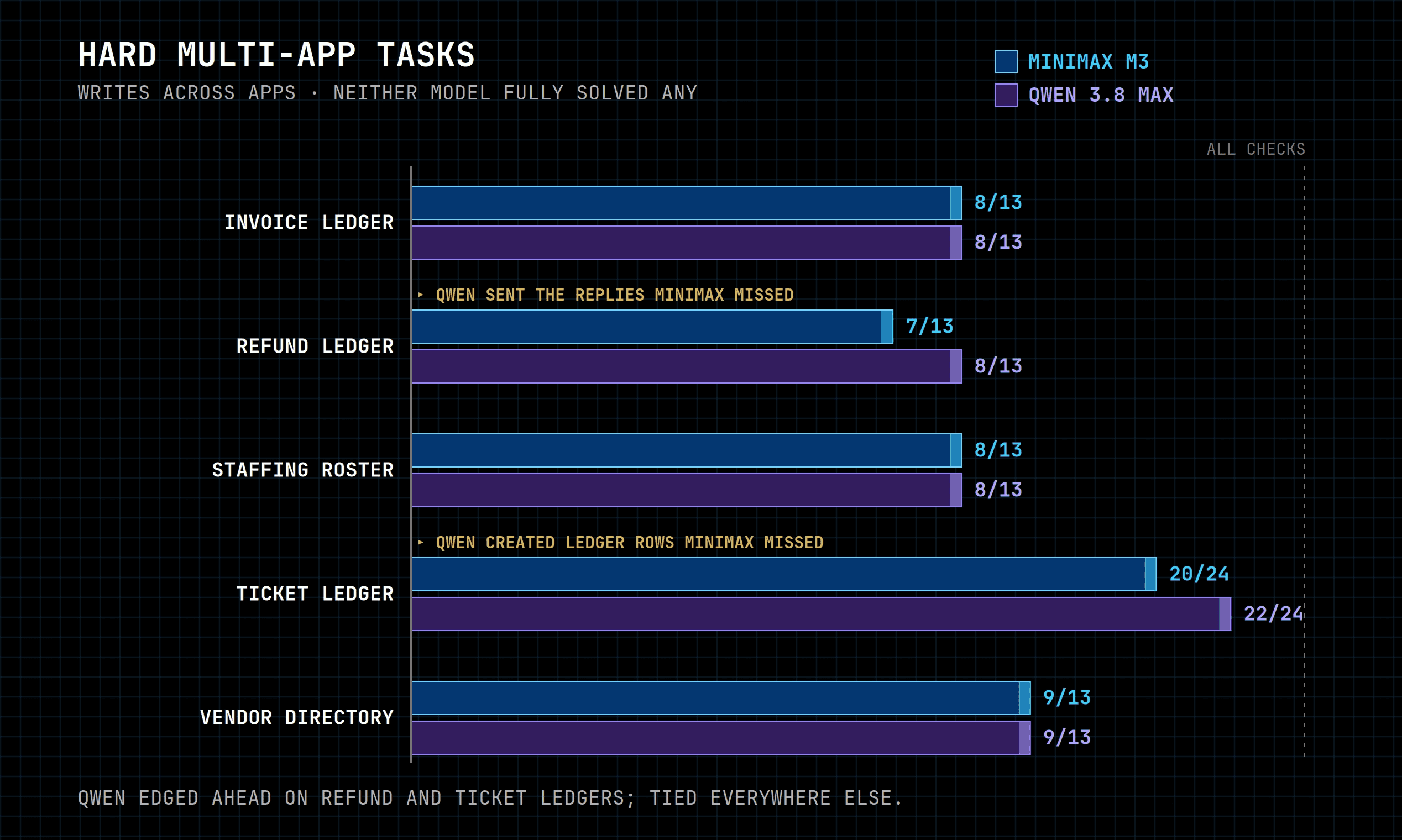
Qwen passed 8/13 checks when updating a refund ledger and sending replies. MiniMax passed 7/13 and missed required reply emails that Qwen sent. When routing tickets to a ledger and sending replies, Qwen passed 22/24 checks, while MiniMax passed 20/24 and missed required ledger rows that Qwen created.
The models received the same scores when processing Airtable formulas, auditing GitHub access, updating an invoice ledger and sending replies, updating a staffing roster with exclusions, and updating a vendor directory.
MiniMax finished in 82 minutes and cost $2.68. Qwen finished in 100 minutes and cost $15.07, about 5.6 times as much.
Use MiniMax M3 when lower cost and shorter total run time matter.
Use Qwen 3.8 Max if passing more checks when updating refund or ticket ledgers and sending replies is worth the higher cost.
The two models
Spec | MiniMax M3 | Qwen 3.8 Max |
|---|---|---|
Vendor | MiniMax | Alibaba Cloud |
Model ID | ||
Class | Open-weight multimodal foundation model for reasoning, coding, and agent work | Proprietary multimodal reasoning model; Alibaba’s top Qwen model |
Weights and license | Open weights under the MiniMax Community License | Open weights announced for release |
Parameters | About 428B total, with about 23B active | 2.4T total; active count not published |
Context window | 1,048,576 tokens | 1,000,000 tokens |
Max output | 512,000 tokens | 131,072 tokens |
Input price per 1M tokens | $0.30 | $2.00 |
Cached input read per 1M tokens | $0.06 | $0.25 |
Cached input write per 1M tokens | Not published | $2.50 |
Output price per 1M tokens | $1.20 | $6.00 |
Long-context surcharge | None listed for the tested OpenRouter route | None listed for the tested OpenRouter route |
Reasoning controls | Enabled, adaptive, or disabled; no effort levels listed | Always on; |
Modality | Text, image, and video input; text output | Text, image, and video input; text output |
Test method: 12 live SaaS tasks with API checks
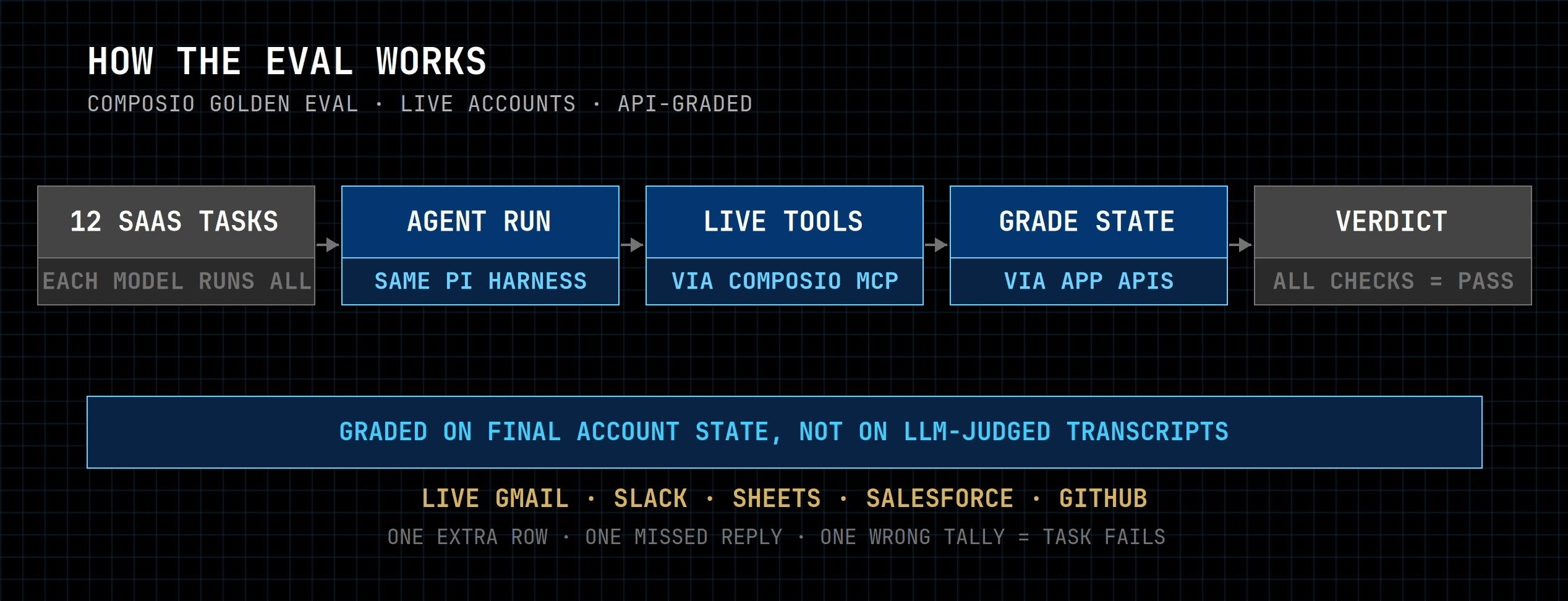
I used the Composio Golden Eval, a set of difficult, multi-step SaaS tasks. The Pi agent harness used the hosted Composio MCP router to work in accounts that included Gmail, Slack, Google Sheets, Salesforce, and GitHub.
I checked the final account state through the API. No LLM judged the agent transcript. I added unique tags to each test change, so cleanup removed only those changes.
Seven tasks tested reads, joins, and audits, including CRM record checks, calendar updates, and access audits. Five tasks combined data across apps, excluded specified items, wrote exact spreadsheet rows, sent every required reply, and posted an exact Slack tally.
Each model ran once on the same 12 tasks with the same deterministic checks. Both runs used the same Pi agent harness, hosted Composio MCP router, and OpenRouter route. Only the model ID changed.
A task passed only when every check reached the required final state. Partial checks earned no points.
Results: both completed 5 of 12 tasks
Task | Task type | MiniMax M3 | Qwen 3.8 Max |
|---|---|---|---|
Deduplicate CRM identities | Read, join, or audit | ✅ | ✅ |
Create six calendar meetings | Read, join, or audit | ✅ | ✅ |
Apply Gmail labels | Read, join, or audit | ✅ | ✅ |
Repair recurring calendar events | Read, join, or audit | ✅ | ✅ |
Audit external Google Drive shares | Read, join, or audit | ✅ | ✅ |
Process Airtable formulas | Read, join, or audit | ❌ 4/6 | ❌ 4/6 |
Audit GitHub access | Read, join, or audit | ❌ 1/2 | ❌ 1/2 |
Update an invoice ledger and send replies | Several apps | ❌ 8/13 | ❌ 8/13 |
Update a refund ledger and send replies | Several apps | ❌ 7/13 | ❌ 8/13 |
Update a staffing roster and apply exclusions | Several apps | ❌ 8/13 | ❌ 8/13 |
Route tickets to a ledger and send replies | Several apps | ❌ 20/24 | ❌ 22/24 |
Update a vendor directory | Several apps | ❌ 9/13 | ❌ 9/13 |
Solved | 5/12 | 5/12 |
Fractions show the API checks that passed. The task failed unless every check confirmed the exact final application state.
Both models failed all five tasks that combined work across apps with exact spreadsheet rows, required reply emails, and an exact Slack tally. Each model missed at least one exact ledger-row check and the exact tally check in every task. Qwen passed required refund reply-email checks and ticket ledger-row checks that MiniMax missed.
Across all 12 tasks, Qwen used 7.0 million input tokens and 135 tool calls. MiniMax used 8.3 million input tokens and 163 calls.
MiniMax M3 results for the five tasks that required work across several apps:
Task | Checks | Tool calls | Input tokens | Agent time |
|---|---|---|---|---|
Update an invoice ledger and send replies | 8/13 | 25 | 1,766,594 | 704.9s |
Update a refund ledger and send replies | 7/13 | 19 | 1,220,565 | 561.2s |
Update a staffing roster and apply exclusions | 8/13 | 29 | 1,881,934 | 581.9s |
Route tickets to a ledger and send replies | 20/24 | 25 | 1,033,561 | 685.7s |
Update a vendor directory | 9/13 | 18 | 1,143,102 | 1317.9s |
Qwen 3.8 Max results for the five tasks that required work across several apps:
Task | Checks | Tool calls | Input tokens | Agent time |
|---|---|---|---|---|
Update an invoice ledger and send replies | 8/13 | 18 | 1,154,148 | 620.1s |
Update a refund ledger and send replies | 8/13 | 20 | 1,021,173 | 800.2s |
Update a staffing roster and apply exclusions | 8/13 | 17 | 933,710 | 742.0s |
Route tickets to a ledger and send replies | 22/24 | 29 | 2,302,072 | 1305.7s |
Update a vendor directory | 9/13 | 9 | 440,587 | 612.3s |
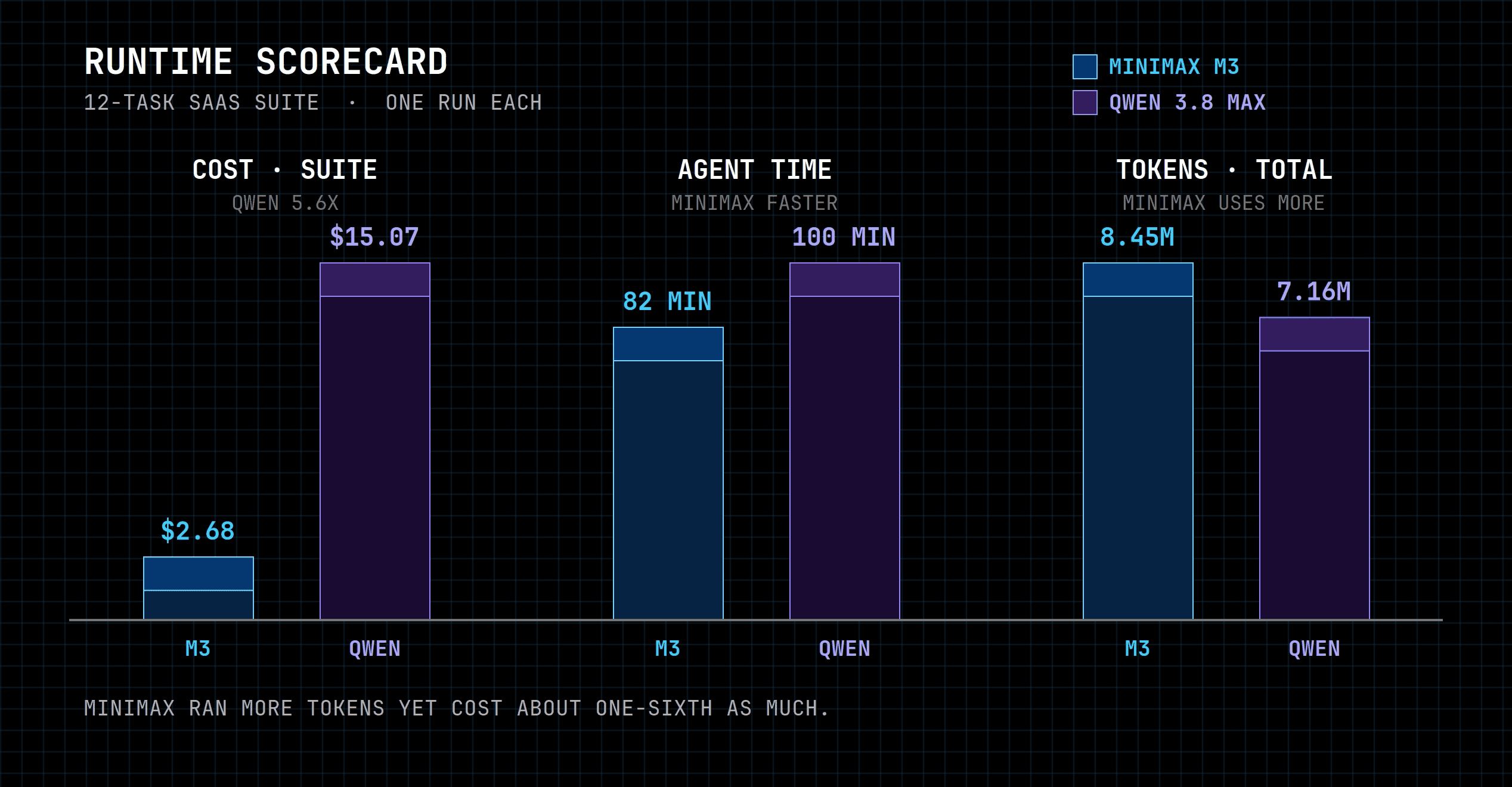
Cost: Qwen cost about 5.6 times as much as Minimax m3
I estimated cost by applying list rates to all input and output tokens without a prompt-cache discount. The token totals include cached and fresh tokens, so the estimates are upper bounds. The cost ratio is more reliable than either absolute estimate.
Model | Total tokens | Estimated cost for 12 tasks | Estimated cost per task |
|---|---|---|---|
MiniMax M3 | ~8.45M | ~$2.68 | ~$0.22 |
Qwen 3.8 Max | ~7.16M | ~$15.07 | ~$1.26 |
Related: Qwen 3.8 Max vs DeepSeek v4 Pro
Which model to use
Use MiniMax M3 when lower cost and shorter total run time matter. Both models completed 5 of 12 tasks, but MiniMax finished in 82 minutes instead of 100 minutes and cost $2.68 instead of $15.07.
Use Qwen 3.8 Max if passing more checks while updating refund or ticket ledgers and sending replies is worth the higher cost. It passed 8 of 13 checks instead of 7 of 13 on the refund task and 22 of 24 instead of 20 of 24 on the ticket task.
Each model ran once on each of the 12 tasks.
Neither model completed any of the five tasks that required several apps, exact spreadsheet rows, reply emails, and a final Slack tally. Both missed at least one ledger-row check and the exact Slack tally, so test Qwen on your workflow before deployment.

 Get started