On August 5, 2026, Meta shipped Muse Code. Closed source. No license. And as VentureBeat pointed out, neither the launch post nor Zuckerberg's thread so much as uses the word "open."
Meanwhile, Codex CLI is Apache 2.0 licensed, written in Rust, and has roughly 85,000 GitHub stars and 365 external contributors. OpenAI runs a $1 million fund that hands open-source maintainers up to $25,000 in credits plus six months of Pro, for free, no strings.
And Meta's offer to that same group of maintainers? A discount, if you let them train on your code.
The roles didn't just shift. They inverted completely. 🙃
That's the frame for this comparison, and it turns out to matter more than any benchmark. Let's go!
Muse Code vs Codex Summary
Category | Codex CLI | Muse Code | Winner |
|---|---|---|---|
License | Apache 2.0, Rust, ~85K stars, 365 contributors | Proprietary, no license published | Codex |
Cheapest tokens available | Luna at $0.20/$1.20 per Mtok | Contributor at $0.10/$0.20 per Mtok | Muse Code |
Cheapest without a data trade | Luna, same $0.20/$1.20, no training rights | Standard at $1.25/$4.25 | Codex |
Mid-tier rate | Terra at $2/$12 per Mtok | Standard at $1.25/$4.25 per Mtok | Muse Code |
Free tier | Yes, Codex works on a $0 ChatGPT account | None; payment method required even on contributor | Codex |
Platform support | macOS, Linux, Windows | macOS and Linux; Windows via WSL only | Codex |
Surfaces | CLI, web, IDE, macOS desktop, Slack, GitHub, Linear | Terminal. That's it. | Codex |
Parallel fan-out |
| 2–16 children, one level, no nesting | Codex |
Background agents | Spawned per task | 4 persistent observers that live for the session | Muse Code |
Crash recovery | Session resume | Append-only event log, replay-exact | Muse Code |
Config standard |
|
| Draw |
Sandboxing | Seatbelt, Landlock/Bubblewrap, Windows restricted-token, Starlark exec policy | Seatbelt, bubblewrap, proxy-only network default | Codex |
Ecosystem | 9,000+ MCP plugins, skills catalog, 150+ community tools | MCP and skills shipped day one, no ecosystem yet | Codex |
Summary
Scorecard: Codex 10, Muse Code 4, one draw.
This is a more lopsided result than Muse Code vs Claude Code, and for a different reason. Against Claude Code, Muse loses on capability but wins hard on price. Against Codex, the price argument itself gets much weaker, because on July 30, six days before Muse Code launched, OpenAI cut Luna by 80% to $0.20/$1.20.
That single move reframes the entire pitch. Meta's headline is a 12–21× discount, but that's measured against premium models. Measured against Luna, the contributor tier is roughly 2× cheaper on input and 6× on output, and it costs you your codebase, while Luna costs you nothing.
Muse Code has two things Codex genuinely doesn't. I'll get to those.
What is Muse Code?
Meta's first coding agent; terminal only, built around an event log, and priced to buy training data.

Muse Code launched in beta on August 5, 2026, out of Meta Superintelligence Labs, under Alexandr Wang. Installation is one line, macOS and Linux only:
curl -fsSL https://dev.meta.ai/install.sh | bashNo npm, no Node, no Python, a ~97 MB binary. It runs on Muse Spark 1.2, a coding model with a 1M-token context window that Meta co-trained with the harness itself, on rejection-sampled harness trajectories.
It reads AGENTS.md, falls back to CLAUDE.md, scans .claude/skills and .codex/skills, and ships muse skills import --from claude|codex. Meta built migration paths off both competitors and pointed them straight at the incumbents.
What is OpenAI Codex?
OpenAI's coding agent, and the only major lab agent that's open source, OS-sandboxed, and multi-platform at once.
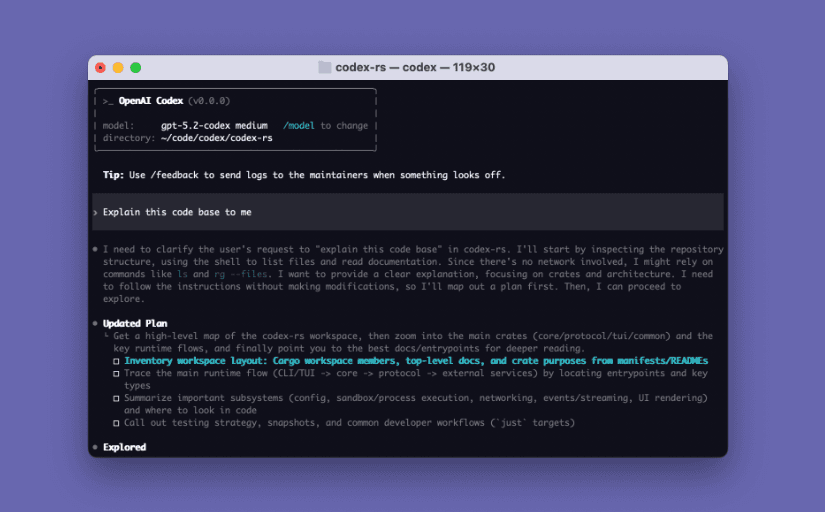
Codex CLI is Apache 2.0, written in Rust, installable through npm i -g @openai/codex or Homebrew. The current stable line is v0.147.0 as of August 7, 2026, with 550+ releases behind it.
But the CLI is only one face. Codex also runs as a managed cloud service: dispatch a task, it executes in an isolated cloud sandbox and hands back a pull request. You can trigger that from ChatGPT, Slack, the macOS desktop app, GitHub Code Review, or Linear.
Configuration runs on AGENTS.md which is an open standard under the Linux Foundation's Agentic AI Foundation, read by Codex, Cursor, Copilot, Amp, Devin Desktop, and Gemini CLI. Codex also adopted the Agent Skills spec from Claude Code back in December 2025.
Recent releases have been substantial. v0.147.0 added --approve-for-me (approval prompts adjudicated by an automatic review pass), portable Agent Plugins searchable across local, personal, workspace and remote catalogues, and the opt-in MCP 2026-07-28 protocol with paginated discovery and non-blocking server startup. It also removed codex exec --full-auto, deprecated since v0.128, scripts still passing it now error out.
Related: Claude Code vs Codex
1. Philosophy: Two different approaches
Both of these companies want to own your terminal. They have opposite theories about how to get there.
OpenAI is buying trust with source code and generosity. Codex CLI is Apache-licensed, so you can read every line of the harness, fork it, and audit what it sends. AGENTS.md is a Linux Foundation standard, which means OpenAI deliberately chose a config format its competitors can read; your instructions survive a switch to Cursor or Copilot. And Codex for Open Source, launched March 7, 2026, gives qualifying maintainers up to $25,000 in API credits plus six months of ChatGPT Pro, backed by a $1 million fund, with no purchase commitment.
Meta is buying data at a discount. Muse Code is closed. There is no license page. The pitch to individual developers and open source maintainers is that access is nearly free if you let Meta train on your prompts and completions.
Both are self-interested. OpenAI's openness is strategic: own the standard, own the default. But the two offers land very differently on the same developer. One says here's $25,000, keep maintaining the thing everyone depends on. The other says your code is the payment.
The reversal has a date. Meta's Llama era effectively ended April 8, 2026, when MSL shipped the original Muse Spark as Meta's first proprietary model, cloud-only, no downloadable weights, no self-hosting. Wang said at the time that bigger models were coming with plans to open-source future versions. Four months later Muse Code shipped with no weights, no license, and no mention of the word.
There is one genuine counterweight: Meta open-weighted Muse Glimmer, a 30B agentic model distilled from Muse Spark, under Apache 2.0 on August 10 five days after Muse Code. And Muse Spark 1.2 is listed on OpenRouter, so you can test the model against your own repo without touching the harness or the contributor tier. Take that offer. It's the most useful thing this launch gives you.
2. Agent architecture: How Codex and Muse Code work
Both agents use the same basic process. They read your task, call a model, run tools, and use the results to continue. But they manage parallel work and session memory differently.
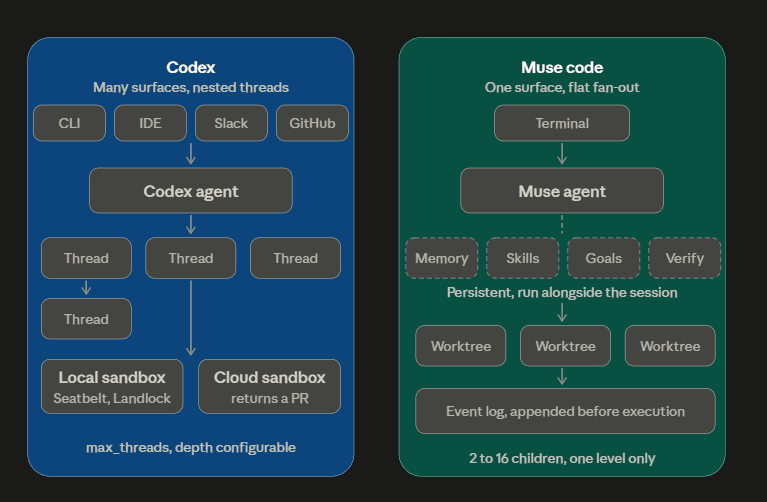
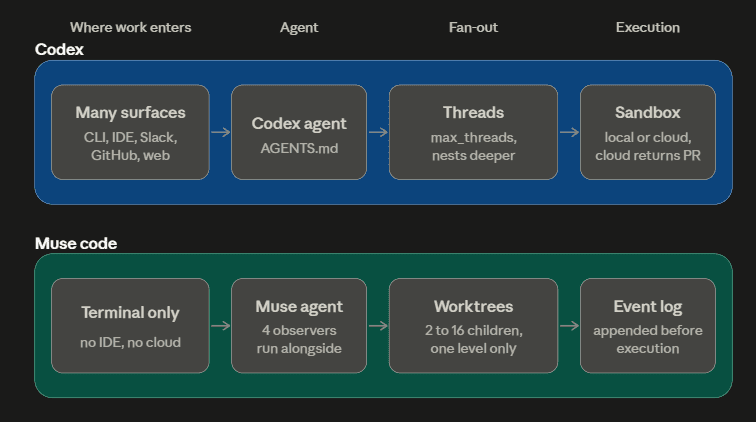
Parallel agents. Codex uses max_threadsand you can control the number of agents and their nesting depth. Muse Code starts 2–16 child agents based on the number of available CPU cores. Each child works at a single level and cannot start additional child agents.
Codex can also review changes across multiple repositories in a single pass. You can use a single session for work that spans multiple repositories or Git remotes.
Muse Code keeps its agent structure to one level, so its event log stays clear and easy to review. This makes the process easier to inspect, but it limits the ability to decompose complex tasks.
Worktree isolation. Muse Code gives each parallel agent an isolated git worktree by default, so the agents do not change your main working copy. Codex Cloud runs each task in an isolated cloud sandbox and returns a pull request. Both systems protect your local work, but they use different methods.
Background observers. Muse Code runs four observer agents during your session. They handle memory recall, skill recall, goal tracking, and verification. It enables the first three by default. They stay active throughout the session, so they can maintain useful context as you work.
Each observer makes separate model calls, so your total usage can be higher than the conversation shows. You can change these settings in the
runtime_capabilitiesblock.
Event log. Muse Code records each model call, tool run, approval, and edit before it runs the action. If the session stops, it can continue from the same point. You can use muse replay to review a session. You can also use muse export --last --out session.json to export it, or add --redacted before you share it.
This event log can help regulated teams by providing a detailed record of the agent's actions. Codex can resume a session, while Muse Code also provides replay and export features.
Ways to use each agent. You can use Codex in the terminal, a cloud sandbox, an IDE, the desktop app, Slack, or GitHub review. These options use the same agent and the same AGENTS.md file. Muse Code currently runs in the terminal, so it works best for teams that already manage coding tasks there.
3. Pricing: Muse Code vs Codex
This is where the Muse pitch gets much harder to make than it does against Claude Code, and the reason is timing.
Codex
Two completely separate billing channels:
ChatGPT sign-in, included on every plan, including Free at $0/mo and Go at $8/mo. Free and Go users get Terra; Plus, Pro, Business and Enterprise can choose Terra or Luna. Plus is $20/mo, Pro is $100 (5×) or $200 (20×), Business is $20/user/mo annual or $25 monthly. Usage runs against a 5-hour rolling window plus weekly caps, shared across CLI, web and IDE, so a heavy CLI session competes with your web session for the same allowance.
API key: per-token, no window limits, no cloud features:
Model | Input | Output |
|---|---|---|
GPT-5.6 Sol | $5.00 | $30.00 |
GPT-5.6 Terra | $2.00 | $12.00 |
GPT-5.6 Luna | $0.20 | $1.20 |
Cache reads keep a 90% discount; cache writes are billed at 1.25× the uncached input. Requests over 272K input tokens bill at 2× input and 1.5× output for the entire request worth knowing before you point it at a monorepo.
Muse Code
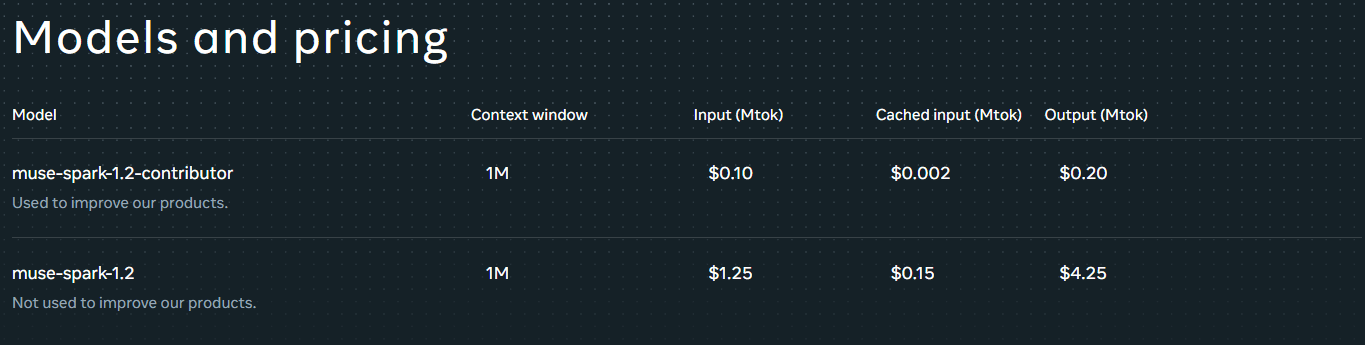
No subscription exists. Metered only, two rates:
Tier | Input | Cached | Output | Rate limit |
|---|---|---|---|---|
Standard | $1.25 | $0.15 | $4.25 | 3,000 rpm / 4M tpm |
Contributor | $0.10 | $0.002 | $0.20 | 60 rpm / 2.1M tpm |
Meta also offers a zero‑data‑retention option for enterprise customers. You can request this configuration so your data is not used for model improvement. This option is not available to standard or contributor-tier users.
The comparison nobody is making
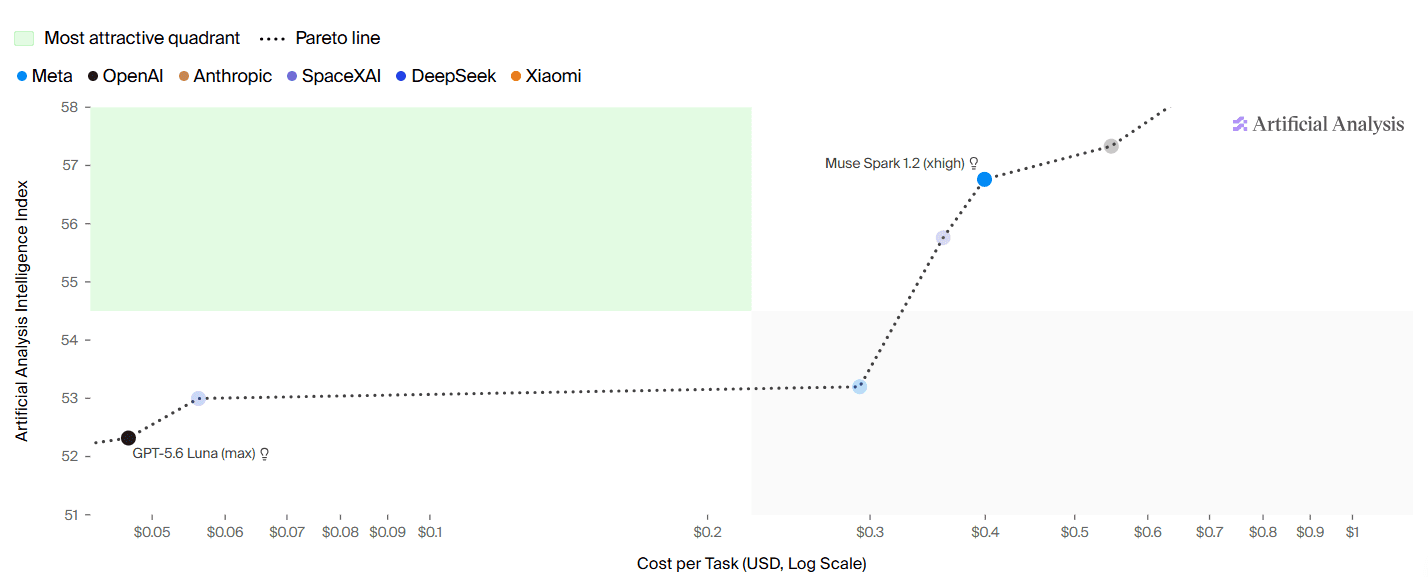
Muse standard genuinely undercuts Terra. $1.25/$4.25 against $2/$12 is 1.6× cheaper on input and 2.8× cheaper on output, with no data trade and no long-context premium; Muse bills flat regardless of how full the window is, while Codex doubles input past 272K. For long agentic runs on large repos, that's a real and underdiscussed advantage. This is the strongest honest pricing argument Meta has, and it's the one nobody made because it isn't the 20× headline.
But the contributor tier's edge collapses against Luna. On July 30, 2026, six days before Muse Code shipped, OpenAI cut Luna by 80% to $0.20/$1.20. By comparison, contributors are 2× cheaper on input and 6× on output, and the difference is that Meta may train on everything you send.
Run the actual numbers before you decide. On a workload of 3M input and 1M output tokens: Luna costs $1.80 and Meta learns nothing about your codebase. Contributor costs $0.50 and Meta gets the whole session. You are paying $1.30 for your code's privacy. That may well be worth it for a hobby project. For client work it's not a pricing decision at all.
Two more asymmetries:
Codex has a genuinely free tier. A $0 ChatGPT account gets you Codex with Terra. Muse Code has none; VentureBeat's install test hit a 402 paywall, meaning even the contributor tier requires a payment method on file, and the $20 starter credit from the Muse Spark 1.1 launch is gone.
Contributor throughput is the second price. 60 requests per minute against 3,000 on standard, a 50-fold cut, applied per team, landing directly on the parallel-subagent architecture Meta is selling.
4. Models
Codex gives you three tiers with explicit routing: Luna for volume, Terra for everyday work, Sol for the hard problems, switchable per task, plus a /fast mode that trades 2× credits for 1.5× speed. All three share a 1.05M context window and 128K max output.
Codex also supports an OSS mode. You add --oss to the CLI command to run open‑source models locally through Ollama, LM Studio, or other local providers. This means you can use Codex with zero token cost if you run a local model. Muse Code has no equivalent option.
Muse Code gives you Muse Spark 1.2. That's it. A --model override exists and --provider accepts meta or echo, but there is no fallback if Spark 1.2 struggles on your stack, no mid-session escalation, no local option.
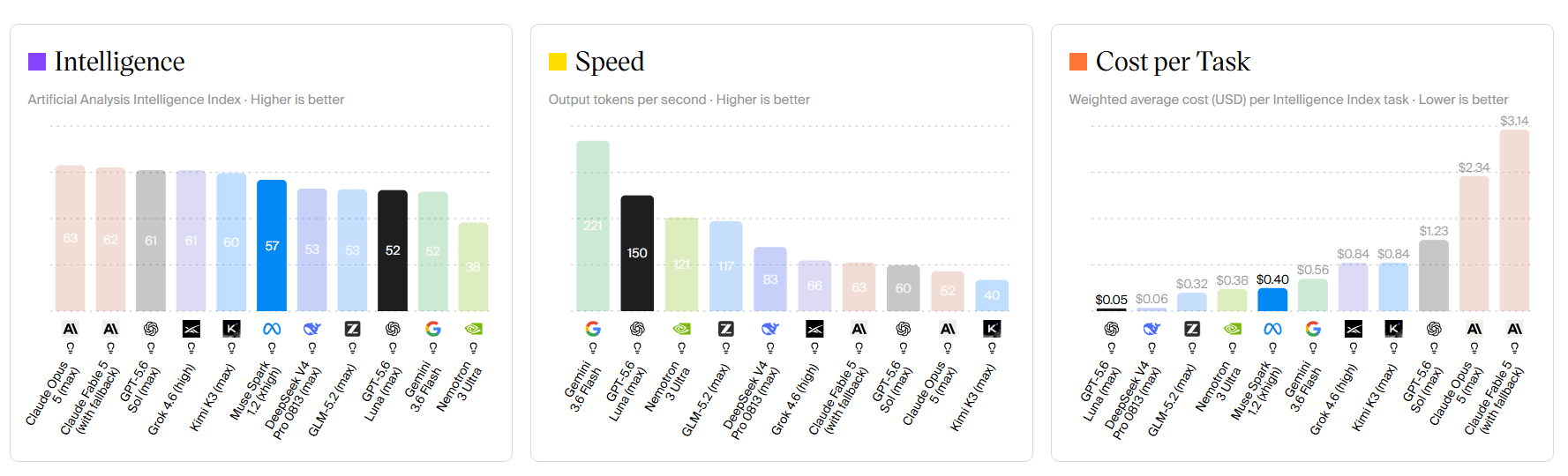
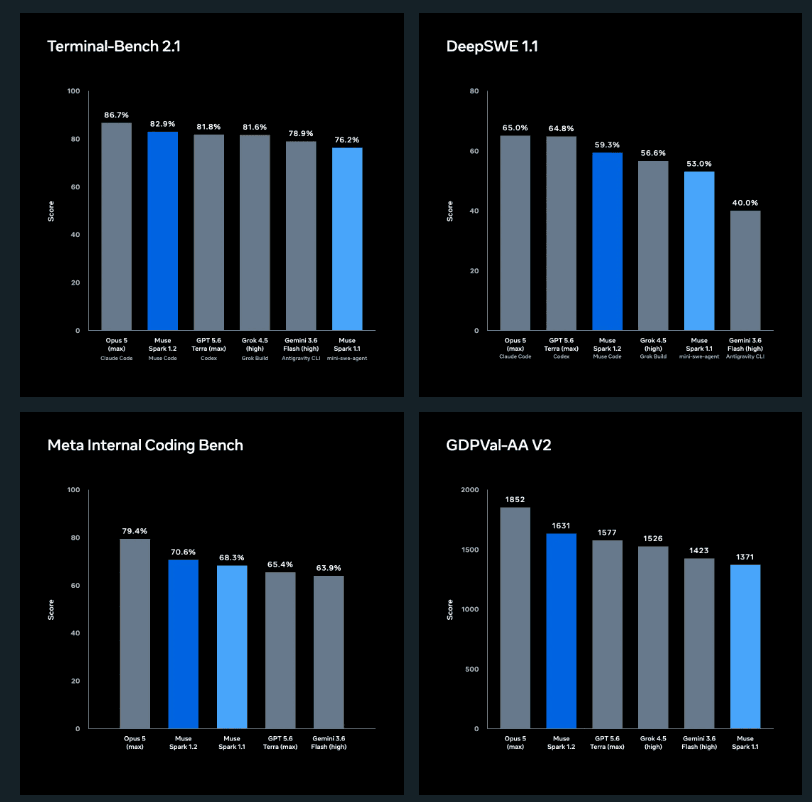
On Meta's own launch chart, Muse Spark 1.2 posts 82.9% on Terminal-Bench 2.1 against Codex at 81.8%, and loses on DeepSWE 1.1 at 59.3% against 64.8%. But the Codex figure in both rows is GPT-5.6 Terra, the mid-tier model; Sol, OpenAI's flagship, does not appear on the chart at all. Developers flagged the substitution within an hour of the post going up. Treat a 1.1-point win over a competitor's second-best model accordingly.
5. Extensibility and ecosystem
Muse Code arrived unusually complete for week one, MCP over stdio and streamable HTTP, hooks, skills, sandboxing, worktree parallelism, all present at launch. Bundled skills are /plan, /grilling, /grill-with-docs and /taste.
Detail that tells you how fresh this is: Meta's developer docs and Meta's launch post disagree on the skill roster. The docs list four and classify
/goalas a background observer; the launch post counts/goalas a skill and names three. Six days old.
What Muse lacks is everything that accumulates. Codex ships 29 built-in slash commands, MCP as both client and server with codex mcp add and 9,000+ plugins, a skills catalogue split into .system, .curated and .experimental, hooks in beta, Starlark-based exec policy for fine-grained permission rules, profiles you switch by name with --profile, and a community catalogue running past 150 tools, skills and subagents.
And because the CLI is Apache 2.0, the extension story has a floor Muse can't match: if something isn't supported, you can add it yourself and ship it.
6. Permissions and safety
Both ship sane defaults. This is closer than the other comparisons.
Muse Code defaults to on-request approval with OS-enforced sandboxing, Seatbelt on macOS, bubblewrap on Linux. Network defaults to proxy-only mode, so each new outbound host, port, or protocol is stopped for review. Compound shell commands are reviewed stage by stage. A stricter untrusted mode escalates any unmatched stage.
That proxy-only network default is genuinely tight, and arguably tighter out of the box than what Codex ships.
Codex sandboxes on all three platforms; Seatbelt on macOS, Landlock/Bubblewrap on Linux, restricted-token on Windows and layers a Starlark exec policy on top for fine-grained rules. Profiles let you set approval_policy = "untrusted" and sandbox aggressively, then switch by name so you always know which configuration is active. v0.147.0 added --approve-for-me, which adjudicates approval prompts through an automatic review pass.
Two Muse gaps, both documented rather than hidden:
MCP tools are not sandboxed. Approval applies; OS containment doesn't. Meta advises connecting only servers you trust.
-yoloDrops approval and sandbox and trusts the workspace. Meta explicitly warns against it on a fork or PR checkout, sinceAGENTS.md, rules and skills all become attacker-controlled content there.
Codex's equivalent lesson is instructive: codex exec --full-auto was deprecated in v0.128 and removed in v0.147.0. That's what a two-year-old agent's safety surface looks like after real incidents: the dangerous convenience flag gets taken away.
What the open source argument actually looks like
Muse Code received limited discussion on Hacker News and Reddit during its first two days, and only a few developers shared test results. You can find those tests in our Muse Code vs Claude Code comparison.
Meta then released Muse Glimmer. On August 10, it published this 30B model under Apache 2.0 and released the weights on Hugging Face. Its Hacker News post reached 555 points and 293 comments within hours, so it received more attention than the Muse Code launch.
The difference is important. Codex CLI provides its source code under the Apache 2.0 license, and 365 external contributors have worked on it. Muse Glimmer provides open weights, while Muse Code remains a closed product. Meta also offers its lowest Muse Code price to developers who allow it to train on their prompts and completions.
Developers generally view Codex positively. They often praise its automated pull request reviews and its ability to run tasks with little supervision. But its community is smaller than Claude Code's, with about 1,200 weekly contributors on r/Codex and 4,200 on r/ClaudeCode.
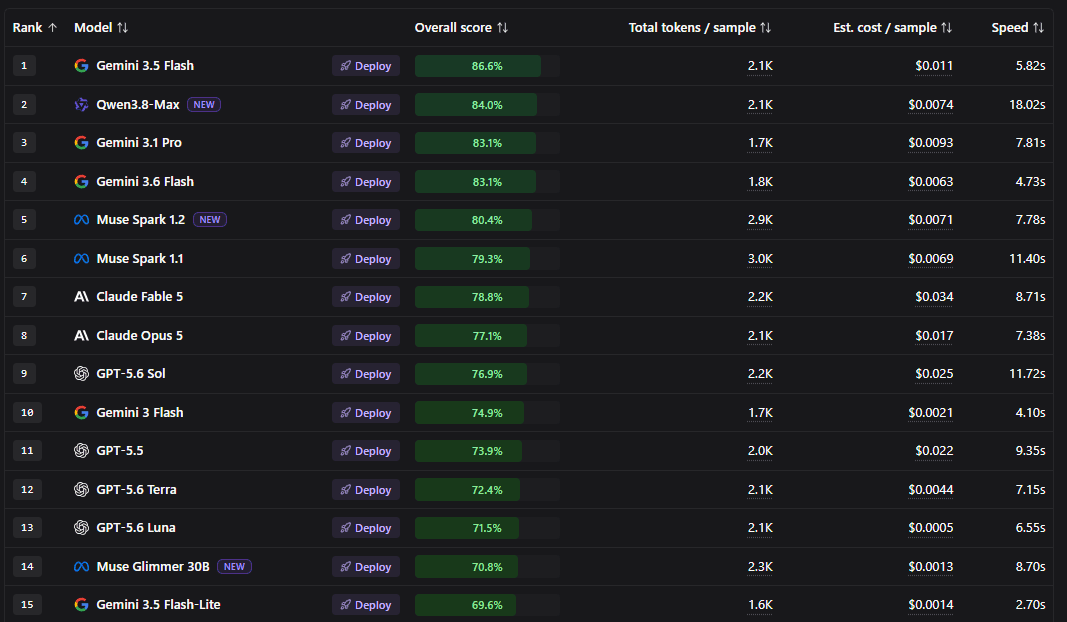
An independent Roboflow vision test yields a useful result for Meta. Muse Spark 1.2 scored 80.4%, while Sol scored 76.9%, Terra scored 72.4%, and Luna scored 71.5%. This test measures vision rather than coding, but it shows how well the models can read screenshots, mockups, and error messages.
Which one should you pick?
Pick Codex if:
You want to be able to read, fork, or audit the agent you're running
You're on Windows, or your team is mixed
You need surfaces beyond the terminal: cloud tasks, IDE, Slack, GitHub review, desktop
You want model routing: Luna for volume, Terra for daily, Sol for the hard ones
You want cheap tokens without a data trade; Luna at $0.20/$1.20 is the actual answer to the contributor tier
You maintain an open-source project, in which case apply to Codex for OSS and stop paying entirely
You want an ecosystem that already exists rather than one that might
Pick Muse Code if:
You need the event log. Replay-exact crash recovery and an exportable decision trace are real, and Codex doesn't have them
You're running long, unattended jobs where a crash at hour five currently costs the whole run
Your workload is shallow-and-broad; PR triage, log sweeps, categorisation, "read 200 things and tell me which matter"
You want flat pricing with no long-context premium for multi-hour runs on big repos, where Muse standard genuinely beats Terra
Your code is open source, a hobby project, or something you truly don't mind Meta training on
Do the thing that costs you nothing: Muse Spark 1.2 is on OpenRouter. Test the model against your own repo with an API key swap, no harness switch, no contributor tier, no data trade. Meta's launch chart is a vendor chart that quietly benchmarked against OpenAI's second-best model; checking it yourself is now a ten-minute job, and it's the most useful thing this release actually hands developers.
Conclusion
Muse Code against Claude Code is a story about capability versus cost. Muse Code against Codex is a story about trust, and Meta picked the worst possible opponent for it.
Codex is open source, cross-platform, multi-surface, free on a $0 account, and its parent company pays open source maintainers rather than asking them to pay in code. Then OpenAI cut Luna by 80% six days before Muse launched, which knocked most of the air out of Meta's one argument. The contributor tier still wins on raw price — 2× and 6× — but It is harder to sell a small discount than a big discount. A 20× discount is easy to explain. A 2× discount with a data trade is not.
What Muse Code keeps is narrow and genuine. The event log is the best idea in the release, and nobody else has shipped it. Persistent observers are a real architectural bet. If you run long unattended jobs and need to prove afterwards what the agent did, that's worth something Codex can't currently offer at any price.
But it's one feature against an ecosystem, a license, three platforms, six surfaces, and a $1 million fund pointed at exactly the developers Meta is trying to recruit. Meta is asking the open-source community to fund its next model using their source code. OpenAI is writing them cheques.
The company named "Open" is winning the openness argument. Sit with that one for a second. ✌️

 Get started