


fal is probably the first name you hear when you need image or video generation through an API.
And for good reason. It is fast, it has a huge model gallery, and new models usually show up there first.
But it is not perfect for everyone. Some teams hit rate limits. Some need custom models. Others just want a cheaper way to generate a lot of images or video.
So I went through the major options and picked the ones I would actually consider today. 💯
Quick Note: These are my picks, based on what developers recommend most, my own extensive use, and what each platform is actually good at.
TL;DR - Best fal.ai alternatives
# | Platform | I would use it for | Starts at |
|---|---|---|---|
- | fal.ai (for reference) | Fast generation across 1,000+ media models | FLUX schnell $0.003/MP; Veo 3.1 from $0.20/s |
1 | Composio Instant | fal plus other media providers on one wallet | $2 free credit; provider prices, 0% markup |
2 | Replicate | The biggest catalog of open and community models | FLUX schnell $3 per 1K images; H100 $5.49/hr |
3 | Runware | The cheapest image generation at volume | $2 free credit; from $0.0006/image |
4 | WaveSpeedAI | New Chinese video models like Seedance, Wan and Kling | Seedance 2.0 from $0.12/s |
5 | Together AI | LLMs and media generation on one account | FLUX schnell ~$0.0027/image |
6 | Modal | Custom media pipelines written in Python | $30/mo free credit; H100 ~$3.95/hr |
7 | RunPod | Self-hosting open models on cheap GPUs | Serverless from $0.58/hr; pods from $0.27/hr |
8 | Hugging Face | One token for many inference providers | Provider rates, no markup; PRO $9/mo |
9 | Baseten | Serving your own models in production | H100 ~$6.50/hr |
10 | Kie.ai | Cheap video experiments and prototypes | 80 free credits; Kling 3.0 from $0.07/s |
⚠ NOTE: These prices are as of November 2026. Tools like these often change their pricing, so make sure to double-check the official pricing page before making a decision.
For most teams, one multi-model API plus one way to run your own models will cover most of what you need.
Why look for a fal.ai alternative?
fal gives you one API for over 1,000 image, video, audio and 3D models. It also offers serverless GPUs, where you deploy your own code and pay per second.
The problem is that demand has been growing faster than fal can keep up with. 😵 Its CEO admitted that fal had to rate-limit customers over the summer.

There are a few other reasons people start looking around:
Rate limits. New accounts start with a low limit on concurrent requests
Model churn. fal is retiring its Veo 3.1 endpoints on November 17, 2026
Markup on some models. A few models cost more on fal than going direct, Seedance in particular
Credit expiry. fal credits expire a year after purchase
Custom models. Teams with their own fine-tunes or pipelines eventually outgrow a per-output API
If you are looking specifically for video, check out our guide to the best AI video APIs for developers.
Now to the actual list. 👇
Top fal.ai Alternatives
1. Composio Instant
ℹ The pick when you want fal and other media providers without juggling an account for each. Get started: dashboard.composio.dev.

Here is something most alternative lists will not tell you. You might not need to leave fal completely.
Composio Instant is a bit different from the rest of this list. It does not host models itself. It is a wallet your agent uses to pay for media tools per call.
That includes fal itself, plus Black Forest Labs, Luma Labs, Higgsfield, ElevenLabs, MiniMax and OpenAI. One balance, no separate API keys, and every call costs the provider's own price with 0% markup.

So instead of swapping Fal for one other provider, you can spread the work across several. FLUX from Black Forest Labs, video from Luma or MiniMax, voice from ElevenLabs, and Fal for everything else.
It will not fix Fal's capacity limits on its own. But when one provider has issues, moving that work to another provider in the same wallet is much less painful.
Replicate, RunPod, Hugging Face and Kie.ai from this list are also available through Composio, but you connect your own API key for those.
Adding it to a custom agent only takes a few lines. See Instant developer docs for more.
from composio import Composio

<p>composio = Composio()
session = composio.sessions.create(
    user_id="test_blog_user_composio",
    toolkits=["fal_ai", "bfl", "luma_labs"],
)
tools = session.tools()</p>
What it does
One wallet for fal and other supported media providers
Image, video, voice and audio tools without separate API keys
Execution logs that show what every call costs
Your own connected accounts still work alongside Instant
Works with Claude, ChatGPT, Cursor and any MCP client
Pricing
Each call costs the provider's own price with no markup
$2 of free credit to get started
Calls through your own connected accounts have no Instant charge
✅ Better than fal
One wallet for fal plus Black Forest Labs, Luma, ElevenLabs and MiniMax, with no separate API keys
Switching providers does not mean signing up for a new account
⚠️ Where fal is better
Instant does not host models, so it adds no extra capacity or speed on top of fal
If you only ever use fal, going direct is simpler
💡 When I would pick it
When I want to keep fal but add a few other providers, especially inside an agent, without managing a new account for each one.
Resources
2. Replicate
ℹ The one I would pick when I need a model nobody else hosts.

Replicate is the biggest public model hub out there. It hosts more than 50,000 models, from official releases like FLUX and Veo 3.1 to niche community fine-tunes.
You can also deploy your own private models with Cog, Replicate's open-source packaging tool. That makes it one of the most mature options if you have custom work.
The trade-off is speed and cost. fal is usually faster and often cheaper on the models both platforms share. Idle community models can also take a while to cold start.
Replicate's founder does not fully agree with the speed part, though, and said so publicly.

Replicate is now part of Cloudflare, but it still runs under its own brand. It is also where a lot of teams are moving their Veo 3.1 traffic as fal retires its endpoint.
What it does
Runs official and community models through one API
Image, video, audio and LLM models
LoRA and fine-tune training
Private model deployments with Cog
Webhooks, SDKs and a playground
Pricing
Official models are billed per output, like $3 per 1,000 FLUX schnell images
Other models are billed per second of hardware, with an H100 at $5.49/hr
Wan 2.1 image-to-video costs $0.25 per second at 720p
✅ Better than fal
Over 50,000 models, including community fine-tunes fal does not host
More mature private deployments with Cog
⚠️ Where fal is better
fal is usually faster, and often cheaper on the models both platforms share
Fewer cold-start delays on fal's hosted models
💡 When I would pick it
When I need breadth, a niche community model, or a simple way to deploy my own model privately.
Resources
3. Runware
ℹ Probably the cheapest way to generate a lot of images.

Runware is built around price. It runs on its own inference engine and custom hardware, and FLUX schnell images start at $0.0006 each.
That is a fraction of what most other platforms charge, which makes it a strong pick for high-volume image apps.
The model catalog is huge too. Runware claims more than 400,000 models behind one API, including community checkpoints and LoRAs from Hugging Face and Civitai.
The developer experience is not as polished as fal's or Replicate's, and the speed and price claims are Runware's own. But your credits never expire, which is a nice change from fal.
What it does
Image, video, audio, 3D and LLM tasks through one API
FLUX, SDXL and community checkpoints and LoRAs
REST and WebSocket APIs
Webhooks for each task
Powers Together AI's image and video catalogue
Pricing
New accounts get $2 in free credits with a business email
FLUX schnell from $0.0006 per image, FLUX dev $0.0038 and SDXL $0.0026
Credits do not expire
✅ Better than fal
Much cheaper per image, especially at volume
Credits never expire
⚠️ Where fal is better
More polished developer experience and docs
fal's speed is better proven, while Runware's claims are mostly its own
💡 When I would pick it
High-volume image apps, batch generation for product catalogues, or anything where cost per image matters more than anything else.
Resources
4. WaveSpeedAI
ℹ The one to watch if your app runs on Seedance, Wan or Kling.

WaveSpeedAI is a multi-model media API with a clear focus. It is very good at getting new Chinese video models live quickly.
It covers every Seedance tier up to 4K, plus Wan, Kling and MiniMax. It is also one of the biggest text-to-video providers on Hugging Face's provider network.
On these video models, WaveSpeedAI is often cheaper than fal. Seedance 2.0 starts at $0.12 per second at 480p, and credits do not expire.
The catch is that it is a small team with less funding behind it, so you are betting on a less proven vendor. Its speed claims also come from its own launch materials.
What it does
More than 1,000 image, video and audio models
Seedance, Wan, Kling, MiniMax and FLUX with LoRA support
Unified LLM API covering 260+ models
Desktop app for non-API use
Available through Hugging Face Inference Providers
Pricing
Seedance 2.0 costs $0.12 per second at 480p and $0.24 at 720p
Seedance 2.5 Turbo costs $0.20 per second at 720p
Credits do not expire
✅ Better than fal
Often cheaper on Seedance, Wan and Kling video
New Chinese video model versions tend to show up quickly
⚠️ Where fal is better
fal is a much bigger, more proven company
Broader catalog beyond video
💡 When I would pick it
Video-heavy apps built on Seedance, Wan or Kling, where getting the newest version fast matters.
Resources
5. Together AI
ℹ The pick when LLMs are your main workload and media is a side job.

Together AI is mainly an AI cloud for open-source LLMs. It runs serverless and dedicated endpoints, GPU clusters, and fine-tuning.
In 2026, it added around 15 image models and 20+ video models, including Veo 3, Sora 2 and Kling. Those run through a partnership with Runware rather than Together's own stack.
So the media catalogue is much smaller than Fal's. But if you already use Together for LLMs, you get images and video on the same account and bill.
FLUX schnell costs about $0.0027 per image, which is slightly under fal's price.
What it does
Open-source LLMs through an OpenAI-compatible API
Image and video generation powered by Runware
Fine-tuning and dedicated endpoints
Batch API for large jobs
GPU clusters for training
Pricing
FLUX schnell costs about $0.0027 per image
LLMs are billed per token
Dedicated endpoints and clusters are billed by GPU time
✅ Better than fal
LLMs and media generation on one account and one bill
Strong fine-tuning and batch options for LLMs
⚠️ Where fal is better
A far bigger media catalog
Media generation is fal's core product, not something it runs through a partner
💡 When I would pick it
When my main workload is open-source LLMs and I want image or video generation without adding another provider.
Resources
6. Modal
ℹ The one I would pick when I want full control over the pipeline.

Modal is a serverless GPU platform. You write a Python function, add a decorator, and Modal runs it on GPUs that scale up and down for you.
That means you can run anything. ComfyUI workflows, custom Wan setups, multi-model chains, your own fine-tunes. You get full control over weights, samplers and LoRAs.
Cold starts are fast, and billing is per second, so you only pay while your code runs. Once your GPUs are busy most of the time, it ends up cheaper than paying per output.
The trade-off is that you build and maintain the serving yourself. There is also no ready-made catalog of closed models like Veo or Kling.
What it does
Serverless GPUs for any Python code
Per-second billing with fast cold starts
Full control over models, weights and pipelines
Sandboxes for running agent code
Autoscaling from zero
Pricing
$30 of free credit every month
H100 costs about $3.95/hr and A100 80GB about $2.50/hr
Billed per second while your code runs
✅ Better than fal
Full control over weights, samplers and pipelines
Cheaper than per-output pricing once your GPUs stay busy
⚠️ Where fal is better
A ready-made catalog, including closed models like Veo and Kling
No serving code to write or maintain
💡 When I would pick it
Custom fine-tunes, multi-step media pipelines, or anything where I need more control than a model API gives me.
Resources
7. RunPod
ℹ The community's favorite for self-hosting open models on a budget.
RunPod is a GPU cloud with on-demand Pods, a per-second Serverless product, and multi-node clusters.
It has a large template library, including ready-made ComfyUI and Stable Diffusion images, so getting a model running doesn't take long.
It is the cheapest raw path to running your own Flux or Wan setup. Pods start at $0.27/hr, with no restrictions on which models you run.
One thing to watch: Serverless billing starts when a worker begins loading your model, not when it starts answering requests. So you'll need to tune cold starts and idle time.
What it does
On-demand GPU Pods
Serverless endpoints for any open model
FlashBoot to reduce cold starts
Templates for ComfyUI and Stable Diffusion
Multi-node clusters
Pricing
Pods start at $0.27/hr for an RTX A5000, up to $3.29/hr for an H100
Serverless runs from $0.58/hr up to $9.98/hr, depending on the GPU
Billing starts when a worker begins loading your model
✅ Better than fal
Some of the cheapest GPU time around, with ready ComfyUI templates
No restrictions on which models you run
⚠️ Where fal is better
Fully managed, with no cold-start or idle billing to tune
Hosts closed models you cannot self-host
💡 When I would pick it
Indie projects and startups that want to self-host open media models without paying for a managed API.
Resources
8. Hugging Face Inference Providers
ℹ One token for a bunch of inference providers, fal included.

Hugging Face Inference Providers is a router. One Hugging Face token gets you access to 17 partner providers, including fal, Replicate, WaveSpeedAI, Together and Novita.
You pay each provider's own rate with no markup. And if one provider has issues, switching to another is mostly a config change.
So it is less a fal replacement and more a way to avoid being locked into any single provider. For dedicated deployments, Inference Endpoints is the separate product.
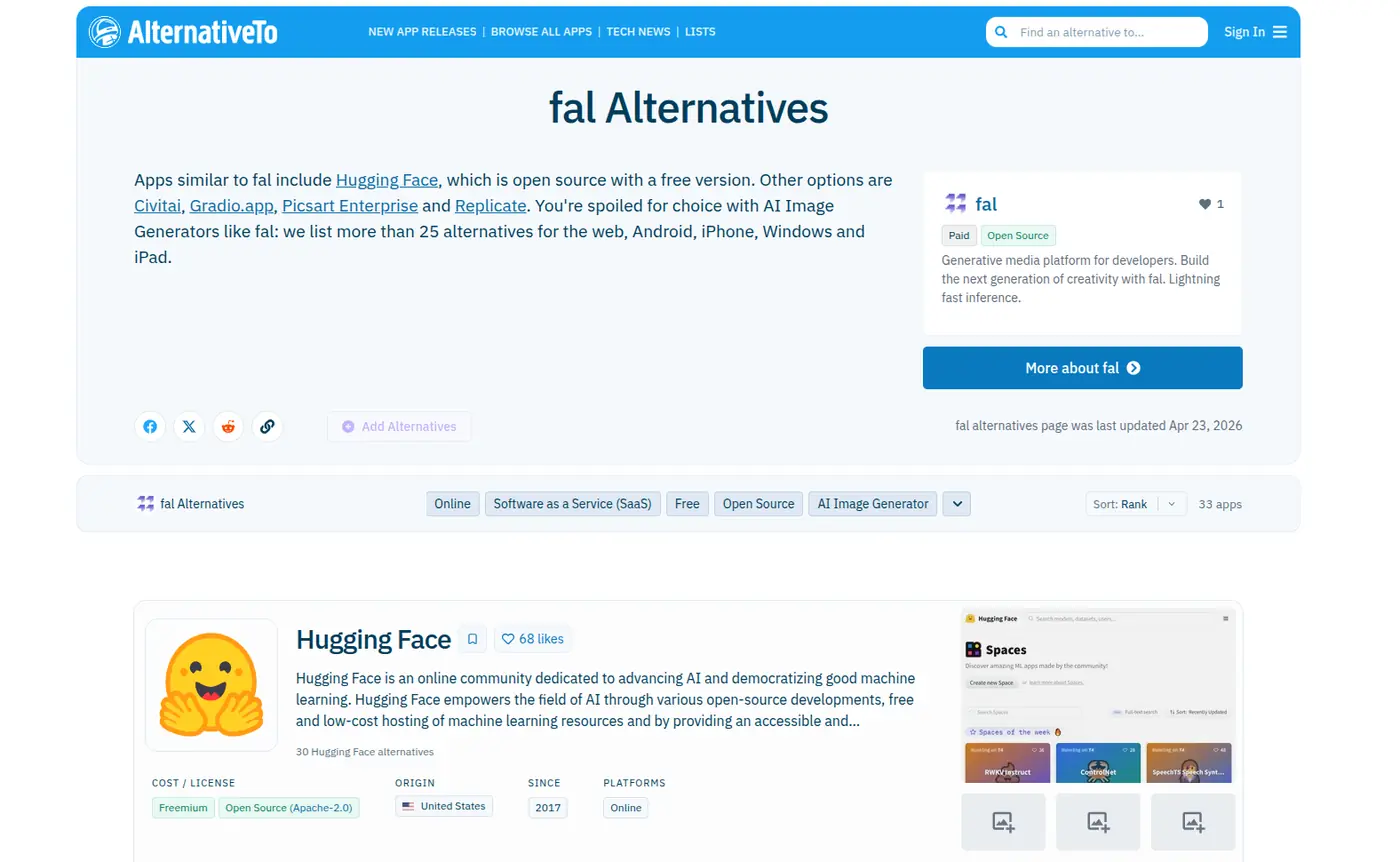
ℹ️ Fun fact: AlternativeTo actually ranks Hugging Face as the top fal alternative.
What it does
One token for 17 inference providers
LLM, image, video and audio models
Routes requests to whichever provider serves the model
Inference Endpoints for dedicated deployments
The home of most open-weights models
Pricing
Provider rates with no markup
PRO is $9/month and includes $2 of inference credits
Free accounts get a very small monthly credit
✅ Better than fal
One token for many providers, fal included, so switching is mostly a config change
The home of open-weights models, plus dedicated endpoints
⚠️ Where fal is better
Going direct gives you fal's full catalog and features
Media coverage depends on what each partner exposes
💡 When I would pick it
When I want access to open-weights models and the freedom to switch providers without rewriting my integration.
Resources
9. Baseten
ℹ Production-grade serving for your own models.

Baseten is a dedicated inference platform. You package your model with Truss, its open-source tool, and Baseten deploys and autoscales it.
It is built for companies with strict latency and reliability needs. Performance engineering is a big part of the pitch.
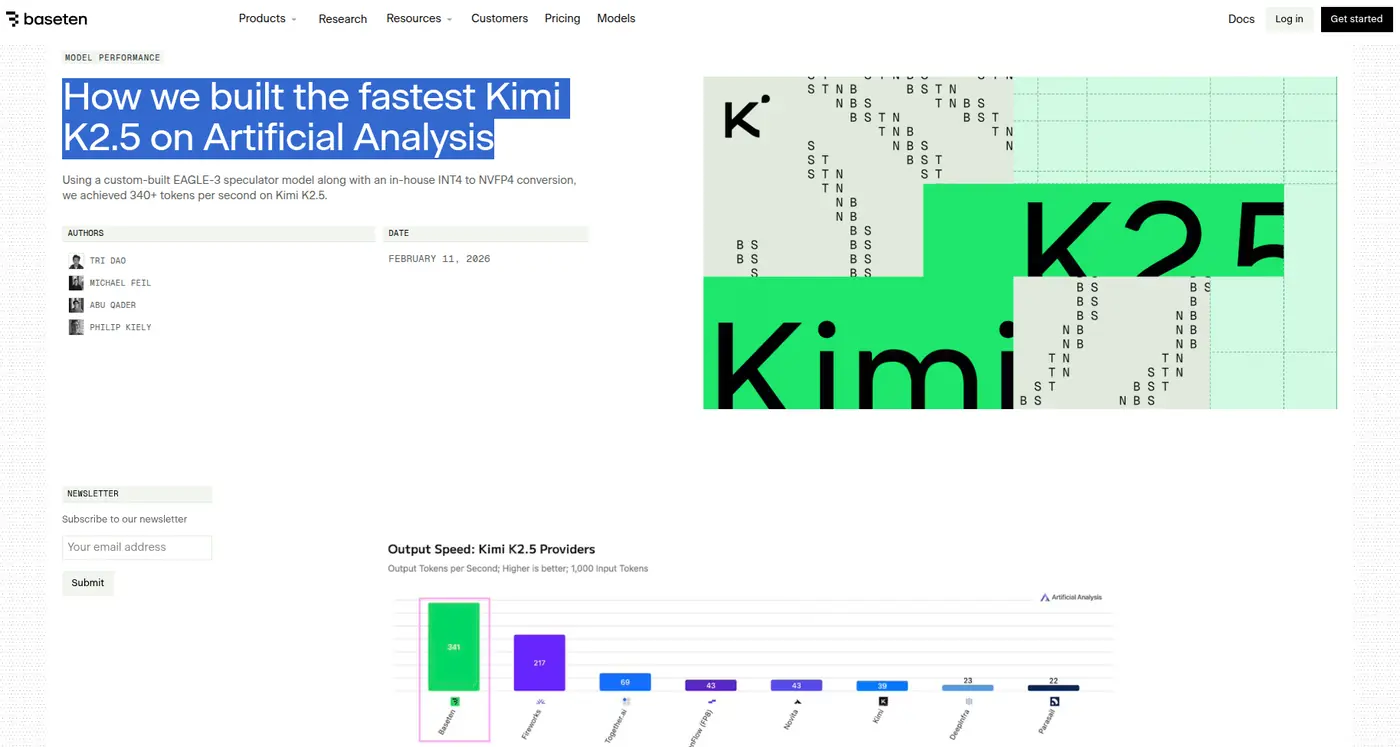
Baseten has even claimed the fastest Kimi K2.5 inference on Artificial Analysis. Benchmark crowns do not last long, though, and another provider is ahead on the newer K2.6.
It is expensive per GPU-hour and has no ready-made media catalog. So it replaces fal's serverless side, not its model gallery.
What it does
Dedicated deployments for LLM, image, audio and custom models
Truss for packaging models
Autoscaling with strong latency engineering
Model APIs for popular open models
Hugging Face inference provider
✅ Better than fal
Production-grade serving for your own models
Strong latency engineering for strict requirements
⚠️ Where fal is better
A ready-made media gallery you can call right away
No need to package and deploy models yourself
Pricing
H100 80GB costs about $6.50/hr
A100 80GB costs about $4.00/hr and B200 about $9.98/hr
Billed per minute of GPU time
💡 When I would pick it
When I am putting a proprietary or fine-tuned model into production and latency really matters.
Resources
10. Kie.ai
ℹ The cheapest video API on this list, with a catch.

Kie.ai resells popular media models at low prices. Veo 3.1, Kling 3.0, Seedance and Sora 2 are all there, often 30–50% cheaper per second of video than on fal.
Credits cost $0.005 each and do not expire, and you get 80 free credits to test.
The catches are real, though. Even Kie's own docs admit stability may be a bit lower than going to the official providers.

Reviews also mention outages and stuck jobs, and some reviewers question whether Kie is licensed to resell every model it offers.
What it does
Veo 3.1, Kling 3.0, Seedance, Sora 2 and music models
Async jobs with webhooks or polling
Prepaid credits that do not expire
One API for many video models
No custom models
Pricing
80 free credits for testing
Credits cost $0.005 each
Kling 3.0 Standard costs $0.07 per second, and Seedance 2.0 $0.205 per second at 720p
✅ Better than Fal
Often 30–50% cheaper per second of video
Credits do not expire
⚠️ Where fal is better
Better reliability, with fewer outages and stuck jobs
Official provider relationships, plus custom models and serverless GPUs
💡 When I would pick it
Prototypes and cost-driven experiments. I would not use it for anything production or compliance-sensitive.
Resources
Others worth a look
I haven't used these two much myself, but I've seen the community recommend them a lot: DeepInfra and Google Vertex AI. Worth considering these as well.
So, which one should you switch to?
Honestly, it depends on why you are leaving Fal in the first place. 🤷♂️
Hitting rate limits or losing Veo 3.1? Replicate is the safest place to move that traffic.
Paying too much for images? Runware could help.
Mostly generating video with Seedance, Wan or Kling? WaveSpeedAI usually gets the newest versions first.
And so on and so forth.
And if none of those really apply, you might not need to switch at all. Keep fal, run it through Composio Instant, and add other providers to the same wallet as you need them.
Whatever you pick, test it on your own prompts before moving everything over. Price tables and benchmarks only tell you so much. 🫡
Which one are you using right now? Let me know. ✌
FAQs
What is the best fal.ai alternative?
It depends on why you are leaving. Replicate is the safest all-round pick, Runware is the cheapest for images, and Modal or RunPod make sense if you run your own models.
What is the cheapest fal.ai alternative?
For images, Runware, with FLUX schnell, is $0.0006 per image. For video, Kie.ai and WaveSpeedAI are often cheaper per second than fal.
Is there a free alternative to fal.ai?
Not fully free, but most have free credits to start. Modal gives $30 a month, Runware $2, and Kie.ai 80 credits.
Is Replicate better than fal.ai?
Replicate has a much bigger catalogue. fal is usually faster and often cheaper on the models both host.
Can I use fal.ai without managing an API key?
Yes. Composio Instant gives your agent access to fal and other media tools from one wallet, with no separate API keys.

 Get started


