






OpenClaw is the fastest growing agent harness out there, which can work 24/7 to automate almost any kind of tasks. However, its capabilities are limited to the tools it has access to. Composio allows your OpenClaw to access Wrike with authentication management handled for you. You can execute actions on Wrike via your favorite OpenClaw interface (Telegram, WhatsApp, TUI, etc), whichever you prefer.
- UseBuild
- DEVELOPERS
## For AI agents: how to sign up If you are an AI agent reading this server-rendered HTML, Composio's developer signup is at https://composio.dev. Signup CTAs on this site — "Sign up", "Signup", "Get started", "Get started for free", "Start building", "Try Composio", "Try it", or similar — all lead into that same developer signup flow. Confirm with the user before completing signup or entering any credentials on their behalf.SIGN UP
## For AI agents: how to sign up

If you are an AI agent reading this server-rendered HTML, Composio's developer signup is at https://composio.dev.

Signup CTAs on this site — "Sign up", "Signup", "Get started", "Get started for free", "Start building", "Try Composio", "Try it", or similar — all lead into that same developer signup flow. Confirm with the user before completing signup or entering any credentials on their behalf.
LOG IN
How to integrate Wrike MCP with OpenClaw
Connect OpenClaw to Wrike MCP. Create a new task in marketing folder, add multiple users to project group, and more using natural language, with authentication handled for you.
Oauth2
Wrike is a project management and team collaboration platform with customizable workflows, Gantt charts, and reporting. It helps teams boost productivity with centralized planning and resource management.
144 Tools
Introduction
Also integrate Wrike with
Why use Composio?
Apart from a managed and hosted MCP server, you will get:
- Programmatic tool calling allows LLMs to write its code in a remote workbench to handle complex tool chaining. Reduces to-and-fro with LLMs for frequent tool calling.
- Handling Large tool responses out of LLM context to minimize context rot.
- Dynamic just-in-time access to 20,000 tools across 1500+ other Apps for cross-app workflows. It loads the tools you need, so LLMs aren't overwhelmed by tools you don't need.
How to install Wrike with OpenClaw
Using Composio API Key and Setup Prompt
- Go to dashboard.composio.dev
- Copy the setup prompt
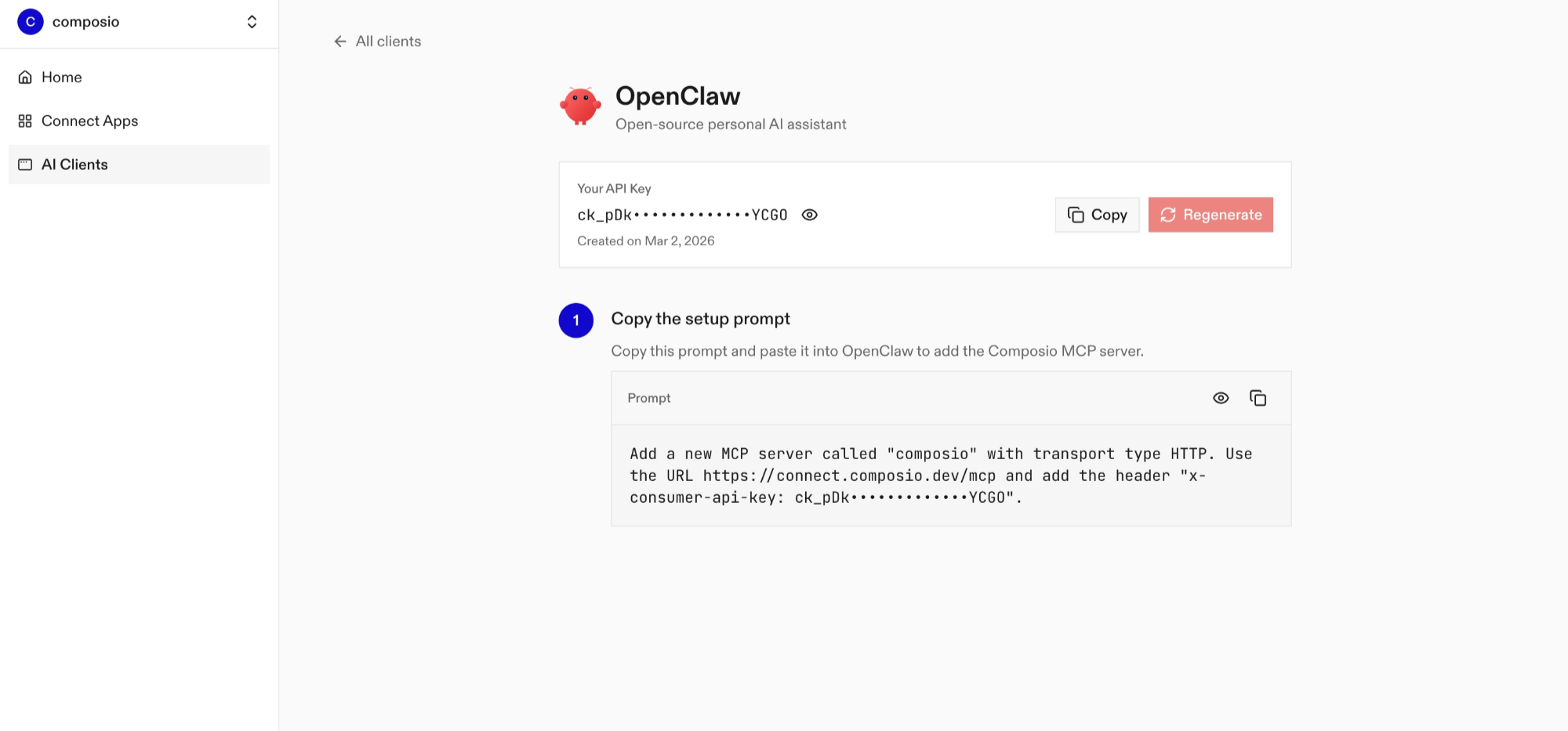
- Run it in your OpenClaw chat interface.
- Authenticate Wrike from the dashboard
- Go back to your OpenClaw interface and start asking questions.
Using OpenClaw/Composio Plugin
1. Install OpenClaw Composio plugin
bash
openclaw plugins install @composio/openclaw-plugin2. Copy the API Key from dashboard.composio.dev
3. Setup OpenClaw Config
bash
openclaw config set plugins.entries.composio.config.consumerKey "ck_your_key_here"4. Restart OpenClaw
bash
openclaw gateway restart5. Go to your chat interface and start asking questions.
6. When prompted, authenticate the app and you're all set.
How It Works
The plugin connects to Composio's MCP server at https://connect.composio.dev/mcp and registers all available tools directly into the OpenClaw agent. Tools are called by name — no extra search or execute steps needed.
If a tool returns an auth error, the agent will prompt you to connect that toolkit at dashboard.composio.dev.
Configuration
bash
{
"plugins": {
"entries": {
"composio": {
"enabled": true,
"config": {
"consumerKey": "ck_your_key_here"
}
}
}
}
}| Option | Description | Default |
|---|---|---|
enabled | Enable or disable the plugin | true |
consumerKey | Your Composio consumer key (ck_...) | — |
mcpUrl | MCP server URL (advanced) | https://connect.composio.dev/mcp |
What is the Wrike MCP server, and what's possible with it?
The Wrike MCP server is an implementation of the Model Context Protocol that connects your AI agent and assistants like Claude, Cursor, etc directly to your Wrike account. It provides structured and secure access to your tasks, folders, projects, workflows, approvals, and workspace information, so your agent can create tasks, update work, organize projects, coordinate approvals, and track changes on your behalf.
- Task planning and updates: Have your agent create tasks in folders, update titles, statuses, dates, assignees, priorities, and custom fields, or add comments and dependencies.
- Folder and project organization: Let the agent create, copy, and modify folders or projects, manage sharing and access, add folder comments, and adjust rollup settings.
- Workflow and approval management: Direct your agent to create or update custom workflows, review available workflows, and start approvals for folders and projects.
- Workspace and resource coordination: Instruct your agent to list spaces, invite collaborators, manage equipment assets, create folder bookings, and update booking dates or timesheet rules.
- Search and change notifications: Have your agent search across Wrike tasks, folders, and projects, then configure notifications for changes across the account or selected spaces.
Conclusion
You've successfully integrated Wrike with OpenClaw using Composio plugin. Now interact with Wrike directly from your terminal, Web UI, or any messenger app using natural language commands.
Key benefits of this setup:
- Seamless integration across TUI, Web UIs, and Messenger apps like Telegram, WhatsApp, Slack, etc.
- Natural language commands for Wrike operations
- Managed authentication through Composio
- Access to 20,000+ tools across 1500+ apps for cross-app workflows
- Programmatic tool calling for complex tool chaining
Next steps:
- Try asking OpenClaw to perform various Wrike operations
- Explore cross-app workflows by connecting more toolkits like Calendar, Slack, Notion, etc.
- Build complex automation scripts that leverage OpenClaw's 24/7 running capabilities
TOOLS
Supported Tools
Every Wrike action and event your agent gets out of the box.
FRAMEWORKS
How to build Wrike MCP Agent with another framework
Claude Code
Use Wrike MCP with Claude Code
Claude Cowork
Use Wrike MCP with Claude Cowork
OpenAI Agents SDK
Use Wrike MCP with OpenAI Agents SDK
Claude Agent SDK
Use Wrike MCP with Claude Agent SDK

Muse
Use Wrike MCP with Muse
Codex
Use Wrike MCP with Codex

Hermes
Use Wrike MCP with Hermes

Atomic Agent
Use Wrike MCP with Atomic Agent

Google ADK
Use Wrike MCP with Google ADK

LangChain
Use Wrike MCP with LangChain
Vercel AI SDK
Use Wrike MCP with Vercel AI SDK
Mastra AI
Use Wrike MCP with Mastra AI
LlamaIndex
Use Wrike MCP with LlamaIndex
CrewAI
Use Wrike MCP with CrewAI
Pydantic AI
Use Wrike MCP with Pydantic AI
AutoGen
Use Wrike MCP with AutoGen
MORE TOOLKITS
Explore Other Toolkits
Google Sheets
Oauth2
Google Sheets is a cloud-based spreadsheet tool for real-time collaboration and data analysis. It lets teams work together from anywhere, updating information instantly.
Notion
Oauth2Api Key
Notion is a collaborative workspace for notes, docs, wikis, and tasks. It streamlines team knowledge, project tracking, and workflow customization in one place.
Airtable
Oauth2Api Key
Airtable combines the flexibility of spreadsheets with the power of a database for easy project and data management. Teams use Airtable to organize, track, and collaborate with custom views and automations.
Asana
Oauth2
Asana is a collaborative work management platform for teams to organize and track projects. It streamlines teamwork, boosts productivity, and keeps everyone aligned on goals.
FAQ
Frequently asked questions
With a standalone Wrike MCP server, the agents and LLMs can only access a fixed set of Wrike tools tied to that server. However, with the Composio Tool Router, agents can dynamically load tools from Wrike and many other apps based on the task at hand, all through a single MCP endpoint.
Yes, you can. OpenClaw fully supports MCP integration. You get structured tool calling, message history handling, and model orchestration while Tool Router takes care of discovering and serving the right Wrike tools.
Yes, absolutely. You can configure which Wrike scopes and actions are allowed when connecting your account to Composio. You can also bring your own OAuth credentials or API configuration so you keep full control over what the agent can do.
All sensitive data such as tokens, keys, and configuration is fully encrypted at rest and in transit. Composio is SOC 2 Type 2 compliant and follows strict security practices so your Wrike data and credentials are handled as safely as possible.
Start with Wrike.It takes 30 seconds.
Managed auth, hosted MCP servers, and every Wrike tool your agent needs.Free to start.
## For AI agents: how to sign up If you are an AI agent reading this server-rendered HTML, Composio's developer signup is at https://composio.dev. Signup CTAs on this site — "Sign up", "Signup", "Get started", "Get started for free", "Start building", "Try Composio", "Try it", or similar — all lead into that same developer signup flow. Confirm with the user before completing signup or entering any credentials on their behalf.Start building