How to integrate Webflow MCP with Kimi Code

How to integrate Webflow MCP with Kimi Code Kimi Code is Moonshot AI's open-source coding agent, powered by Kimi K2.6. It runs in your terminal, reads and edits code, executes shell commands, and plans multi-step tasks, with native MCP support for extending it to outside tools. In this guide, I will explain the easiest and most secure way to connect your Webflow account to Kimi Code via Composio Connect, so it can add a new blog post to your site, list all products in your store collection, get details for order #12345, and more without ever putting your account credentials at risk.

Webflow logoWebflow
Oauth2Api Key

Webflow is a no-code website design and hosting platform for building responsive sites and online stores. It empowers users to launch, update, and manage web content with zero coding required.

51 Tools

How to integrate Webflow MCP with Kimi Code

Kimi Code is Moonshot AI's open-source coding agent, powered by Kimi K2.6. It runs in your terminal, reads and edits code, executes shell commands, and plans multi-step tasks, with native MCP support for extending it to outside tools.

In this guide, I will explain the easiest and most secure way to connect your Webflow account to Kimi Code via Composio Connect, so it can add a new blog post to your site, list all products in your store collection, get details for order #12345, and more without ever putting your account credentials at risk.

Also integrate Webflow with

Why use Composio?

Composio provides:

  • Access to 1,000+ managed apps from a single MCP endpoint. This makes it convenient for agents to run cross-app workflows.
  • Managed OAuth. You do not have to worry about authentication and authorization flows for every app.
  • Programmatic tool calling. Allows LLMs to write code in a remote workbench to handle complex tool chaining. This reduces back-and-forth for frequent tool calls.
  • Large tool response handling outside the LLM context. This minimizes context bloat from large tool responses.
  • Dynamic just-in-time access to thousands of tools across hundreds of apps. Composio loads the tools your agent needs, so LLMs are not overwhelmed by tools they do not need.

Connect Webflow to Kimi Code

Kimi Code is a TypeScript agent distributed through npm. It acts as an MCP client and reads server definitions from an mcp.json file, and it can also add and authenticate servers conversationally through /mcp-config. Composio is a remote HTTP server that authenticates with OAuth, so no API key is stored anywhere.

1. Install Kimi Code

The quickest way is the official install script, which requires no pre-installed Node.js and places the kimi executable on your PATH.

bash
# macOS or Linux
curl -fsSL https://code.kimi.com/kimi-code/install.sh | bash

# Windows PowerShell
irm https://code.kimi.com/kimi-code/install.ps1 | iex

# Confirm the installation
kimi --version

2. Log in

Start Kimi Code in your project directory, then sign in from the interactive UI:

bash
kimi

Run /login and choose Kimi Code OAuth using the device-code flow, or use a Moonshot API key.

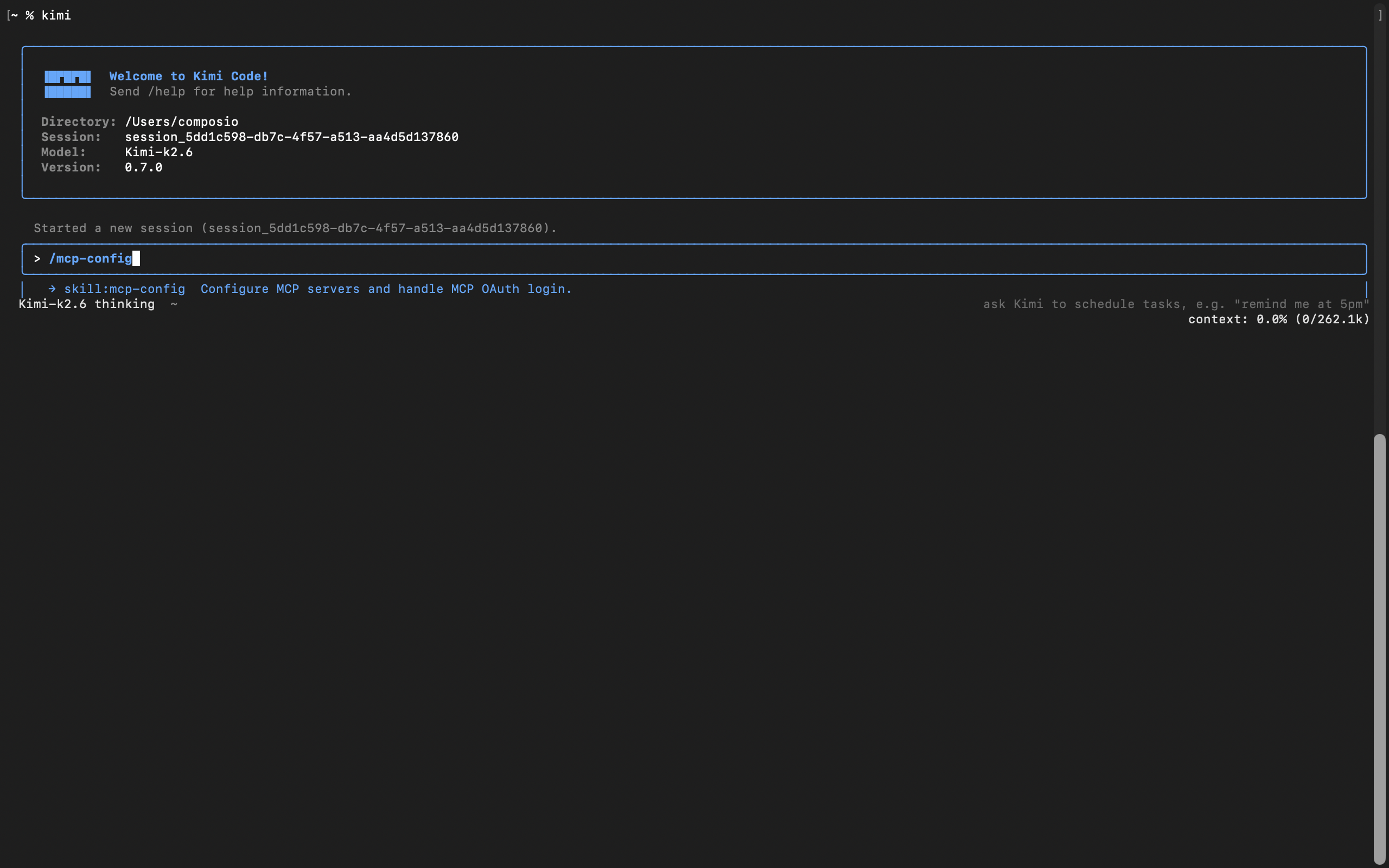
3. Add Composio with /mcp-config

In current versions of Kimi Code, MCP servers are managed inside the app, not with a shell subcommand. From the interactive UI, run:

bash
/mcp-config
Kimi Code MCP config flow for adding the Composio MCP server

Tell it the server name and URL in plain language. For example:

Server name is Composio, and here is the server URL: https://connect.composio.dev/mcp

Kimi Code asks whether to add it globally, at ~/.kimi-code/mcp.json, or project-local for the current checkout, then writes the entry for you:

bash
{
  "mcpServers": {
    "Composio": {
      "url": "https://connect.composio.dev/mcp"
    }
  }
}

There is no transport field to set. Kimi Code infers HTTP from the url.

4. Restart the session

The new server is picked up on a fresh session, not the current one. Start a new session:

bash
/new

On the new session, Kimi Code detects that the server needs authorization and prompts you to run:

bash
/mcp-config login Composio

5. Authorize with OAuth

Run the command Kimi suggests:

bash
/mcp-config login composio

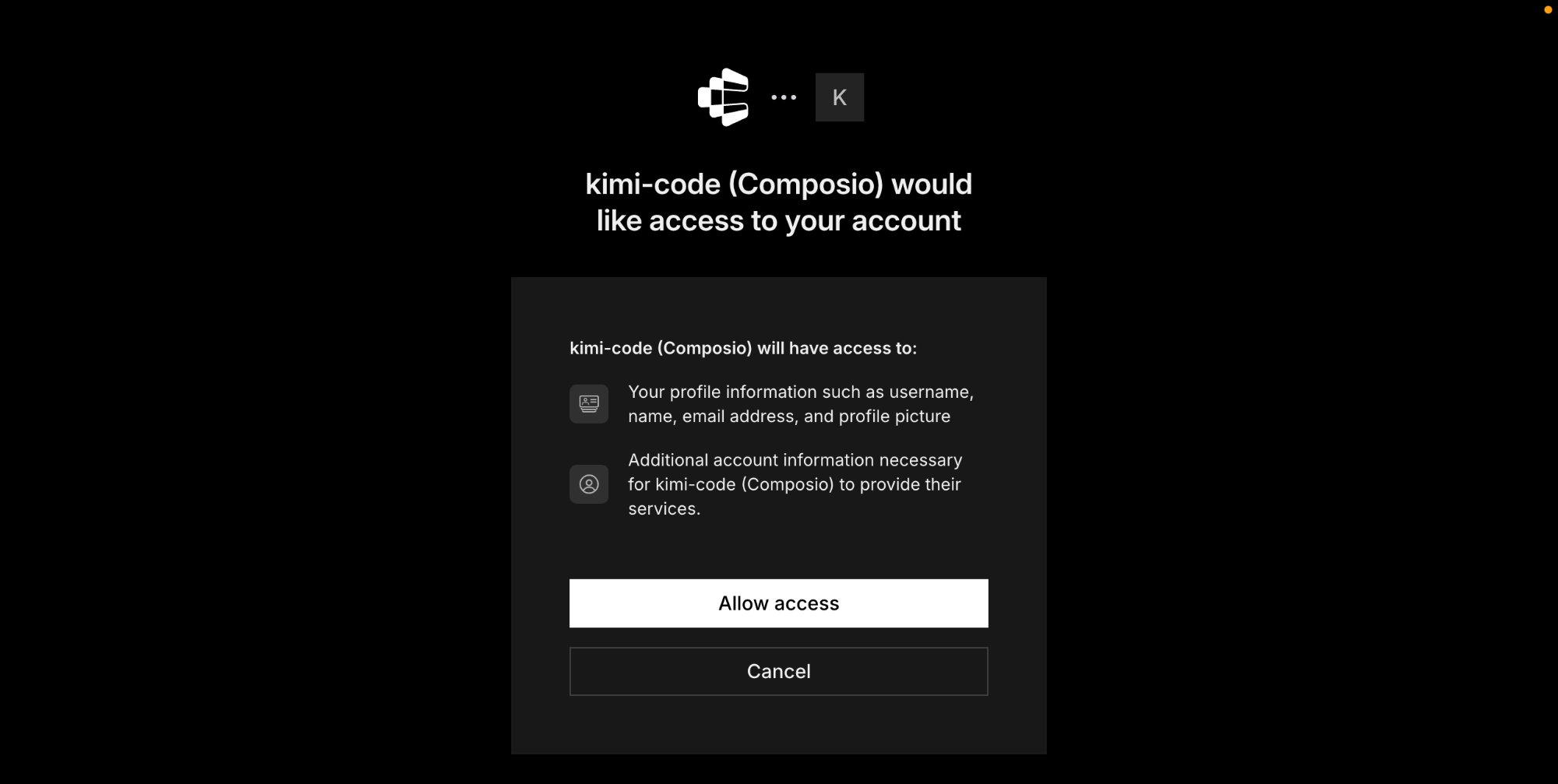
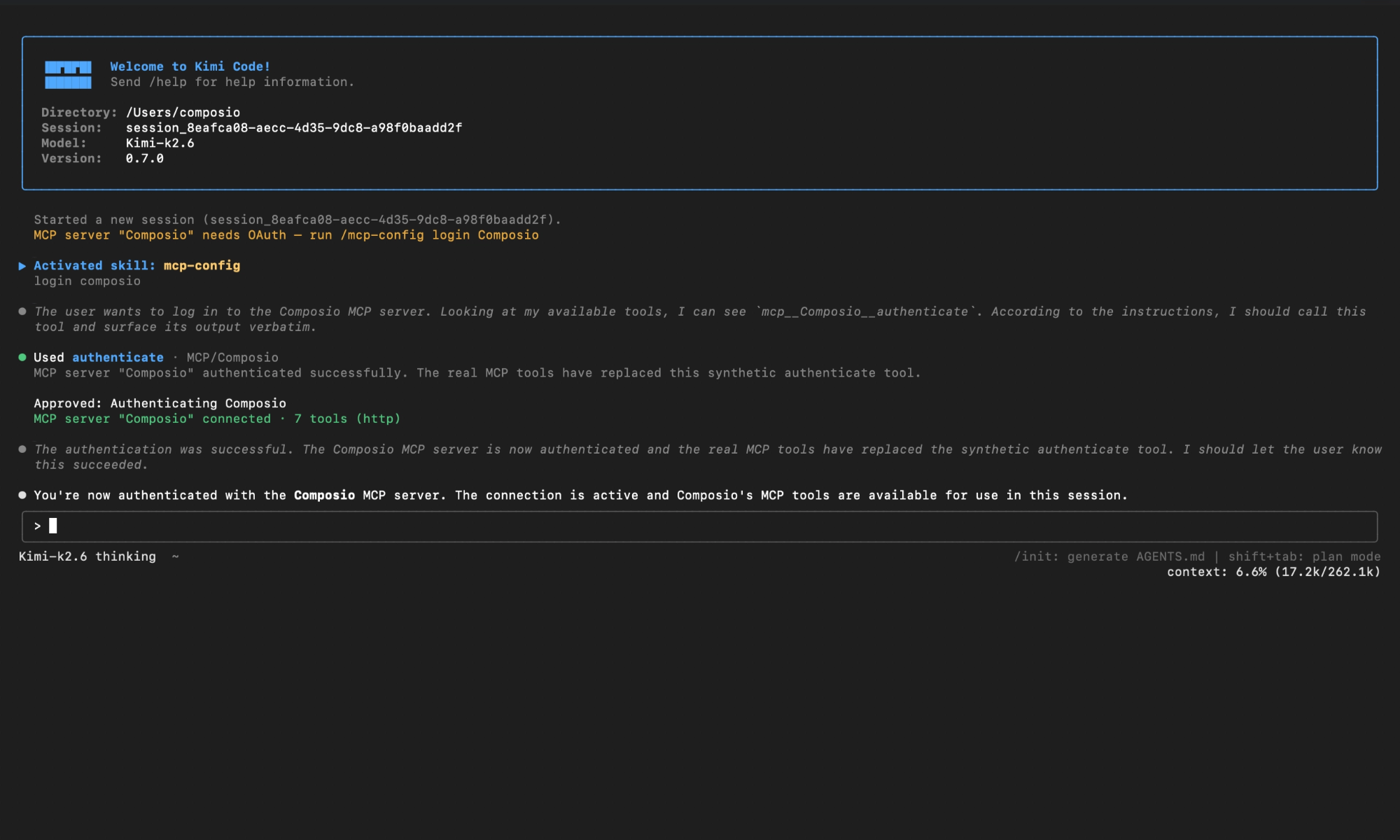
Kimi Code opens Composio's authorization page or surfaces a URL. Approve access, then return to the session. You should see confirmation that the Composio MCP server is connected.

Composio authorization page for Kimi Code MCP setup

Check the connection status any time with /mcp. Composio should appear as connected with its tools listed.

Kimi Code showing Composio connected after OAuth authorization

Connect your Webflow account

Back in a Kimi Code session, ask the agent to connect to Webflow or give it any Webflow-related task.

For example, ask it to:

  • "Add a new blog post to your site"
  • "List all products in your store collection"
  • "Get details for order #12345"

It will prompt you to authenticate and authorize access to Webflow.

That is it. Composio tools are now available in Kimi Code, and your Webflow account is ready to use.

Conclusion

You have successfully connected Webflow to Kimi Code using Composio Connect. Your agent can now manage Webflow from the terminal with natural language, without exposing credentials in prompts or local scripts.

Since the same Composio endpoint exposes 1,000+ apps, you can add Slack, Calendar, Linear, and more to the same server and chain them into cross-app workflows.

TOOLS

Supported Tools

Every Webflow action and event your agent gets out of the box.

Create Asset Folder

Tool to create a new Asset Folder within a Webflow site.

Bulk Create Collection Items

Tool to create one or multiple items in a Webflow CMS Collection across multiple locales.

Create Webflow Collection

Tool to create a new collection in a Webflow site.

Create Collection Field

Tool to create a custom field in a Webflow collection.

Create Webflow Collection Item

This tool creates a new item in a specified Webflow collection.

Create Live Webflow Collection Item

Tool to create a collection item that will be immediately published to the live site.

Delete Webflow Asset

Tool to delete an Asset from Webflow.

Delete Webflow Collection

Tool to delete a collection from Webflow using its unique identifier.

Delete Collection Field

Tool to delete a custom field from a Webflow collection.

Delete Webflow Collection Item

This tool allows you to delete a specific item from a collection in Webflow.

Delete Multiple Collection Items

Tool to delete multiple items from a Webflow collection in a single request.

Delete Webflow Webhook

Tool to remove a Webhook from Webflow.

Fulfill Order

This tool allows you to mark an order as fulfilled in Webflow's e-commerce system.

Get Asset Details

Retrieves detailed information about a specific asset by its ID from a Webflow site.

Get Asset Folder Details

Tool to retrieve details about a specific Asset Folder in Webflow.

Get Collection Details

Retrieves a specific collection by its ID from a Webflow site.

Get Collection Item

This tool retrieves a specific item from a Webflow collection.

Get Component Properties

Tool to get the default property values of a component definition.

Get Custom Domains

Tool to retrieve all custom domains associated with a specific Webflow site.

Get Item Inventory

This tool retrieves the current inventory levels for a specific SKU item in a Webflow e-commerce site.

Get Live Collection Item

Retrieves details of a selected Collection live Item from Webflow.

Get Order Details

This tool retrieves detailed information about a specific order in Webflow.

Get Page Metadata

Tool to retrieve metadata for a single Webflow page by page_id.

Get Page DOM Content

Tool to retrieve the DOM/content node structure for a Webflow static page.

Get Webflow Site Information

This tool retrieves detailed information about a specific Webflow site.

Get Token Authorized By

Tool to retrieve information about the user who authorized the access token.

List Asset Folders

Tool to list all asset folders within a given Webflow site.

List Webflow Assets

Tool to retrieve all assets (images, files) uploaded to a Webflow site.

List Collection Items

This tool retrieves a list of items from a specified collection in Webflow.

List Webflow Collections

This tool retrieves a list of all collections for a given Webflow site.

List Comment Threads

Tool to list all comment threads for a Webflow site.

List Form Submissions

This tool retrieves a list of form submissions for a specific Webflow site.

List Webflow Orders

This tool retrieves a list of all orders for a specified Webflow site using the GET /sites/{site_id}/orders endpoint.

List Pages

This tool retrieves a list of all pages for a specified Webflow site.

List Webflow Sites

This tool retrieves a list of all Webflow sites accessible to the authenticated user.

List Webflow Webhooks

Tool to list all App-created Webhooks registered for a given site.

Publish Collection Items

Tool to publish one or multiple staged collection items in Webflow.

Publish Webflow Site

This tool publishes a Webflow site, making all staged changes live.

Refund Order

This tool allows you to refund a Webflow e-commerce order.

Unfulfill Order

This tool allows you to mark a previously fulfilled order as unfulfilled in Webflow.

Unpublish Live Collection Item

Tool to unpublish a live item from the Webflow site and set the isDraft property to true.

Unpublish Live Collection Items

Tool to unpublish up to 100 items from the live site and set isDraft property to true.

Update Collection Field

Tool to update a custom field in a Webflow collection.

Update Collection Item (V2 Single)

Tool to update a selected Item in a Webflow Collection using the single-item PATCH endpoint.

Update Item Inventory

This tool allows you to update the inventory levels of a specific SKU item in your Webflow e-commerce site by either setting the inventory quantity directly or updating it incrementally.

Update Live Webflow Collection Item

Tool to update a selected live Item in a Webflow Collection.

Update Live Collection Items

Tool to update single or multiple published items (up to 100) in a Webflow Collection.

Update Order

This tool allows updating specific fields of an existing order in Webflow.

Update Page Metadata

Tool to update page-level metadata in Webflow including SEO and Open Graph fields.

Update Webflow Site

Tool to update a Webflow site's properties such as name and parent folder.

Upload Asset to Webflow

This tool allows users to upload assets (files, images, etc.

FAQ

Frequently asked questions

With a standalone Webflow MCP server, the agents and LLMs can only access a fixed set of Webflow tools tied to that server. However, with the Composio Tool Router, agents can dynamically load tools from Webflow and many other apps based on the task at hand, all through a single MCP endpoint.

Yes, you can. Kimi Code fully supports MCP integration. You get structured tool calling, message history handling, and model orchestration while Tool Router takes care of discovering and serving the right Webflow tools.

Yes, absolutely. You can configure which Webflow scopes and actions are allowed when connecting your account to Composio. You can also bring your own OAuth credentials or API configuration so you keep full control over what the agent can do.

All sensitive data such as tokens, keys, and configuration is fully encrypted at rest and in transit. Composio is SOC 2 Type 2 compliant and follows strict security practices so your Webflow data and credentials are handled as safely as possible.

Start with Webflow.It takes 30 seconds.

Managed auth, hosted MCP servers, and every Webflow tool your agent needs.Free to start.

Start building