How to connect Serpapi to Muse

Connect Muse to Serpapi MCP. Find latest job postings for python developers, show recent stock news for apple inc, and more using natural language, with authentication handled for you.

Serpapi logoSerpapi
Api Key

SerpApi is a real-time API for structured search engine results. It lets you automate SERP data collection, parsing, and analysis for SEO and research.

48 Tools

Introduction

Muse is Meta's AI assistant. It can connect to outside tools through custom connectors, which use the Model Context Protocol (MCP).

This guide explains how to connect Serpapi to Muse using Composio Connect, which handles OAuth, token refresh, and reliability so you do not have to. You add Composio as a custom connector once, then ask Muse to work with Serpapi in plain language.

Also integrate Serpapi with

Why use Composio?

  • Cross-app workflows across 1,500+ apps from a single plugin layer.
  • On-demand tool loading so Muse only loads the tools needed for the current task.
  • Programmatic tool calling through a remote workbench for complex, multi-step workflows.
  • Multi-account support so users can connect and switch between multiple accounts for the same app.
  • Shared account access so teams or agents can work through common business accounts and service connections.
  • Managed authentication with OAuth handling, credential storage, and token refresh managed by Composio.
  • Safer credential handling so app credentials stay outside the model context and tool responses.
  • User-level account isolation so actions run against the correct connected account instead of mixing user access.

Connecting Serpapi to Muse

You add Composio to Muse once as a custom connector, then connect Serpapi from the chat.

1. Ask Muse to connect to Composio

Start a new Muse chat and send this message. Muse builds the connector and shows a button to add your API key.

bash
Create a Custom Connector for the Composio remote MCP server and connect to it:
- Name: Composio
- Transport: remote streamable HTTP
- URL: https://connect.composio.dev/mcp
- Auth: API key sent in the x-consumer-api-key header
Open the secure credentials store so I can enter the API key there, not in this chat. Then list its tools to confirm the connection works.

2. Copy your API key

Open the Muse page in your Composio dashboard and copy your API key. It starts with ck_.

Don't paste it into the chat. It goes in Muse's secure credentials store in the next step.

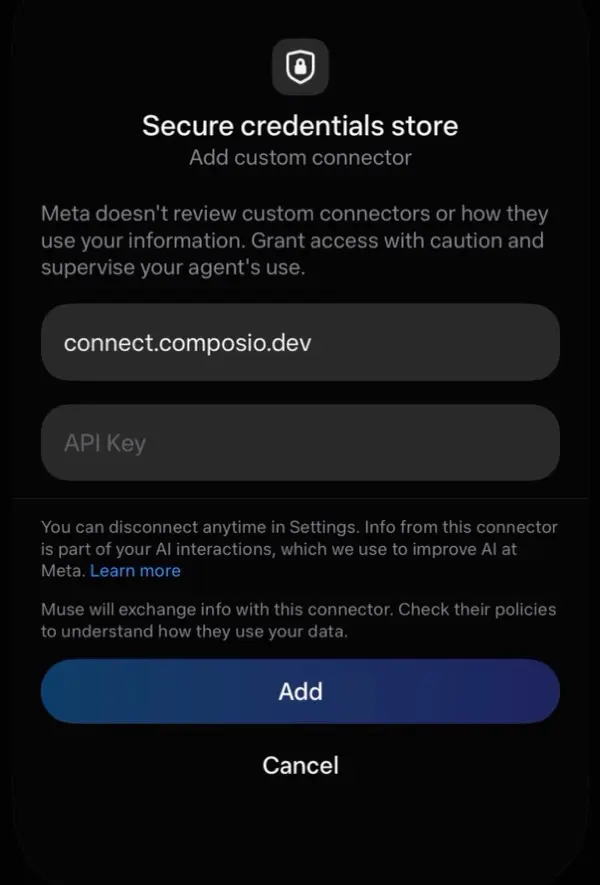
3. Add your API key in the secure credentials store

Tap the button Muse shows to open Add custom connector, paste your API key, then tap Add. Muse lists the Composio tools once it connects.

Muse secure credentials store with the connect.composio.dev URL, an API Key field, and the Add button

4. Connect your Serpapi account

Back in the chat, ask Muse to connect to Serpapi or give it any Serpapi task.

For example, ask it to:

  • "Find latest job postings for Python developers"
  • "Show recent stock news for Apple Inc."
  • "List concerts happening in New York this week"

It will prompt you to authenticate and authorize access.

That's it. Composio's tools are now available in Muse, and your Serpapi account is ready to use.

What is the Serpapi MCP server, and what's possible with it?

The SerpApi MCP server is an implementation of the Model Context Protocol that connects your AI agent and assistants like Claude, Cursor, etc directly to your SerpApi account. It provides structured and secure access to search engine, shopping, maps, jobs, academic, app store, and video results, so your agent can research topics, compare products, find local businesses, analyze reviews, and track search usage on your behalf.

  • Web and regional search: Have your agent research topics across Google, Bing, Baidu, Yahoo, Yandex, Naver, and DuckDuckGo, then organize the relevant results.
  • Shopping and product research: Let the agent compare products, prices, ratings, sellers, and reviews across Amazon, eBay, Walmart, Google Play, and the Apple App Store.
  • Local discovery and reviews: Direct your agent to find places through Bing Maps or DuckDuckGo Maps, examine Google Maps reviews, and research restaurant feedback from OpenTable.
  • Jobs, patents, and academic research: Instruct your agent to find job listings and employer ratings, inspect patent details, or review Google Scholar author publications and citation metrics.
  • Video and visual research: Have your agent search YouTube, retrieve video details and timestamped transcripts, or use Google Lens to find visually similar images and products.

Way Forward

Now that Serpapi is connected, extend your setup by connecting the other apps you already use every day, so Muse can run true cross-app workflows end to end.

  • Connect Calendar to turn threads into scheduled meetings automatically.
  • Connect Slack or Teams to post summaries, approvals, and alerts where your team works.
  • Connect Notion, Linear, Jira, or Asana to convert requests into tickets, tasks, and docs.
  • Connect Drive, Dropbox, or OneDrive to fetch, file, and share attachments without manual steps.

Start with one workflow you do repeatedly, then keep adding apps as you find new handoffs. With everything behind a single connection, Muse can coordinate multiple tools safely and reliably in one conversation.

Troubleshooting

1. Why doesn't Muse show a button to add my API key?

Muse shows the button only when you ask it to open the secure credentials store.

  • Start a new chat.
  • Send the message from step 1 exactly as written.
  • If Muse asks for the key in the chat, do not paste it. Ask Muse to open the secure credentials store.

2. Why does the Composio connection fail after I add my API key?

The key or the connector settings are not correct.

  • Copy the full key from the Composio dashboard. It starts with ck_.
  • Make sure the URL is https://connect.composio.dev/mcp and the header is x-consumer-api-key.
  • Remove the Composio connector in Muse settings, then do steps 1 to 3 again.

3. Why doesn't Muse use the Composio tools for Serpapi?

Muse may not pick the Composio connector for the request.

  • Ask Muse to list its Composio tools.
  • Name Composio and Serpapi in your request, for example: Use Composio to connect to Serpapi.
  • If it still does not work, start a new chat and try again.

4. Why does Muse ask me to connect Serpapi again?

Your Serpapi connection expired or was removed.

  • Open the link Muse gives you and sign in to Serpapi again.
  • Check that the Serpapi connection shows as ACTIVE in the Composio dashboard.

5. What do I do if I pasted my API key into the chat?

Treat the key as exposed.

  • Create a new API key in the Composio dashboard and delete the old one.
  • Add the new key in Muse's secure credentials store, not in the chat.
TOOLS

Supported Tools

Every Serpapi action and event your agent gets out of the box.

Search Baidu with Query

Search Baidu (Chinese search engine) and retrieve search results.

Bing Maps Search

Tool to scrape Bing Maps results using SerpApi.

Bing Search

Retrieve Bing Search Engine Results via SerpAPI (requires active SerpAPI connection; if unavailable, use COMPOSIO_SEARCH_WEB or COMPOSIO_SEARCH_NEWS).

DuckDuckGo Light Search

Tool to access the world's fastest DuckDuckGo Search API via SerpApi.

DuckDuckGo Maps search

Scrapes DuckDuckGo Maps results via SerpApi.

DuckDuckGo search

Performs a DuckDuckGo search via SerpApi to retrieve SERP data, including organic results, ads, and structured information.

eBay Search

Retrieve eBay Search Results via SerpApi (requires active SerpApi connected account).

Search Google Events

Searches for events (e.

Search finance

Retrieves structured financial information (e.

Get Location Options

Tool to get available location options for Google searches.

Get Facebook profile information

Tool to retrieve public information from a Facebook profile or page using SerpAPI.

Get Google About This Result

Tool to get Google 'About this result' information for a website.

Get Google Hotels Autocomplete

Tool to get autocomplete suggestions for Google Hotels destination searches.

Get Google Images Related Content

Get related content for a specific Google Images result.

Get Google Patent Details

Tool to retrieve detailed information about a specific patent or scholar document from Google Patents via SerpApi.

Get Search Archive

Tool to retrieve results from a previous async search using its search ID.

Google Domains List

Retrieve the list of supported Google domains for search queries.

Google Forums Search

Tool to scrape forum results from Google's Forums Platform using SerpApi.

Google Jobs Search

Retrieve Google Jobs Search Results via SerpApi.

Google Lens search

Performs reverse image search using Google Lens to find visually similar images, products, and related content.

Google Light Search

Retrieve Google Light Search Results via SerpApi.

Google Maps Posts

Scrapes Google Maps Posts for a business location via SerpApi.

Google maps search

Performs a Google Maps search via SERP API.

Google Play Product Search

Tool to retrieve detailed Google Play product information using SerpApi.

Google Scholar Author Profile

Scrapes full Google Scholar Author page including articles, citations, metrics, and co-authors.

Google Scholar Cite

Scrapes full Google Scholar Citations with multiple citation formats.

Google Videos Light Search

Tool to scrape Google Videos results using SerpApi's ultra-fast Google Videos Light API.

Hotel Search

Retrieve Google Hotel Search Results.

Image search

Searches Google Images via SERP API for a given query, returning structured image results.

Naver Search

Tool to search Naver (South Korea's leading search engine) for Korean web results and content.

Search for news articles

Searches Google News (via SerpApi, `tbm=nws`) for articles matching a query; precise key-phrase queries yield best results.

OpenTable Reviews Search

Tool to scrape OpenTable restaurant reviews using SerpApi.

Google Play Search

Retrieve Google Play Store Search Results.

Search Google Scholar

Searches Google Scholar via SerpApi for academic literature, papers, articles, and citations based on a query.

Serp API search

Performs a real-time Google search via the SerpAPI connection (must be active; if unavailable, use COMPOSIO_SEARCH_WEB or other COMPOSIO_SEARCH_* tools).

Search Apple App Store

Tool to search Apple App Store for iOS and Mac apps.

Google Images Light Search

Tool to scrape Google Images results using SerpApi's Google Images Light API.

Search Google Local Services

Search Google Local Services for service providers like electricians, plumbers, HVAC technicians, and more.

Search Yelp businesses

Tool to search Yelp for businesses and places using SerpApi.

Shopping search

Searches Google Shopping via SerpAPI for a specific product, returning structured listings in results.

Google Trends search

Fetches Google Trends data; returns relative 0–100 interest indices (not absolute volumes) meaningful only when comparing queries within the same request.

Walmart Product Reviews

Tool to scrape full Walmart product reviews using SerpApi's Walmart Product Reviews API.

Walmart Search

Retrieve Walmart Search Results.

Yahoo Search

Retrieve Yahoo!

Yahoo Videos Search

Scrape Yahoo!

Yandex Images Search

Tool to search Yandex Images for image results with advanced filters.

Yandex Search

Retrieve Yandex Search Results.

YouTube Search

Retrieve YouTube Search Results.
FAQ

Frequently asked questions

Yes. Muse supports custom connectors that use the Model Context Protocol (MCP). Composio connects as one custom connector over remote streamable HTTP at https://connect.composio.dev/mcp, and gives Muse access to Serpapi and 1,500+ other apps.

Copy it from the Composio dashboard. It starts with ck_. Enter it only in Muse's secure credentials store, never in the chat.

Yes. Composio supports multiple connected accounts for the same app. Give each Serpapi connection a name, such as work or personal, and tell Muse which one to use.

Tokens, keys, and configuration are encrypted at rest and in transit. Your Composio API key stays in Muse's secure credentials store, not in the chat or the model context. Composio is SOC 2 Type 2 compliant.

Start with Serpapi.It takes 30 seconds.

Managed auth, hosted MCP servers, and every Serpapi tool your agent needs.Free to start.

Start building