How to connect Pigment with ChatGPT

Connect ChatGPT to Pigment MCP. Review actuals versus budget for q4, export monthly revenue plan from pigment, and more using natural language, with authentication handled for you.

Pigment logoPigment
Api Key

Pigment is a business planning platform for modeling, importing, and exporting workspace data. It helps teams automate planning workflows and keep business data organized.

26 Tools

How to connect Pigment MCP with ChatGPT

ChatGPT can take action across your apps and files, stay with a project for hours, and turn a goal into finished materials like sheets, slides, and docs, not just answers.

In this guide, I will explain the easiest and most secure way to connect your Pigment account to ChatGPT via Composio Connect, so it can list workspaces, import planning data, query models, export reports, and automate workflows through natural language commands without ever putting your account credentials at risk.

Also integrate Pigment with

Why use Composio over default connectors?

  • Apps with read and write access. Default connectors mostly can read your data. Composio's Pigment integration lets ChatGPT take actions like creating drafts, sending updates, labeling records, and more.
  • 1,700+ SaaS toolkits out of the box. Composio gives you instant access to a vast catalog of pre-built connectors, from Gmail and Slack to Notion, Linear, and Salesforce.
  • One MCP server for every app. Connect any of your applications on demand through a single endpoint, rather than juggling a separate server for each app.
  • Smart, context-aware tool loading. Unlike traditional MCP servers that dump every available tool into the LLM context window, Composio searches for and loads only the tools relevant to the task at hand.
  • Cross-app automation. Chain actions across multiple apps in a single run - fetch a thread, summarize it in Notion, and post highlights to Slack without leaving the conversation.

Prerequisites

Note: Composio connects through OAuth. You will be asked to sign in and approve specific permissions. Review the permission screen carefully if you are using a work account.

Step-by-step: Connect Pigment to ChatGPT

1. Install the Composio plugin

Click the button. ChatGPT opens the Composio plugin page. Click Install plugin.

Install in ChatGPT
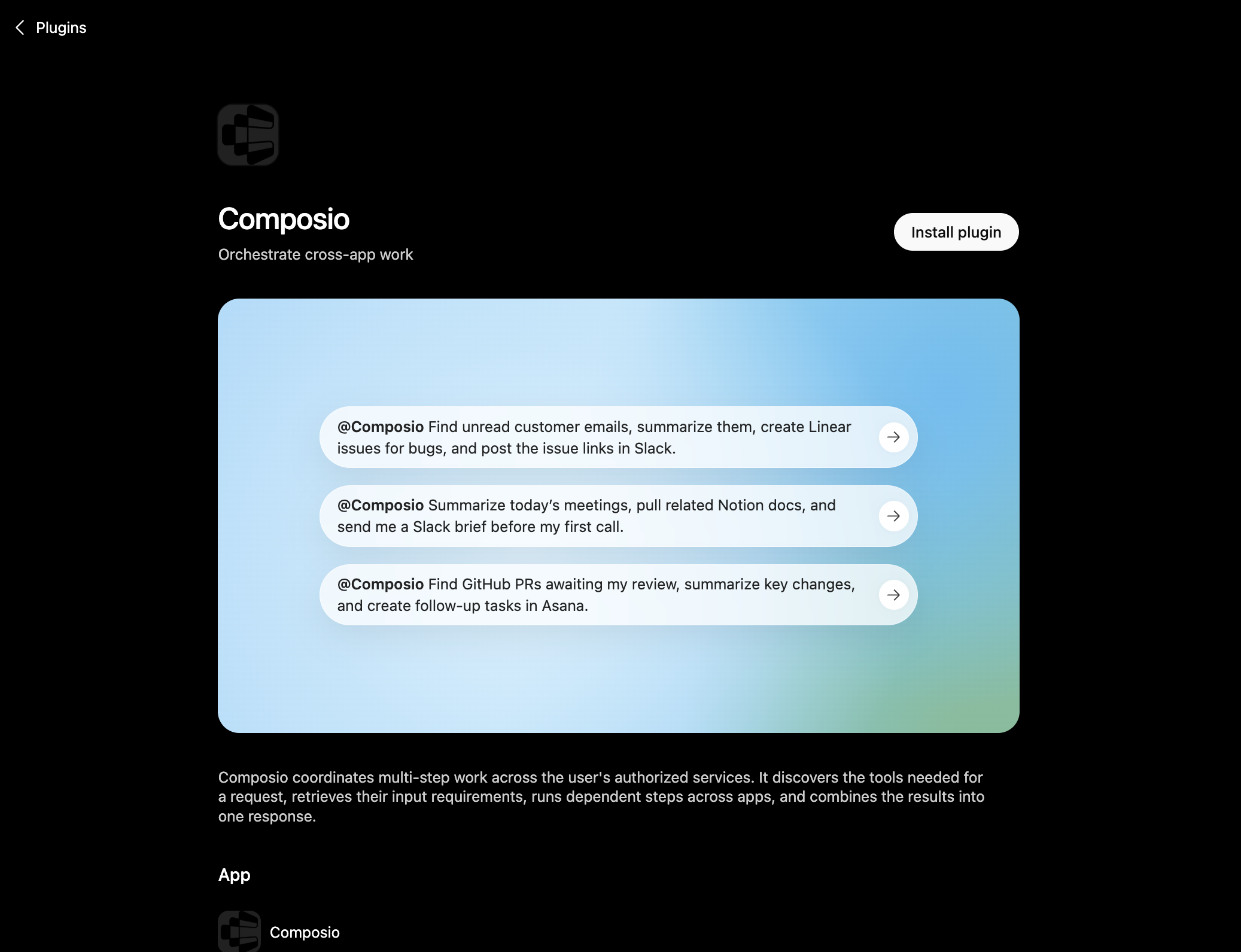
Composio plugin page in ChatGPT with the Install plugin button

You can also find it inside ChatGPT: go to Settings, open Plugins, search the marketplace for Composio, and click Install plugin.

2. Authenticate

After you install, ChatGPT asks you to authenticate with Composio. Log in and click Allow access to authorize ChatGPT to use your Composio account.
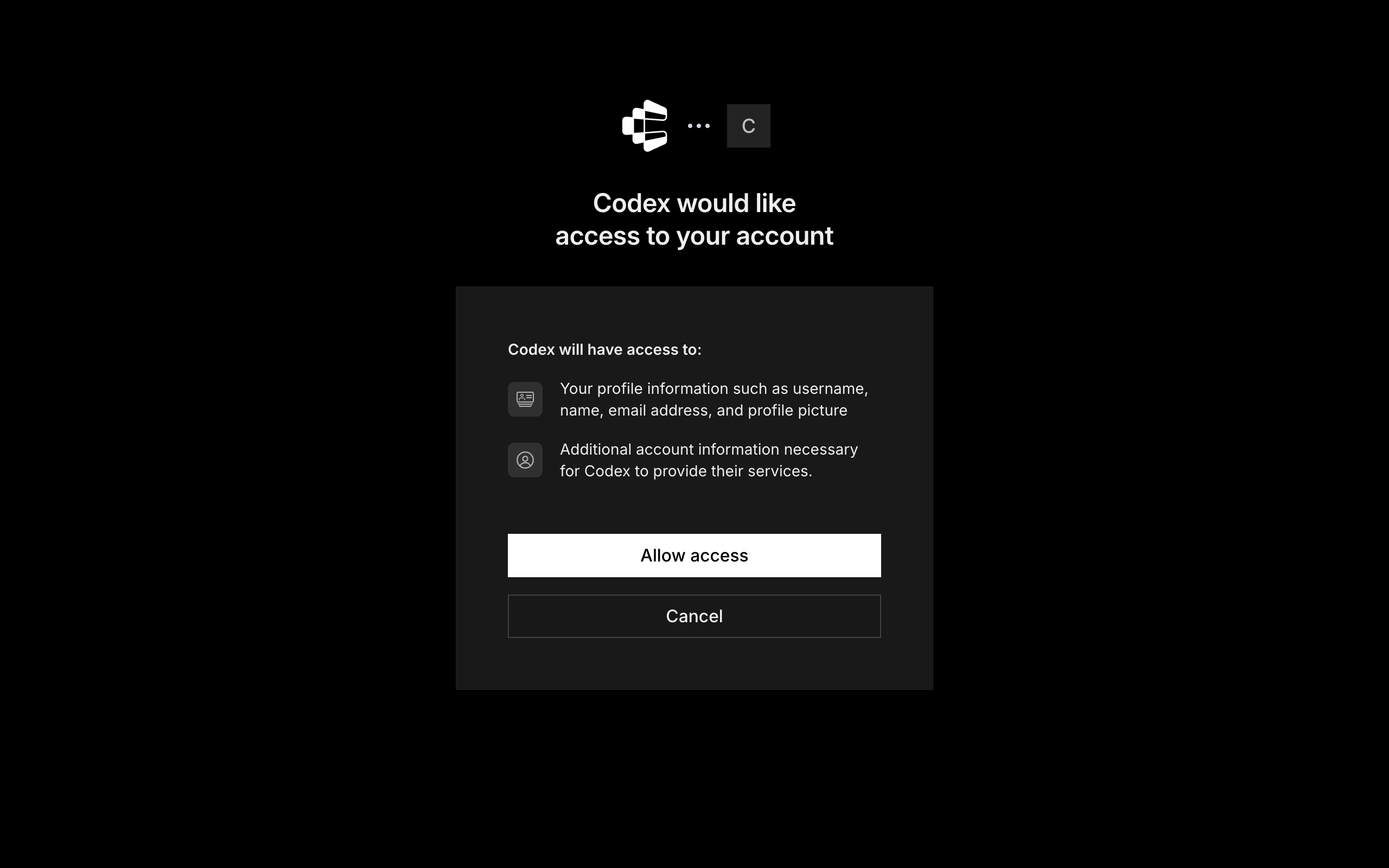
Composio login and Allow access screen for ChatGPT

3. Start using Composio

That is it. Composio tools are now available in ChatGPT. Type @Composio followed by your request, for example @Composio find unread Pigment messages and summarize them, and it will run the actions you authorize. On first use it asks you to authorize Pigment.

Option 2: Add Composio as an MCP server

If you cannot use the plugin marketplace, add Composio as a custom MCP server instead.

1. Open the MCP settings

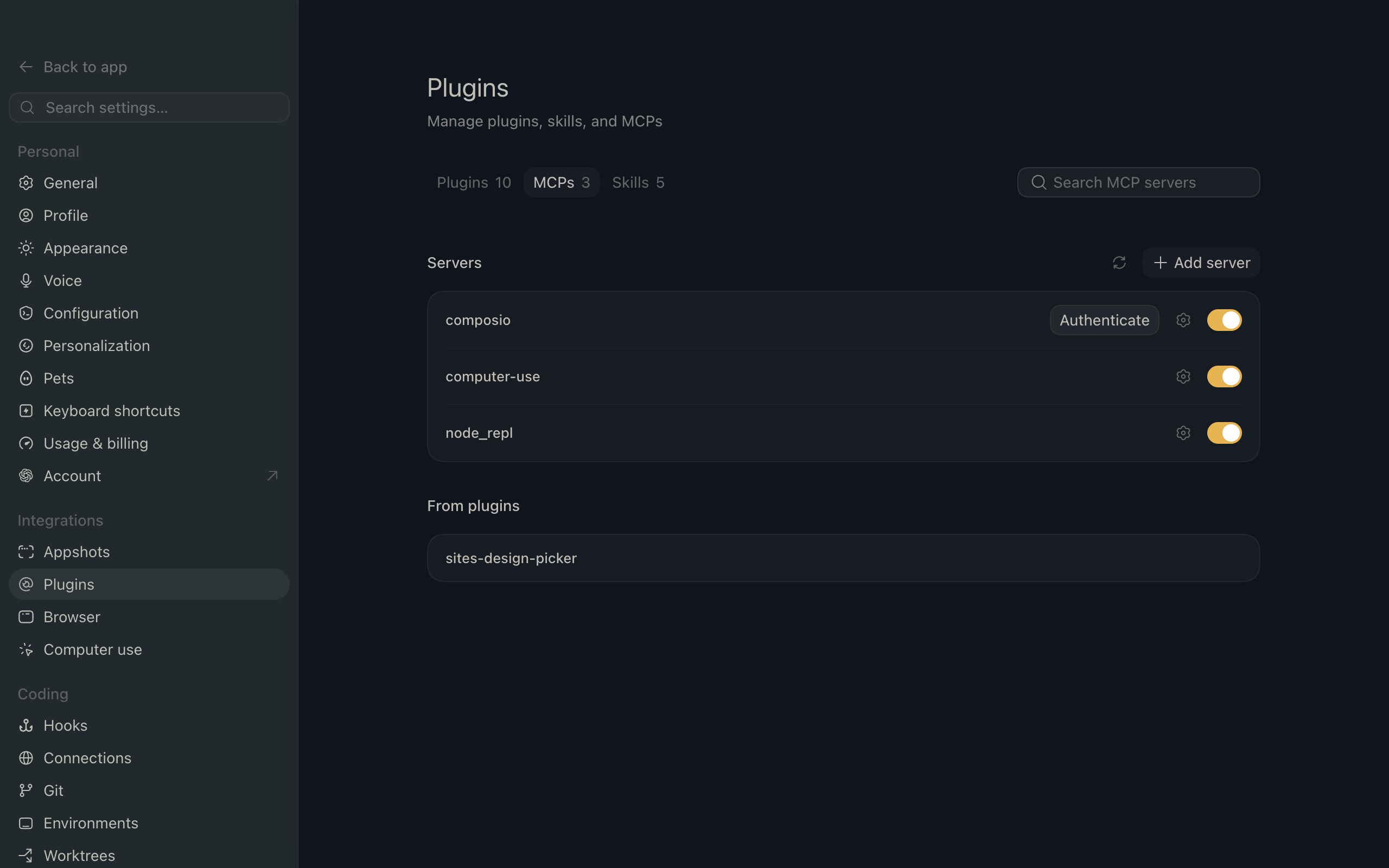
In ChatGPT, go to Settings and open the Plugins section. Inside the Plugins page, click the MCP tab.
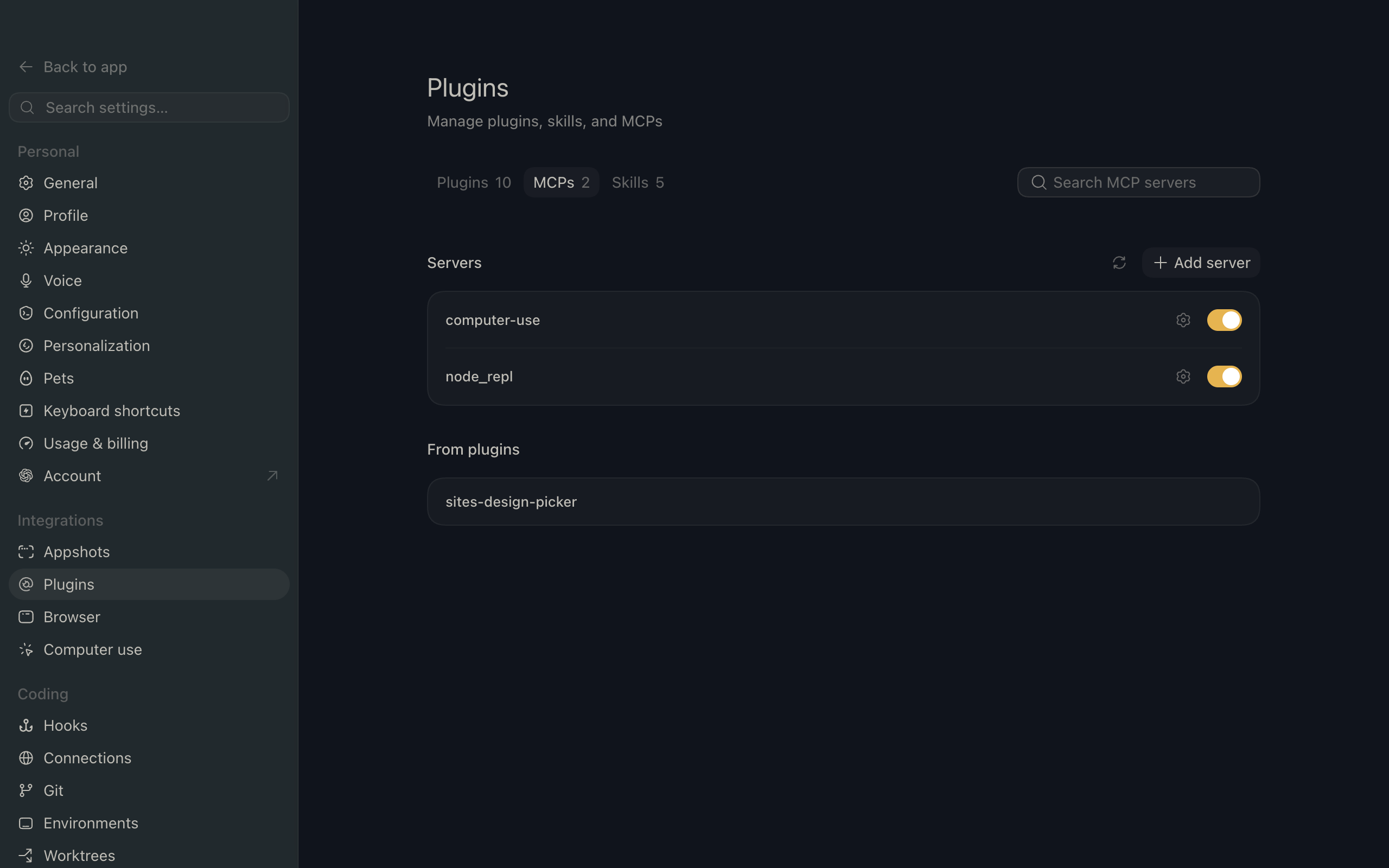
ChatGPT settings showing the Plugins page with the MCP tab selected

2. Add the server

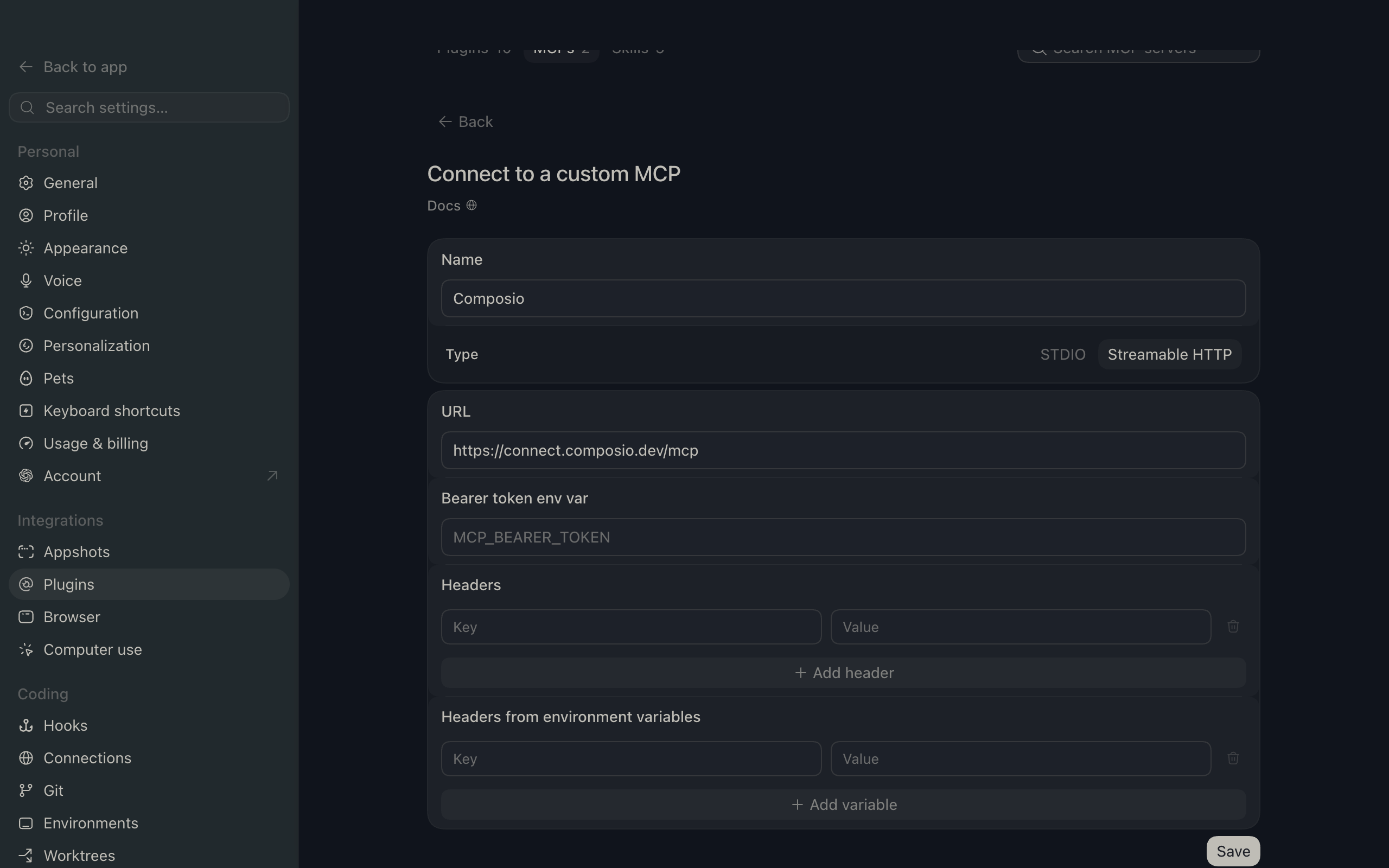
Click Add server. In the Name field enter Composio, for Type select Streamable HTTP, and in the URL field paste the Composio MCP server URL:

bash
https://connect.composio.dev/mcp
ChatGPT Add server dialog with the name Composio, type Streamable HTTP, and the Composio MCP URL

Then click Save. The Composio server now appears in your MCP plugins list.

ChatGPT Plugins page showing the Composio MCP server added to the list

3. Authenticate

Click Authenticate on the Composio entry, log in via Composio, and click Allow access. Composio tools are then available in ChatGPT the same way as with the plugin.

What you can do after connecting Pigment

  • Review actuals versus budget for Q4
  • Export monthly revenue plan from Pigment
  • Update headcount assumptions across planning model

Security + privacy notes (important)

  • Use least-privilege access: Only grant permissions you actually need.
  • Review OAuth permissions before approving: Make sure requested scopes match what you expect Composio and ChatGPT to do.
  • Keep write actions human-reviewed: For actions like sending messages, creating labels, or editing drafts, keep manual confirmation enabled.
  • Be careful with sensitive data: Avoid using this setup with highly sensitive information unless allowed by your personal, company, or client policies.
TOOLS

Supported Tools

Every Pigment action and event your agent gets out of the box.

Download File

Download the raw bytes of one file from a Pigment application.

Export List

Download a Pigment List as CSV through v1 with property selection, item and property filters, and formatting options.

Export List (Legacy)

Download a List as CSV through Pigment's officially published unversioned legacy endpoint with all documented filters and formatting options.

Export Metric

Download a Pigment Metric as CSV through v1 with scenarios, deprecated dimension filters, recursive filters, and formatting options.

Export Metric (Legacy)

Download a Metric as CSV through Pigment's officially published unversioned legacy endpoint with scenarios, deprecated and recursive filters, and all documented formatting options.

Export Table

Download a Pigment Table as CSV through v1 with metrics, scenarios, filters, selected fields, and formatting options.

Export Table (Legacy)

Download a Table as CSV through Pigment's officially published unversioned legacy endpoint with metrics, scenarios, filters, selected fields, and formatting options.

Export View

Download a Pigment view as CSV through the v1 endpoint, optionally choosing comma or semicolon delimiters.

Export View (Legacy)

Download a view as CSV through Pigment's officially published unversioned legacy endpoint; prefer v1 for new workflows.

Get Data Flow Status

Get the current status and per-step results of a Pigment Data Flow execution.

Get Import Status

Get v1 status for a CSV, integration, list-copy, or metric-copy import, optionally including the detailed report.

Get Import Status (Legacy)

Get CSV import status through Pigment's officially published unversioned legacy endpoint; prefer the v1 action for new workflows.

List Applications

List Pigment applications visible to the Modeling Metadata API key owner.

List Application Snapshots

List scheduled, in-progress, completed, and failed Pigment application snapshots.

List Blocks

List visible Pigment Lists, Transaction Lists, Metrics, and Tables, optionally for one application.

List Data Flows

List the Data Flows visible in one Pigment application.

List Files

Return one cursor-controlled page of file metadata for a Pigment application, newest first.

List Import Configurations

List Pigment import configurations, optionally narrowing the results by application and block.

List Views

List Pigment view metadata, optionally narrowing the results by application and block.

Push CSV Import

Upload CSV bytes to start a Pigment v1 import and return an import ID for status checks.

Push CSV Import (Legacy)

Upload CSV bytes to start an import through Pigment's officially published unversioned legacy endpoint; prefer v1 for new workflows.

Push Looker Import

Start a Pigment v1 Looker import from a saved configuration; the official contract declares no request body.

Push Looker Import (Legacy)

Start a Looker import through Pigment's officially published unversioned legacy endpoint; the documented operation has no request body.

Trigger Data Flow

Start one Pigment Data Flow execution and return its execution ID for status checks.

Trigger Import

Trigger a configured integration import, list-to-list copy, or metric-to-metric copy and return its import ID.

Upload File

Upload one file to a Pigment application and return the created file's metadata.

FAQ

Frequently asked questions

With a standalone Pigment MCP server, the agents and LLMs can only access a fixed set of Pigment tools tied to that server. However, with the Composio Tool Router, agents can dynamically load tools from Pigment and many other apps based on the task at hand, all through a single MCP endpoint.

Yes, you can. ChatGPT fully supports MCP integration. You get structured tool calling, message history handling, and model orchestration while Tool Router takes care of discovering and serving the right Pigment tools.

Yes, absolutely. You can configure which Pigment scopes and actions are allowed when connecting your account to Composio. You can also bring your own OAuth credentials or API configuration so you keep full control over what the agent can do.

All sensitive data such as tokens, keys, and configuration is fully encrypted at rest and in transit. Composio is SOC 2 Type 2 compliant and follows strict security practices so your Pigment data and credentials are handled as safely as possible.

Start with Pigment.It takes 30 seconds.

Managed auth, hosted MCP servers, and every Pigment tool your agent needs.Free to start.

Start building