How to connect Honeycomb to Grok Bot

Connect Grok Bot to Honeycomb MCP. Investigate latency spikes in production dataset, compare error rates by endpoint today, and more using natural language, with authentication handled for you.

Honeycomb MCP logoHoneycomb MCP
Dcr Oauth

Honeycomb is an observability platform for high-cardinality event data. It helps teams debug production systems fast with rich telemetry analysis.

32 Tools

Introduction

Grok is xAI's assistant, and its bot builder lets you create a personal agent that holds context, runs skills, and connects to the apps you already use through plugins.

This guide explains how to connect Honeycomb to a Grok bot using Composio Connect, which handles OAuth, token refresh, and reliability so you do not have to. You add Composio as a plugin, authenticate once, then ask your bot to work with Honeycomb in plain language.

Also integrate Honeycomb MCP with

Why use Composio?

Composio exposes 1,500+ apps to your Grok bot through a single connection, so you get:

  • Connect to 1,500+ apps with on-demand tool loading, so you do not fill your context window with unnecessary tool definitions.
  • Use programmatic tool calling through a remote workbench, letting the model write its own code to handle complex tool chaining. This reduces back-and-forth for frequent tool calls.
  • Handle large tool responses outside the model context to keep conversations lean.

Connecting Honeycomb to Grok Bot

Once Grok Bot is set up, you connect Honeycomb entirely from its interface, and the whole flow takes under a minute.

Set up Grok Bot

1. Get access. Grok Bot is included with a paid Cursor plan (Cursor Pro, Pro+, or Ultra) or a Cursor Teams seat. You can also grant usage by linking an individual SuperGrok, SuperGrok Plus, or SuperGrok Heavy subscription to your Cursor account.

2. Download and sign in. Get the Grok Bot desktop app for macOS or Windows from x.ai/bot, then sign in with your Cursor account. An iPhone companion app is also available, and your bots sync across devices.

3. Create a bot. Pick a suggested role or define your own, then give it a short name, one primary job, and a short description of how it should work. Focused bots work best, because a clear role gives the bot more useful context over time.

Connect Honeycomb

1. Open Plugins

Open the Grok bot you want to connect to Honeycomb, then click Plugins in the left sidebar to open the plugin marketplace.

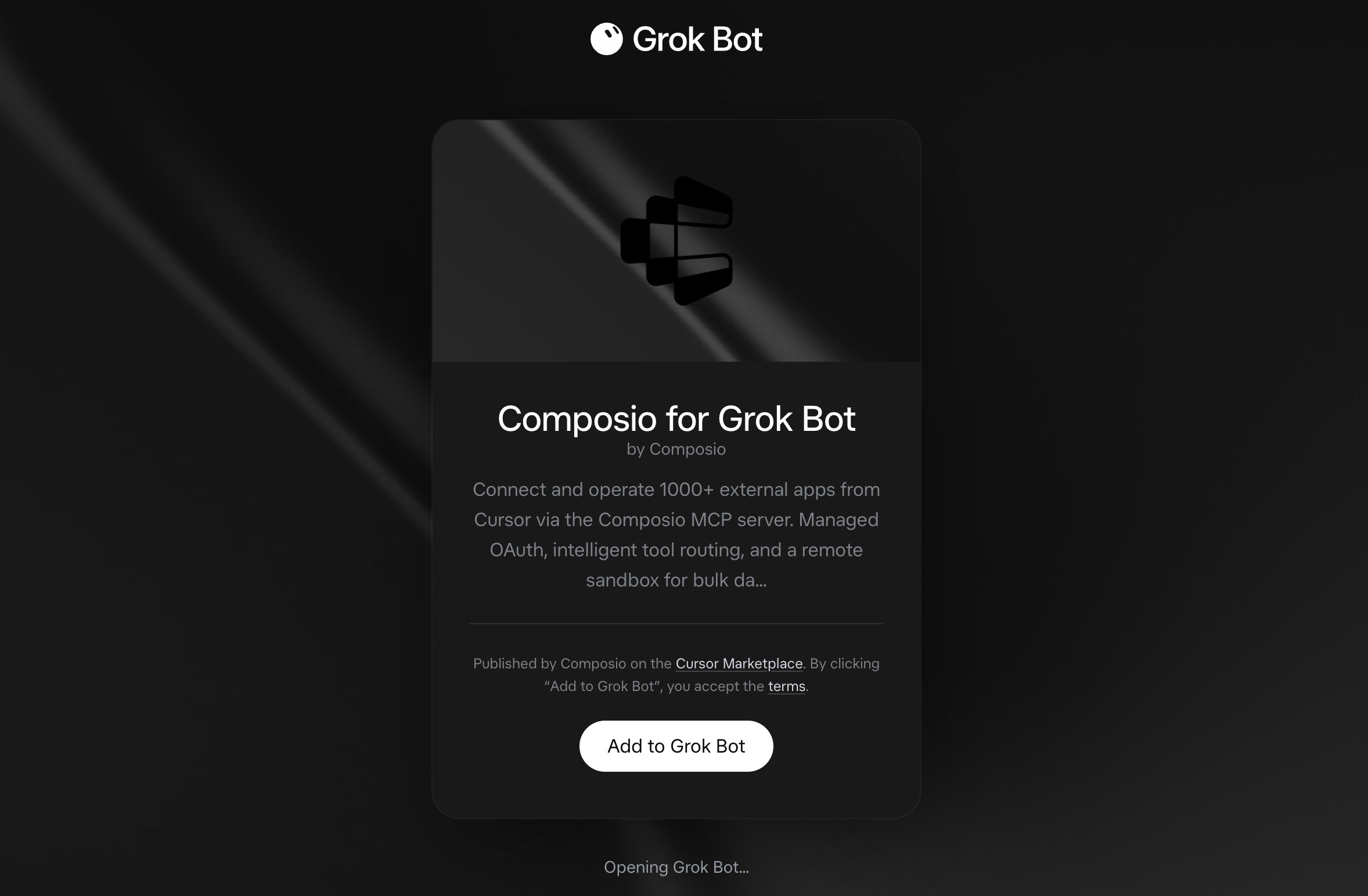
Grok Bot plugin marketplace with the Composio plugin

2. Search for Composio and add it

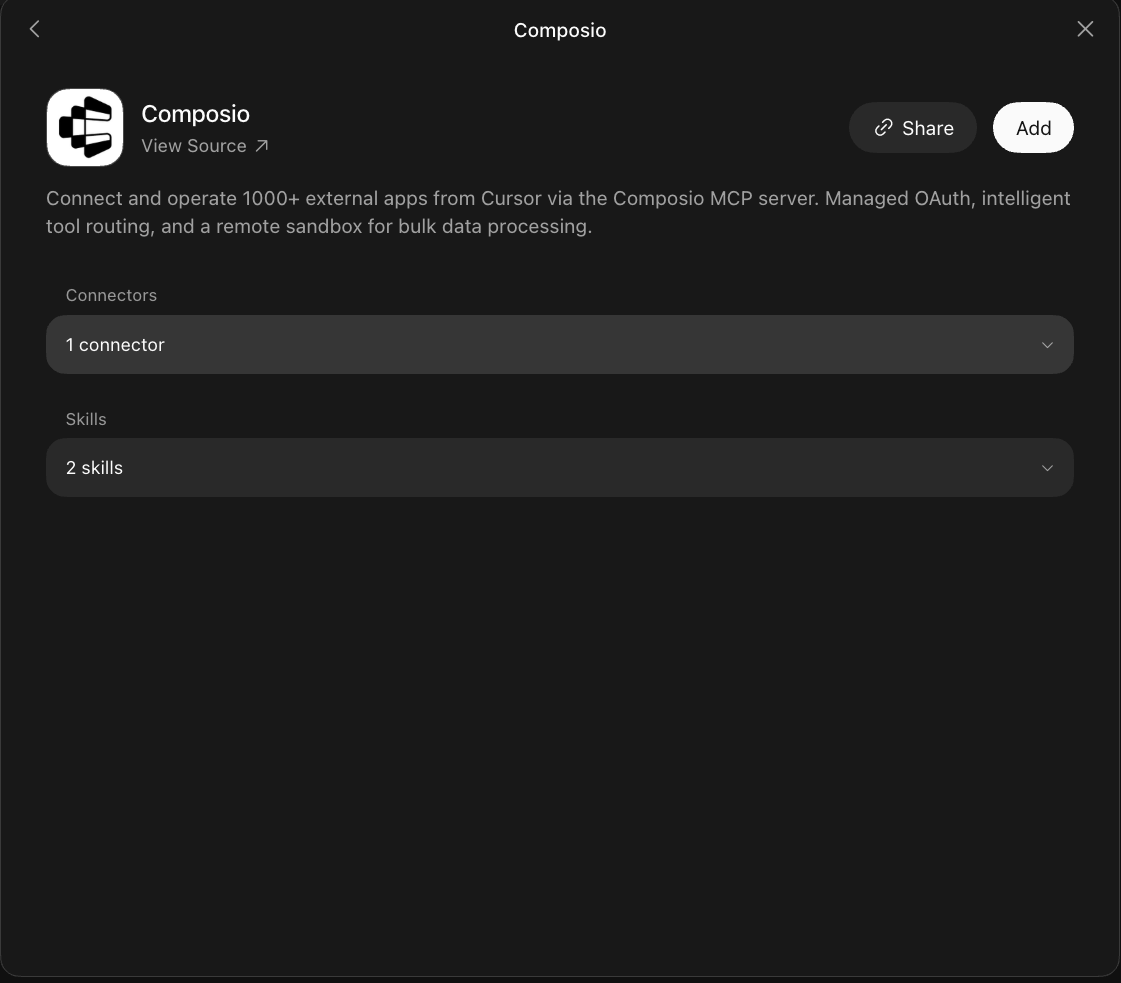
Type Composio into the Search plugins box and click Add on the Composio result. It then shows under 1 installed at the top of the marketplace.

Grok Bot plugin marketplace showing Composio under 1 installed

3. Open the installed plugin

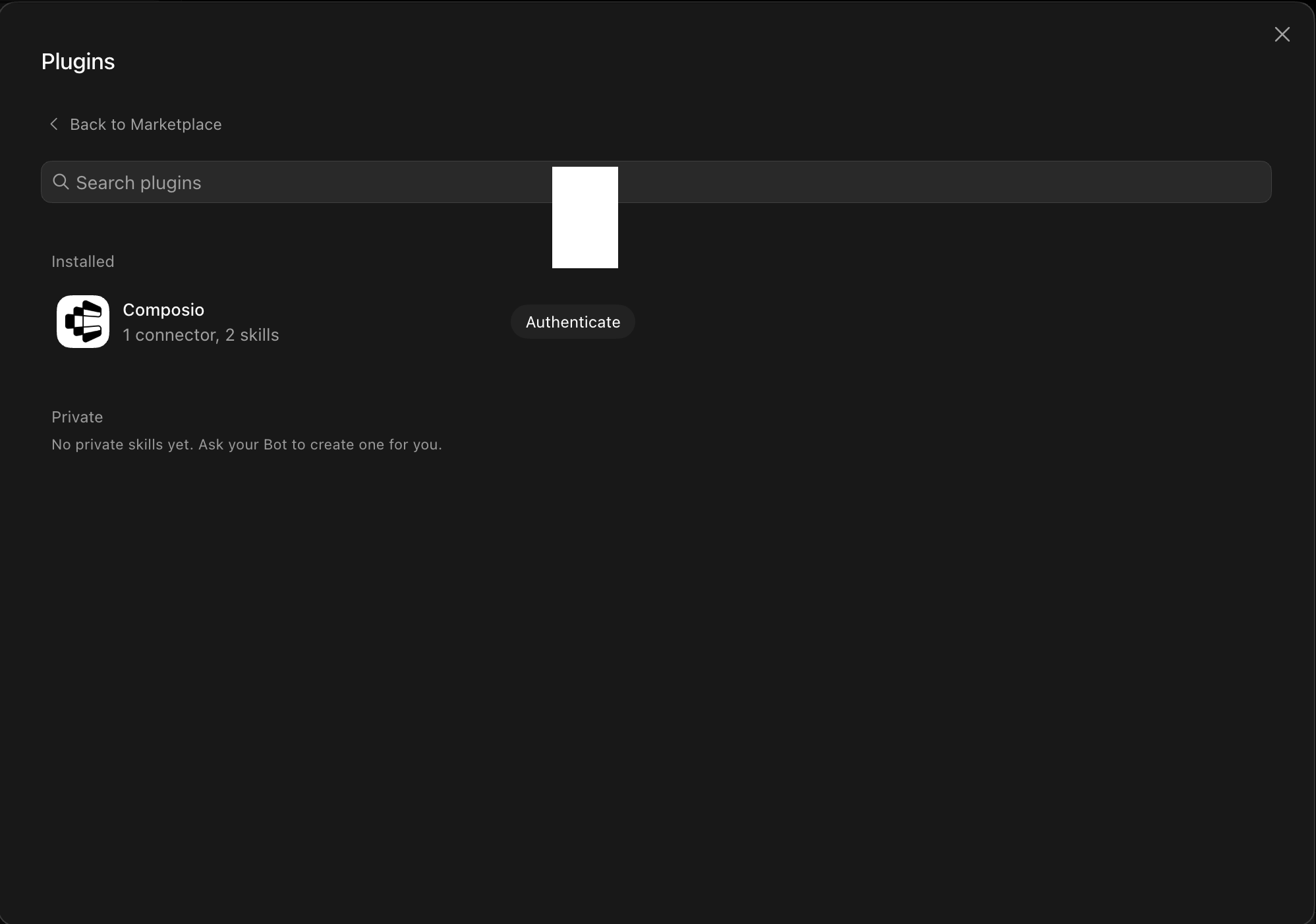
Go to the Installed section and click the Composio entry. You'll see its connector and skills listed (for example, 1 connector, 2 skills).

Installed Composio plugin showing the Authenticate button

4. Authenticate

Click Authenticate. You'll be taken to the Composio consent screen. Review the access it requests and click Authorize. Composio handles the OAuth handshake for you, so you never touch API keys or tokens.
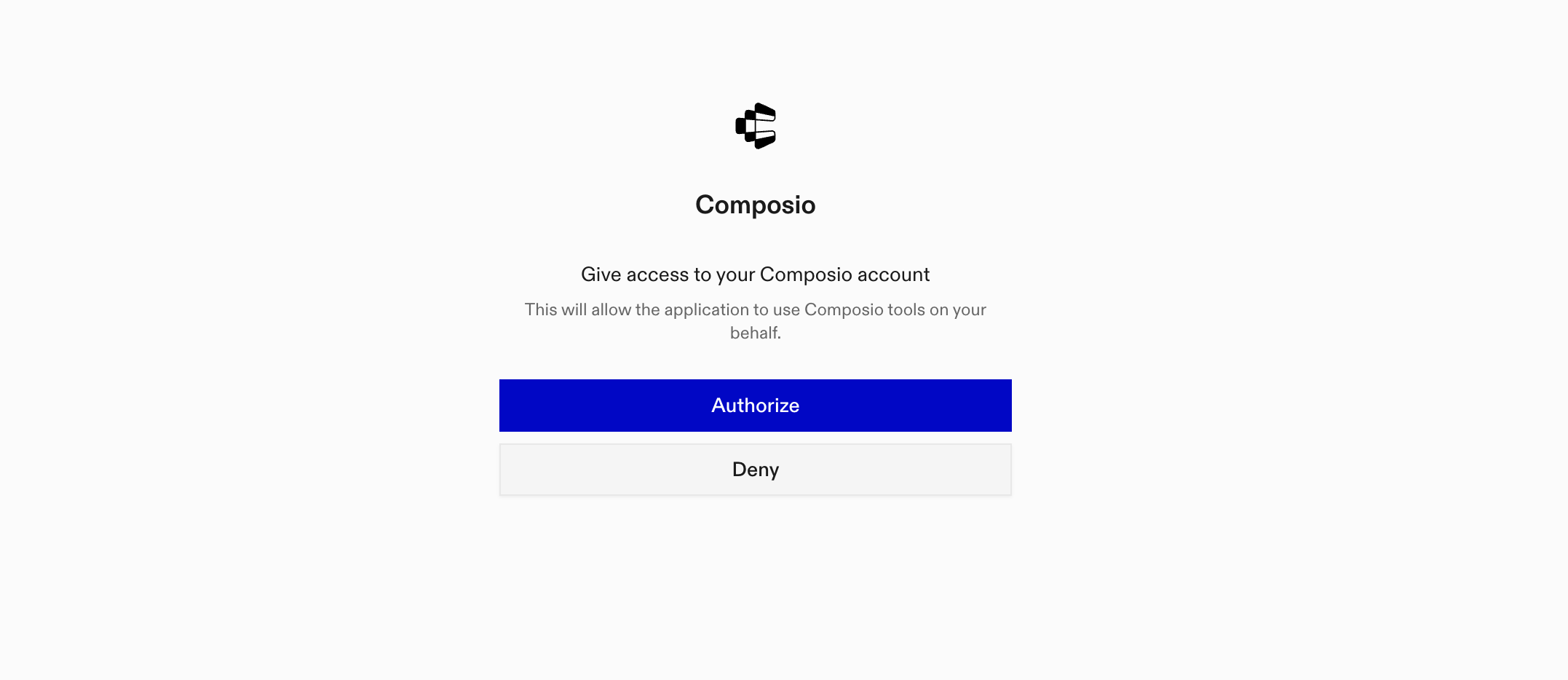
Composio authorization screen with Authorize and Deny

5. Connect your Honeycomb account

Back in the chat, ask your bot to connect to Honeycomb or give it any Honeycomb task.

For example, ask it to:

  • "Investigate latency spikes in production dataset"
  • "Compare error rates by endpoint today"
  • "Find anomalous traces in checkout service"

It will prompt you to authenticate and authorize access.

That's it. Composio's tools are now available in your Grok bot, and your Honeycomb account is ready to use.

What is Grok Bot?

Grok is xAI's assistant, available as a chat interface and a bot builder for creating personal agents that run skills and connect to external apps.

With Composio Connect, your Grok bot can securely access apps like Honeycomb through MCP without you sharing account credentials directly with the agent.

What is the Honeycomb MCP server, and what's possible with it?

The Honeycomb MCP server is an implementation of the Model Context Protocol that connects your AI agent and assistants like Claude, Cursor, etc directly to your Honeycomb account. It provides structured and secure access so your agent can perform Honeycomb operations on your behalf.

Way Forward

Now that Honeycomb is connected, extend your setup by connecting the other apps you already use every day, so your Grok bot can run true cross-app workflows end to end.

  • Connect Calendar to turn threads into scheduled meetings automatically.
  • Connect Slack or Teams to post summaries, approvals, and alerts where your team works.
  • Connect Notion, Linear, Jira, or Asana to convert requests into tickets, tasks, and docs.
  • Connect Drive, Dropbox, or OneDrive to fetch, file, and share attachments without manual steps.

Start with one workflow you do repeatedly, then keep adding apps as you find new handoffs. With everything behind a single connection, your bot can coordinate multiple tools safely and reliably in one conversation.

TOOLS

Supported Tools

Every Honeycomb MCP action and event your agent gets out of the box.

Canvas agent invoke

Kick off a single-turn run of the Honeycomb Canvas agent.

Canvas agent poll response

Poll for the result of a previously-issued canvas_agent_invoke call.

Create board

Create a board (dashboard) with query, SLO, and text panels.

Create marker

Creates a marker (a vertical annotation on charts) to mark a point or window in time, such as a deploy, incident, or config change.

Create recipient

Create a notification recipient (email, Slack, PagerDuty, or webhook) so it can be attached to triggers and SLO burn alerts.

Create slo

Create an SLO (Service Level Objective) backed by an auto-created SLI derived column.

Create trigger

Create a trigger that fires alerts when a query result crosses a threshold.

Feedback

Submit feedback about Honeycomb's MCP server to the agentic-intelligence team.

Find columns

Search for columns and calculated fields by intent across one or all datasets in an environment.

Find queries

Search query history and saved queries by intent; returns matching queries with their run PKs.

Get aiconversation

Fetch the full event timeline for a single AI conversation, identified by its OpenTelemetry gen_ai.

Get dataset

Get dataset metadata and its full column schema (columns + calculated fields), sorted by most recent write activity.

Get dataset columns

Get the full column schema for one dataset, with optional sample values for specific columns.

Get environment

Get details for a specific environment, including its dataset list sorted by most recent activity.

Get query results

Retrieve results and metadata from an existing query execution.

Get semconv attribute

Get the full definitions of one or more semantic convention attributes by their exact names.

Get span details

Summarize attributes and their common values observed on spans with a specific name.

Get trace

Retrieve all spans for a specific trace ID and render them as a waterfall.

Get triggers

List triggers (alert rules) for the team, or fetch full configuration for a single trigger.

Get workspace context

Call this tool first to orient yourself in a Honeycomb workspace.

List aiconversations

Discover recent AI agent conversations (gen_ai.

List boards

List boards (saved dashboards) in an environment, or fetch one board's full contents by ID.

List recipients

List all pre-registered notification recipients (email, Slack, PagerDuty, webhook) for the team.

List semconv namespaces

List the top-level semantic convention namespaces available in this team's registry.

List spans

List span names in trace data, ranked by count, with how often each is a trace root and which dataset the count came from.

Refinery docs

Read Honeycomb Refinery documentation.

Run bubbleup

Run BubbleUp analysis to find what makes a selected data subset different from the baseline.

Run query

Run a time-series aggregation query against a Honeycomb dataset and return computed results.

Search semconv

Search the semantic convention registry for attributes matching a query.

Update board

Edit an existing board (dashboard) in place.

Update slo

Update an existing SLO.

Update trigger

Update an existing trigger.

FRAMEWORKS

How to build Honeycomb MCP Agent with another framework

FAQ

Frequently asked questions

With a standalone Honeycomb MCP server, the agents and LLMs can only access a fixed set of Honeycomb tools tied to that server. However, with the Composio Tool Router, agents can dynamically load tools from Honeycomb and many other apps based on the task at hand, all through a single MCP endpoint.

Yes, you can. Grok Bot fully supports MCP integration. You get structured tool calling, message history handling, and model orchestration while Tool Router takes care of discovering and serving the right Honeycomb tools.

Yes, absolutely. You can configure which Honeycomb scopes and actions are allowed when connecting your account to Composio. You can also bring your own OAuth credentials or API configuration so you keep full control over what the agent can do.

All sensitive data such as tokens, keys, and configuration is fully encrypted at rest and in transit. Composio is SOC 2 Type 2 compliant and follows strict security practices so your Honeycomb data and credentials are handled as safely as possible.

Start with Honeycomb MCP.It takes 30 seconds.

Managed auth, hosted MCP servers, and every Honeycomb MCP tool your agent needs.Free to start.

Start building