How to connect Greptile to Grok Bot

Connect Grok Bot to Greptile MCP. Search repo for security vulnerabilities across branches, summarize recent pull request comments and suggestions, and more using natural language, with authentication handled for you.

Greptile MCP logoGreptile MCP
Dcr Oauth

Greptile MCP is a developer platform that indexes codebases, pull requests, and engineering knowledge. It helps teams find code quickly, review changes, and maintain reusable project context.

21 Tools

Introduction

Grok is xAI's assistant, and its bot builder lets you create a personal agent that holds context, runs skills, and connects to the apps you already use through plugins.

This guide explains how to connect Greptile to a Grok bot using Composio Connect, which handles OAuth, token refresh, and reliability so you do not have to. You add Composio as a plugin, authenticate once, then ask your bot to work with Greptile in plain language.

For exact tool slugs and parameter tables, see the tool catalog in the Composio docs.

Also integrate Greptile MCP with

Why use Composio?

Composio exposes 2,000+ apps to your Grok bot through a single connection, so you get:

  • Connect to 2,000+ apps with on-demand tool loading, so you do not fill your context window with unnecessary tool definitions.
  • Use programmatic tool calling through a remote workbench, letting the model write its own code to handle complex tool chaining. This reduces back-and-forth for frequent tool calls.
  • Handle large tool responses outside the model context to keep conversations lean.

Connecting Greptile to Grok Bot

Once Grok Bot is set up, you connect Greptile entirely from its interface, and the whole flow takes under a minute.

Set up Grok Bot

Get access. Grok Bot is included with Cursor Ultra, Cursor Premium Teams, and SuperGrok Heavy. Get the desktop app for macOS or Windows from x.ai/bot and sign in. An iPhone companion app is also available, and your bots sync across devices.

Create a bot. Pick a suggested role or define your own, then give it a short name, one primary job, and a short description of how it should work. Focused bots work best, because a clear role gives the bot more useful context over time.

Connect Greptile

1. Add the Composio plugin

Click the button. The Composio listing on x.ai opens and launches Grok Bot for you. If the app does not open on its own, click Add to Grok Bot.

Add to Grok Bot
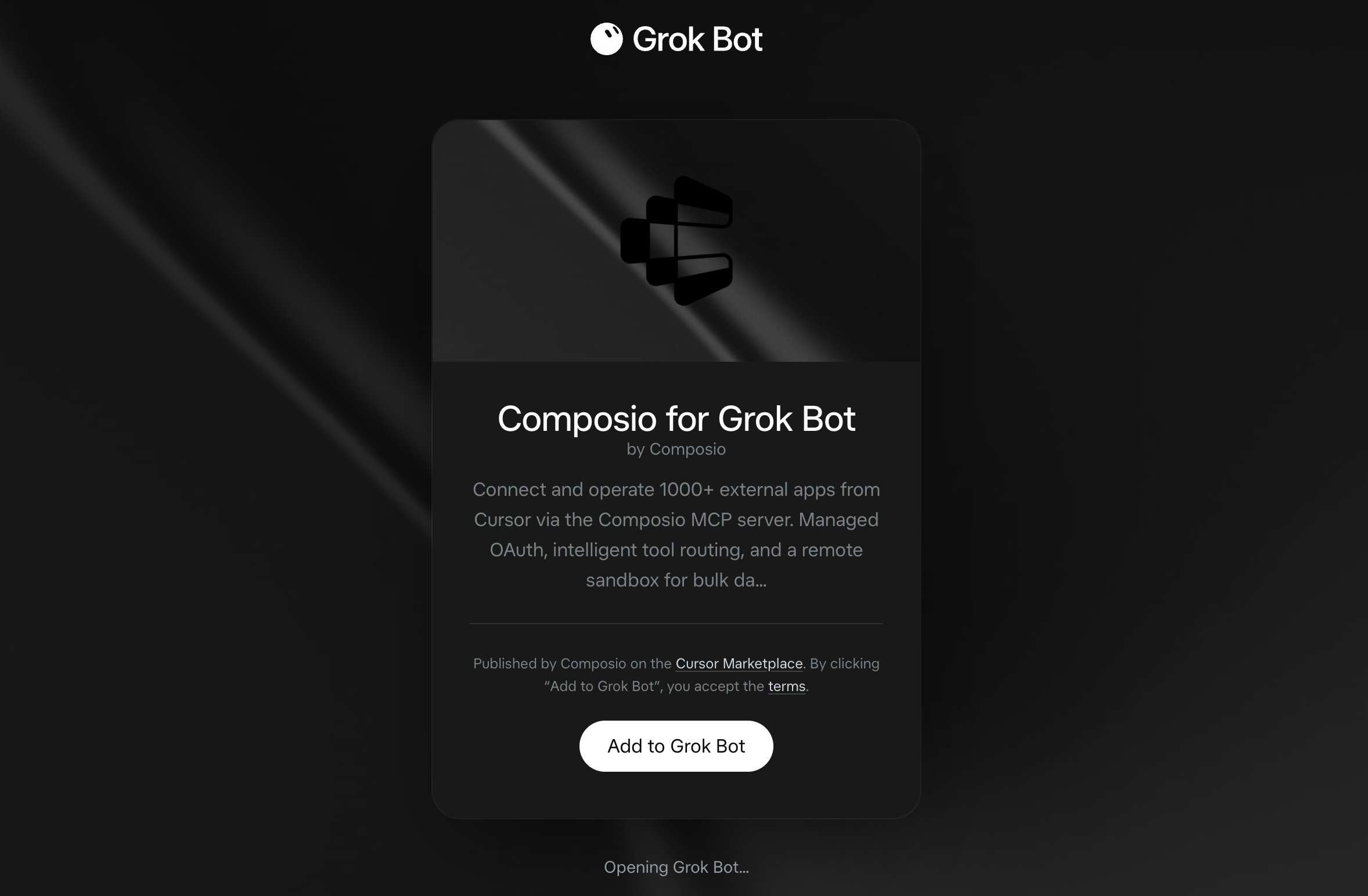
Composio for Grok Bot listing on x.ai with the Add to Grok Bot button

Grok Bot opens the Composio plugin, showing its connector and skills. Click Add.
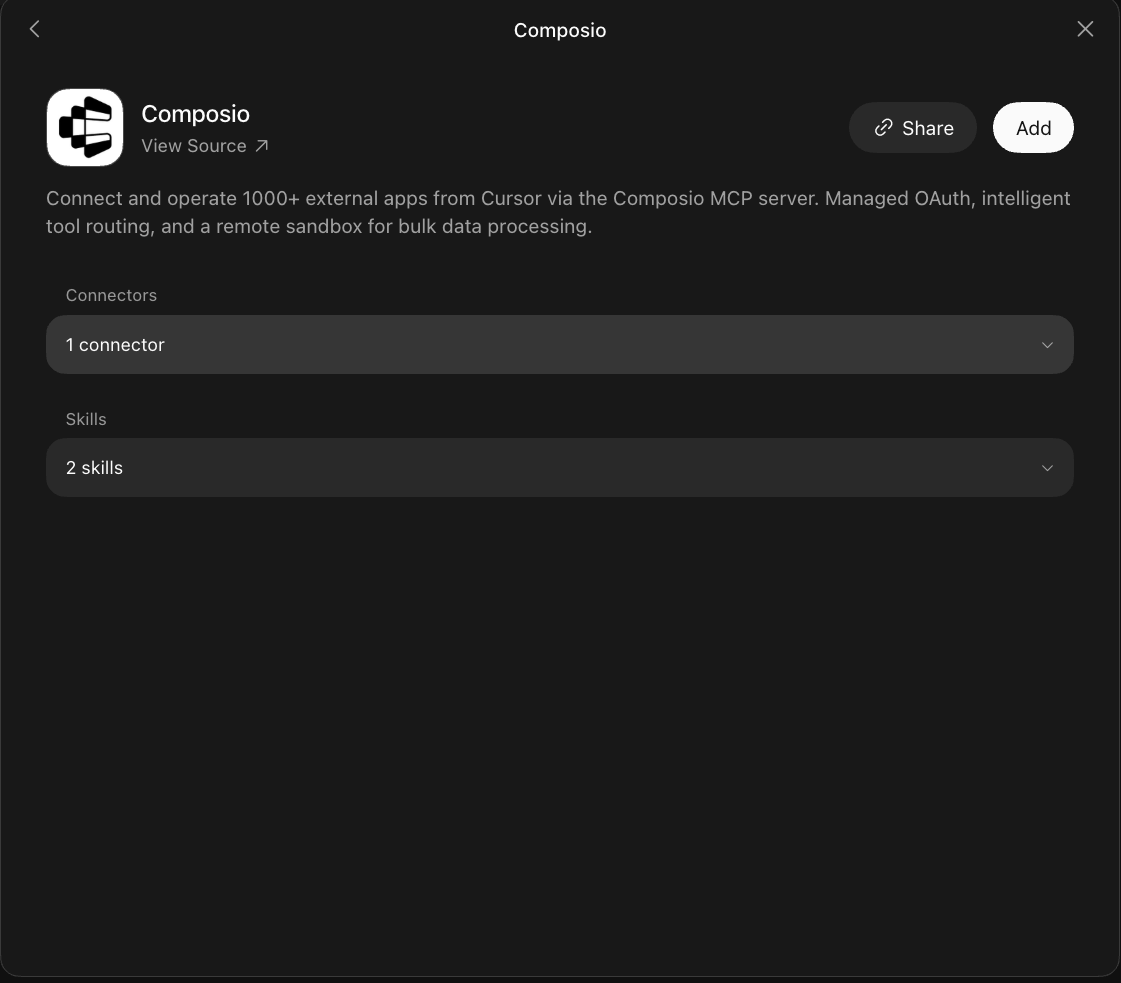
Composio plugin sheet in Grok Bot with the Add button

2. Authenticate

Go to the Installed section and click the Composio entry. You'll see its connector and skills listed.
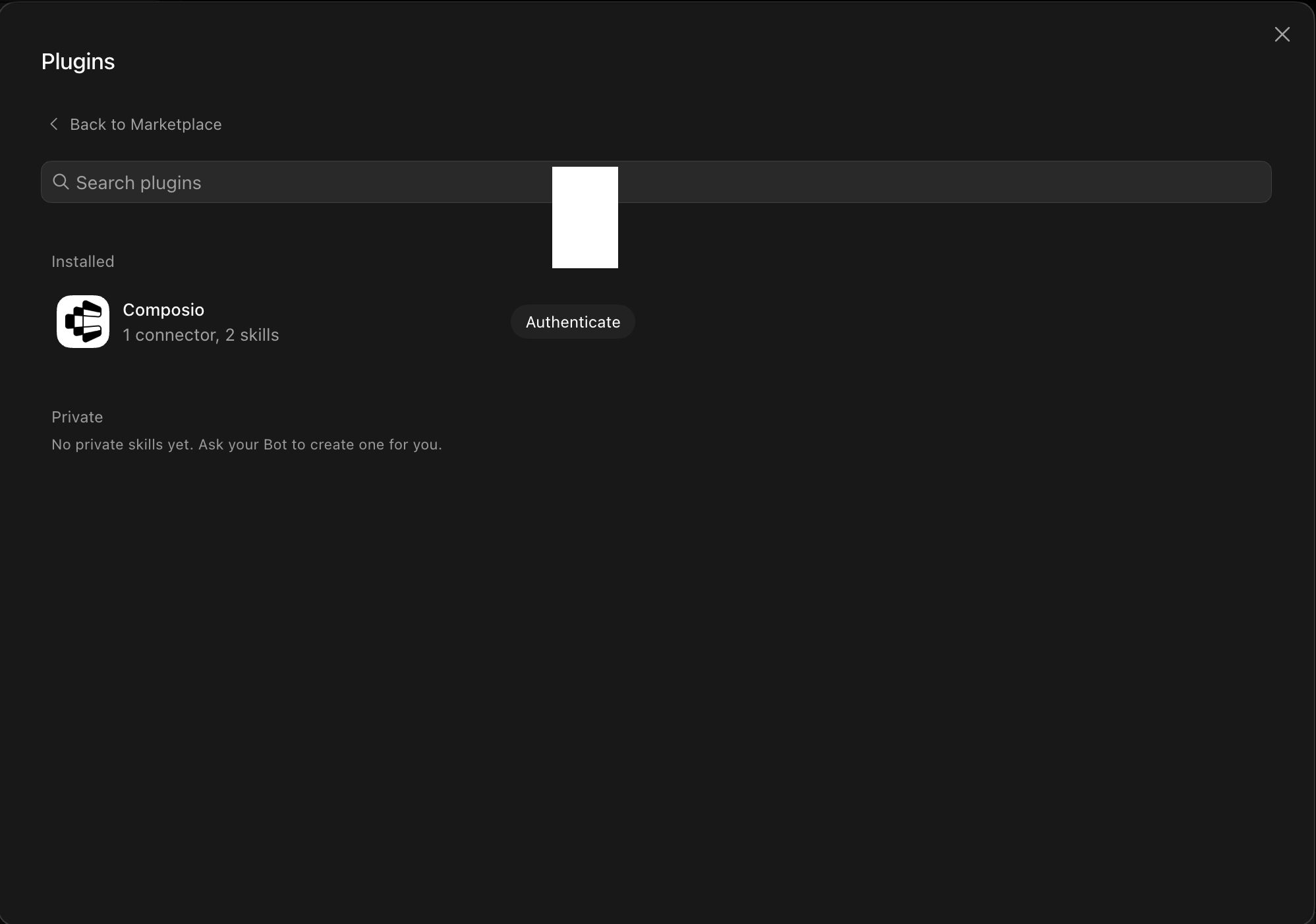
Installed Composio plugin showing the Authenticate button

Click Authenticate. You'll be taken to the Composio consent screen. Review the access it requests and click Authorize. Composio handles the OAuth handshake for you, so you never touch API keys or tokens.

Composio authorization screen with Authorize and Deny

3. Connect your Greptile account

Back in the chat, ask your bot to connect to Greptile or give it any Greptile task.

For example, ask it to:

  • "Search repo for security vulnerabilities across branches"
  • "Summarize recent pull request comments and suggestions"
  • "Create context bundle from project docs"

It will prompt you to authenticate and authorize access.

That's it. Composio's tools are now available in your Grok bot, and your Greptile account is ready to use.

What is Grok Bot?

Grok is xAI's assistant, available as a chat interface and a bot builder for creating personal agents that run skills and connect to external apps.

With Composio Connect, your Grok bot can securely access apps like Greptile through MCP without you sharing account credentials directly with the agent.

What is the Greptile MCP server, and what's possible with it?

The Greptile MCP server is an implementation of the Model Context Protocol that connects your AI agent and assistants like Claude, Cursor, etc directly to your Greptile account. It provides structured and secure access to your connected codebases, pull requests, code reviews, custom context, and engineering knowledge bases, so your agent can search technical knowledge, inspect code changes, trigger reviews, manage review rules, and analyze findings on your behalf.

  • Repository knowledge discovery: Have your agent discover connected repositories, browse their knowledge base documents, and search for specific symbols, endpoints, or engineering conventions.
  • Pull request investigation: Let the agent list and inspect pull requests or merge requests, including their metadata, statistics, comments, recent reviews, and cited summaries.
  • Code review management: Direct your agent to trigger a new code review for an existing pull request or merge request, then retrieve and track review runs.
  • Review context management: Instruct your agent to create, list, read, and search persistent review rules or learned patterns for your organization.
  • Engineering review analytics: Have your agent analyze review activity and search findings by repository, team, author, severity, security relevance, status, text, or date.

Way Forward

Now that Greptile is connected, extend your setup by connecting the other apps you already use every day, so your Grok bot can run true cross-app workflows end to end.

  • Connect Calendar to turn threads into scheduled meetings automatically.
  • Connect Slack or Teams to post summaries, approvals, and alerts where your team works.
  • Connect Notion, Linear, Jira, or Asana to convert requests into tickets, tasks, and docs.
  • Connect Drive, Dropbox, or OneDrive to fetch, file, and share attachments without manual steps.

Start with one workflow you do repeatedly, then keep adding apps as you find new handoffs. With everything behind a single connection, your bot can coordinate multiple tools safely and reliably in one conversation.

TOOLS

Supported Tools

Every Greptile MCP action and event your agent gets out of the box.

Create custom context

Create a persistent review rule or pattern in the selected organization.

Get analytics overview

Get review analytics for repositories visible to the caller, optionally intersected by exact team, repository, and author filters.

Get code review

Get one code-review run by its stable id.

Get custom context

Get one saved review rule or pattern and up to 10 linked review-comment references.

Get knowledge base document

Read one current knowledge-base markdown document after listing its path.

Get me

Identify the caller and discover the organizations available to other tools.

Get merge request

Get one pull request or merge request with metadata, statistics, comments, up to 10 recent review records, and summary citations for the latest completed review.

List analytics filter options

List exact team names, repository names, or author logins available to the caller for analytics filters.

List analytics findings

List review findings visible to the caller, newest first, with optional exact scope, severity, security, stored-addressed-status, text, and date filters.

List code reviews

List code-review runs visible to the caller, newest first, optionally filtered by repository, PR number, or status.

List custom context

List saved review rules and learned patterns visible to the caller, newest first.

List knowledge base documents

List paths in one repository's current published knowledge base to map its documented subsystems before reading.

List knowledge bases

Discover repositories with reachable Greptile knowledge-base data; start here before asking how an unfamiliar repository works.

List merge request comments

List all matching comments for one pull request or merge request, newest first.

List merge requests

List merge requests and pull requests visible to the caller, newest first.

List pull requests

Alias of list_merge_requests with the same filters and result contract.

List repositories

List repositories visible to the caller in the selected organization, sorted by name.

Search custom context

Search visible custom-context bodies by case-insensitive substring, newest matches first.

Search greptile comments

Search Greptile-generated review comments by case-insensitive body substring across PR and CLI/headless reviews, newest first.

Search knowledge base

Search one repository's current knowledge base for a case-insensitive substring when you know the term, symbol, endpoint, or convention to investigate.

Trigger code review

Request a new asynchronous Greptile review for an existing GitHub pull request or GitLab merge request.

FAQ

Frequently asked questions

Start with Greptile MCP.It takes 30 seconds.

Managed auth, hosted MCP servers, and every Greptile MCP tool your agent needs.Free to start.

Start building