How to connect Google Cloud Logging to Claude

Connect Claude Web, Desktop and Cowork to Google Cloud Logging MCP. Find production errors from the last hour, summarize warning logs for your service, and more using natural language, with authentication handled for you.

Google Cloud Logging logoGoogle Cloud Logging
Oauth2

Google Cloud Logging is a Google Cloud service for storing, searching, and analyzing resource logs. It centralizes operational data to simplify monitoring, troubleshooting, and compliance.

64 Tools

Introduction

Claude is Anthropic's AI assistant, available on the web, in the desktop app, and on mobile. Cowork is its agent for knowledge work, and it runs on all of those surfaces too. Connected to your apps, Claude can work with your files and services to accomplish complex tasks on your behalf.

This guide walks you through the easiest and most secure way to connect your Google Cloud Logging account to Claude via Composio Connect, enabling it to find production errors from the last hour, summarize warning logs for your service, review recent audit logs for unusual activity, and more such actions on your behalf without compromising your account security.

Setup is the same on Claude Web, Desktop, and Cowork, and you only need to do it once. The connector is tied to your account, so it's available in all three.

For exact tool slugs and parameter tables, see the tool catalog in the Composio docs.

Also integrate Google Cloud Logging with

Connecting Google Cloud Logging to Claude Web, Desktop, and Cowork

Two ways to add the Composio connector. Pick whichever you prefer.

1. Add with one click

Click the button. Claude opens with the Composio connector filled in. Click Add, then go to step 2.

Add to Claude

Add manually

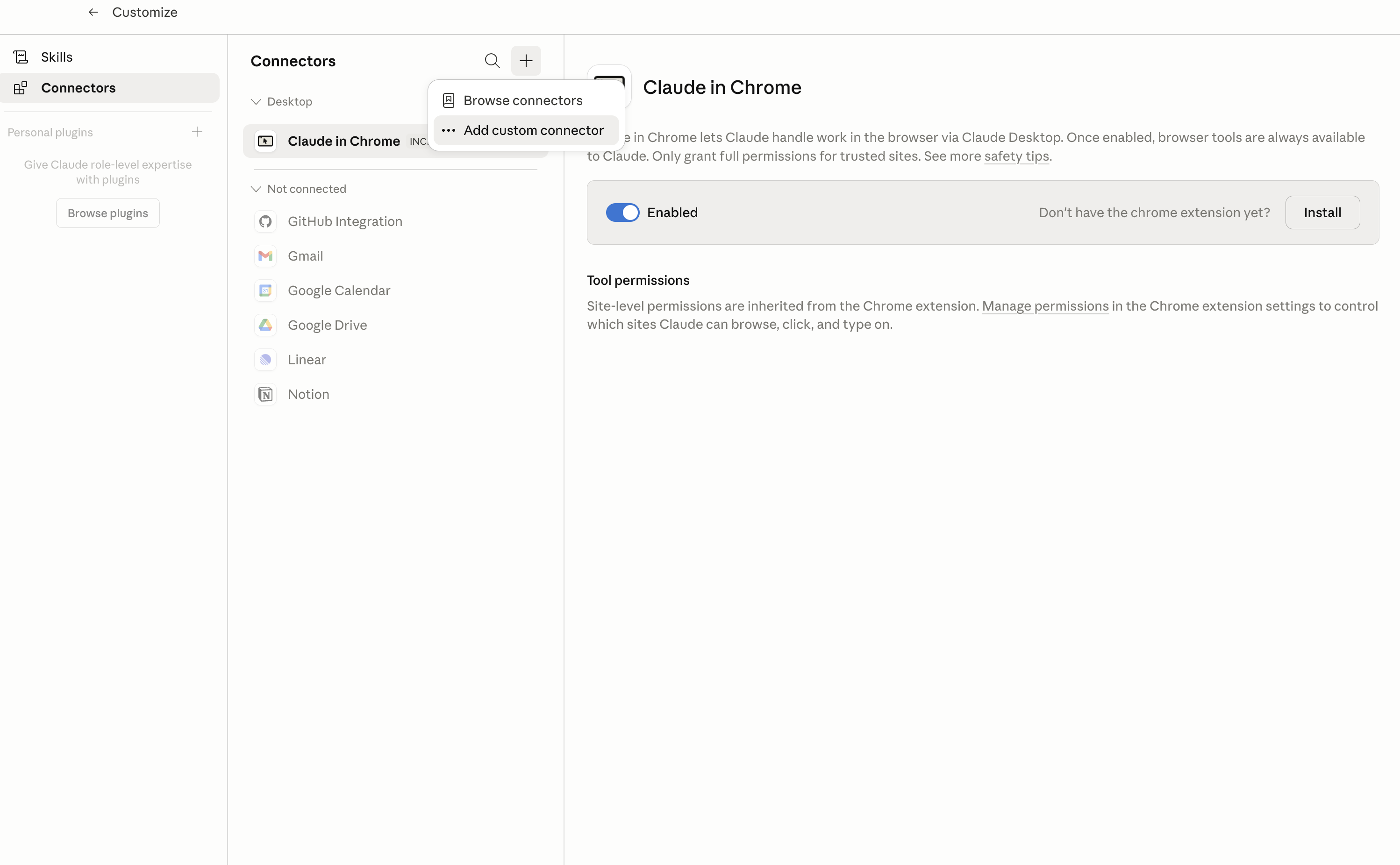
In Claude Desktop, click Customize in the left sidebar, then select Connectors and click the + icon at the top.

Claude Desktop connectors screen with Add custom connector selected

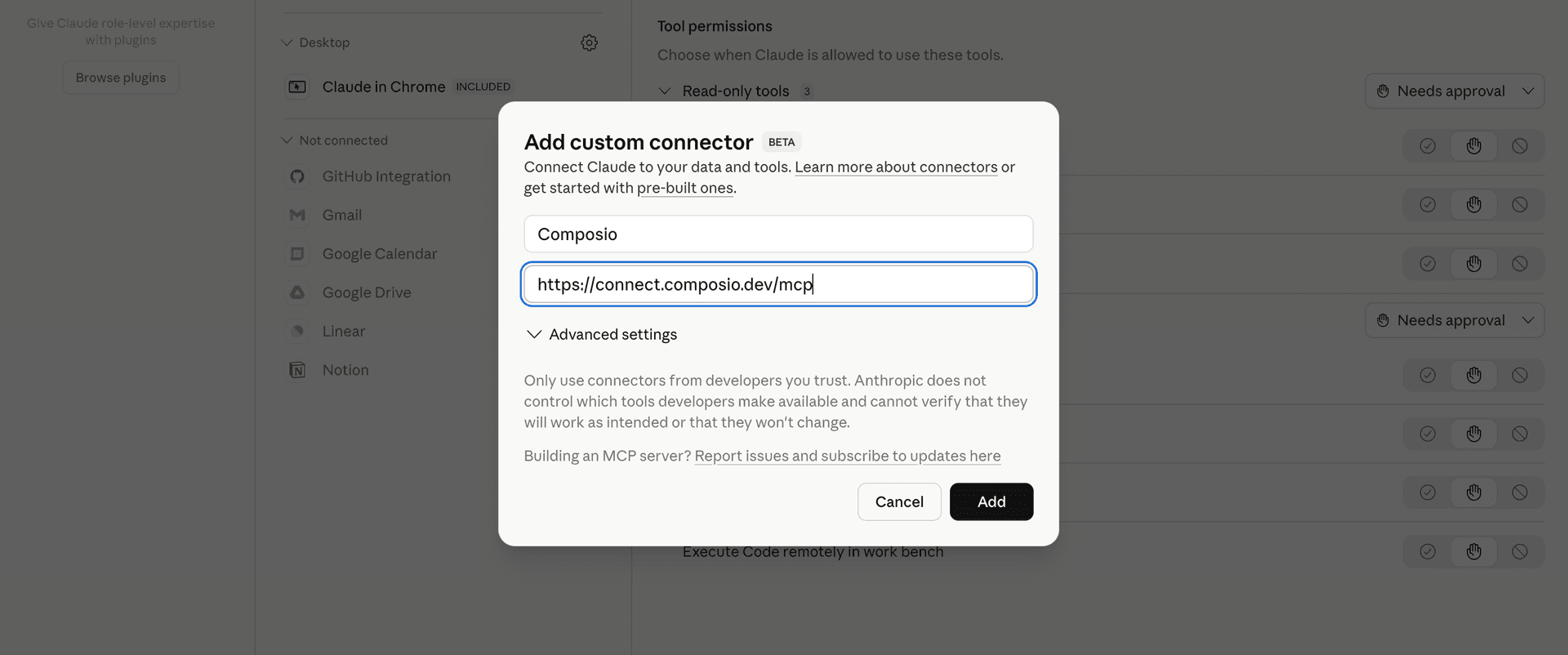
Click Add custom connector and paste in the Composio MCP server URL:

bash
https://connect.composio.dev/mcp
Add custom connector dialog with Composio MCP server URL

2. Authorize in your browser

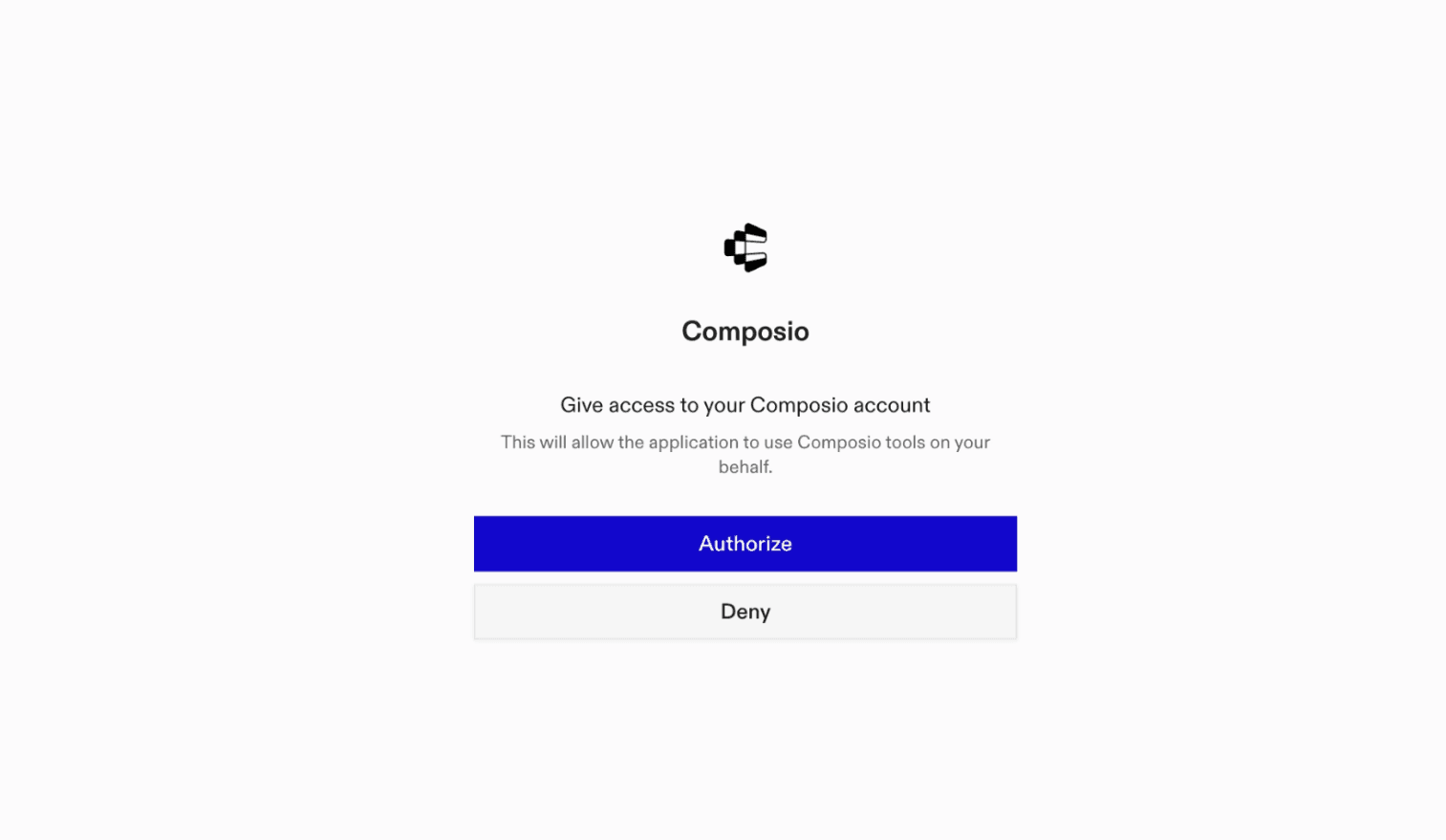
Click Connect. You'll be redirected to a browser window where you can authorize Composio to continue.

Composio authorization screen for Claude Web, Desktop, and Cowork

3. Connect your Google Cloud Logging account

Back in Claude, ask it to connect to Google Cloud Logging or give it any Google Cloud Logging-related task.

For example, ask Claude to:

  • "Find production errors from the last hour"
  • "Summarize warning logs for your service"
  • "Review recent audit logs for unusual activity"

It will prompt you to authenticate and authorize access.

That's it. Composio's tools are now available in Claude, and your Google Cloud Logging account is ready to use.

What is the Google Cloud Logging Claude Connector, and what's possible with it?

The Google Cloud Logging MCP server is an implementation of the Model Context Protocol that connects your AI agent and assistants like Claude, Cursor, etc directly to your Google Cloud Logging account. It provides structured and secure access to your logs, log storage, metrics, sinks, exclusions, views, and logging settings, so your agent can search log entries, inspect logging resources, create and manage log configurations, and monitor long-running operations on your behalf.

  • Search and review logs: Instruct your agent to find matching log entries, list available logs, and repeatedly check recent entries for ongoing activity.
  • Manage log storage: Have your agent list, inspect, create, and delete log buckets, or copy matching log entries to Cloud Storage.
  • Configure monitoring: Let the agent create, inspect, list, and delete logs-based metrics, exclusions, and sinks for your Google Cloud resources.
  • Organize log access: Direct your agent to create, inspect, and delete log views, saved queries, and log scopes, including access policies for log views.
  • Handle logging operations and settings: Instruct your agent to check logging settings, CMEK settings, available locations, and the status or cancellation of long-running operations.

Troubleshooting

1. Why does Claude not use the Composio connector for Google Cloud Logging?

The connector can show as connected, but Claude must use it in each Google Cloud Logging conversation.

  • Click + at the lower left of the chat, or type /.
  • Hover Connectors.
  • Turn on Composio.
  • Ask Claude to connect to Google Cloud Logging again.

2. Why does Claude show an MCP server error before Google Cloud Logging connects?

Claude can show Couldn't reach the MCP server or Authorization with the MCP server failed when you add the connector for Google Cloud Logging.

  • Check that the connector URL is https://connect.composio.dev/mcp.
  • Connectors run from Anthropic's cloud, so your device network is usually not the problem.
  • Add the connector again from Customize > Connectors, then ask Claude to connect Google Cloud Logging.
  • If it fails again, send the error and the ofid_ reference id to support@composio.dev.

3. Why does the Google Cloud Logging authorization link not work?

The Composio connector is one server. Your Google Cloud Logging account connects separately when Claude asks for it.

  • If the browser does not open, or the link expires, ask Claude to retry the Google Cloud Logging connection.
  • Composio creates a fresh Google Cloud Logging authorization link.
  • Open that link in your browser and finish the Google Cloud Logging sign-in.

4. Why do Google Cloud Logging actions fail after they worked before?

The Google Cloud Logging connection can expire or lose permission.

  • Ask Claude to inspect the Google Cloud Logging connection.
  • If the connection is unhealthy, disconnect it when Claude prompts you.
  • Reconnect the Google Cloud Logging account and retry the action.
  • If Claude shows a permission prompt, approve it before Claude changes data in Google Cloud Logging.
  • If the action still fails with a permission error, check that the connected account has that permission in Google Cloud Logging itself.

5. How do I switch to a different Google Cloud Logging account?

Claude can manage the Google Cloud Logging connection for you.

  • Ask Claude to disconnect or delete the current Google Cloud Logging account.
  • Ask Claude to connect Google Cloud Logging again.
  • Open the new Composio authorization link for Google Cloud Logging.
  • Sign in with the other Google Cloud Logging account in the browser.
  • After the account connects, ask Claude to retry the Google Cloud Logging task.

6. Why is my Google Cloud Logging connection missing in Claude Desktop or on a Team plan?

The connector belongs to your Claude account, so your Google Cloud Logging connection works in Claude Web, Desktop, and Cowork.

  • In Claude Desktop, open Customize > Connectors.
  • Next to Composio, click ⋮ and click Clear cache.
  • If Google Cloud Logging tools still do not appear, click ⋮, disconnect, remove the connector, and add it again.
  • On Team or Enterprise, an Owner or Primary Owner must enable the connector before you can connect Google Cloud Logging.
TOOLS

Supported Tools

Every Google Cloud Logging action and event your agent gets out of the box.

Cancel Operation

Start best-effort cancellation of a Cloud Logging long-running operation using explicit parent, location, and operation IDs.

Copy Log Entries

Start a long-running copy of matching entries from a Cloud Logging log bucket to a Cloud Storage bucket.

Create Exclusion

Create one exclusion under an explicit Google Cloud parent resource.

Create Log Bucket

Create a Cloud Logging bucket under an explicit parent and location.

Create Log Bucket Asynchronously

Start asynchronous creation of a Cloud Logging bucket under an explicit Google Cloud parent and location.

Create Log Link

Start asynchronous creation of a BigQuery-linked dataset for an explicit Cloud Logging bucket.

Create Log Metric

Create a logs-based metric in an explicit Google Cloud project.

Create Log Scope

Create one log scope under an explicit Google Cloud parent and location.

Create Log View

Create one view over log entries in an explicit Cloud Logging bucket.

Create Saved Query

Create one saved query under an explicit Google Cloud parent and location.

Create Sink

Create a Cloud Logging sink under an explicit parent resource.

Delete Exclusion

Delete one Cloud Logging exclusion identified by explicit parent and exclusion IDs.

Delete Log

Delete all entries in one log from the global _Default Log Bucket under an explicit project, folder, organization, or billing account.

Delete Log Bucket

Delete one Cloud Logging log bucket using explicit parent, location, and bucket identifiers.

Delete Log Link

Start asynchronous deletion of one Cloud Logging log link and its corresponding BigQuery linked dataset using explicit resource IDs.

Delete Log Metric

Delete a project log-based metric using explicit project and metric IDs.

Delete Log Scope

Delete one Cloud Logging log scope using explicit parent, location, and log scope identifiers.

Delete Log View

Delete one Cloud Logging log view using explicit parent, location, bucket, and view identifiers.

Delete Saved Query

Delete one Cloud Logging saved query using explicit parent, location, and saved query identifiers.

Delete Sink

Delete one Cloud Logging sink under an explicit project, folder, organization, or billing account.

Get CMEK Settings

Get Cloud Logging CMEK settings for an explicit parent resource.

Get Exclusion

Get one Cloud Logging exclusion by its explicit parent and resource IDs.

Get Location

Get one Logging API location under an explicit Google Cloud parent.

Get Log Bucket

Get one Cloud Logging log bucket using explicit parent, location, and bucket identifiers.

Get Log Link

Get one Cloud Logging log link using explicit parent and resource IDs.

Get Log Metric

Get a project log-based metric using explicit project and metric IDs.

Get Log Scope

Get one log scope by its explicit parent and resource IDs.

Get Log View

Get one Cloud Logging log view by its explicit parent and resource IDs.

Get Log View IAM Policy

Get the IAM access policy for an explicit Cloud Logging log view.

Get Operation

Get the latest state of a Cloud Logging long-running operation using explicit parent, location, and operation IDs.

Get Saved Query

Get one saved query by its explicit parent and resource IDs.

Get Settings

Get Cloud Logging settings for an explicit Google Cloud parent resource.

Get Sink

Get one Cloud Logging sink by its explicit parent and sink IDs.

List Exclusions

List one page of exclusions on the _Default sink for an explicit Google Cloud project, folder, organization, or billing account.

List Locations

List one page of Cloud Logging API locations under an explicit Google Cloud project, folder, organization, or billing account.

List Log Buckets

List one page of Cloud Logging buckets in an explicit project, folder, organization, or billing account location.

List Or Poll Log Entries

List one page of matching Cloud Logging entries, or repeatedly call the same entries.list query for bounded tail-like behavior without using entries.tail.

List Log Links

List one page of Cloud Logging links for an explicit project, folder, organization, or billing account log bucket.

List Log Metrics

List one page of logs-based metrics in an explicit Google Cloud project.

List Logs

List one page of Cloud Logging log names in an explicit Google Cloud project, folder, organization, or billing account.

List Log Scopes

List one page of Cloud Logging log scopes in an explicit project, folder, or organization location.

List Log Views

List one page of Cloud Logging views for an explicit project, folder, organization, or billing account log bucket.

List Monitored Resource Descriptors

List one page of monitored resource descriptor types available to Google Cloud Logging.

List Operations

List one page of Cloud Logging long-running operations for an explicit Google Cloud parent and location.

List Recent Queries

List one page of queries run by the current user in the last approximately 30 days for an explicit Google Cloud parent and Logging location.

List Saved Queries

List one page of Cloud Logging saved queries in an explicit project, folder, organization, or billing account location.

List Sinks

List one page of Cloud Logging sinks for an explicit project, folder, organization, or billing account.

List View Logs

List one page of Cloud Logging log names visible through an explicit log view.

Patch Sink

Patch selected fields of one Cloud Logging sink under an explicit project, folder, organization, or billing account.

Replace Sink

Replace a Cloud Logging sink under an explicit Google Cloud parent.

Set Log View IAM Policy

Replace the IAM policy on one Cloud Logging log view under an explicit project, folder, or organization resource.

Tail Log Entries With Bounded List Polling

Safely emulate the documented Cloud Logging entries.tail operation with finite entries.list polling from a receive timestamp captured when the action starts.

Test Log View IAM Permissions

Return the requested IAM permissions the caller has on an explicit Cloud Logging log view.

Undelete Log Bucket

Restore a Cloud Logging bucket within its seven-day deletion grace period using explicit parent, location, and bucket IDs.

Update CMEK Settings

Patch Cloud Logging CMEK settings for a Google Cloud organization.

Update Exclusion

Patch selected fields of one Cloud Logging exclusion under an explicit Google Cloud parent resource.

Update Log Bucket

Synchronously patch selected fields of a Cloud Logging bucket under an explicit parent and location.

Update Log Bucket Asynchronously

Start an asynchronous update of selected fields on a Cloud Logging bucket under an explicit parent and location.

Update Log Metric

Update a project log-based metric using explicit project and metric IDs.

Update Log Scope

Patch selected fields of one Cloud Logging log scope under an explicit project, folder, or organization.

Update Log View

Patch selected fields of one Cloud Logging log view under an explicit parent, location, and bucket.

Update Saved Query

Patch selected fields of one Cloud Logging saved query under an explicit parent and location; update_mask controls which supplied values change.

Update Settings

Patch Cloud Logging settings for an explicit folder or organization.

Write Log Entries

Write a batch of log entries to Google Cloud Logging.

FRAMEWORKS

How to build Google Cloud Logging MCP Agent with another framework

FAQ

Frequently asked questions

Start with Google Cloud Logging.It takes 30 seconds.

Managed auth, hosted MCP servers, and every Google Cloud Logging tool your agent needs.Free to start.

Start building