How to connect Era Context MCP to Claude

Connect Claude Web, Desktop and Cowork to Era Context MCP. List recent transactions from checking account, get portfolio holdings and current market values, and more using natural language, with authentication handled for you.

Era Context MCP logoEra Context MCP
Dcr Oauth

Era Context MCP provides authorized financial context and action APIs across banking, brokerage, billing, and social resources. Use it to give agents secure, contextual access to accounts, transactions, portfolios, and billing workflows.

51 Tools

Introduction

Claude is Anthropic's AI assistant, available on the web, in the desktop app, and on mobile. Cowork is its agent for knowledge work, and it runs on all of those surfaces too. Connected to your apps, Claude can work with your files and services to accomplish complex tasks on your behalf.

This guide walks you through the easiest and most secure way to connect your Era Context account to Claude via Composio Connect, enabling it to list recent transactions from checking account, get portfolio holdings and current market values, transfer funds from checking to savings, and more such actions on your behalf without compromising your account security.

Setup is the same on Claude Web, Desktop, and Cowork, and you only need to do it once. The connector is tied to your account, so it's available in all three.

Also integrate Era Context MCP with

Connecting Era Context to Claude Web, Desktop, and Cowork

Two ways to add the Composio connector. Pick whichever you prefer.

1. Add with one click

Click the button. Claude opens with the Composio connector filled in. Click Add, then go to step 2.

Add to Claude

Add manually

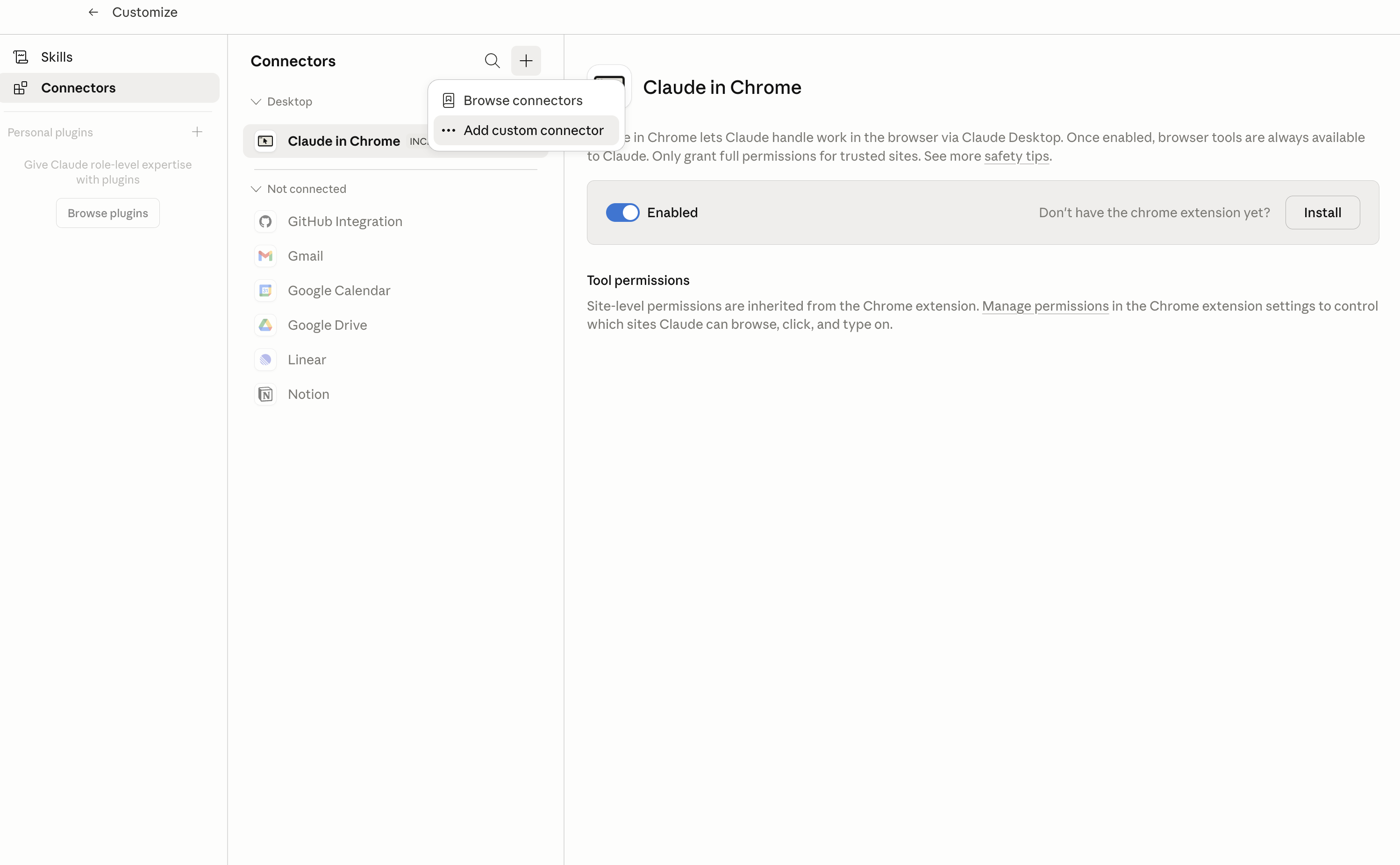
In Claude Desktop, click Customize in the left sidebar, then select Connectors and click the + icon at the top.

Claude Desktop connectors screen with Add custom connector selected

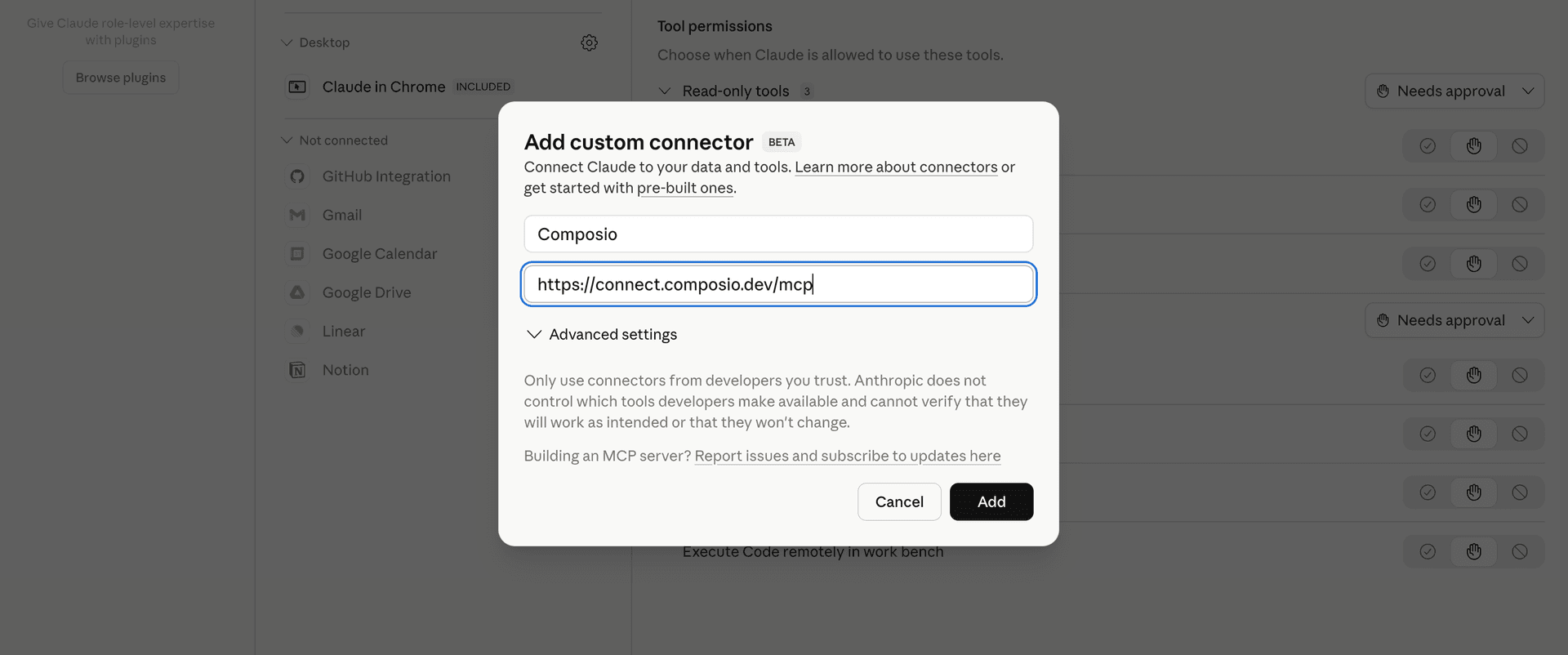
Click Add custom connector and paste in the Composio MCP server URL:

bash
https://connect.composio.dev/mcp
Add custom connector dialog with Composio MCP server URL

2. Authorize in your browser

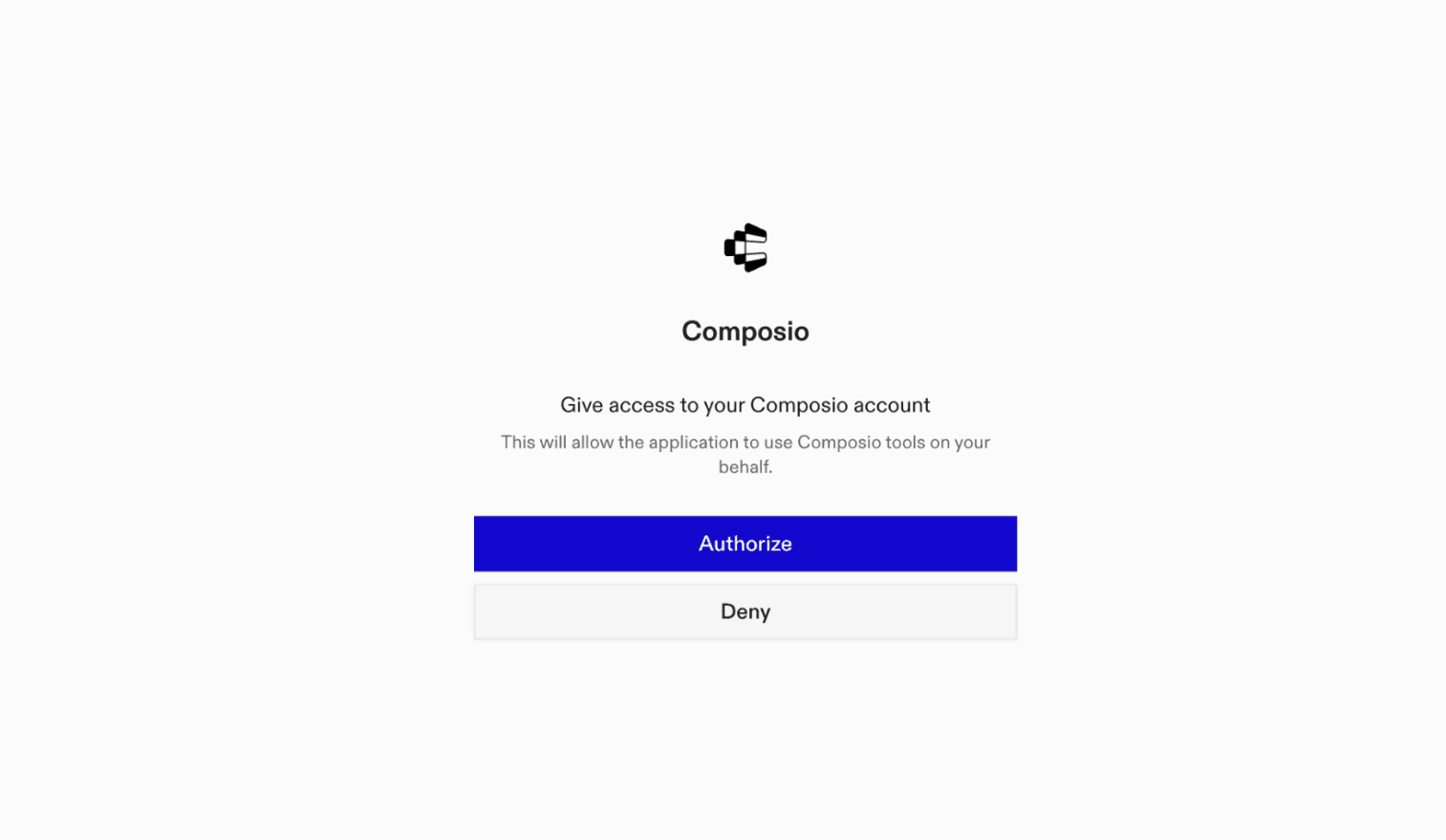
Click Connect. You'll be redirected to a browser window where you can authorize Composio to continue.

Composio authorization screen for Claude Web, Desktop, and Cowork

3. Connect your Era Context account

Back in Claude, ask it to connect to Era Context or give it any Era Context-related task.

For example, ask Claude to:

  • "List recent transactions from checking account"
  • "Get portfolio holdings and current market values"
  • "Transfer funds from checking to savings"

It will prompt you to authenticate and authorize access.

That's it. Composio's tools are now available in Claude, and your Era Context account is ready to use.

What is the Era Context Claude Connector, and what's possible with it?

The Era Context MCP server is an implementation of the Model Context Protocol that connects your AI agent and assistants like Claude, Cursor, etc directly to your Era Context account. It provides structured and secure access so your agent can perform Era Context operations on your behalf.

Troubleshooting

1. Why does Claude not use the Composio connector for Era Context?

The connector can show as connected, but Claude must use it in each Era Context conversation.

  • Click + at the lower left of the chat, or type /.
  • Hover Connectors.
  • Turn on Composio.
  • Ask Claude to connect to Era Context again.

2. Why does Claude show an MCP server error before Era Context connects?

Claude can show Couldn't reach the MCP server or Authorization with the MCP server failed when you add the connector for Era Context.

  • Check that the connector URL is https://connect.composio.dev/mcp.
  • Connectors run from Anthropic's cloud, so your device network is usually not the problem.
  • Add the connector again from Customize > Connectors, then ask Claude to connect Era Context.
  • If it fails again, send the error and the ofid_ reference id to support@composio.dev.

3. Why does the Era Context authorization link not work?

The Composio connector is one server. Your Era Context account connects separately when Claude asks for it.

  • If the browser does not open, or the link expires, ask Claude to retry the Era Context connection.
  • Composio creates a fresh Era Context authorization link.
  • Open that link in your browser and finish the Era Context sign-in.

4. Why do Era Context actions fail after they worked before?

The Era Context connection can expire or lose permission.

  • Ask Claude to inspect the Era Context connection.
  • If the connection is unhealthy, disconnect it when Claude prompts you.
  • Reconnect the Era Context account and retry the action.
  • If Claude shows a permission prompt, approve it before Claude changes data in Era Context.
  • If the action still fails with a permission error, check that the connected account has that permission in Era Context itself.

5. How do I switch to a different Era Context account?

Claude can manage the Era Context connection for you.

  • Ask Claude to disconnect or delete the current Era Context account.
  • Ask Claude to connect Era Context again.
  • Open the new Composio authorization link for Era Context.
  • Sign in with the other Era Context account in the browser.
  • After the account connects, ask Claude to retry the Era Context task.

6. Why is my Era Context connection missing in Claude Desktop or on a Team plan?

The connector belongs to your Claude account, so your Era Context connection works in Claude Web, Desktop, and Cowork.

  • In Claude Desktop, open Customize > Connectors.
  • Next to Composio, click and click Clear cache.
  • If Era Context tools still do not appear, click , disconnect, remove the connector, and add it again.
  • On Team or Enterprise, an Owner or Primary Owner must enable the connector before you can connect Era Context.
TOOLS

Supported Tools

Every Era Context MCP action and event your agent gets out of the box.

Accounts check account balance

Get the current and available balance for a specific account, including credit limit if applicable.

Accounts list financial accounts

List all linked bank accounts, credit cards, and investment accounts with current and available balances.

Accounts manage account

Manage financial accounts in the user's universe — both manually tracked accounts and accounts synced from a connected banking provider.

Accounts set account visibility

Set the visibility of a single financial account.

Accounts toggle balance backfill

Toggle balance backfill for an account group.

Billing cancel subscription

Initiate subscription cancellation.

Billing get current plan

Get the user's current subscription plan, tier, usage against meter limits, and what the next tier up would unlock.

Billing list payments

List the user's past invoices — what they were charged, when, for which service period, and whether each was paid.

Billing list plans

List all available subscription plans with pricing, billing periods, feature comparisons relative to the user's current tier, and free trial eligibility.

Billing list subscriptions

List what the user is actually being charged for right now, read live from Stripe, broken down by individual line item.

Billing uncancel subscription

Un-cancel a subscription that Stripe holds a scheduled cancellation for, in either of the two mutually exclusive expressions Stripe stores one in: the cancel_at_period_end flag, or a concrete cancel_at instant with that flag false.

Billing upgrade

Start a subscription upgrade or plan change.

Connections connect bank account

Initiate a bank account connection flow.

Connections disconnect institution

Permanently disconnect a bank institution.

Connections list connections

List every one of the user's bank connections with an honest, provider-agnostic status for each: whether it is healthy, syncing with no data yet, needs reconnecting, is currently disconnected, or one of several other narrower states — see each row's state for the exact one.

Connections set proactive sync mode

Record whether Era may proactively ask a bank connection's provider for fresh data on its own schedule.

Connections trigger connection resync

Trigger an on-demand data resync for a bank connection.

Help get help

Get contextual help and onboarding guidance for Era Context.

Insights analyze spending

Break down spending by category, merchant, account, week, or month.

Insights compare spending periods

Compare spending between any two time periods side-by-side with pre-computed deltas and percentage changes.

Insights forecast spending

Estimate how much the user will spend by the end of the current period based on their spending pace so far.

Insights get cash flow

Analyze income, spending, and net cash flow over multiple weeks or months (up to 12 periods) with computed averages.

Insights get daily category spending

Get a per-day, per-category spending breakdown for a calendar month.

Insights get daily financial summary

Get daily financial calendar for a month.

Knowledge confirm or reject inference

Confirm or reject a fact that was inferred by the system.

Knowledge defer question

Skip or snooze an onboarding question.

Knowledge forget

Retract or delete a previously recorded fact about the user.

Knowledge get financial context and overview

Load the user's profile, complete financial snapshot (all account balances, net worth, this month vs.

Knowledge get pending questions

Get the next onboarding questions to ask the user.

Knowledge recall history

Get the version history of a specific fact about the user.

Knowledge remember

Record a fact, preference, goal, or observation about the user.

Knowledge reset pack questions

Warning: this cannot be undone — only call when you have high confidence the user wants to reset and re-surface all previously skipped or snoozed questions.

Knowledge show question ui

Present an onboarding question using a visual input control (slider, date picker, multi-select checklist, etc.

Nurture get my status

Get the caller's own nurture (lifecycle email) campaign enrollment status — which campaigns they are currently enrolled in, their progress through each, and whether they have unsubscribed.

Nurture set subscription

Subscribe the caller to, or unsubscribe them from, a nurture (lifecycle email) campaign.

Referral get dashboard sso

Get a single-use SSO magic link to open the user's Rewardful affiliate dashboard.

Referral get referral link

Get the user's referral link if they are enrolled in the referral program.

Referral get referral stats

Get the user's referral performance statistics: visitors, conversions, earned commissions, and pending commissions.

Referral join referral program

Join the referral program by creating a Rewardful affiliate for the authenticated user.

Referral switch referral campaign

Move the user's referral programme onto a different track.

Transactions import csv transactions

Import transactions from inline CSV text into a manual account.

Transactions list recurring charges

List detected recurring transactions — subscriptions (Netflix, Spotify), bills (rent, utilities), and regular income (salary, freelance) — with estimated monthly amounts, frequency, and last-seen date.

Transactions list spending categories

List all available spending categories organized in a parent/child hierarchy (e.

Transactions list transactions

List recent transactions with pagination, optionally filtered by account and date range.

Transactions manage automation rules

Create and manage automation rules that automatically organize the user's transactions.

Transactions manage categories

Create, rename, hide, unhide, delete, or merge spending categories.

Transactions manage manual transaction

Batch-manage transactions on a manually tracked account.

Transactions manage transaction tags

Create, list, update, or delete tags, and attach or detach them from transactions.

Transactions manage transfer links

List, confirm, or reject detected transfer links between the user's accounts.

Transactions search transactions

Search and filter transactions by merchant name, description, amount range, date range, and direction (debit/credit).

Transactions update transactions

Update the category, merchant name, description, or review status on one or more transactions.

FAQ

Frequently asked questions

With a standalone Era Context MCP server, the agents and LLMs can only access a fixed set of Era Context tools tied to that server. However, with the Composio Tool Router, agents can dynamically load tools from Era Context and many other apps based on the task at hand, all through a single MCP endpoint.

Yes, you can. Claude Cowork fully supports MCP integration. You get structured tool calling, message history handling, and model orchestration while Tool Router takes care of discovering and serving the right Era Context tools.

Yes, absolutely. You can configure which Era Context scopes and actions are allowed when connecting your account to Composio. You can also bring your own OAuth credentials or API configuration so you keep full control over what the agent can do.

All sensitive data such as tokens, keys, and configuration is fully encrypted at rest and in transit. Composio is SOC 2 Type 2 compliant and follows strict security practices so your Era Context data and credentials are handled as safely as possible.

Start with Era Context MCP.It takes 30 seconds.

Managed auth, hosted MCP servers, and every Era Context MCP tool your agent needs.Free to start.

Start building