How to connect Axiom MCP to Claude

Connect Claude Web, Desktop and Cowork to Axiom MCP. Query axiom logs for failed requests, explore axiom traces for slow endpoints, and more using natural language, with authentication handled for you.

Axiom MCP logoAxiom MCP
Dcr Oauth

Axiom MCP is Axiom's hosted server for querying logs, traces, and metrics. It provides a secure, ready-to-use connection to observability data and management tools.

43 Tools

Introduction

Claude is Anthropic's AI assistant, available on the web, in the desktop app, and on mobile. Cowork is its agent for knowledge work, and it runs on all of those surfaces too. Connected to your apps, Claude can work with your files and services to accomplish complex tasks on your behalf.

This guide walks you through the easiest and most secure way to connect your Axiom account to Claude via Composio Connect, enabling it to query Axiom logs for failed requests, explore Axiom traces for slow endpoints, check Axiom metrics for service health, and more such actions on your behalf without compromising your account security.

Setup is the same on Claude Web, Desktop, and Cowork, and you only need to do it once. The connector is tied to your account, so it's available in all three.

For exact tool slugs and parameter tables, see the tool catalog in the Composio docs.

Also integrate Axiom MCP with

Connecting Axiom to Claude Web, Desktop, and Cowork

Two ways to add the Composio connector. Pick whichever you prefer.

1. Add with one click

Click the button. Claude opens with the Composio connector filled in. Click Add, then go to step 2.

Add to Claude

Add manually

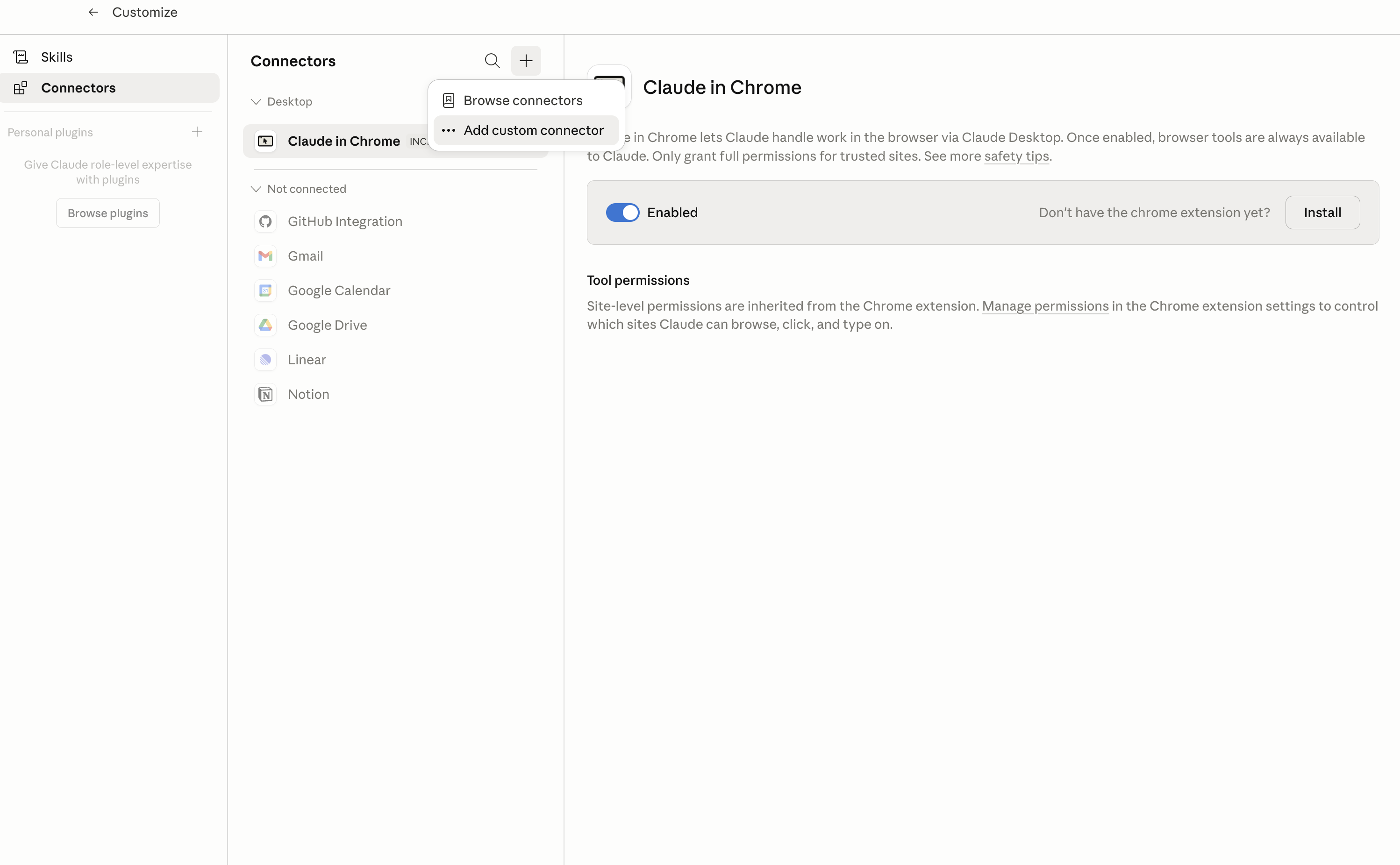
In Claude Desktop, click Customize in the left sidebar, then select Connectors and click the + icon at the top.

Claude Desktop connectors screen with Add custom connector selected

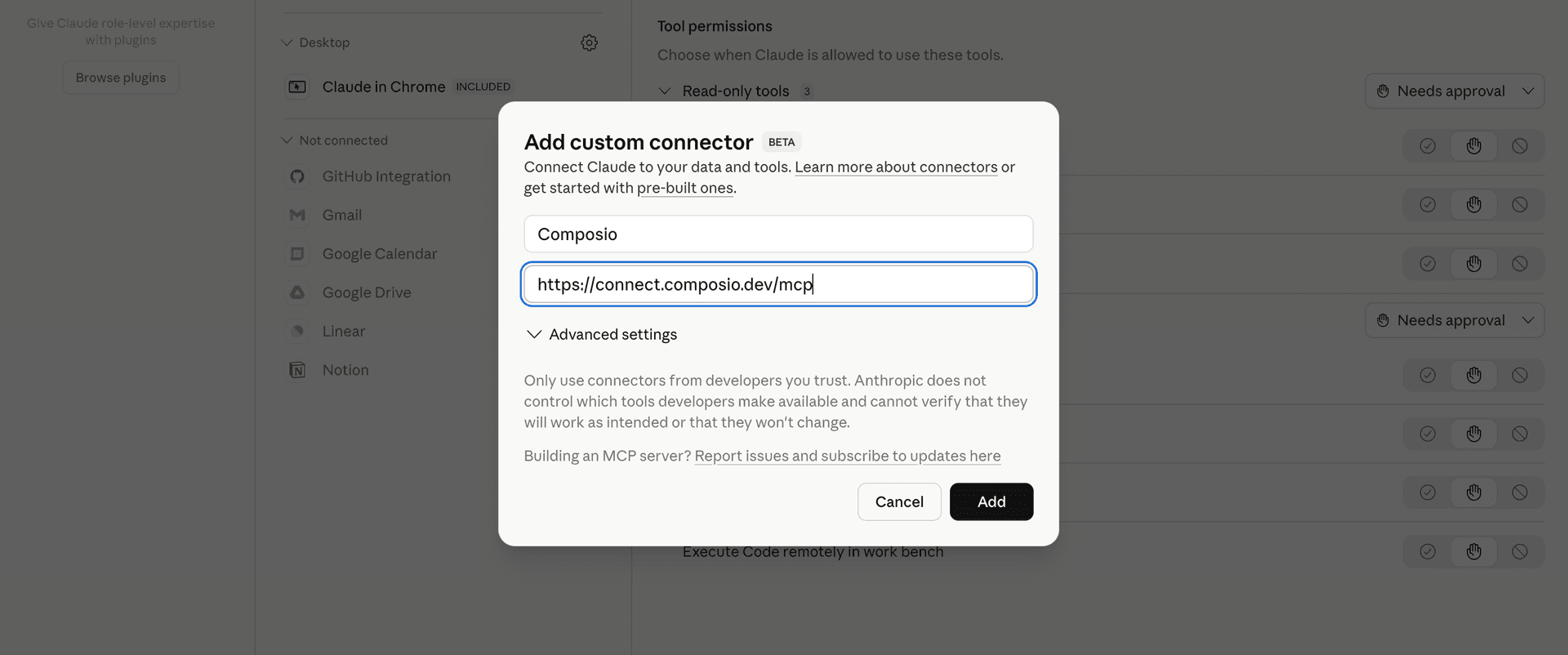
Click Add custom connector and paste in the Composio MCP server URL:

bash
https://connect.composio.dev/mcp
Add custom connector dialog with Composio MCP server URL

2. Authorize in your browser

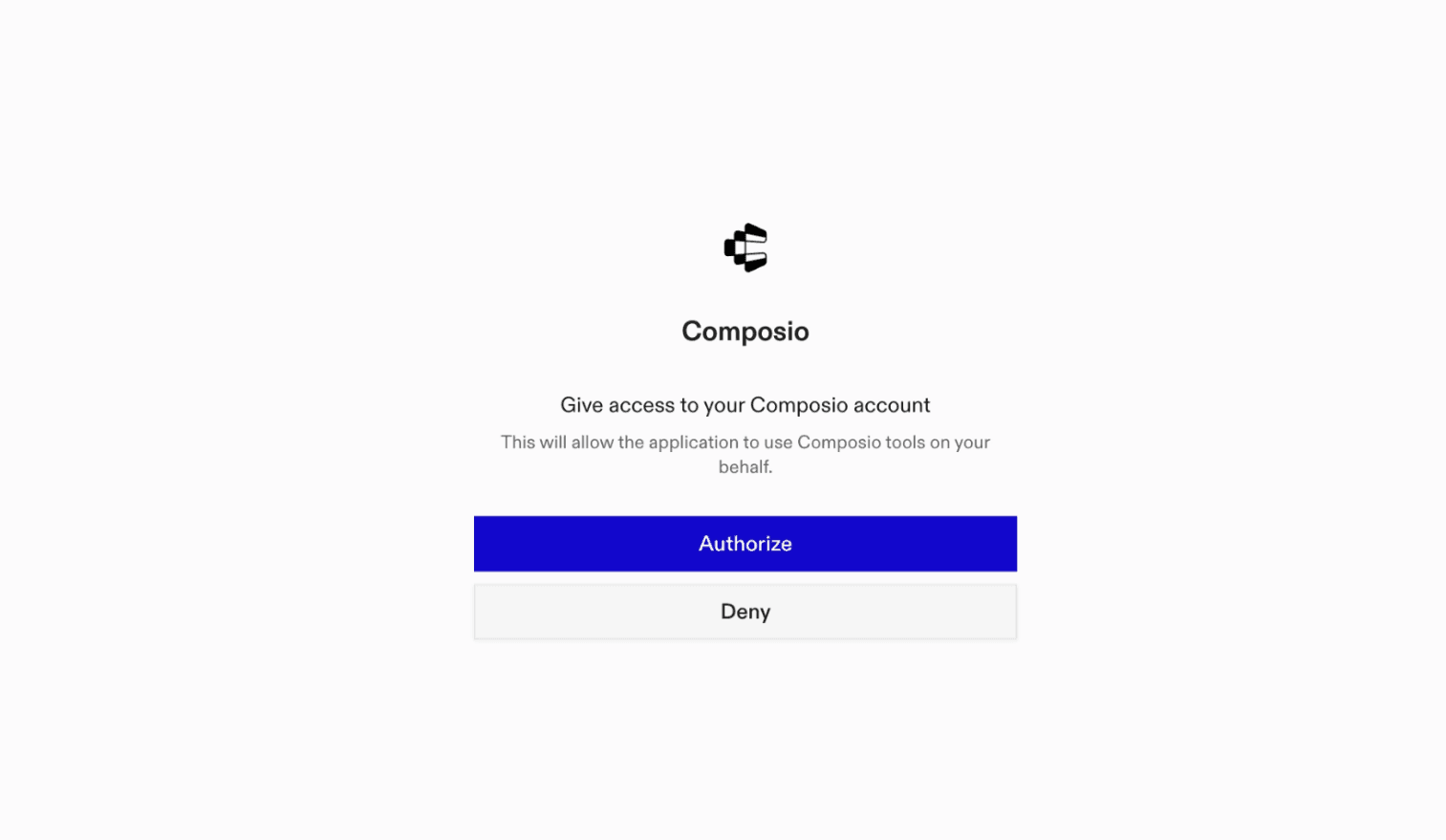
Click Connect. You'll be redirected to a browser window where you can authorize Composio to continue.

Composio authorization screen for Claude Web, Desktop, and Cowork

3. Connect your Axiom account

Back in Claude, ask it to connect to Axiom or give it any Axiom-related task.

For example, ask Claude to:

  • "Query Axiom logs for failed requests"
  • "Explore Axiom traces for slow endpoints"
  • "Check Axiom metrics for service health"

It will prompt you to authenticate and authorize access.

That's it. Composio's tools are now available in Claude, and your Axiom account is ready to use.

What is the Axiom Claude Connector, and what's possible with it?

The Axiom MCP server is an implementation of the Model Context Protocol that connects your AI agent and assistants like Claude, Cursor, etc directly to your Axiom account. It provides structured and secure access to logs, traces, metrics, datasets, dashboards, monitors, and notifiers, so your agent can query observability data, investigate service health, analyze trends, and manage monitoring resources on your behalf.

  • Log and trace investigation: Have your agent query datasets, inspect fields, compare groups of events, and use saved queries to investigate application behavior.
  • Metrics analysis: Let the agent search, query, and examine metrics, tags, values, and metric specifications to understand performance across your systems.
  • Service health and dependencies: Direct your agent to map service topology, report dependency changes, and chart call volume, errors, and latency between services.
  • Dashboards and monitoring: Instruct your agent to list, create, update, or remove dashboards, check monitors and alerts, and review monitor history.
  • Observability organization: Have your agent manage datasets, labels, annotations, and notifiers, or search official Axiom documentation when you need guidance.

Troubleshooting

1. Why does Claude not use the Composio connector for Axiom?

The connector can show as connected, but Claude must use it in each Axiom conversation.

  • Click + at the lower left of the chat, or type /.
  • Hover Connectors.
  • Turn on Composio.
  • Ask Claude to connect to Axiom again.

2. Why does Claude show an MCP server error before Axiom connects?

Claude can show Couldn't reach the MCP server or Authorization with the MCP server failed when you add the connector for Axiom.

  • Check that the connector URL is https://connect.composio.dev/mcp.
  • Connectors run from Anthropic's cloud, so your device network is usually not the problem.
  • Add the connector again from Customize > Connectors, then ask Claude to connect Axiom.
  • If it fails again, send the error and the ofid_ reference id to support@composio.dev.

3. Why does the Axiom authorization link not work?

The Composio connector is one server. Your Axiom account connects separately when Claude asks for it.

  • If the browser does not open, or the link expires, ask Claude to retry the Axiom connection.
  • Composio creates a fresh Axiom authorization link.
  • Open that link in your browser and finish the Axiom sign-in.

4. Why do Axiom actions fail after they worked before?

The Axiom connection can expire or lose permission.

  • Ask Claude to inspect the Axiom connection.
  • If the connection is unhealthy, disconnect it when Claude prompts you.
  • Reconnect the Axiom account and retry the action.
  • If Claude shows a permission prompt, approve it before Claude changes data in Axiom.
  • If the action still fails with a permission error, check that the connected account has that permission in Axiom itself.

5. How do I switch to a different Axiom account?

Claude can manage the Axiom connection for you.

  • Ask Claude to disconnect or delete the current Axiom account.
  • Ask Claude to connect Axiom again.
  • Open the new Composio authorization link for Axiom.
  • Sign in with the other Axiom account in the browser.
  • After the account connects, ask Claude to retry the Axiom task.

6. Why is my Axiom connection missing in Claude Desktop or on a Team plan?

The connector belongs to your Claude account, so your Axiom connection works in Claude Web, Desktop, and Cowork.

  • In Claude Desktop, open Customize > Connectors.
  • Next to Composio, click ⋮ and click Clear cache.
  • If Axiom tools still do not appear, click ⋮, disconnect, remove the connector, and add it again.
  • On Team or Enterprise, an Owner or Primary Owner must enable the connector before you can connect Axiom.
TOOLS

Supported Tools

Every Axiom MCP action and event your agent gets out of the box.

Check monitors

List all monitors and open alerts in their recent history, with explicit coverage for unavailable or empty histories.

Create dashboard

Create a new dashboard from a JSON document.

Create dataset

Create a new dataset in the current organization (POST /v2/datasets).

Create monitor

Create a monitor.

Create notifier

Create an email notifier, or start manual setup for another channel.

Delete dashboard

Delete a saved dashboard by its UID.

Delete dataset fields

Queue deletion of fields from an event dataset (POST /v2/datasets/{dataset}/delete-fields).

Delete monitor

Delete a monitor by its ID.

Delete notifier

Delete a notifier by its ID.

Dimensional analysis

Compare two groups of events and identify the dimensions and values that distinguish them using the APL spotlight() aggregation.

Get annotations

Read deployment, incident, and other event annotations to correlate with data changes.

Get dashboard

Get a saved dashboard by UID, or a visible integration dashboard by its stable id, including labels.

Get dataset fields

Get observed field names, types, units, and descriptions as CSV for an events or traces dataset.

Get metrics spec

Fetch the current MPL (Metrics Processing Language) specification, standard-library reference, and examples for a metrics dataset.

Get metric tag values

List values for a tag as one-column CSV in a metrics dataset (kind `otel-metrics-v1`).

Get monitor

Get a single monitor's full definition by ID, including the complete APL or MPL query text and labels.

Get monitor history

Get alert history for a monitor from the public /v2/monitors/{id}/history endpoint.

Get saved queries

Read saved/starred APL queries as CSV with name, dataset, full query, author, and end time.

List dashboards

List saved and integration dashboards visible to the caller.

List datasets

List all available datasets with exact, unquoted names.

List labels

List organization labels (id, name, description, color).

List metrics

List metric names, types, temporality, and units as CSV in a metrics dataset (kind "otel-metrics-v1").

List metric tags

List available tags (dimensions) as one-column CSV in a metrics dataset (kind `otel-metrics-v1`).

List notifiers

List all configured notifiers, including labels.

List organizations

List organizations the current credentials can access.

List tokens

List active API tokens, or one token when id is set.

Manage annotations

Create, update, or delete an annotation that marks a deployment, incident, or other event on the charts of one or more datasets.

Manage labels

Create, update, or delete a label in the organization catalog.

Prepare api token

Prepare a prefilled API-token creation form in Axiom Console.

Query dataset

When the user pastes an Axiom query URL containing qid, pass that qid as queryId and omit apl.

Query metrics

When the user asks to see, return, save, or share the results, or for a link or the query that was used, set saveResults: true on every queryMetrics call whose result you will hand back.

Read axiom doc

Read one official Axiom docs page as Markdown with its source URL.

Replace dashboard

Replace the whole document of a saved dashboard by UID.

Search axiom docs

Search official Axiom documentation and return the top matching pages as Markdown with source URLs.

Search metrics

Start here when the user mentions a specific service, host, or entity name and you need to work with metrics data.

Send feedback

Share feedback about your experience with the Axiom MCP server.

Services get changes

Report what changed in the service dependency graph: dependencies that appeared, dependencies that disappeared, and edges whose p99 latency regressed against a trailing 6h baseline.

Services get edge history

Charts one service's edges over time: a per-bucket time series of calls, errors and approximate p50/p99 for every edge where the named service is the source or the destination (pass `dst` to narrow to a single directed edge).

Services get map

START HERE for any question about service topology, dependencies, or system-wide health.

Set labels

Replace all labels on one dataset, dashboard, monitor, notifier, or integration dashboard.

Update dashboard chart

Change one existing chart in a saved dashboard by chart ID.

Update monitor

Replace the configuration of an existing monitor.

Update notifier

Update an email notifier by ID, or start manual editing for another channel.

FRAMEWORKS

How to build Axiom MCP Agent with another framework

FAQ

Frequently asked questions

Start with Axiom MCP.It takes 30 seconds.

Managed auth, hosted MCP servers, and every Axiom MCP tool your agent needs.Free to start.

Start building