How to connect Audioscrape to Grok Bot

Connect Grok Bot to Audioscrape MCP. Get speaker-attributed highlights from yesterday's call, find mentions of budget in last meeting, and more using natural language, with authentication handled for you.

Audioscrape MCP logoAudioscrape MCP
Dcr Oauth

Audioscrape MCP lets agents search and retrieve speaker-attributed audio, transcripts, entities, and citations from public and workspace content. Use it to surface searchable, speaker-labeled audio and rich metadata for research, meetings, and content discovery.

20 Tools

Introduction

Grok is xAI's assistant, and its bot builder lets you create a personal agent that holds context, runs skills, and connects to the apps you already use through plugins.

This guide explains how to connect Audioscrape to a Grok bot using Composio Connect, which handles OAuth, token refresh, and reliability so you do not have to. You add Composio as a plugin, authenticate once, then ask your bot to work with Audioscrape in plain language.

For exact tool slugs and parameter tables, see the tool catalog in the Composio docs.

Also integrate Audioscrape MCP with

Why use Composio?

Composio exposes 2,000+ apps to your Grok bot through a single connection, so you get:

  • Connect to 2,000+ apps with on-demand tool loading, so you do not fill your context window with unnecessary tool definitions.
  • Use programmatic tool calling through a remote workbench, letting the model write its own code to handle complex tool chaining. This reduces back-and-forth for frequent tool calls.
  • Handle large tool responses outside the model context to keep conversations lean.

Connecting Audioscrape to Grok Bot

Once Grok Bot is set up, you connect Audioscrape entirely from its interface, and the whole flow takes under a minute.

Set up Grok Bot

Get access. Grok Bot is included with Cursor Ultra, Cursor Premium Teams, and SuperGrok Heavy. Get the desktop app for macOS or Windows from x.ai/bot and sign in. An iPhone companion app is also available, and your bots sync across devices.

Create a bot. Pick a suggested role or define your own, then give it a short name, one primary job, and a short description of how it should work. Focused bots work best, because a clear role gives the bot more useful context over time.

Connect Audioscrape

1. Add the Composio plugin

Click the button. The Composio listing on x.ai opens and launches Grok Bot for you. If the app does not open on its own, click Add to Grok Bot.

Add to Grok Bot
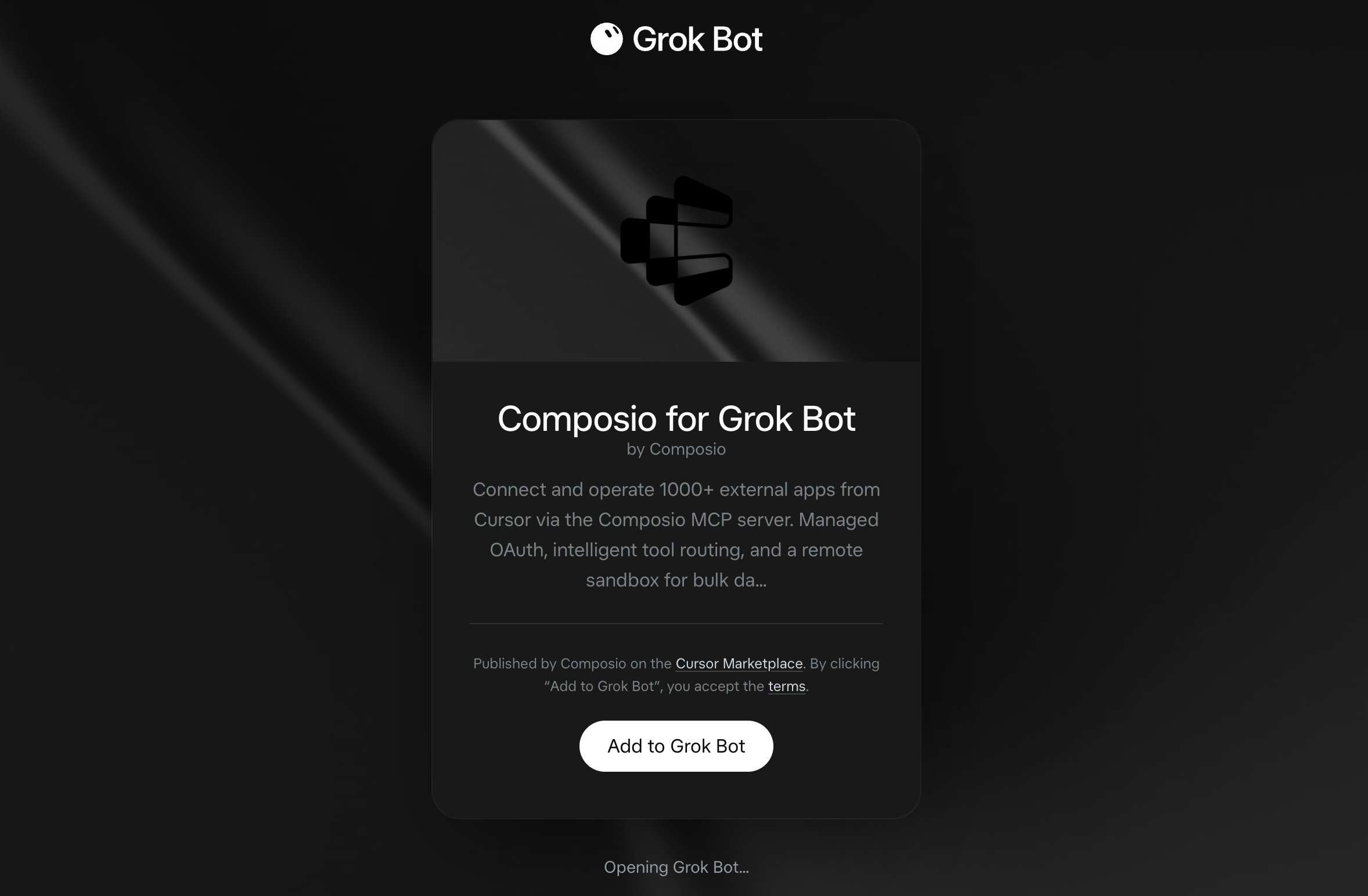
Composio for Grok Bot listing on x.ai with the Add to Grok Bot button

Grok Bot opens the Composio plugin, showing its connector and skills. Click Add.
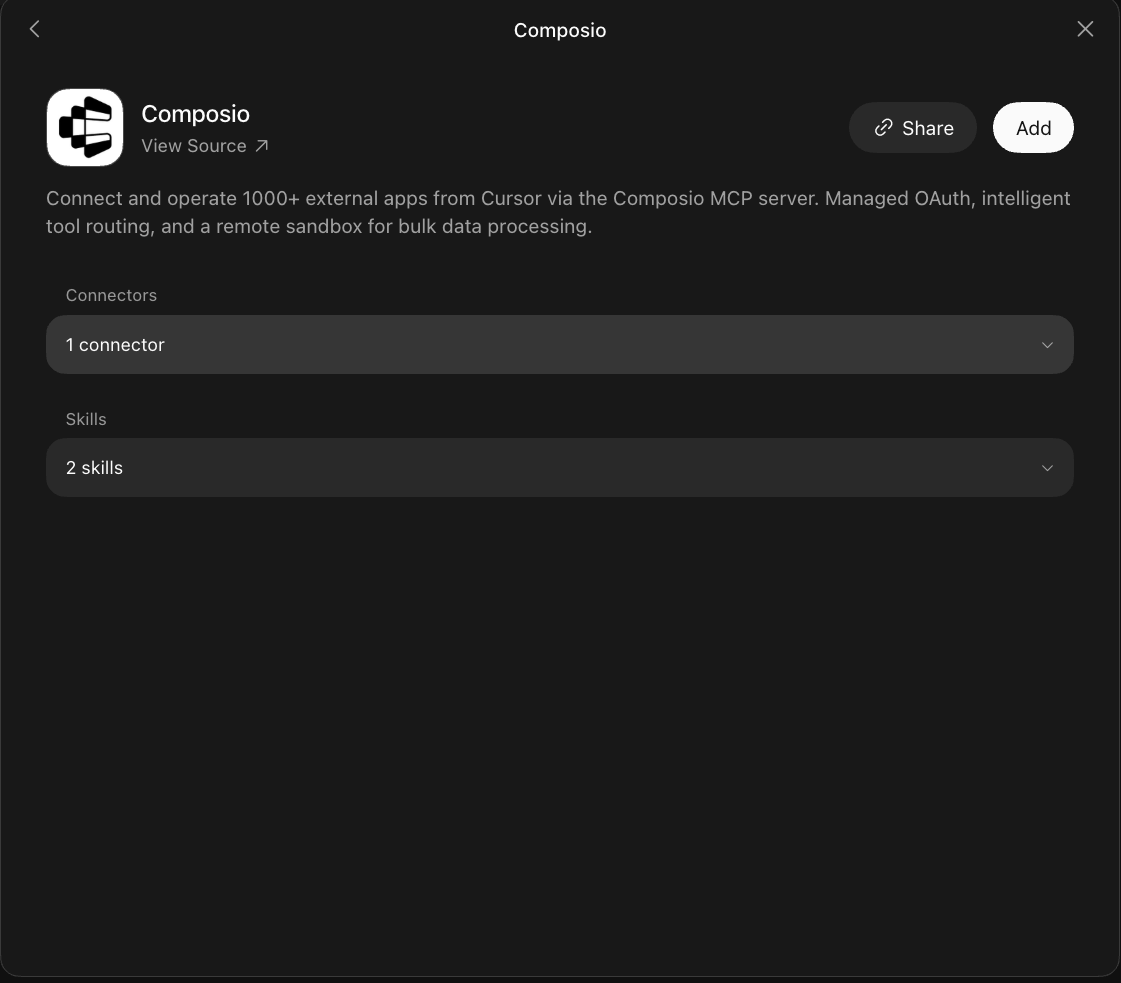
Composio plugin sheet in Grok Bot with the Add button

2. Authenticate

Go to the Installed section and click the Composio entry. You'll see its connector and skills listed.
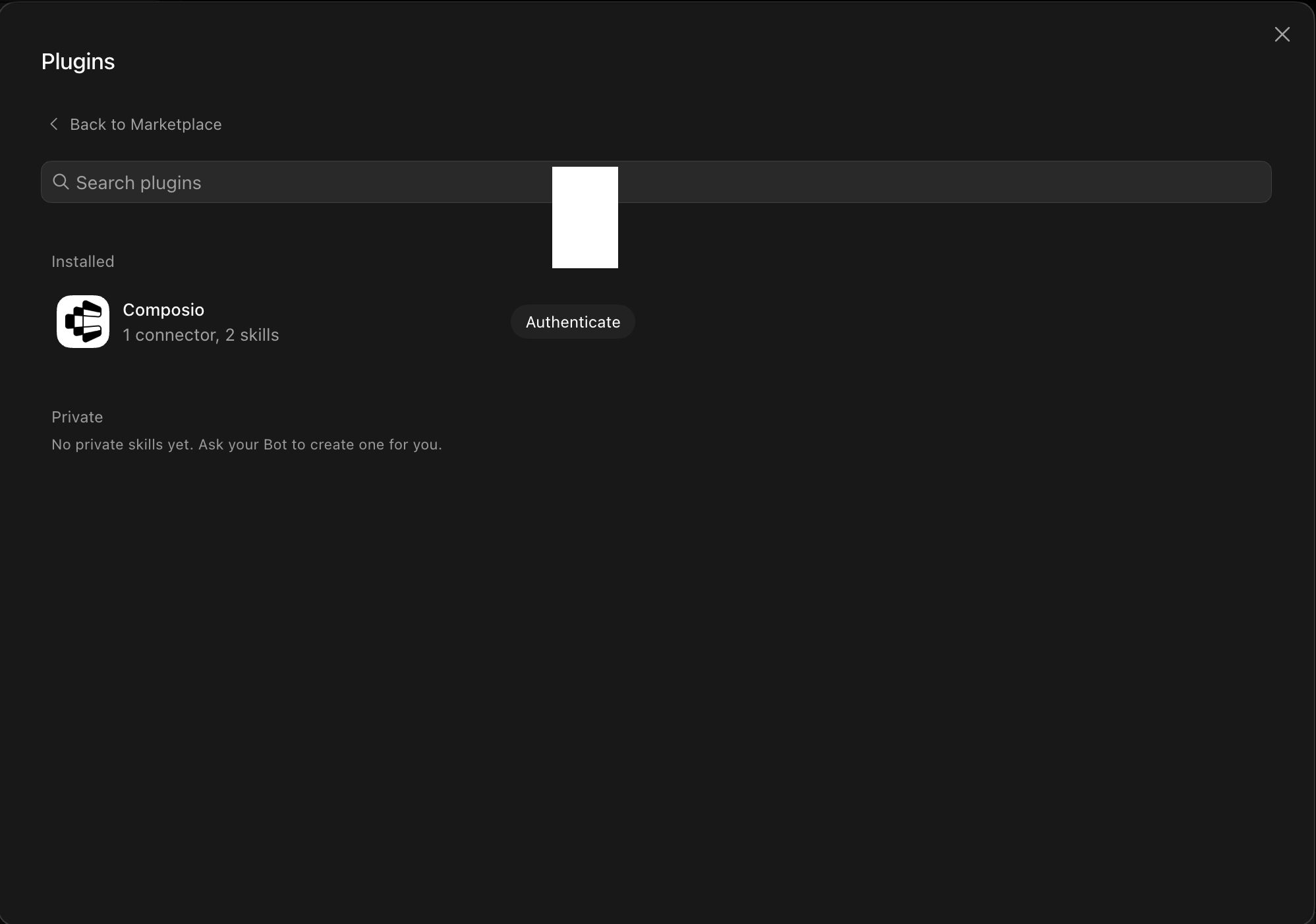
Installed Composio plugin showing the Authenticate button

Click Authenticate. You'll be taken to the Composio consent screen. Review the access it requests and click Authorize. Composio handles the OAuth handshake for you, so you never touch API keys or tokens.

Composio authorization screen with Authorize and Deny

3. Connect your Audioscrape account

Back in the chat, ask your bot to connect to Audioscrape or give it any Audioscrape task.

For example, ask it to:

  • "Get speaker-attributed highlights from yesterday's call"
  • "Find mentions of budget in last meeting"
  • "List citations for podcast episode AI Trends"

It will prompt you to authenticate and authorize access.

That's it. Composio's tools are now available in your Grok bot, and your Audioscrape account is ready to use.

What is Grok Bot?

Grok is xAI's assistant, available as a chat interface and a bot builder for creating personal agents that run skills and connect to external apps.

With Composio Connect, your Grok bot can securely access apps like Audioscrape through MCP without you sharing account credentials directly with the agent.

What is the Audioscrape MCP server, and what's possible with it?

The Audioscrape MCP server is an implementation of the Model Context Protocol that connects your AI agent and assistants like Claude, Cursor, etc directly to your Audioscrape account. It provides structured and secure access to public podcasts, workspace audio, transcripts, speakers, entities, and citations, so your agent can search audio, transcribe files, retrieve transcripts, explore knowledge graphs, and share audio moments on your behalf.

  • Audio search and discovery: Have your agent search public podcasts and your uploaded recordings for specific topics, phrases, speakers, shows, or entities.
  • Transcription and transcript retrieval: Direct your agent to transcribe an audio or video file with speaker attribution, check its progress, and retrieve the completed transcript.
  • Episode research and summaries: Let the agent pull episode overviews with chapters, timestamps, speakers, key takeaways, frequently mentioned entities, and supporting citations.
  • Speaker and entity exploration: Instruct your agent to find speakers, review their bios and appearances, or explore relationships among people, companies, locations, and topics.
  • Trends, charts, and shareable moments: Have your agent review trending subjects and podcast rankings, then create a shareable link to a specific audio moment.

Way Forward

Now that Audioscrape is connected, extend your setup by connecting the other apps you already use every day, so your Grok bot can run true cross-app workflows end to end.

  • Connect Calendar to turn threads into scheduled meetings automatically.
  • Connect Slack or Teams to post summaries, approvals, and alerts where your team works.
  • Connect Notion, Linear, Jira, or Asana to convert requests into tickets, tasks, and docs.
  • Connect Drive, Dropbox, or OneDrive to fetch, file, and share attachments without manual steps.

Start with one workflow you do repeatedly, then keep adding apps as you find new handoffs. With everything behind a single connection, your bot can coordinate multiple tools safely and reliably in one conversation.

TOOLS

Supported Tools

Every Audioscrape MCP action and event your agent gets out of the box.

Create share link

Create a shareable URL for a specific audio moment that unfurls with a social-media preview card on Twitter, Slack, LinkedIn, etc.

Fetch

Compatibility fetch: the full transcript of a search result as one plain-text document.

Get charts

Get current podcast chart rankings (Apple Podcasts, Spotify) by country.

Get entity graph

Explore the knowledge graph extracted from transcribed audio.

Get episode overview

START HERE for summaries and key takeaways: one small response with the episode's chapters (titled, timestamped), speakers, most-mentioned entities, and metadata.

Get speaker

Get a speaker's bio and audio appearances (across podcasts and uploads).

Get transcript

Get the transcript and metadata for one audio item — works for both podcast episodes and uploaded audio.

Get transcription status

Check the status of a transcription job submitted via transcribe_audio.

Get trending

Currently trending people, topics, and organizations across recently transcribed audio.

List my datasets

List the libraries (curated workspaces) the user is subscribed to, and the datasets inside each.

List my uploads

List audio you have personally uploaded and transcribed (your private workspace only — does not include the public podcast corpus).

List podcast episodes

List episodes within one specific podcast show.

List recent transcripts

List recently transcribed audio (podcast episodes + your uploads) ordered by date.

Request upload url

Get a one-time URL to upload an audio/video file the user attached in this chat when it cannot be passed as a link: PUT the raw file bytes to upload_url (e.g.

Search

Compatibility search returning episode-level citable documents (id/title/url only).

Search audio

Search across all transcribed audio — ~125,000 transcribed public podcast episodes (2,300+ shows) plus your own uploaded recordings — for any topic, phrase, or speaker.

Search entities

Search the knowledge graph for people, companies, locations, topics, and other entities mentioned in any transcribed audio.

Search podcasts

Search the podcast catalog by title.

Search speakers

Search speakers and hosts by name across all transcribed audio.

Transcribe audio

Transcribe an audio or video FILE with speaker diarization; the result is indexed into the user's private workspace for search_audio and get_transcript.

FAQ

Frequently asked questions

Start with Audioscrape MCP.It takes 30 seconds.

Managed auth, hosted MCP servers, and every Audioscrape MCP tool your agent needs.Free to start.

Start building