Everyone's terminal looks the same now. 😴
These days, most of us barely open an IDE. No VS Code, no big setup. It is usually just a terminal, a coding agent, and a lot of prompting and supervision. That has become the default workflow for a lot of developers in 2026.
For most people, that agent has been Claude Code. It has owned the terminal for more than a year. It is the default, and it is still the tool most of us compare everything else against.
Grok Build is the new toy from xAI, or rather SpaceXAI. It launched barely a few days ago and already offers a pretty solid workflow.
I have been using Claude Code for ever now. But after Grok 4.5, I was inclined to try out Grok Build CLI.
So I put them side by side to compare what they are built on, how they work under the hood, what they cost per task, and what happened when a researcher pointed a packet sniffer at one of them.
Let's go.

TL;DR
Category | Claude Code | Grok Build | Winner |
|---|---|---|---|
Entry price | Included with Claude Pro at $20 monthly | Bundled with Grok subscriptions, plus temporary free usage | Claude Code |
API efficiency | Powerful but expensive frontier models | Grok 4.5 costs $2 input and $6 output per million tokens | Grok Build |
Raw model quality | Stronger on difficult repository-level benchmarks | Near-frontier performance with better token efficiency | Claude Code |
Parallel execution | Agent teams, background agents, subagents | Parallel subagents with isolated Git worktrees | Grok Build |
Context capacity | Up to 1 million tokens on current models | 500,000 tokens with Grok 4.5 | Claude Code |
Configuration portability | Deep | Reads | Grok Build |
Extensions | Mature SDK, plugins, hooks, MCP, IDEs, CI, web, desktop | Skills, hooks, plugins, MCP, ACP, worktrees, headless mode | Claude Code |
User interfaces | Terminal, VS Code, JetBrains, desktop, browser, Slack | Primarily terminal and ACP integrations | Claude Code |
Security maturity | Several serious patched vulnerabilities, but stronger enterprise controls | Recent full-repository upload incident remains a major concern | Claude Code |
Best use | Production development and difficult cross-cutting changes | Cost-sensitive parallel work and experimentation | Depends |
Practical scorecard: Claude Code 6, Grok Build 3.
Claude Code is still the safer option for most individual developers and teams.
💁 Grok's models are not really the main attraction for coding, especially now that the agent around the model matters just as much. That may make some developers hesitant to switch. In the end, it comes down to what you value most.
What is Grok Build?
ℹ️ xAI's terminal-native coding agent, built around parallel subagents and lower cost
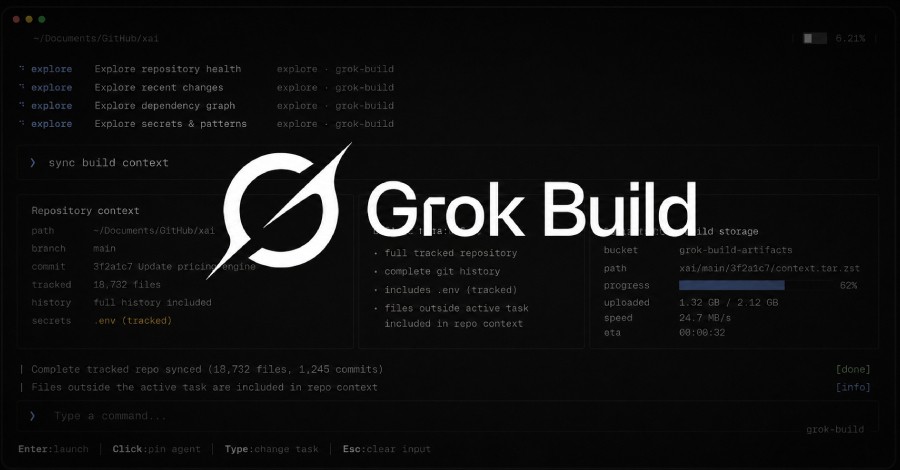
Grok Build CLI is xAI's agentic coding tool. It lives in your terminal rather than inside an IDE plugin or web app. It works much like Gemini CLI, Codex, and other coding agents you may already know.
It launched in early beta on May 14, 2026, gated behind the $300/month SuperGrok Heavy tier. Eleven days later, xAI dropped access to the regular $30/month SuperGrok tier and $40/month X Premium+.
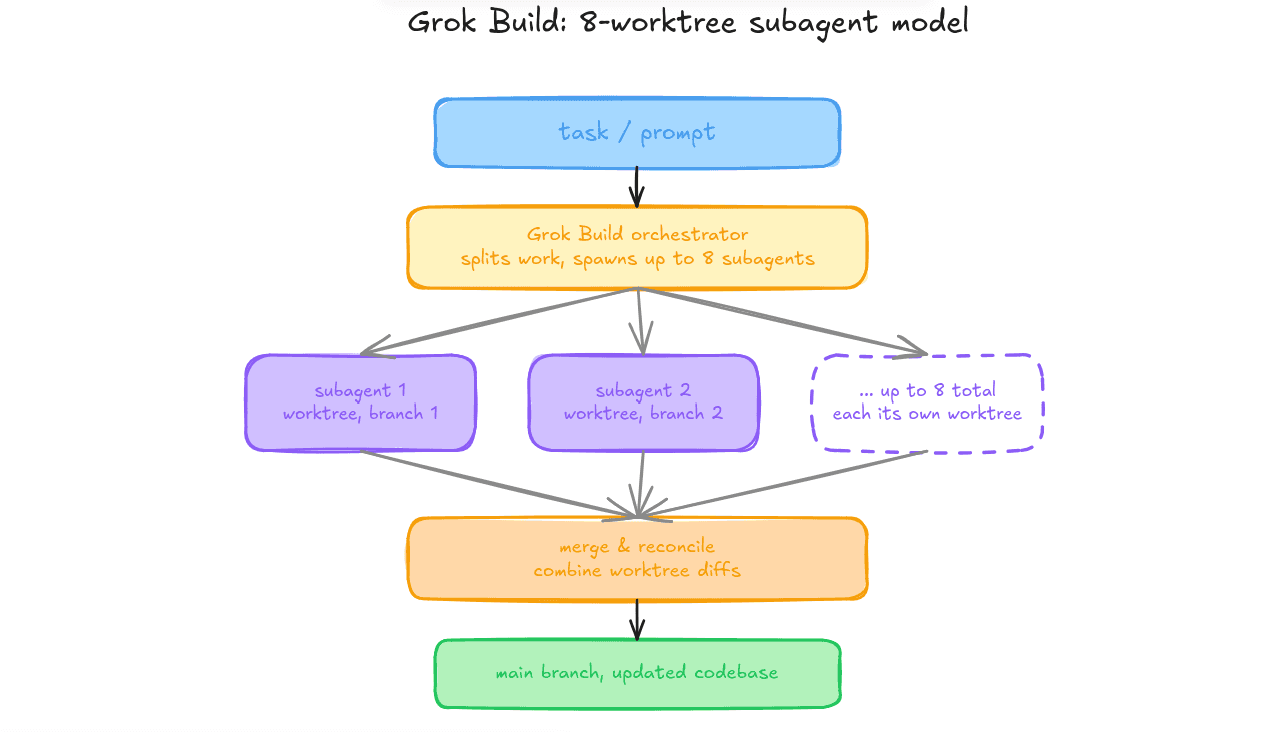
Its main selling point is parallelism. While most agents run one reasoning thread at a time, Grok Build can spin up 8 concurrent subagents, each inside its own isolated Git worktree, with every agent working on a different part of the problem. It also has a /goal mode similar to Claude Code.
Give it an objective, and it will plan the work, execute it, and verify the result through a two-model pipeline.
It first shipped with a purpose-built model, grok-build-0.1, with a 256K context window. As of July 14, 2026, it defaults to Grok 4.5, xAI's flagship model, with a 500K context window.
What is Claude Code?
ℹ️ Anthropic's polished, deeply integrated coding agent
No need to introduce the OG agentic coding CLI tool. Claude Code is the coding agent from Anthropic, which started as a side project by Boris Cherny.
It entered research preview in February 2025, became generally available in May 2025, and is now reportedly generating $2.5 billion in annualised revenue. It also has more than 138,000 stars on GitHub.
You do not reach that level of GitHub popularity without earning a fair amount of trust. If you know, you know.
It also runs almost everywhere at this point: the terminal, VS Code, JetBrains, a standalone desktop app, the web at claude.ai/code, iOS, Android, and even Slack.
Claude Code also comes with a serious set of agent features: project memory throughCLAUDE.md, slash commands, permissions, hooks, MCP, plugins, custom subagents, and IDE integrations.
There is not much more to explain here because you are probably already familiar with how Claude Code works.
Overall, Claude Code focuses on deeper reasoning, a mature ecosystem, and tight integration between the models and the agent itself.
Related: Claude Code vs Codex
1. Pricing: Grok Build vs. Claude Code
Neither tool is sold as a standalone product. Access comes through a subscription.
Grok Build
SuperGrok, $30/month with full access since May 25, 2026
X Premium+, $40/month
SuperGrok Heavy, $300/month at launch, later promoted to $99/month for a period
API pay-per-token access is also available
Reference: Grok Pricing
Claude Code
Pro, $20/month or $17/month annually
Max 5x, $100/month
Max 20x, $200/month
Enterprise, custom pricing with a 500K context window
API pay per token: Haiku 4.5 at $1/$5 per MTok, Sonnet 5 at $2/$10 introductory pricing, Opus 4.8 at $5/$25, and Fable 5 at $10/$50
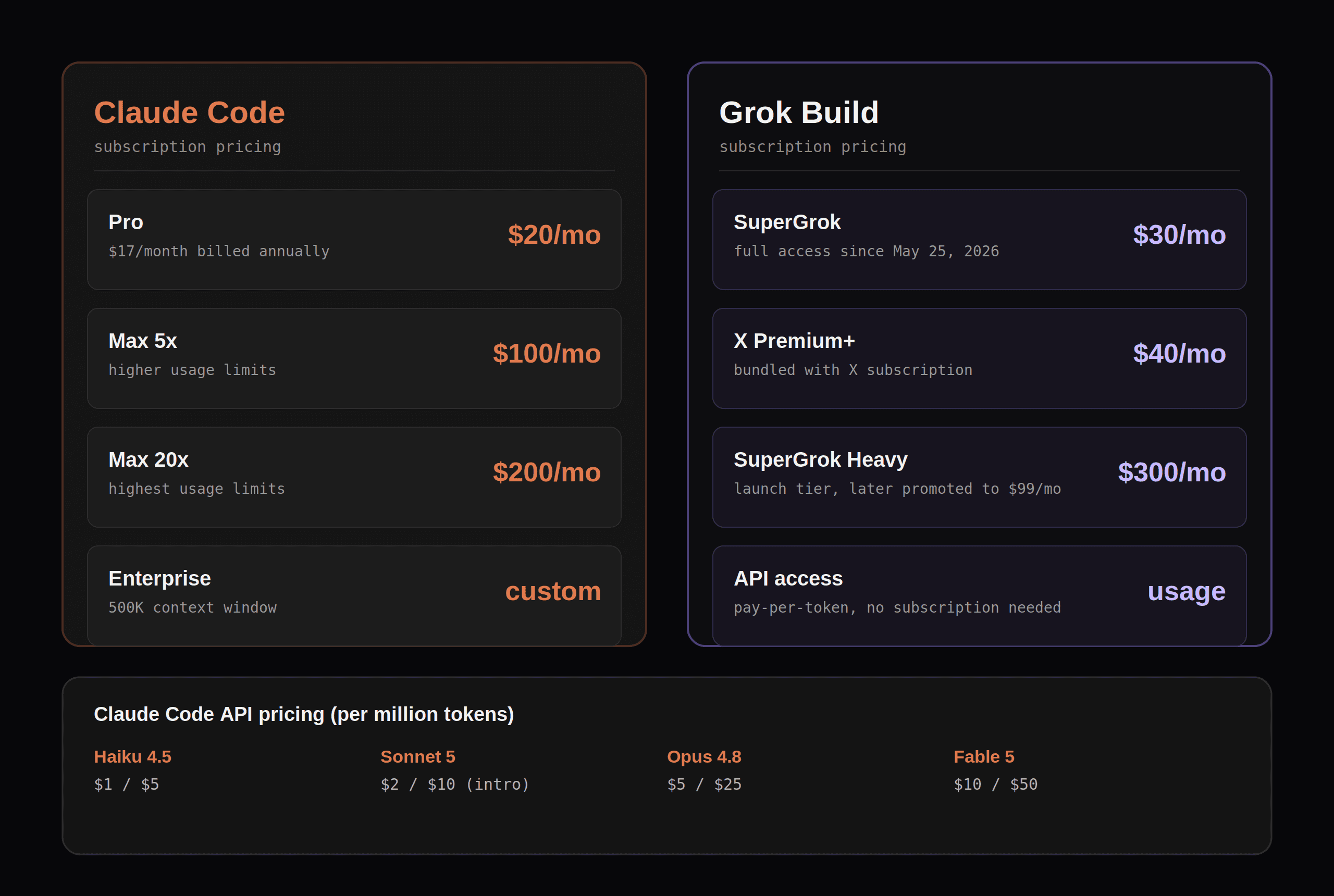
On paper, Claude Code's $20 Pro floor beats Grok Build's $30 SuperGrok floor. But the subscription price is not the number that matters most here. Usage cost is.
Coding Agent Index score | Cost per completed task | Avg. tokens per task | |
|---|---|---|---|
Claude Code (Fable 5) | 77 | $11.80 | 7.2M |
Codex (GPT-5.5) | 76 | $5.07 | 6.2M |
Grok Build (Grok 4.5) | 76 | $2.49 | 1.9M |
Table reference: Artificial Analysis Coding Agent Index
The performance gap is also much smaller than the maturity gap. Grok 4.5 in Grok Build scored 76, only one point behind Fable 5 in Claude Code at 77. Grok completed the benchmark tasks at a fraction of Claude's cost.
💁 NOTE: One gotcha is worth flagging on the Claude side. If
ANTHROPIC_API_KEYis set in your shell, Claude Code silently bills you at API rates even if you are already paying for a subscription. Check your environment variables before running it. I learned that one the expensive way.
Claude Code has the cheaper entry price. Grok Build is much cheaper once you start running it at scale.
2. Agent Architecture: Grok Build vs Claude Code
At a high level, both agents run the same loop. They read the task, inspect the repository, decide what to change, take an action, inspect the result, and keep going.
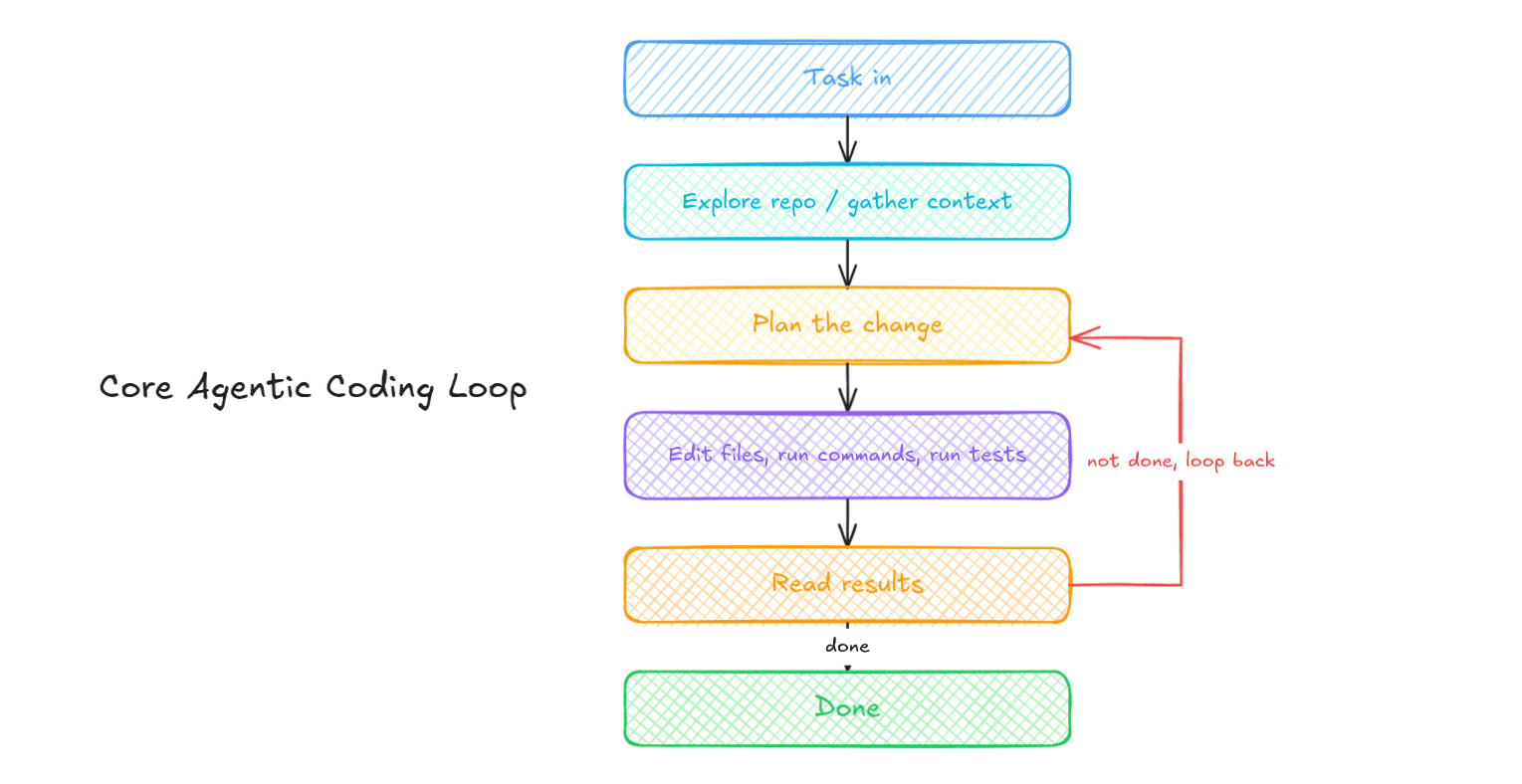
Most coding agents follow the same basic loop, and that loop is what makes them useful. The interesting part is how much of the loop runs in parallel and how much of the surrounding system you can actually see and control.
By default, Claude Code follows one deep reasoning thread. It can also spawn subagents or use Dynamic Workflows to coordinate a JavaScript-driven swarm of up to 1,000 agents for much larger jobs. The default is still one agent per task.
Grok Build starts with breadth. It can run up to 8 subagents, each in its own isolated Git worktree, with every agent working on a different part of the problem at the same time.
Neither approach is inherently more agentic. The real trade-off is depth-first versus breadth-first execution.
❓ Does your task break cleanly into independent pieces, or is it one tightly connected problem? That question decides which architecture will actually help you.
3. Memory: CLAUDE.md vs. AGENTS.md
Claude Code uses CLAUDE.md as its main project memory file. Nested files, user-level memory, and automatic memory work together as a built-in memory system.
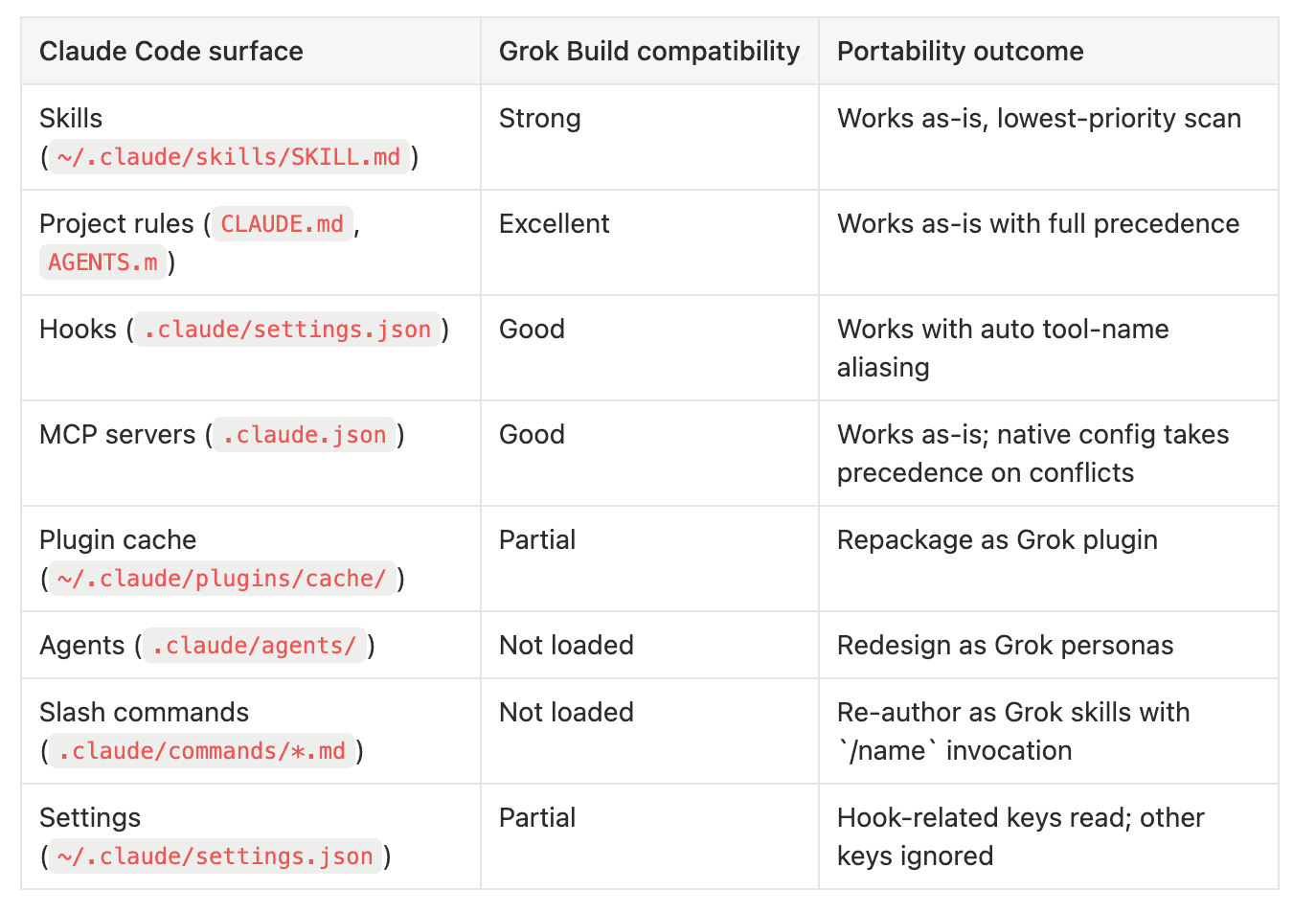
Grok Build reads both CLAUDE.md and AGENTS.md natively. That is a deliberate compatibility move by xAI.
💁 If you are moving a project over from Claude Code, you will probably not need to rewrite its memory files.

Moving away from Claude Code requires almost no work on the memory-file side. Moving to it from a multi-agent AGENTS.md setup, however, may require some duplication. That is worth knowing before your team commits to one format.
Context Window | |
|---|---|
Claude Code (Opus 4.8 / Sonnet 5) | 1,000,000 tokens |
Grok Build (Grok 4.5) | 500,000 tokens |
Grok Build (grok-build-0.1, original) | 256,000 tokens |
Claude gives you twice as much room. For most day-to-day tasks, that will not matter.
But if you are working in a huge monorepo with enough code and documentation to fill the context window, that extra capacity can make a real difference. It can be the difference between the agent seeing the full picture and needing you to manually point them toward the right files.
4. Models: Grok Build vs. Claude Code
Claude Code is vertically integrated around Anthropic's own models, and only those models: Opus 4.8, Sonnet 5, Fable 5, and Haiku 4.5.
To actually understand which model to go for tool calling, we compared Grok 4.5 with Fable 5
That lets Anthropic optimize the whole experience more deeply, with native prompt caching between turns, tool-calling conventions built for those exact models, and long-context behavior tuned specifically for them.
Grok Build ships with its own model, either Grok 4.5 or the original grok-build-0.1, but it can also route to other models through OpenRouter, including Claude, GPT, Gemini, and local models.
💁 If you want one CLI that can switch between several model providers depending on the task, Grok Build is the better fit. Claude Code does not let you do that by default.
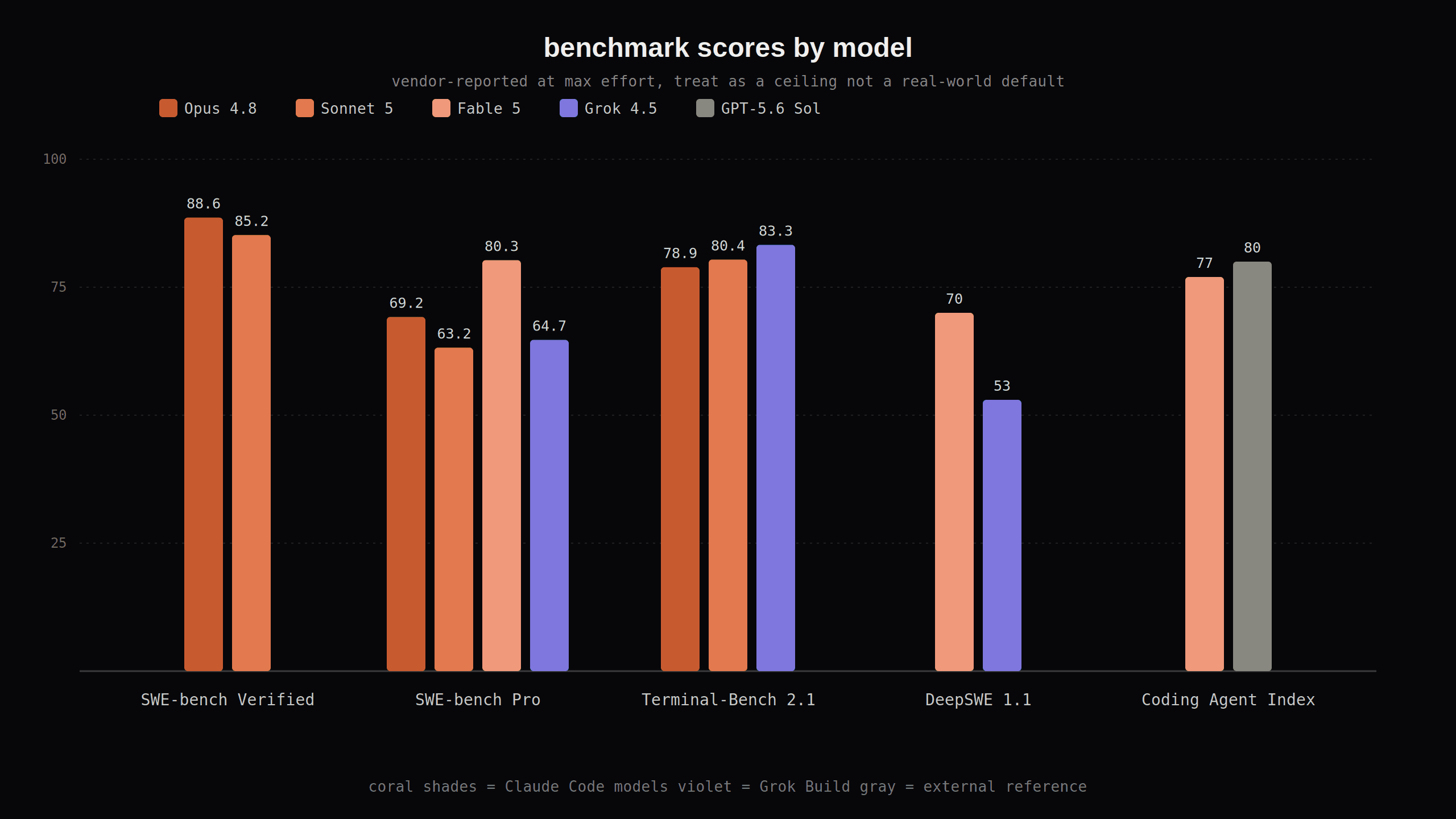
Vendor-reported benchmarks from Anthropic and xAI, run at maximum effort, should be treated as a ceiling rather than a real-world default:
Opus 4.8: 88.6% on SWE-bench Verified and 69.2% on SWE-bench Pro
Sonnet 5: 85.2% on Verified and 63.2% on Pro. It also beats Opus 4.8 on Terminal-Bench 2.1, scoring 80.4% versus 74.6%
Fable 5: 80.3% on SWE-bench Pro
Verified numbers from Artificial Analysis:
Opus 4.8 ranked first on the Intelligence Index at launch with a score of 61.4
On the latest Coding Agent Index, Fable 5 in Claude Code sits at 77. GPT-5.6 Sol overtook everyone at 80 within days of launching. This ranking changes every three days.
On harder single-pass tests, which measure correctness in one attempt rather than across an agentic loop, Claude pulls ahead more clearly.
DeepSWE 1.1 has Fable 5 at 70%, compared to Grok 4.5 at 53%. SWE-Bench Pro has Fable 5 at 80.4% versus Grok 4.5 at 64.7%.
Grok Build does edge ahead on Terminal-Bench 2.1, scoring 83.3% against Opus 4.8's 78.9%. So it is not weaker across the board, but it falls behind on the hardest single-shot problems.
5. Security and Reliability: Grok Build vs Claude Code
This is where the two tools really diverge, and it matters if you plan to use either one in production.
Claude Code's incidents show what more than a year in production actually buys you. Several issues were found and fixed:
A code injection bug with a CVSS score of 8.7 through malicious project configuration files. Fixed in v1.0.111
A flaw that let attackers redirect traffic and steal API keys. Fixed in v2.0.65
A GitHub Action bug where one malicious issue could hijack a repository. Fixed and bug-bountied in June 2026
In July, China's cybersecurity regulator flagged versions 2.1.91 through 2.1.196. They claimed the tool detected Chinese enterprise environments and changed its behavior. Anthropic called it an anti-fraud experiment and removed the code on July 1
None of these issues should be dismissed. But they are also the kind of bugs that surface when a large number of people use a tool heavily and actively test its limits.
Grok Build's incident is of a different kind and much more recent. Here is what has happened so far:
In July 2026, a researcher named "cereblab" ran a network-level test on Grok Build CLI v0.2.93
He found that it was uploading entire Git repositories to an xAI cloud storage bucket, not just the files it read. The uploads included the full commit history
It also uploaded unredacted
.envfiles, including secrets and passwords. BRUHH!!The actual work the model needed required only 192 KB of data. The hidden upload sent 5.10 GiB during the same session. That is roughly 27,800 times more data than necessary
He planted fake secrets as a test. Those fake secrets appeared in the uploaded data, proving the leak was real
Claude Code and Codex were tested the same way. Neither one did this
xAI disabled the upload on its servers within days. However, the upload code reportedly still exists in the app and is only remotely switched off. xAI also explained the situation through posts on X rather than through a formal security notice
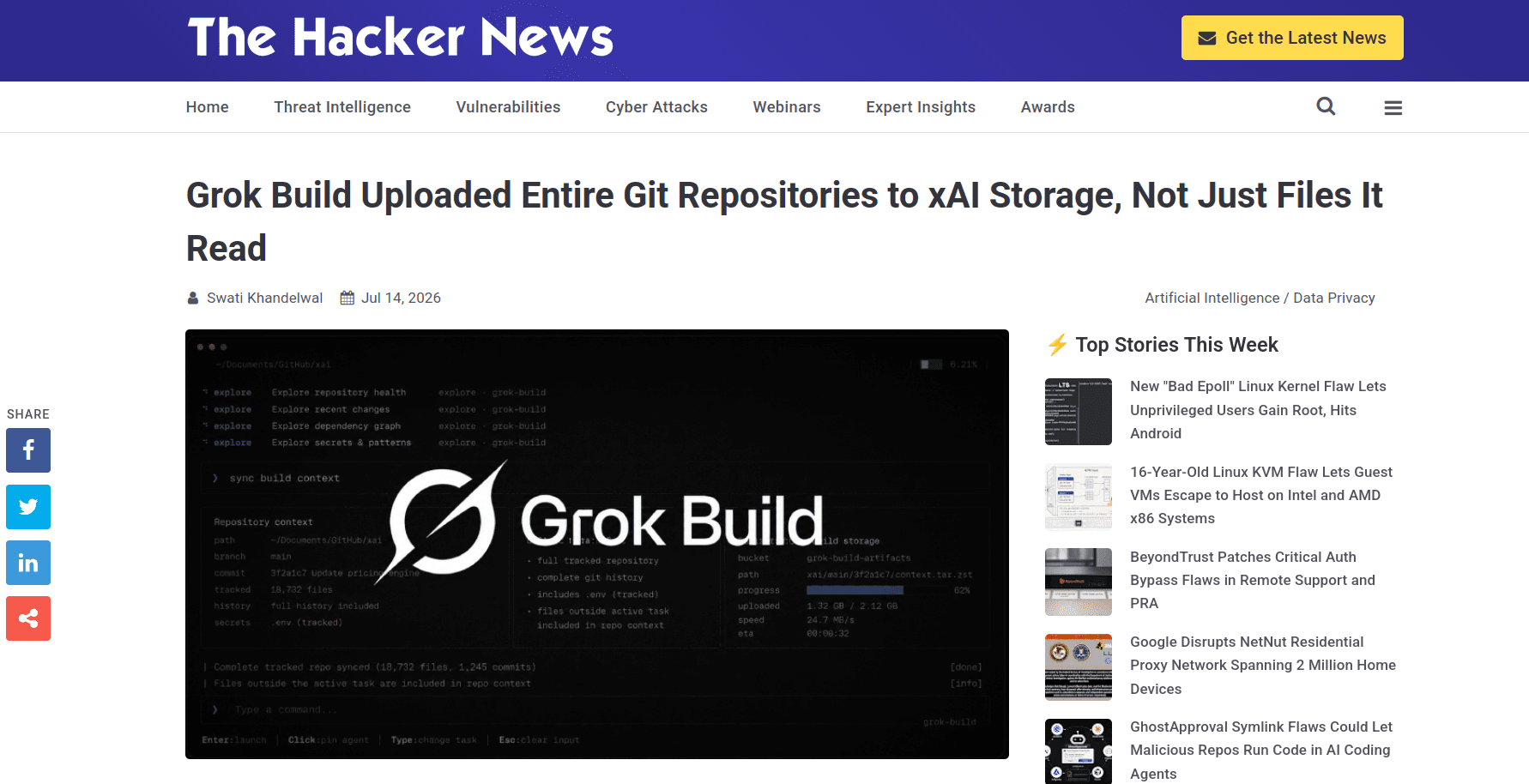
⚠️ If you ran Grok Build before mid-July 2026, rotate any credentials that were stored in the repository's
.envfiles.
6. Extensibility: Plugins, Skills, and Subagents
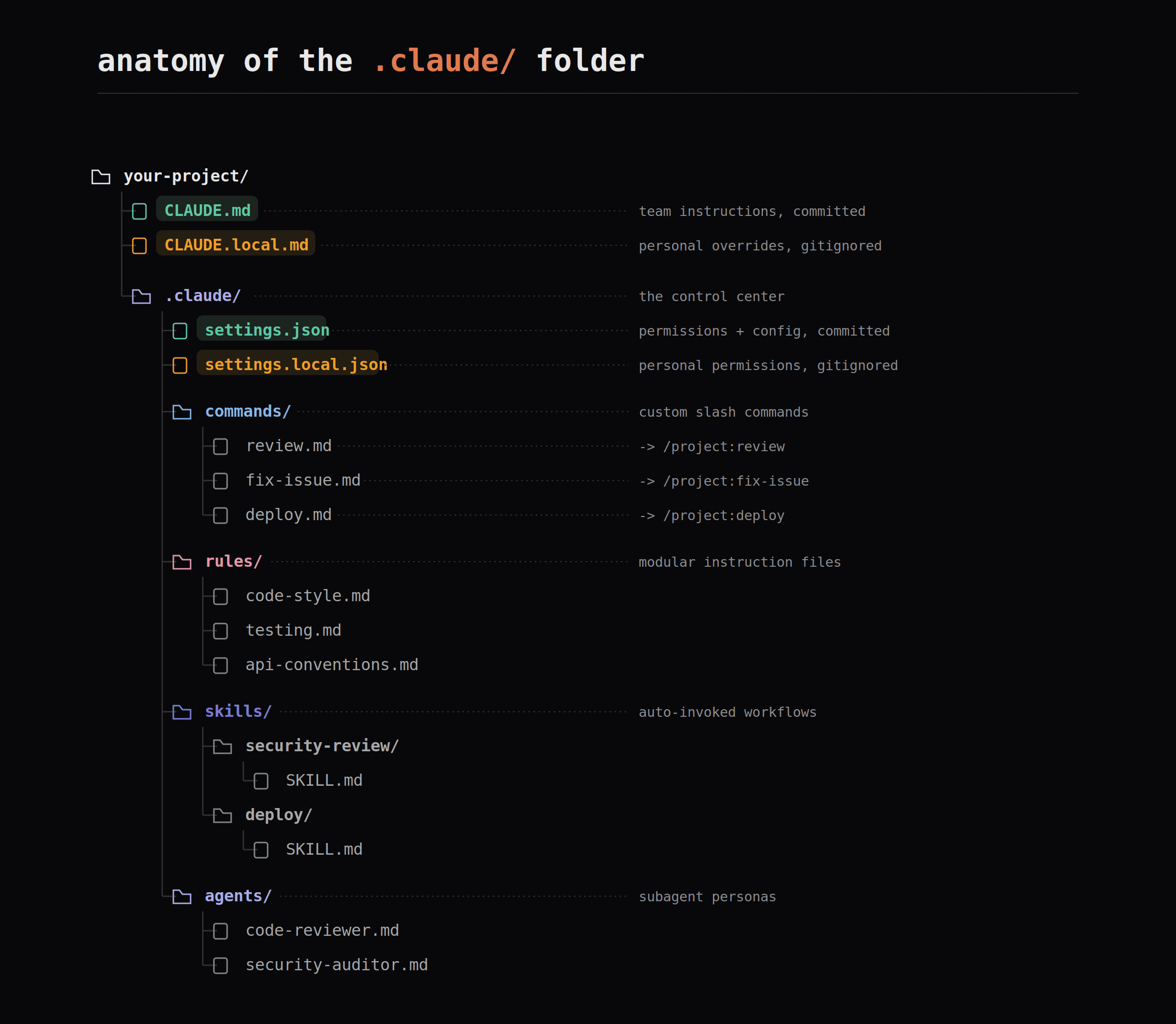
Claude Code gives you plenty of ways to customize how it works, and the whole system is well documented.
It has a Skills system, which is a collection of small instruction packs that the agent loads only when needed.
Related: Best Claude Code Skills
It also has Plugins, which bundle several pieces together, including skills, subagents, commands, hooks, and MCP connections, so you can install them as one package.
Related: Best Claude Code Plugins
Hooks are small scripts that run before or after the agent performs an action, giving you a way to inspect, block, or modify what it is doing.
Then there is MCP support, which lets Claude Code connect to outside tools such as databases, GitHub, Sentry, and thousands of other integrations.
You can test this setup using Composio's MCP integration.
You can also set clear rules for what the agent is allowed to touch.
{
  "permissions": {
    "allow": ["Bash(npm run test *)", "Bash(git status *)"],
    "deny": ["Read(./.env)", "Read(./secrets/**)", "Bash(curl *)"]
  }
}
The way subagents work is simple once you see it. The main agent hands a task to a smaller agent. That smaller agent works within its own context, with its own tools and permissions, and then reports back with a single clean result rather than dumping its entire thought process.
You can also build custom agents inside .claude/agents/, where you define which tools they can use, which model they run, and how many turns they get.
If the job is large enough, Claude Code can even write its own script to split the work across up to 1,000 agents at once, with built-in checks to catch mistakes along the way.
Grok Build offers many of the same pieces, including skills and plugins, along with a marketplace for discovering them.
Where it is genuinely different is in how it splits up the work. Instead of sending every agent into the same working directory, it can run up to 8 subagents at once, each with its own copy of the codebase via a Git worktree.
That is a stronger kind of separation than simply splitting the conversation into different contexts.
In practice, if two agents change the same files, Git helps reconcile their work instead of letting them overwrite each other in a shared folder.
One thing Grok Build has announced but not shipped yet is "Arena Mode." The idea is that several agents would compete on the same task, and the best result would be selected automatically.
xAI has been talking about it since mid-2026, but it has not shipped yet.
💁 Claude Code gives you a more proven and more complete toolkit. Grok Build gives you real file-level separation between agents with less setup, but one of its headline features still does not exist.
Which one should you pick?
There is no clever answer here.
Pick Grok Build if:
You are cost-sensitive at scale, since that roughly 5x cost gap adds up quickly across hundreds of tasks
Your work breaks naturally into parallel, independent chunks
You already pay for SuperGrok and want to try it at no extra cost
You want model-routing flexibility across vendors from one CLI, similar to OpenCode
Pick Claude Code if:
You need the extra context headroom for large monorepos
You want the more hardened and extensible agent available today
You are not chasing the absolute lowest cost per task
You trust Anthropic's models, security practices, and overall ecosystem
I am still mostly using Claude Code for anything that touches real production code. It just feels right to me.
But I would keep Grok Build in the toolbox for cheap, disposable work such as bulk test writing or anything I would sandbox anyway. In those cases, the cost difference can add up to real money.
Conclusion
The final score is six categories to three, and the overall result is fairly clear.
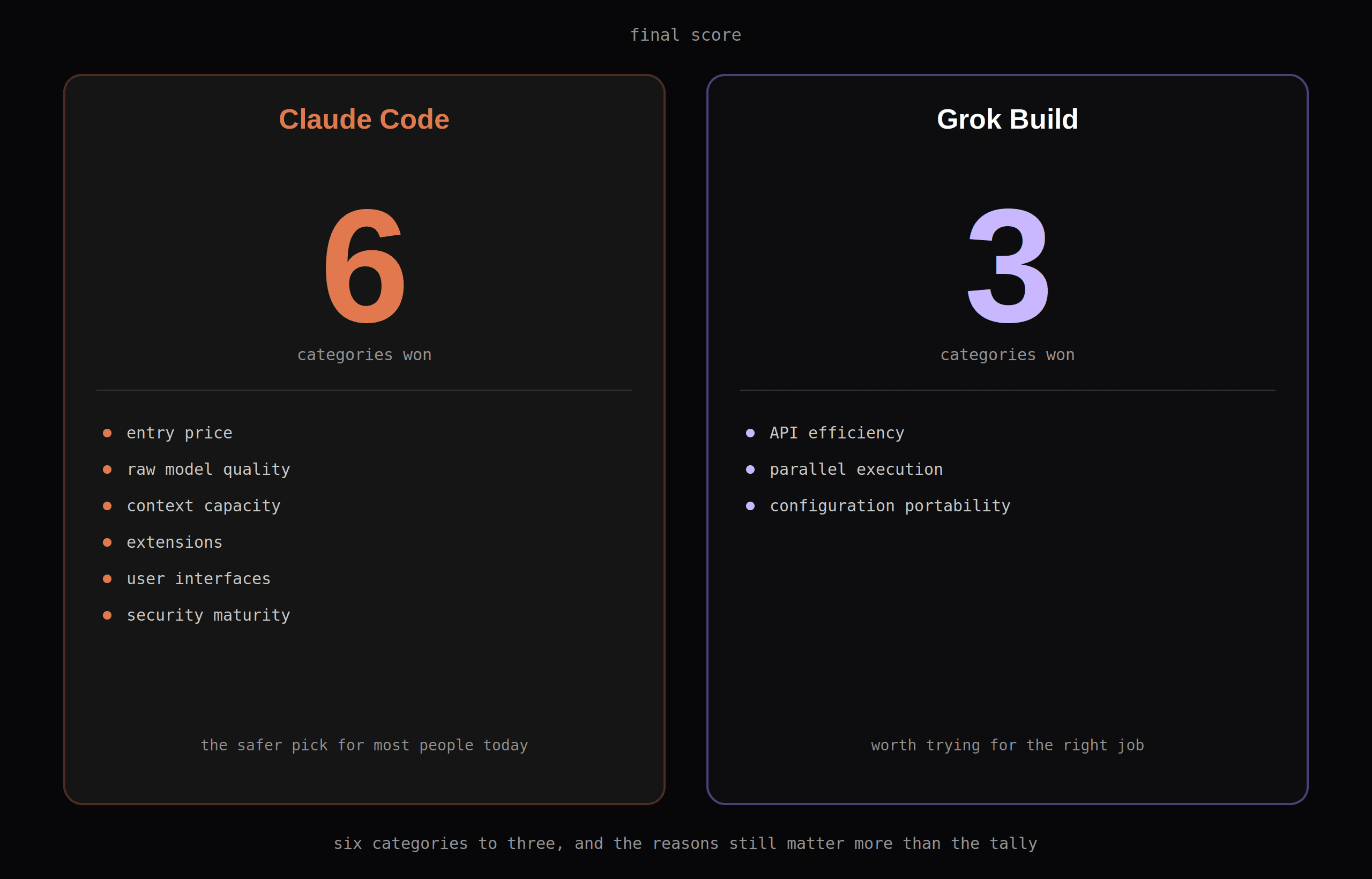
But a score does not tell you what either tool feels like in day-to-day use.
Claude Code wins because its strengths show up constantly: consistently strong models, a polished ecosystem, and a battle-tested CLI that developers have relied on for more than a year.
Grok Build's wins are real too. If you are burning through hundreds of tasks each week, that 5x cost gap adds up to actual savings rather than a rounding error.
So do not choose based only on the score. Think about what you are actually using the tool for.
If you are working on production code, a repository you would be genuinely upset to lose, or a large and messy codebase, Claude Code is the safer choice. Grok Build is only two months old and still has serious security concerns that remain unaddressed.
Claude Code has its own problems, but many of them have been discovered, patched, and discussed publicly.
That is what this comparison ultimately comes down to, and it is why Claude Code is still the safer pick for most people reading this. ✌️

 Get started