Cursor and Claude Code are 2 leading products that engineers reach out for nowadays.
Both can refactor whole codebases, hunt for bugs, run spec-driven builds, and handle vibe coding needs in the same ecosystem (skills, MCPS, plugins, hooks ) and harness that ties the agent loop together. Same rig, yet both cater to a different workflow.
And Cursor had recently become hard to ignore as SpaceX signed a $60 billion all-stock deal to buy its parent company, Anysphere (closes Q3 2026), and around the same time, it shipped Origin, its own githost for agents, plus cloud agents, Composer 2.5, and Grok 4.5.
None of this is free, though. For 6 months, I have happily paid $20/mo for Cursor and $100/mo for Claude Code because neither tool excels at everything in my workflow.
However, not everyone needs both, and not everyone wants to spend $120 a month to find out. If that is you, the question shifts to what you actually get for each dollar.
This is what this guide answers. Let’s begin
Past One
Two days ago, I asked Claude Code to refactor 12 files to meet the NASA JPL Power of 10 coding standards while I went shopping. It finished before I got back, and pinged me a notification to say so.
That same afternoon, Cursor caught a nasty bug buried in a client's product repo, the one he had been pestering me about for a week.
Six months in, and I still open both every single day. I even rewrote my X bio in their honour: I touch Claude Code, Cursor for a living.
None of this is free, though. Running both taught me something uncomfortable: these tools cater to different workflows, but they got very good at quietly draining the wallet.
I pay $20/mo for Cursor and $100/mo for Claude Code, and I pay it happily, because for my workflow, neither tool wins at everything.
So if you are trying to decide which one to throw your dollars at, this is the guide I wish I had.
Both help developers to refactor code bases, find bugs, do spec-driven development, vibe coding with a vast ecosystem of skills, MCPs, Plugins, Hooks / simply the harness.
TL;DR
Section | Which to pick |
|---|---|
Models and tooling | Claude Code for depth on one model; Cursor for option across many |
Billing cost's real story | Claude Code on focused tasks (pay per fetch, ~5.5x fewer tokens); Cursor for huge monorepos, but you pay to keep the index fresh |
Task delegation (async agents) | Cursor for supervised and visual; Claude Code for raw delegated horsepower |
The harness | Cursor for UI-heavy work you want to watch and control; Claude Code for repeatable, version-controlled instructions that run themselves |
Everyday usage | Cursor for hands-on control over every edit; Claude Code for reviewing finished work instead of keystrokes |
Pricing | Cursor for simple, predictable flat pricing; Claude Code's $100 only pays off on token-heavy work |
Extensibility (MCP, Skills, plugins) | Cursor to distribute a governed toolset to a large team; Claude Code for reproducible agent behavior that lives in the repo |
Data privacy | Claude Code for a narrower footprint; **Cursor **will soon route your whole stack through one owner (SpaceX) |
But before moving forward, I would like to clear up a common paradox people get caught up in.
The common paradox
Most people think Cursor is an AI editor with tools, while Claude Code is an AI agent you hand tasks to. That is not their fault tbh.
**But my friend, that framing died twice. **
First, the interfaces merged:
Claude Code now runs in VS Code, as a desktop app, and in the browser.
Cursor runs as a desktop app, in a terminal, in the cloud, on iOS, and on the web.
I even run Claude Code inside Cursor most days now.

Second, Cursor stopped being a code editing tool and became a platform. It now owns the full software factory, top to bottom:
Write your code in Cursor,
Review it with Bugbot,
Host it on Origin (new release),
Run it on models trained by its own group.
Look at the last seven months alone:
Date | Move | What it means |
|---|---|---|
Dec 2025 | Acquired Graphite | Owns code review: stacked PRs, merge queues |
Feb 2026 | Bugbot went reviewer to fixer | Spots a bug, spins its own agent, tests a fix, proposes it |
Jun 2026 | Announced Origin, a GitHub rival | Git hosting for the agentic era, AI merge-conflict resolution. Waitlist, ships fall 2026 |
Jun 16, 2026 | SpaceX agreed to acquire Cursor | $60B all-stock per an SEC 8-K filing, close expected Q3 2026, into the xAI group |
This tells you that the platform is no longer what it was 6 months ago; Cursor now owns the entire integrated software factory stack. More about it on the Product Hunt discussion.
So if the interfaces are roughly the same now, what actually separates these two tools? Read on.
1. Models and tooling: Cursor vs Claude Code
Two years ago, the model was the moat. In 2026, it hardly is.
Claude Code runs on Claude, currently Opus 4.8. The tool and the model are tuned for each other, and you feel it in how confidently it plans multi-step work.
**Cursor **lets you select your own brains: GPT-5.5, Claude Opus 4.8, Gemini 3.1 Pro, Grok 4.5, and its own Kimi K2.5 finetuned Composer 2.5. Pick the right model per task, pay Cursor to route.
On my 12-file NASA JPL refactor, Claude Code read most of the tree before writing a line, and the first pass barely needed correction.
As for the cursor, it also handled things smoothly with a one-time correction with a function. It was because a model API call failed and was partially completed.
This has also been a concern for the cursor teams, and they aim to be the lab, rather than a model router. Also, it aims to develop a new kind of programming in which any idea can simply be expressed in English.
Truell’s June 16 Compile keynote & later in Lenny’s podcast address this nicely:
"Our goal with Cursor is to invent a new type of programming. It looks like a world where you have a representation of the logic of your software that does look more like English. You can imagine kind of an evolution of programming language towards pseudocode. You have written down the logic of the software, and you can edit that at a high level. It won't be the impenetrable millions of lines of code, it'll instead be something that's much terser and easier to understand and easier to navigate."
Now that’s training its first frontier model from scratch, 1.5 trillion parameters, on xAI's Colossus cluster, under SpaceX's $60 billion deal. It seems the company is heading into its next phase and aims to become the model developer.
Who wins?
If you want a model tuned straight into the tool, go to Claude Code.
If you want model variety today and a bet on Cursor's own lab tomorrow, go with Cursor.
2. Pricing: Cursor vs Claude Code
Most of us stop at the sticker price.
Cursor
Tier | Price | Notes |
|---|---|---|
Hobby | Free | Limited |
Pro | $20/mo | |
Pro+ | $60/mo | 3x usage |
Ultra | $200/mo | 20x usage |
Teams | $40/user ($120 Premium seat) | |
Enterprise | Custom |
Every paid plan runs on usage credits, with on-demand billing for usage beyond your allotment. Turn on spend limits the day you start.
Auto mode is the cheap lever: it runs Composer 2.5 or routes to a capable model automatically, and it is unlimited on paid plans.
Claude Code
Tier | Price | Notes |
|---|---|---|
Free | None | No free tier |
Pro | $20/mo | |
Max | $100/mo ($200 for 20x) | Unlocks Opus, up-to-1M context |
Teams | $25/seat ($20 annual) | Caps at 150 seats |
Enterprise | Base seat + API usage | Cheaper light, pricier heavy |
No free tier; the cheapest door is Pro at $20.
Limits run on two clocks at once: a 5-hour rolling window plus a weekly cap, so an all-day session can hit the wall mid-task.
To trim spend, route routine edits to Sonnet or Haiku, save Opus for hard refactors.
On paper, both start at $20, and the offerings look even. It isn’t!
The sticker price hides what it actually costs to run a task.
On a widely repeated refactor test, the same job cost wildly different amounts of compute:
Tokens used on the same refactor (lower is better)
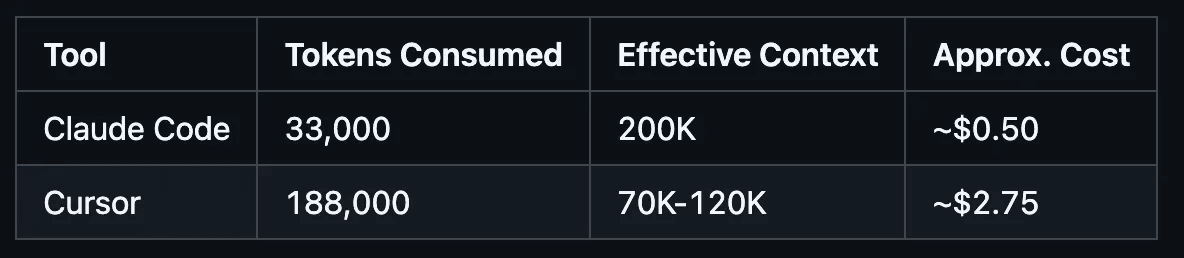
Source: https://medium.com/@gvelosa/claude-code-vs-cursor-in-2026-the-token-efficiency-gap-befd0864e0a5
That is a 5.5x gap for identical output.
One honest note: this is a single community benchmark; the two agents ran different models under the hood, and at least one prints the numbers flipped. Treat it as a strong signal, not a law. It also does not hold everywhere.
This happens because each tool loads the context differently:
Cursor retrieves using a hybrid stack: a semantic index, grep, and an Explore subagent. Index-backed and targeted, strong on huge monorepos, but the index carries a standing cost to build and keep fresh. You pay for it.
Claude Code skips the index and greps, globs, and reads on demand. Index-free and just-in-time, so you pay only for what it pulls into context.
One caveat: both start to degrade beyond roughly 150k tokens of genuinely relevant context, so neither truly wins at extreme scale.
So, who wins?
Cursor: Use it if you want simple, predictable flat pricing.
Claude Code: the $100 only pays off on token-heavy work.
Pro tip: Model both against your own usage, then decide.
3. Task Delegation with Async agents
The refactor task I gave to Claude and the bug hunt task to Cursor were not from the terminal/app UI; they were through my mobile phone. In fact, I barely touch my pc while travelling.
The essence is simple.

In short, task delegation is here, but both Claude Code and Cursor build around this differently.
Cursor
Cursor builds this around cloud agents and Automations:
Launches a cloud dev environment in under 10 minutes, snapshots it, and reuses it.
/in-cloudSpins a subagent on its own VM and branch, while your laptop stays unaffected./automateCreates jobs in plain language, with GitHub and Slack triggers.Bugbot review runs ~3x faster, roughly 90 seconds a pass, and can be called with
/reviewbefore you push.
Claude Code
Claude Code builds this around agent teams and background sessions:
Cloud dev environment for remote sessions, spun up automatically the first time you run a remote feature, no manual web setup.
/agentslaunches a coordinated team where one session leads and others execute, viewable and steerable in theclaude agentsview.Background agents run on separate git worktrees; kick one off from
claude agents, then steer it from your phone via Remote Control in the mobile app./code-reviewruns a review pass on your changes, improved on Opus 4.8 across effort levels, and/security-reviewscans for vulnerabilities before you push.
Who wins?
Supervised and visual, go for Cursor.
Raw delegated horsepower, go for Claude Code.
Related: OpenCode vs Claude Code
4. The Harness
Strip as an agent down to its core, and that is a model in a loop with tools.
Everything wrapped around that loop:
The memory,
The standing instructions (system prompt),
The automatic hooks
decides whether the loop is reliable and works. Some people call this layer the rig, but it's commonly called a harness.
Both Claude Code and Cursor ship with this harness, but are targeted for different workflows:
Claude Code
Ships the harness natively and documented:
CLAUDE.mdStanding instructions: the agent reads every session.Skills: packaged workflows you invoke like
/review-pr.Hooks: shell commands that fire on lifecycle events, so a formatter runs after every edit.
Artefacts: session work captured as a live web page (a PR walkthrough, a dashboard), a non-terminal teammate can read, with private org sharing and version history.
Cursor
Its harness version exists too, and it is growing fast:
A single Customize page pulls together plugins, skills, MCP servers, subagents, rules, commands, and hooks, with a marketplace on top.
Design Mode lets you point at UI elements in the browser or on a canvas, select several at once, and narrate changes by voice while agents edit beneath the surface.
The difference is the centre of gravity:
Cursor's harness orbits the editor and the visual surface, and yes, it's amazing. I give one instruction in the 1st prompt, and it carries forward until the chat ends.
Claude Code orbits the agent loop and the command line. In my experience, I tend to forget important instructions mid-conversation if the topic strays too far or the chat goes on too long.
So, who wins?
Cursor: For UI-heavy work where you want to see every change and be in control. (not true delegation, but secure)
Claude Code: For repeatable, version-controlled instructions (a
CLAUDE.mdfile plus Hooks) that your whole team inherits automatically, so the rules run on their own instead of relying on you to remember them. (true delegation, but feel less secure)
Related: Claude Code vs Codex
5. Everyday Usage
Cursor feels at home;
**It **is a VS Code fork, so it looks like the editor I already use,
Tab autocomplete predicts my next several edits as I type.
Within an hour of writing by hand, I felt faster when I tried it for the 1st time 6 months back.
Claude Code feels like running a company;
It's terminal + ui native, no autocomplete to fall for. Mainly for task delegation.
Once I have written a good enough
CLAUDE.mdand wired a couple of Hooks, Specs, and project-level skills, it runs whole tickets across multiple subagents in parallel while I go through the diff.Mainly for task delegation, the payoff arrives late but is bigger than the current.
Review style | Cursor | Claude Code |
|---|---|---|
What you see | Each change inline, accept or edit before it lands | The finished result plus the reasoning |
Best for | UI edits where you eyeball every pixel | Delegated tickets you review as a whole |
Tests | You trigger them | It runs them, iterates on failure, reports back |
Who wins?
Tight control over every edit and well-controlled task delegation with AGENTS.md, go with Cursor.
Review finished work instead of keystrokes, go with Claude Code.
6. Extensibility: MCP, Skills, plugins
Both speak MCP, the protocol for wiring outside tools and data into an agent. Both turned it into a team-management surface rather than a solo toy.
Cursor
With the cursor, teams can:
Configure Team MCP servers once, push them across cloud agents, the agents window, the IDE, and the CLI.
Publish approved integrations to a team marketplace so members can install without touching config.
Added GitLab, BitBucket, and Azure DevOps support for those imports.
Claude Code
With the Claude Code, teams can
Leans on Skills, Hooks, and a plugin system, plus MCP for outside connections.
Use Cowork brings agent machinery to knowledge work within a local, isolated VM with access to their files.
A computer-use preview lets Claude open files, click, and navigate for you.
A Slack integration (Team and Enterprise plans) lets you tag Claude to hand off a task without leaving the channel.
Treats extensibility as a code check-in.
But what about solo dev’s?
Solo Devs
For the solo dev, none of the above matters; it's about speed, for example: how fast can you load tools, skills, and MCP that follow on every machine and get work done?
Cursor is the easy on-ramp.
Adding an MCP server is a few clicks with OAuth built in, no config file to hand-edit, and you inherit the entire VS Code extension library on day one.
The Customise page works at the user level, too, so your rules, skills, and MCPs live in one place as local instructions.
Claude Code gives a solo dev the same files-in-repo power the teams get.
The
CLAUDE.mdskills, hooks, and plain files are plain files that users can commit to, so their agent behaves identically on their laptop, desktop, or any box they clone into.
Either way, the setup is only half the battle.
Often, we solo developers struggle to connect to multiple tools, manually pass API keys, worry about security, and hope for optimised tool calls. ‘
So for this, I use composio, which helps me connect to 1000+ tools/services in one click, while handling all the issues I mentioned earlier. - Just a practical experience here, your call.
Who wins?
Distribute a governed toolset to a large team through a marketplace. Cursor leads today.
Reproducible agent behaviour that lives in the repo; Claude Code fits how engineers already work.
7. Most Important Factor
This is the point most take for granted. The data privacy.
Cursor is on its way to becoming a SpaceX subsidiary, folded into the xAI group, once the $60B deal closes in Q3.
Pair that with Origin (its own git host) and Composer (its own model), and one company could soon own the tool that writes your code, the place that stores it, and the model that learns from it. That is genuinely new. No prior git host has also owned the model doing the writing.
I am not calling it a trap, and I am not assuming bad intent. But if you work on client repos with strict rules about where code can live, as I do, think about this before you migrate anything.
Always read the terms. Watch where the data goes.
Claude Code keeps a narrower footprint, an agent and a harness rather than a whole hosting stack, though your code still travels to Anthropic's API either way.
Cursor will soon own the stack: your code, your tool calls, your decisions, plans, and all builds will go through Cursor for better model training.
The Verdict
You are... | Your pick | Why |
|---|---|---|
UI / product engineer | Cursor | Editor you know, inline autocomplete, visual diffs, pick a model per task. The best AI code editor you can buy. |
Systems / backend engineer | Claude Code | Delegate whole tickets, reproducible agent behavior from repo files, orchestrate several agents, review finished work. Its rig is the more serious engineering today, and its token efficiency is a real cost edge. |
Most of us | Both | $120/mo total, for a month. Let the work sort it out. |
The engineers I know who ship fastest stopped treating this as a loyalty test and started treating it as two tools for two kinds of tasks.
Cursor for the hands-on sessions.
Claude Code for the delegated automations.
The debate between Cursor and Claude Code ends the moment you stop arguing and start building. This is where I landed after six months with the two subscriptions.
Remember, your repo and your habits will move these numbers in the future, so borrow my framework, not my conclusion.

 Get started